
Stress Tensor, Primaries, and Conformal Transformations
The free-boson OPEs are local short-distance rules. The stress tensor packages those rules into symmetry. In two-dimensional CFT, is not merely a conserved current in the usual sense; it is a meromorphic object whose contour integrals generate conformal transformations.
For string theory this is doubly important. First, conformal symmetry is the residual gauge symmetry left after fixing the worldsheet metric to conformal gauge. Second, the vanishing of the stress tensor is the quantum descendant of the classical Virasoro constraints. Understanding is therefore the gateway from free fields to physical string states and scattering amplitudes.
Stress tensor in complex coordinates
Section titled “Stress tensor in complex coordinates”For free target-space coordinates , the Euclidean conformal-gauge action is
The basic OPE is
The holomorphic and antiholomorphic stress tensors are
and
Classically, conformal invariance implies tracelessness,
Conservation then gives
away from operator insertions. Thus is holomorphic and is antiholomorphic except at singularities caused by local operators.
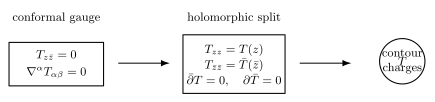
Conservation plus tracelessness imply a holomorphic stress tensor and an antiholomorphic stress tensor . Their singularities near insertions encode conformal transformations.
The holomorphic factorization is what makes two-dimensional CFT so powerful. Symmetry transformations become contour integrals.
Residual conformal transformations
Section titled “Residual conformal transformations”Conformal gauge fixes the metric only up to transformations that preserve angles. In complex coordinates these are
Indeed,
so the metric changes only by a local scale factor, which can be absorbed by a Weyl transformation. This is the residual gauge symmetry of the string worldsheet in conformal gauge.
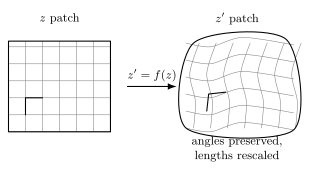
A conformal map preserves angles locally. In conformal gauge the induced scale factor can be absorbed by a Weyl transformation.
Infinitesimally,
The corresponding variation of a local operator is generated by contour integrals of and .
Primary fields
Section titled “Primary fields”A local field is called a primary field of weights if under a finite conformal map it transforms as
The numbers
are the holomorphic and antiholomorphic conformal weights. Their sum and difference are
where is the scaling dimension and is the two-dimensional spin.
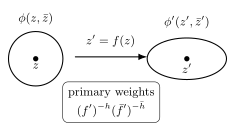
A primary field carries definite conformal weights. A local rescaling by multiplies the field by a fixed power determined by and .
For example:
has weights , while
has weights . A product such as
has weights .
A primary field is not just a field that scales nicely under dilatations. It must transform covariantly under every local holomorphic coordinate change.
The stress tensor as a contour generator
Section titled “The stress tensor as a contour generator”Let be a holomorphic infinitesimal conformal transformation. The associated charge is represented locally by
When this contour surrounds a local operator , the singular part of determines the transformation of :
The antiholomorphic part is analogous:
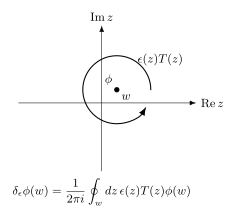
The contour integral of around extracts the residues of the singular OPE. Those residues are the infinitesimal conformal transformation of .
This is the local form of the conformal Ward identity.
The primary-field OPE with
Section titled “The primary-field OPE with TTT”The defining local statement for a primary field is
Similarly,
To see why this is the correct transformation law, insert the OPE into the contour integral:
Using
and
we obtain
This is precisely the infinitesimal version of primary-field covariance, up to the usual active/passive sign convention for coordinate transformations.
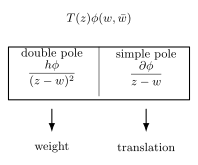
For a primary field, the double pole measures the conformal weight and the simple pole translates the insertion. More singular poles would signal a non-primary operator.
Free-boson examples
Section titled “Free-boson examples”Let us verify these statements with the free-boson stress tensor
First,
There is no double pole, so locally behaves as a dimension-zero scalar. The logarithmic two-point function makes somewhat special globally, but its derivative is a clean primary field.
For we find
Thus
Similarly,
These are the simplest examples of primary fields in the string worldsheet theory.
Ward identities in correlation functions
Section titled “Ward identities in correlation functions”The stress tensor OPE with a primary also determines how behaves inside correlation functions. For primary fields of weights ,
This identity is obtained by applying the OPE near each insertion. It is one of the main computational tools of CFT. The antiholomorphic Ward identity is the same with barred quantities.
A useful way to visualize it is contour deformation. A contour integral of can be moved through the correlator. When it crosses an insertion, the OPE supplies a residue.
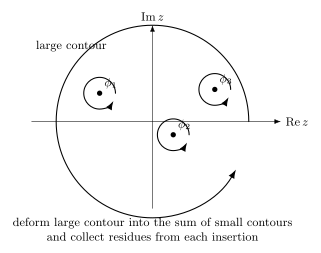
Conformal Ward identities follow by deforming a contour of through a correlation function and summing residues at operator insertions.
Global conformal transformations
Section titled “Global conformal transformations”On the Riemann sphere, the globally well-defined holomorphic maps are the Möbius transformations
They form the group modulo its center. Infinitesimally they are generated by
These correspond to translation, dilatation/rotation, and special conformal transformation on the complex plane. Later, this three-parameter holomorphic freedom and its antiholomorphic partner will let us fix three insertion points on the sphere when computing closed-string tree amplitudes.
What to remember
Section titled “What to remember”The essential local rule is
for a primary field. It implies both the infinitesimal conformal transformation law
and the conformal Ward identity in correlation functions.
The next page applies this machinery to plane-wave vertex operators and then studies the OPE , whose central term produces the Virasoro algebra.
Exercises
Section titled “Exercises”Exercise 1. Holomorphicity from conservation and tracelessness
Section titled “Exercise 1. Holomorphicity from conservation and tracelessness”In complex coordinates, explain why conservation of the stress tensor together with implies .
Solution
Stress-tensor conservation can be written schematically as
Since , tracelessness in conformal coordinates gives
Therefore the second term vanishes and we get
Thus is holomorphic away from insertions.
Exercise 2. Residues and infinitesimal transformations
Section titled “Exercise 2. Residues and infinitesimal transformations”Assume
Evaluate
Solution
Insert the OPE:
The simple-pole residue gives
The double-pole residue gives
Thus
Exercise 3. Show that has weight one
Section titled “Exercise 3. Show that ∂Xμ\partial X^\mu∂Xμ has weight one”Using
and
derive
Solution
There are two equivalent contractions, one for each inside . Contracting one field gives
So
Now expand the uncontracted field around :
Therefore
This is the primary OPE with .
Exercise 4. Ward identity for one insertion
Section titled “Exercise 4. Ward identity for one insertion”Let be a primary of weight . Use the Ward identity to find
in terms of .
Solution
For a single primary insertion, the Ward identity gives
On the plane, translational invariance usually forces the one-point function of a non-identity primary to vanish. But the local Ward identity itself is the formula above.
Exercise 5. Weights of a tensor product operator
Section titled “Exercise 5. Weights of a tensor product operator”Assume has weights and has weights . What are the weights, dimension, and spin of
Solution
Weights add under products, so
The scaling dimension is
and the two-dimensional spin is
Thus is a scalar operator on the worldsheet with dimension two.