
14. Magnetic Field, Hall Transport, and Topological Response
Magnetic field is where finite-density transport stops being one-dimensional. At , a great deal of transport intuition can be compressed into a single number such as or . Once a magnetic field is present, electric, heat, and momentum currents rotate into each other. Conductivity becomes a tensor. The inverse tensor matters as much as the tensor itself. Magnetization currents must be separated from transport currents. In two spatial dimensions, topological terms can produce nondissipative Hall response even in a gapped state. In holography, the same physics appears geometrically through dyonic black branes, electromagnetic duality, Chern—Simons terms, and probe-brane DBI dynamics.
The purpose of this page is to build the conceptual and calculational grammar for magnetic response in holographic quantum matter. The page is mostly about ordinary Hall and magnetotransport. Anomalous chiral transport, Weyl semimetals, and anomaly-induced negative magnetoresistance are important enough to receive their own separate page in the sequence.
The prerequisite is the standard AdS/CFT dictionary and the previous pages, especially the finite-density, transport, momentum-relaxation, and strange-metal pages. The main lesson is simple but easy to miss:
A trustworthy holographic treatment must specify the currents, the thermodynamic ensemble, the order of limits, the subtraction of magnetization currents, and the mechanism by which momentum is relaxed or not relaxed.
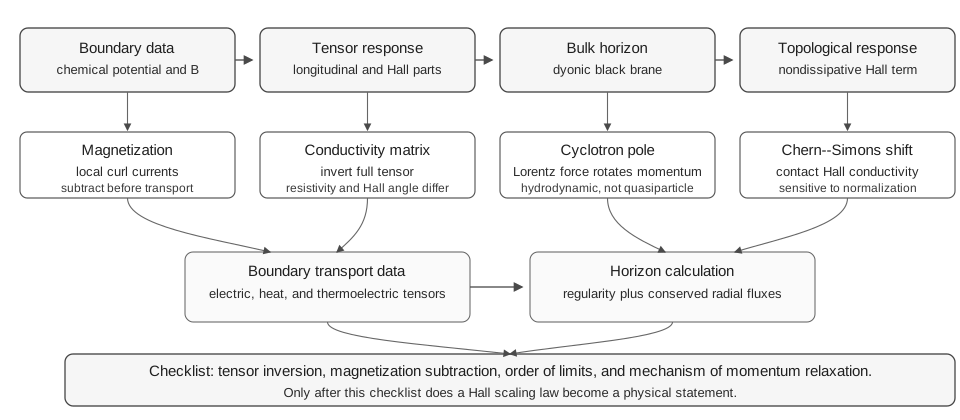
Magnetic response in holographic quantum matter has four intertwined layers: boundary tensor transport, hydrodynamic cyclotron physics, bulk dyonic or DBI descriptions, and topological nondissipative response. The central practical warning is that measured transport currents are not always the same as local equilibrium currents when magnetization is present.
1. The physical question
Section titled “1. The physical question”In a finite-density system without magnetic field, the simplest linear response problem asks how an electric field produces an electric current:
At and in an isotropic state, rotational symmetry forces . The response reduces to a scalar. This is why one can often speak casually about “the conductivity.”
At nonzero magnetic field, even an isotropic state has two independent electric conductivities in two spatial dimensions:
where . The longitudinal part is dissipative. The Hall part is antisymmetric and may be nondissipative. The electric field along can generate a current along .
The same happens for thermoelectric response. Defining the heat current
the linear response matrix is
Here is the thermal conductivity at zero electric field. The open-circuit thermal conductivity, the one measured at , is
In a magnetic field every entry is a tensor. Therefore even writing the measured thermal conductivity requires matrix algebra.
This is already enough to explain why magnetic-field phenomenology is subtle. The following quantities are related but not equivalent:
where is the resistivity tensor and
A strange temperature dependence of is not the same diagnostic as a strange temperature dependence of . A magnetic field forces us to track which tensor component is being discussed.
2. Magnetic field as a source
Section titled “2. Magnetic field as a source”In a relativistic boundary theory, a conserved current couples to a background gauge field through
The electric and magnetic fields are components of the background field strength
In boundary dimensions, the magnetic field is a pseudoscalar:
In boundary dimensions, it is a vector . Most holographic Hall-transport examples are simplest in boundary dimensions, because one can turn on a constant without selecting a direction inside a plane. This is the natural setting for dyonic black branes in .
A chemical potential and a magnetic field play different roles. The chemical potential is the boundary value of , up to the regularity convention at the horizon. The magnetic field is the boundary value of . Schematically,
The charge density is not a source. It is the response conjugate to , equivalently the radial electric flux in the bulk.
At finite density and finite magnetic field, the bulk field strength in a minimal dyonic solution has the form
The electric part encodes charge density. The magnetic part encodes the external magnetic field. A bulk black brane with both electric and magnetic flux is called dyonic.
3. Conductivity, resistivity, and Hall angle
Section titled “3. Conductivity, resistivity, and Hall angle”For an isotropic parity-breaking state in two spatial dimensions, the conductivity tensor can be written as
The resistivity tensor is the inverse matrix:
Thus
This inversion is a major source of confusion. The Hall angle is usually defined by
For small Hall angle, . For large Hall angle, this approximation fails. Therefore a scaling law for is not automatically a scaling law for .
In many condensed-matter discussions, one studies the weak-field regime and defines the Hall coefficient
In a single-band Drude metal with carrier density and charge , this gives up to sign conventions. Holographic systems need not behave like a single-band quasiparticle gas. In particular, a strongly coupled plasma can have both a momentum-drag contribution and an incoherent contribution, and the Hall coefficient can involve thermodynamic susceptibilities rather than a simple particle count.
4. Magnetization currents are not transport currents
Section titled “4. Magnetization currents are not transport currents”A system in a magnetic field can support equilibrium circulating currents. In two spatial dimensions, if is the magnetization density, then a magnetization current has the schematic form
This current is locally nonzero when varies in space, but it is not a transport current carrying charge across the sample. It is a curl current. In a finite sample it is associated with edge circulation.
Heat currents have analogous magnetization pieces. In thermoelectric transport, these are especially important. The current that appears in a local one-point function is not always the same as the current that appears in a transport measurement. One must subtract magnetization currents to obtain transport coefficients.
The clean conceptual separation is
For uniform electric conductivity in a homogeneous state, magnetization currents often drop out automatically. For thermal Hall and thermoelectric response, they can be essential. A Kubo formula that forgets magnetization subtraction may compute a perfectly well-defined correlator but not the experimentally relevant transport coefficient.
This is one reason horizon formulas in holography are powerful: when derived carefully, they compute transport currents after the correct subtractions. But the word “carefully” is doing real work. Magnetic field is exactly where careless Kubo formulas become dangerous.
5. Hydrodynamic magnetotransport
Section titled “5. Hydrodynamic magnetotransport”Hydrodynamics gives the universal low-frequency structure of transport when conserved quantities dominate. At finite charge density , entropy density , energy density , and pressure , the momentum susceptibility of a relativistic fluid is
In a charged fluid with magnetic field, the Lorentz force couples current to momentum. A convenient first-order constitutive relation is
where is the fluid velocity and is the intrinsic or incoherent conductivity. The momentum equation, including a phenomenological momentum-relaxation rate , is
The term is the Lorentz force density. It rotates the current into the transverse momentum equation.
In a clean system, , the magnetic field creates a hydrodynamic cyclotron mode. At small and to leading order in the intrinsic conductivity, the complex frequencies are
where
The cyclotron frequency is fixed by the Lorentz force and inertia. The damping is controlled by the intrinsic conductivity. This is not a quasiparticle cyclotron resonance. It is a collective hydrodynamic pole.
With slow momentum relaxation, the pole becomes
at the same schematic order. The distinction between and is important: relaxes momentum because translations are broken, whereas damps the cyclotron motion by incoherent charge transport in a magnetic field.
In the simplest Drude-like hydrodynamic limit where is neglected, the DC electric conductivity is
As , this gives
The longitudinal DC conductivity vanishes in this idealized clean magnetohydrodynamic limit because a static electric field is balanced by transverse motion. The Hall conductivity remains finite and is fixed by charge density and magnetic field. Including changes the detailed formulas, especially at small density or larger magnetic field, but the tensor structure and pole logic remain.
6. The dyonic black brane
Section titled “6. The dyonic black brane”The simplest holographic realization of Hall transport is the dyonic planar black brane in . Consider the minimal Einstein—Maxwell action
A planar dyonic black brane has a metric of the schematic form
with field strength
The boundary theory lives in dimensions. It is at temperature , chemical potential , charge density , and magnetic field . The horizon regularity condition fixes the thermal state, and the radial electric flux fixes .
The perturbations relevant for electric transport are not just gauge perturbations. At finite density and magnetic field, gauge-field perturbations mix with metric perturbations:
This mixing is the bulk version of the boundary fact that electric current overlaps with momentum and energy current. A conductivity calculation that ignores the metric fluctuations will generally miss the momentum channel.
The retarded prescription is still the same in spirit: solve the coupled linearized bulk equations with infalling boundary conditions at the horizon, read off the boundary source and response data, and differentiate the renormalized on-shell action. The new feature is that the answer is a matrix.
A useful way to package the electric response in two spatial dimensions is the complex conductivity
In special self-dual Maxwell systems, electromagnetic duality acts simply on . This makes -dimensional Hall transport one of the cleanest arenas in which bulk electric-magnetic duality becomes a boundary particle-vortex type statement.
7. Electromagnetic duality and particle-vortex intuition
Section titled “7. Electromagnetic duality and particle-vortex intuition”Four-dimensional Maxwell theory has electric-magnetic duality. In the bulk, this exchanges electric and magnetic field strengths. In the boundary -dimensional theory, it exchanges charge density and magnetic field in a precise sense. Roughly,
This relation is not a statement that density and magnetic field are the same physical source. Rather, it is a duality map between two descriptions. In a boundary language, it resembles particle-vortex duality: charged particles in one description may be related to vortices in another.
In complex conductivity notation, the most basic duality operation acts schematically as
while adding a boundary Chern—Simons contact term shifts
Together such operations generate an -like structure in appropriate quantized settings. The precise normalization depends on units and on how the current is normalized. The important conceptual point is that in dimensions, Hall response, charge-vortex duality, and topological contact terms are naturally intertwined.
This duality viewpoint is powerful, but it has limits. A generic bottom-up holographic model with dilatons, axions, higher-derivative terms, or charged matter will not preserve the simple Maxwell self-duality. Then the complex-conductivity transformation rules are at best useful intuition, not exact identities.
8. Topological Hall response in dimensions
Section titled “8. Topological Hall response in 2+12+12+1 dimensions”In dimensions, a background Chern—Simons term has the form
Varying this action gives
For an electric field , the spatial current is
Therefore the Hall conductivity is
in units where the charge normalization has been absorbed into . Restoring conventional condensed-matter units gives the familiar quantized form proportional to .
This response is topological and nondissipative. It is not produced by momentum drag. It does not require a Fermi surface. It can survive in a gapped phase. This is why one must not interpret every Hall conductivity as a consequence of mobile charge carriers undergoing cyclotron motion.
Holographically, topological Hall response can arise from boundary Chern—Simons terms, bulk theta terms, brane Wess—Zumino couplings, or parity-violating bulk interactions. These terms can shift the Hall conductivity by contact pieces. Whether the shift is physical depends on the boundary theory, the quantization of the coefficient, and the distinction between background and dynamical gauge fields.
This page treats these topological terms as part of ordinary Hall response. Chiral anomaly-induced transport, such as the chiral magnetic and vortical effects in dimensions, belongs to the next page.
9. Probe branes and DBI Hall transport
Section titled “9. Probe branes and DBI Hall transport”Probe flavor sectors give another important route to Hall response. A flavor brane with DBI action has
Turning on a worldvolume magnetic field and electric displacement gives a nonlinear relation between current and applied electric field. The DBI square root couples electric and magnetic fields nonperturbatively. This makes probe branes useful for studying nonlinear conductivity and Hall response in a top-down inspired sector.
A key object is the open-string metric, which controls fluctuations on the brane:
The effective horizon seen by brane fluctuations need not coincide in a naive way with the background metric horizon. In driven systems, the open-string metric can develop its own effective temperature. Even in linear response, the DBI structure changes the dependence of and on density, magnetic field, and embedding data.
The probe limit matters. If the flavor sector carries only order degrees of freedom while the adjoint sector carries order , then probe-brane transport is transport of a sector through a large bath. It is not identical to the full momentum-conserving transport of the entire boundary theory. This is why probe-brane DC conductivities can be finite even when the full translation-invariant system would have a momentum-induced singularity.
10. Hall-angle puzzles and what holography can test
Section titled “10. Hall-angle puzzles and what holography can test”A famous motivation for holographic magnetotransport is the possibility that different transport quantities may scale with different powers of temperature. For example, in some strange-metal phenomenology one discusses behavior of the schematic form
This is sometimes called a two-lifetime structure. But the phrase is dangerous unless one states what the two lifetimes are. Holography gives a cleaner language. Distinct temperature dependences can arise because different observables are controlled by different combinations of:
- momentum relaxation ,
- intrinsic conductivity ,
- charge density ,
- entropy density ,
- magnetic field ,
- scaling exponents and ,
- pair-creation or incoherent sectors,
- magnetization subtractions,
- topological contact terms.
A good holographic model should not merely fit exponents. It should explain which transport channel is coherent, which is incoherent, which is topological, and which is dominated by momentum drag.
One schematic diagnostic is this:
whereas
Magnetic field sharpens this diagnostic because it turns the momentum pole into a cyclotron pole. If the cyclotron pole is sharp, hydrodynamic momentum physics is visible. If it is broad or absent, the response is more intrinsically incoherent or strongly relaxed.
11. Orders of limits
Section titled “11. Orders of limits”Transport coefficients depend on limits. The DC conductivity is usually
Hydrodynamic modes care about how , , , , and are taken to zero. For example, the clean limit does not necessarily commute with the DC limit . Similarly, the weak-field Hall coefficient is defined by taking after extracting the linear-in- part of the response.
A useful hierarchy for weak-field magnetotransport is
with the actual powers of modified in nonrelativistic or hyperscaling-violating theories. Outside such a controlled hierarchy, hydrodynamic formulas may still give qualitative intuition, but they are no longer universal.
Holographic computations are often technically clean because one can solve the full bulk boundary-value problem at finite and then take limits afterward. The interpretation, however, still requires knowing which limit was taken.
12. What is robust and what is model-dependent?
Section titled “12. What is robust and what is model-dependent?”The following features are robust:
- conductivity and thermoelectric response are tensors in a magnetic field;
- Hall response can be nondissipative;
- finite density, magnetic field, and momentum conservation strongly constrain DC transport;
- magnetization currents must be subtracted in thermal and thermoelectric transport;
- clean charged fluids have hydrodynamic cyclotron poles;
- dyonic black branes geometrize finite and finite states;
- topological terms can shift Hall conductivities by contact pieces.
The following features are model-dependent:
- the detailed temperature scaling of , , and ;
- whether transport is coherent or incoherent;
- whether the IR geometry is , Lifshitz, hyperscaling-violating, or something else;
- whether a Chern—Simons term is allowed and quantized;
- whether a Hall response is topological, hydrodynamic, or probe-sector dominated;
- whether a holographic model is top-down, bottom-up, or phenomenological.
For this reason, magnetic response is one of the best stress tests of a holographic quantum matter model. It forces the model to reveal its assumptions.
13. Common pitfalls
Section titled “13. Common pitfalls”Pitfall 1: Confusing conductivity and resistivity.
is not when . The full matrix must be inverted.
Pitfall 2: Forgetting magnetization currents.
Local equilibrium currents can circulate without transporting charge or heat across the system. Thermal Hall and thermoelectric coefficients are especially sensitive to this issue.
Pitfall 3: Treating as always dissipative.
The antisymmetric Hall response can be nondissipative and topological.
Pitfall 4: Calling every Hall-angle scaling law a two-lifetime theory.
A scaling law is not a mechanism. One must identify the slow modes and transport channels.
Pitfall 5: Dropping metric perturbations at finite density.
At finite density, current overlaps with momentum. In the bulk, gauge perturbations mix with metric perturbations. Ignoring this mixing usually gives the wrong transport physics.
Pitfall 6: Confusing magnetic field with charge density.
Electromagnetic duality may exchange and in special theories, but physically they are different boundary data.
Pitfall 7: Assuming probe-brane transport is full-system transport.
Probe sectors can have finite conductivities even when the full clean system has momentum-conservation singularities.
Exercises
Section titled “Exercises”Exercise 1. Invert the Hall conductivity tensor
Section titled “Exercise 1. Invert the Hall conductivity tensor”Let
Compute and identify and .
Solution
The determinant is
The inverse matrix is
Thus
With and , this gives
The common mistake is to write . That is only true when .
Exercise 2. Hall response from a Chern—Simons term
Section titled “Exercise 2. Hall response from a Chern—Simons term”Consider the -dimensional action
Show that it gives a Hall current
Solution
In components,
Varying with respect to gives
For a spatial current,
Using and up to the chosen sign convention, this becomes
Therefore the Chern—Simons term contributes
This contribution is antisymmetric and nondissipative.
Exercise 3. Clean hydrodynamic Hall conductivity
Section titled “Exercise 3. Clean hydrodynamic Hall conductivity”Ignore and temperature gradients. Take
and the steady-state momentum equation
Derive
where , up to the sign convention for .
Solution
Substitute into the momentum equation:
Move the velocity terms to the left:
The inverse of a matrix in two dimensions is proportional to , using . Thus
Multiplying by gives the current:
Now define
Then
and
up to the sign convention for . In the clean limit , the Hall conductivity approaches .
Exercise 4. Magnetization currents do not transport net current in the bulk
Section titled “Exercise 4. Magnetization currents do not transport net current in the bulk”Let
on a two-dimensional sample. Show that the total current through a cross-section depends only on boundary data.
Solution
Take the current through a vertical cross-section at fixed :
Using ,
Therefore
For a periodic system, or a system where the magnetization is the same at the two ends, this vanishes. In a finite sample, the result is an edge contribution. This is why magnetization currents are circulating equilibrium currents rather than bulk transport currents.
Exercise 5. Entropy production and Hall response
Section titled “Exercise 5. Entropy production and Hall response”For electric response, entropy production is proportional to
Show that the Hall part of does not contribute.
Solution
Decompose the conductivity tensor as
Then
The second term vanishes because is symmetric in , while is antisymmetric:
Therefore
The Hall conductivity is nondissipative at this level. This is why a topological Hall response can exist even in a gapped phase without producing entropy.
Summary
Section titled “Summary”Magnetic field upgrades transport from scalar response to tensor response. In holographic quantum matter this upgrade is not cosmetic. It exposes the interplay between charge density, momentum, heat current, magnetization, topology, and the bulk horizon.
The main takeaways are:
- is a boundary source, while is a response encoded by radial electric flux.
- Conductivity, resistivity, Hall coefficient, and Hall angle are distinct observables.
- Magnetization currents must be subtracted from transport currents, especially for thermal and thermoelectric response.
- Hydrodynamics predicts a collective cyclotron pole with
- Dyonic black branes geometrize finite density and magnetic field.
- Electromagnetic duality in the bulk can become particle-vortex-like duality in the boundary theory.
- Chern—Simons and related topological terms can produce nondissipative Hall response.
- Hall-angle scaling is not a mechanism until the relevant slow modes and transport channels are identified.
The next page continues the magnetic-field story in a different direction: anomalies, Weyl semimetals, and chiral transport.
Further reading
Section titled “Further reading”For a broad review of holographic quantum matter, including magnetic fields, magnetotransport, Weyl semimetal motivations, hydrodynamics, memory matrix methods, and transport without quasiparticles, see Hartnoll, Lucas, and Sachdev, Holographic quantum matter.
For a condensed-matter-facing holographic treatment of finite density, holographic hydrodynamics, conductivity, anomalies, translation breaking, and top-down AdS/CMT models, see Zaanen, Liu, Sun, and Schalm, Holographic Duality in Condensed Matter Physics.
For a textbook treatment of linear response, finite density, hydrodynamics, and condensed-matter applications of gauge/gravity duality, see Ammon and Erdmenger, Gauge/Gravity Duality: Foundations and Applications.
For the classic relativistic hydrodynamic treatment of magnetotransport in holographic CFTs, see Hartnoll and Kovtun, Hall conductivity from dyonic black holes.