
Weyl Anomaly, Liouville Theory, and BRST Quantization
Conformal gauge is classically available because the Polyakov action has two local symmetries: worldsheet diffeomorphisms and Weyl rescalings. Quantum mechanically, this gauge choice is legitimate only if the path-integral measure is also Weyl invariant. The obstruction is the Weyl anomaly.
For the flat bosonic string, the cancellation is beautifully economical:
Thus the same number appears in three guises:
After gauge fixing, the remaining expression of gauge symmetry is BRST symmetry. It packages constraints, null states, and gauge redundancies into one cohomological statement.
The Weyl anomaly
Section titled “The Weyl anomaly”Let a two-dimensional CFT of central charge live on a curved worldsheet with metric . The trace of the stress tensor is anomalous:
up to the conventional sign used in defining . The invariant statement is that the trace is proportional to the central charge.
In the bosonic string, the matter sector consists of free scalar fields , so
The reparametrization ghosts form a system with of weight and of weight , hence
Therefore
Weyl invariance of the gauge-fixed path integral requires
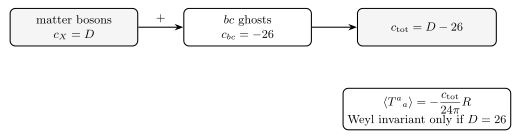
The matter fields contribute , while the reparametrization ghosts contribute . The conformal factor decouples only when the total central charge vanishes.
A useful way to see the anomaly is to write
For a CFT with central charge , the partition function changes under a Weyl rescaling as
The exact sign depends on whether one writes the effective action as or , but the dependence on is physical. If , the conformal factor is pure gauge. If , it becomes dynamical.
The Liouville mode
Section titled “The Liouville mode”When the Weyl anomaly does not cancel, the conformal factor cannot be divided out. Instead it is promoted to a scalar field. After a field redefinition, one obtains the Liouville field .
A standard Euclidean Liouville action is
The term is a background charge. The exponential term is the worldsheet cosmological constant; geometrically, it weights the area of the worldsheet.
In the common Liouville normalization,
A noncritical bosonic string with matter central charge must satisfy
For free matter coordinates, this gives
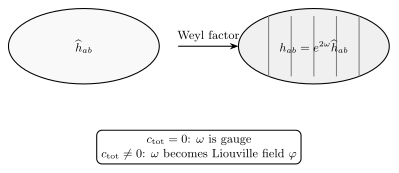
In the critical theory the conformal factor is gauge. In a noncritical theory the anomaly gives it dynamics, producing Liouville theory.
The Liouville mode is not an optional embellishment. It is what remains of a would-be gauge degree of freedom after the quantum anomaly prevents us from gauging it away. Later, the linear-dilaton background will provide a spacetime interpretation of closely related worldsheet physics.
Gauge-fixed action and BRST symmetry
Section titled “Gauge-fixed action and BRST symmetry”In the critical bosonic string, the gauge-fixed matter-plus-ghost action is
where
and
Gauge fixing hides the original local symmetry, but it leaves behind a fermionic global symmetry called BRST symmetry. In the holomorphic sector, the transformations are schematically
where is anticommuting. There is an antiholomorphic copy with tilded fields.
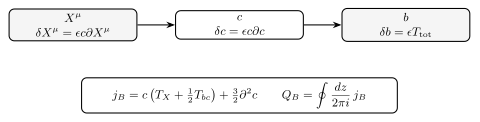
BRST symmetry is the gauge-fixed remnant of diffeomorphism and Weyl invariance. The antighost transforms into the total stress tensor.
The holomorphic BRST current may be written as
Equivalently,
The BRST charge is the contour integral
for the open string. For the closed string one adds an antiholomorphic copy:
The key local relation is
In modes this becomes
This identity explains why the stress tensor generates gauge changes in the path integral: stress-tensor insertions are BRST exact.
Nilpotency and criticality
Section titled “Nilpotency and criticality”The BRST charge must be nilpotent,
otherwise cohomology would not make sense. In the bosonic string this condition is nontrivial. The BRST current OPE contains anomalous singularities unless the total central charge vanishes.
In oscillator language, the open-string BRST charge is
Nilpotency fixes
For the closed string, the same statement holds separately in the left- and right-moving sectors:
Thus BRST nilpotency is the gauge-fixed counterpart of Weyl-anomaly cancellation.
Physical states as BRST cohomology
Section titled “Physical states as BRST cohomology”The physical Hilbert space is the cohomology of :
A state is physical if
and two states are equivalent if they differ by a BRST-exact state:
This is the same logic as gauge theory: closed means gauge invariant, exact means pure gauge.
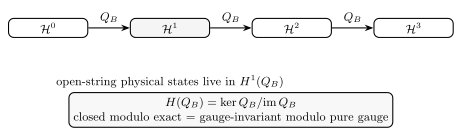
The nilpotent BRST charge organizes the gauge-fixed state space into a complex. Physical states are cohomology classes.
For the open bosonic string, unintegrated physical vertices have ghost number one:
where is a matter primary of weight . For the closed bosonic string, unintegrated physical vertices have ghost number two:
where is a matter primary of weights .
BRST closure of imposes the on-shell condition and transversality conditions on the spacetime polarization. BRST exactness gives the corresponding spacetime gauge redundancy.
Integrated and unintegrated vertices
Section titled “Integrated and unintegrated vertices”The distinction between fixed and integrated punctures is also governed by BRST symmetry. The basic mode identity
says that acting with a ghost turns BRST closure into a worldsheet derivative. For a closed-string vertex, the unintegrated and integrated representatives are
They are related by BRST descent. This is the algebraic reason string amplitudes can be written using three unintegrated vertices on the sphere and integrated vertices for the rest.

Unintegrated vertices carry ghost factors that fix punctures. Integrated vertices are related by -ghost descent and are integrated over worldsheet position or moduli.
This completes the gauge-fixing story. We now have all the ingredients needed for practical scattering calculations: matter correlators, ghost insertions, moduli integrals, BRST-invariant vertex operators, and the rules for fixed versus integrated punctures.
Exercises
Section titled “Exercises”Exercise 1. Weyl anomaly and the critical dimension
Section titled “Exercise 1. Weyl anomaly and the critical dimension”Using and , show that Weyl invariance of the flat bosonic string requires .
Solution
The Weyl anomaly is proportional to the total central charge,
Quantum Weyl invariance requires . Hence
Exercise 2. The Liouville background charge
Section titled “Exercise 2. The Liouville background charge”Assume a noncritical bosonic string with free matter fields and Liouville central charge . Derive .
Solution
Criticality of the combined matter, Liouville, and ghost system requires
Substituting gives
Therefore
Exercise 3. BRST exact stress tensor
Section titled “Exercise 3. BRST exact stress tensor”Use the identity
to explain why a pure gauge change of the worldsheet metric should not affect a physical amplitude.
Solution
A variation of the metric couples to the stress tensor. In the gauge-fixed theory, the total stress tensor is BRST exact:
In a correlator of BRST-closed physical vertex operators, insertion of a BRST-exact operator vanishes unless boundary terms in moduli space contribute. Thus infinitesimal pure gauge deformations of the representative metric do not change physical amplitudes.
Exercise 4. Open-string unintegrated vertex
Section titled “Exercise 4. Open-string unintegrated vertex”Let be a matter primary of weight . Explain why can be a BRST-invariant unintegrated open-string vertex only if .
Solution
The ghost has weight . The unintegrated vertex must have total conformal weight zero so that it can be inserted at a fixed point without a coordinate measure. Therefore
Setting gives
The full BRST analysis also imposes primary-field and on-shell conditions.
Exercise 5. Gauge redundancy from BRST exactness
Section titled “Exercise 5. Gauge redundancy from BRST exactness”For a massless open-string vertex, the matter part is
Explain why a polarization shift is a gauge redundancy.
Solution
The shifted part is proportional to
Thus the change in the integrated vertex is a total derivative on the boundary. In the BRST language, the corresponding unintegrated change is BRST exact, so it represents the zero class in cohomology. Therefore
is the spacetime gauge redundancy of the photon.