
Cylinder and Finite-Size Scaling
Why the cylinder is not just a change of coordinates
Section titled “Why the cylinder is not just a change of coordinates”The cylinder is one of the most important backgrounds in CFT. On the plane, local operators are inserted at points. On the cylinder, the same operators become states, and their scaling dimensions become energy levels. This is the cleanest way to see why a CFT spectrum is physical data rather than a bookkeeping device.
For AdS/CFT, the cylinder is unavoidable. The conformal boundary of global AdS is
Thus a CFT placed on is not an optional finite-volume version of the theory; it is the Hamiltonian frame naturally used by global AdS. The dictionary
is really the statement that radial quantization turns dilatations on flat space into time translations on the cylinder.
The goal of this page is to make this statement precise, first in any dimension and then in the especially powerful two-dimensional case.
The plane-cylinder Weyl map in any dimension
Section titled “The plane-cylinder Weyl map in any dimension”Start with Euclidean flat space in polar coordinates,
Introduce the logarithmic radial coordinate
Then
So punctured flat space is Weyl-equivalent to the cylinder
up to the Weyl factor . A CFT is designed precisely to survive such Weyl transformations, modulo anomalies that will be discussed later.
The dilatation operator on flat space becomes the cylinder Hamiltonian. If is the radius of the spatial sphere, then a scalar primary operator of dimension creates a cylinder state whose excitation energy is
In two dimensions, the spatial cylinder is usually written with circumference , so this becomes
This is the simplest quantitative form of the state-operator correspondence.
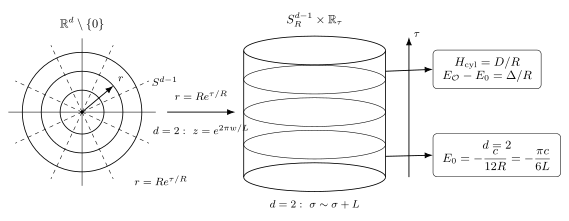
The exponential map turns radial evolution on the plane into Euclidean time evolution on the cylinder , with . In two dimensions, primary dimensions become cylinder excitation energies via , while the vacuum carries the universal Casimir energy .
The cylinder operator
Section titled “The cylinder operator”The Weyl factor in the metric tells us how to relate local operators on the plane and on the cylinder. For a scalar primary of dimension , a convenient convention is
This is not an arbitrary normalization. It is exactly the factor needed to remove the local Weyl rescaling of distances. In even dimensions, the Weyl anomaly affects the partition function and stress-tensor expectation values on curved backgrounds, but separated primary correlators transform by the local Weyl factors. Contact terms require more care; ordinary separated-point correlators do not.
The cylinder state associated with a local operator is
Because the cylinder Hamiltonian is , and because
we get
Descendants are obtained by acting with translations . Since
a descendant at level has excitation energy
The descendants are not merely extra states. They are the Hamiltonian tower that sits above a primary on the cylinder. In AdS language, they are the global-mode excitations of the same bulk representation.
Cylinder two-point functions in any dimension
Section titled “Cylinder two-point functions in any dimension”Let a scalar primary have flat-space two-point function
Set
Then
where . Multiplying by the Weyl factors from the two cylinder operators gives
For large Euclidean time separation,
the correlator decays as
This is the spectral decomposition in disguise. The power law on has become exponential decay on the cylinder because the cylinder has a Hamiltonian with discrete energy levels.
This is one of the most useful mental translations in CFT:
The word “gap” here must be understood carefully. The gap is a finite-size gap caused by compactifying space to . It vanishes as . It is not a flat-space mass gap.
Perturbing away from the fixed point
Section titled “Perturbing away from the fixed point”Finite-size scaling is most powerful when the CFT is slightly deformed. Suppose the fixed point is perturbed by a relevant scalar operator,
The coupling has mass dimension
On a sphere of radius , the only dimensionless coupling that can appear in universal quantities is therefore
This implies the scaling form
where is universal once the operator normalization and the coupling convention are fixed. At the conformal point,
In infinite volume, the same deformation generates a correlation length
Thus finite-size scaling can be phrased in either of two equivalent ways:
The CFT regime is , the massive or gapped regime is , and the crossover between them is encoded by universal scaling functions. This is the continuum version of the finite-size scaling window used in numerical studies of critical systems.
The two-dimensional cylinder
Section titled “The two-dimensional cylinder”In two-dimensional Euclidean CFT, use complex plane coordinate and cylinder coordinate
The exponential map is
The real part of is logarithmic radial time; the imaginary part of is the angular coordinate. Circles around the origin in the -plane become constant- spatial circles on the cylinder.
A primary operator of weights transforms as
Since
we have
This formula is worth absorbing. It says that the same local operator has different coordinate representatives on the plane and on the cylinder, because the Weyl factor rescales local lengths.
Two-dimensional cylinder correlators
Section titled “Two-dimensional cylinder correlators”On the plane, normalize a primary by
Using , one obtains the cylinder correlator
where
For equal Euclidean time, , and for a scalar operator with , this becomes
The power law on the plane has turned into a periodic power law on the circle. At separations much smaller than , this reduces to the flat-space answer,
At large Euclidean time separation, take with fixed . Then
The exponential decay directly reads off the excitation energy
So the cylinder correlator is not merely a useful formula; it is the bridge between local CFT data and Hamiltonian spectroscopy.
Stress tensor, Schwarzian derivative, and Casimir energy
Section titled “Stress tensor, Schwarzian derivative, and Casimir energy”The stress tensor is not an ordinary primary field. In two dimensions, under a holomorphic coordinate transformation , it transforms as
where the Schwarzian derivative is
For
we have
Therefore
Since the plane vacuum has , the cylinder vacuum has a nonzero stress-tensor expectation value,
In Virasoro language, the cylinder Hamiltonian and momentum are
Thus a state associated with a primary of weights and descendant levels has
The vacuum energy is
for a unitary CFT on a spatial circle of circumference in relativistic units. This is the universal Casimir energy.
The word “universal” needs one caution. In a lattice model, the total ground-state energy also contains a nonuniversal extensive contribution,
where is the emergent low-energy velocity. The coefficient of is universal; the bulk energy density is not.
Finite-size scaling as RG in a box
Section titled “Finite-size scaling as RG in a box”At a critical point, the infinite system has no intrinsic length scale. If the system is placed in a finite spatial box of size , then becomes the only infrared scale. This is the logic of finite-size scaling.
Suppose a quantity has scaling dimension . Near a CFT fixed point deformed by couplings to operators of dimensions , define the RG exponents
Then finite-size scaling says
up to corrections from irrelevant operators. At the fixed point, all , so
For energy levels in a relativistic CFT,
The proportionality constants are not arbitrary: in two dimensions, they are the scaling dimensions.
For a critical quantum chain with velocity , the universal CFT predictions are
and
where
The ground-state energy behaves as
for periodic boundary conditions. These three formulas are among the most useful practical bridges between numerical many-body physics and CFT. They allow one to extract the central charge, operator dimensions, and spins from finite-size spectra.
Cylinder versus thermal cylinder
Section titled “Cylinder versus thermal cylinder”There are two common cylinders in CFT, and they mean different things.
| Geometry | Periodic direction | Physical meaning |
|---|---|---|
| space | Hamiltonian quantization on a compact spatial slice | |
| Euclidean time | thermal ensemble at temperature |
In two-dimensional CFT, exchanging space and Euclidean time often looks like a simple modular transformation. In higher-dimensional CFT, the distinction is sharper: the spatial sphere is the natural boundary of global AdS, while the thermal circle is the natural setting for black branes, black holes, and real-time response.
The present page is about the first cylinder. Thermal CFT comes later.
AdS/CFT checkpoint
Section titled “AdS/CFT checkpoint”The global AdS metric may be written schematically as
At large , the conformal boundary is
This is the Lorentzian cylinder. The CFT Hamiltonian on the cylinder is therefore the natural boundary dual of global AdS time translation. The state created by a primary operator corresponds to a one-particle bulk state whose global AdS energy is
Descendants correspond to acting with boundary momentum generators; in global AdS language, they are higher oscillator modes of the same bulk representation.
For large- holographic CFTs, the cylinder spectrum organizes itself as follows:
The cylinder is where this dictionary becomes Hamiltonian physics.
Common pitfalls
Section titled “Common pitfalls”The first pitfall is to confuse a finite-size gap with a mass gap. A massive theory has a correlation length that remains finite as . A CFT on a finite circle has a gap proportional to , which vanishes in the infinite-volume limit. The finite gap is caused by the box, not by a mass.
The second pitfall is to forget the Casimir shift. On the plane, the vacuum has zero scaling dimension. On the cylinder, the vacuum energy is shifted by the Schwarzian term. In two dimensions this shift is fixed by .
The third pitfall is to use finite-size formulas without the velocity in lattice systems. A continuum relativistic CFT sets . A critical spin chain or condensed-matter realization generally has a nonuniversal velocity that must be measured or fixed separately.
Exercises
Section titled “Exercises”Exercise 1 — Derive the Weyl map
Section titled “Exercise 1 — Derive the Weyl map”Starting from
show that
Solution
From , we get
Therefore
Adding the two terms gives
Thus flat space minus the origin is Weyl-equivalent to the cylinder.
Exercise 2 — Derive the cylinder two-point function in any dimension
Section titled “Exercise 2 — Derive the cylinder two-point function in any dimension”Use
to derive the cylinder correlator
Solution
We compute
Factor out :
Using ,
A scalar primary satisfies
Multiplying the plane correlator by cancels the exponential factor in and gives the desired expression.
Exercise 3 — Derive the two-dimensional cylinder two-point function
Section titled “Exercise 3 — Derive the two-dimensional cylinder two-point function”Starting from
and using
derive the two-dimensional cylinder two-point function.
Solution
A primary transforms as
For ,
Also,
Therefore
The antiholomorphic part is identical, so
Exercise 4 — Compute the Schwarzian shift
Section titled “Exercise 4 — Compute the Schwarzian shift”For
compute and use it to show that the plane vacuum has nonzero cylinder energy.
Solution
We have
Thus
and
The stress tensor transforms as
Since in the plane vacuum,
With , this gives the chiral vacuum shift. Combining the holomorphic and antiholomorphic sectors gives
so the vacuum energy is
Exercise 5 — Extract CFT data from finite-size energies
Section titled “Exercise 5 — Extract CFT data from finite-size energies”A critical periodic spin chain has low-energy spectrum
and ground-state energy
Assume is known. Explain how to extract and from numerical data at several large values of .
Solution
For each excited level,
As , this approaches the scaling dimension . In practice one fits
where is controlled by irrelevant operators.
For the central charge, first fit the extensive part . Then compute
As , approaches . In real numerical work, , , and correction terms are often fit simultaneously.
Exercise 6 — Why the finite cylinder is not massive
Section titled “Exercise 6 — Why the finite cylinder is not massive”A scalar two-point function on the cylinder decays at large Euclidean time as
Explain why this exponential decay does not mean that the CFT has developed a mass gap.
Solution
The decay exponent is
This gap is caused by compactifying space to a circle of circumference . It vanishes as :
A genuine mass gap would remain finite in the infinite-volume limit. Therefore the finite cylinder has a discrete spectrum, but the underlying infinite-volume CFT remains gapless.
Takeaway
Section titled “Takeaway”The cylinder turns scale into time:
In two dimensions this gives exact and extremely useful formulas:
For AdS/CFT, this is the first Hamiltonian form of the dictionary: CFT scaling dimensions are global AdS energies.
Further reading
Section titled “Further reading”For the 2D cylinder, finite-size scaling, and the central charge, see Di Francesco, Mathieu, and Sénéchal on radial quantization, modular invariance, and finite-size scaling. For the higher-dimensional cylinder, the most useful companions are modern conformal bootstrap lecture notes, where the cylinder is treated as the natural Hilbert-space quantization of a CFT. The next pages will use this cylinder picture to discuss Weyl anomalies, thermal CFT, and entanglement.