Massless Closed-String Vertices and Gauge Invariance
The closed bosonic string has a universal massless level. In oscillator language it is
ϵμνα−1μα~−1ν∣0;k⟩,k2=0,
subject to physical-state constraints and gauge equivalences. In the CFT language the corresponding matter vertex operator is
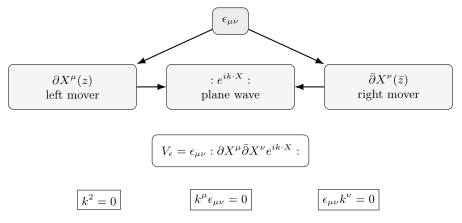
Vϵ(k;z,zˉ)=ϵμν:∂Xμ(z)∂ˉXν(zˉ)eik⋅X(z,zˉ):.
For an integrated closed-string vertex we use
∫d2zVϵ(k;z,zˉ),
while the unintegrated sphere vertex is
c(z)c~(zˉ)Vϵ(k;z,zˉ).
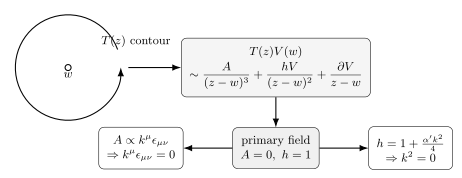
The operator Vϵ must be a (1,1) primary. This single worldsheet statement contains the spacetime wave equation, the transversality conditions, and the gauge structure of the graviton, two-form, and dilaton.
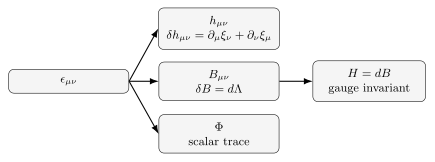
The massless closed-string vertex factorizes into a left-moving oscillator, a right-moving oscillator, and a center-of-mass plane wave. The polarization tensor ϵμν carries the spacetime field content.
The antiholomorphic OPE similarly contains a third-order pole proportional to ϵμνkν. Therefore the massless closed-string vertex is a (1,1) primary exactly when
k2=0,kμϵμν=0,ϵμνkν=0.
The double pole imposes the weight condition, while the absence of a third-order pole imposes transversality. The same statement in the antiholomorphic sector gives right transversality.
These conditions are the CFT version of the old covariant physical-state constraints
The polarization tensor is not unique. It has the equivalence
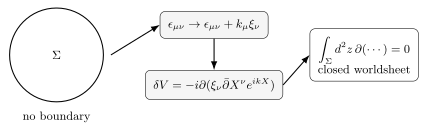
ϵμν∼ϵμν+kμξν+ξ~μkν.
This is not an extra assumption. It follows directly from the fact that the corresponding change in the integrated vertex is a total derivative. Indeed,
up to the free equation of motion ∂∂ˉXν=0 and contact terms. On a closed worldsheet with no boundary this integral vanishes. The same argument applies to the shift ξ~μkν using ∂ˉ.
A polarization shift proportional to kμ or kν changes the integrated vertex by a total derivative. On a closed worldsheet this decouples from amplitudes.
In spacetime terms, the symmetric and antisymmetric pieces become the familiar gauge symmetries
hμν∼hμν+∂μξν+∂νξμ,
and
Bμν∼Bμν+∂μΛν−∂νΛμ.
The gauge-invariant field strength of the two-form is
Hμνρ=3∂[μBνρ].
The dilaton is the gauge-invariant scalar trace component. It will play a special role on the next page: its expectation value controls the string coupling.
The graviton gauge symmetry is linearized diffeomorphism invariance. The two-form has its own one-form gauge parameter. The dilaton is a scalar and controls the string coupling in perturbation theory.
The primary-field conditions are equivalent to the free spacetime equations of motion in a convenient gauge. For the graviton, the linearized Einstein equation in de Donder gauge reduces to
k2hμν=0,kμhμν=0,
with residual gauge transformations generated by ξμ. For the two-form, the free equation and gauge condition may be written
k2Bμν=0,kμBμν=0,B∼B+dΛ.
Thus the worldsheet primary condition is not merely a kinematic trick. It is the first appearance of a recurring principle:
physical spacetime equations arise from the requirement that vertex operators be allowed operators in a conformal field theory.
show that the third-order pole in T(z)Vϵ(w,wˉ) is proportional to kμϵμν.
Solution
The stress tensor is T(z)=−α′−1:∂Xρ∂Xρ:. The third-order pole comes from a double contraction: one ∂X in T contracts with ∂Xμ in the vertex, while the other contracts with the exponential. There are two identical Wick pairings, so
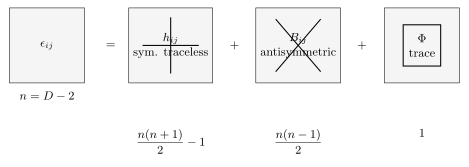
The first term is the number of symmetric traceless components of an n×n matrix. The second term is the number of antisymmetric components. The last term is the trace. Adding gives
2n(n+1)−1+2n(n−1)+1=2n2+n+n2−n=n2.
This equals the dimension of the product of left and right transverse vector polarizations.