
Quantum Corrections, JLMS, and Replica Methods
The main idea
Section titled “The main idea”The RT/HRT formula is the leading term in a semiclassical expansion. It says that the entropy of a boundary region is computed by an area,
where is the classical extremal surface anchored on and homologous to . This is the correct first answer in the limit in which the bulk is classical and the CFT has a parametrically large number of degrees of freedom.
But a bulk quantum field theory living on a fixed geometry also has entanglement. The surface divides the bulk into two regions, and bulk fields can be entangled across that division. Therefore the first quantum correction to holographic entropy is not another mysterious geometric object. It is the ordinary bulk entanglement entropy across the RT/HRT surface, together with the renormalization of the gravitational area term.
The quantum-corrected object is the generalized entropy
Here is a codimension-two bulk surface homologous to , and is the bulk region bounded by . The term is the entropy of bulk quantum fields in . The term is a reminder that the area and bulk entropy terms are separately UV divergent; only the properly renormalized generalized entropy is physical.
The fully semiclassical prescription is
A surface that extremizes is called a quantum extremal surface, or QES. The final minimization chooses the dominant saddle, just as classical RT chooses the minimal-area surface among classical extremal candidates.
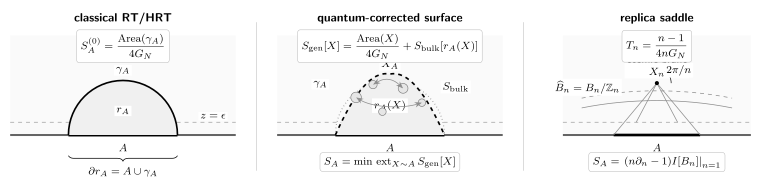
Classical RT/HRT uses only the area of or . Quantum corrections replace area by generalized entropy, , and the surface is shifted until . In the replica derivation, the quotient bulk saddle contains a codimension-two cosmic brane with tension ; its limit selects the entropy surface.
This page has three jobs.
First, it explains how the replica trick derives the classical RT/HRT area term. Second, it explains why the first correction is bulk entanglement, known as the FLM correction. Third, it introduces the JLMS relation, which says that boundary modular physics is equal to bulk modular physics in the entanglement wedge, up to the area operator. That relation is one of the conceptual bridges from entanglement entropy to bulk reconstruction.
The expansion parameter
Section titled “The expansion parameter”For an Einstein-like holographic CFT, the bulk Newton constant is small in AdS units. Schematically,
where is the stress-tensor two-point-function coefficient. Thus
By contrast, the entanglement entropy of a finite number of bulk quantum fields across a fixed surface is usually
So the hierarchy is
for a standard large- expansion. The leading term is classical geometry. The next term is one-loop bulk physics.
This hierarchy is powerful, but it can be misleading if stated too casually. The bulk entropy may be order one, but it can still change which surface is selected when two classical area saddles are nearly degenerate. This is the same saddle-competition logic that later appears in Page-curve and island calculations.
Boundary replica trick
Section titled “Boundary replica trick”For a normalized density matrix , the von Neumann entropy is
The replica trick computes it from integer moments
and then analytically continues to :
In Euclidean QFT, is computed by a path integral on an -fold branched cover of the original spacetime. The sheets are glued cyclically along the cut defining the region . If is the Euclidean partition function on this replica manifold, then
Writing , the entropy is equivalently
The last expression is useful because holography replaces the boundary effective action by a bulk saddle action:
Here is a bulk geometry whose conformal boundary is .
Bulk replica saddles
Section titled “Bulk replica saddles”Assume the dominant bulk saddle respects the replica symmetry . Then one can quotient by this symmetry:
The quotient geometry has the original unreplicated boundary , but it contains a codimension-two conical defect in the bulk. For integer , this defect is the fixed locus of the replica symmetry. It is anchored on at the boundary.
Near the fixed locus, the transverse directions look like a cone. In the quotient geometry the angular opening is
so the deficit angle is
Einstein’s equations interpret such a conical defect as a codimension-two cosmic brane with tension
This is a very efficient way to remember the replica derivation: the -dependent entropy is computed by a cosmic brane, and the entanglement entropy arises from the limit, where the brane tension vanishes but its backreaction leaves the area term.
In the limit,
The brane becomes infinitesimal. The bulk geometry returns to the original geometry, but the location of the fixed locus remains: it is the entropy surface.
Why extremality appears
Section titled “Why extremality appears”The classical area prescription is not an independent guess once the replica saddle is assumed. It follows from smoothness of the replicated bulk.
Near a candidate codimension-two surface, introduce local polar coordinates in the two transverse directions,
where are coordinates along the surface, are the two transverse Cartesian coordinates, and are the two extrinsic curvature tensors. If the opening angle is changed to produce a cone, the Einstein equations develop singular terms unless the trace of the extrinsic curvature vanishes:
Equivalently, in Lorentzian signature the two null expansions vanish,
This is precisely the HRT extremality condition.
For static time-reflection-symmetric states, extremality plus the homology condition reduces to minimality on the static slice. In a general time-dependent spacetime, the same replica logic leads to the covariant extremal surface rather than a minimal surface on an arbitrary bulk time slice.
The classical result can be summarized as
The replica derivation explains both ingredients: the area comes from differentiating the conical action, and the extremality comes from regularity of the replicated saddle.
The FLM correction
Section titled “The FLM correction”Now include bulk quantum fluctuations. Formally, after integrating out bulk fields around the classical background, the bulk partition function contains an effective action
where is the one-loop effective action of bulk fields on the replicated geometry. Differentiating the gravitational part gives the area. Differentiating the bulk one-loop part gives the entropy of bulk quantum fields across the entropy surface.
The result is the FLM formula:
Here is the classical RT/HRT surface, and is the bulk region bounded by . The expectation value in the area term reminds us that metric fluctuations and renormalization of contribute at the same order as bulk entanglement.
A useful way to see why the classical surface is enough at first subleading order is the following. Write the QES as
The area term is multiplied by , but the first variation of the area vanishes at :
Therefore the displacement of the surface does not change the leading area contribution at order . At that order, one evaluates bulk entanglement on the classical entanglement wedge. At higher orders, the surface must be corrected by extremizing the full generalized entropy.
This is the conceptual upgrade from RT/HRT to QES:
| Order | Surface condition | Entropy functional |
|---|---|---|
| Classical | ||
| One-loop | classical surface sufficient for entropy | |
| All semiclassical orders |
The bulk entropy is the von Neumann entropy of bulk quantum fields restricted to the entanglement wedge region :
This sounds simple, but several subtleties are important.
First, is UV divergent. Any local QFT has short-distance entanglement across a sharp surface. In a gravitational theory, these divergences renormalize the gravitational couplings appearing in the area functional. Thus the split
is scheme-dependent term by term, while is the meaningful object.
Second, gauge fields and gravitons have edge-mode and constraint subtleties. A gauge theory Hilbert space does not factorize naively across a spatial cut. The clean statement is not that there is a unique regulator-independent number called by itself. The clean statement is that the generalized entropy, including the correct gravitational and edge contributions, computes the boundary entropy.
Third, is not restricted to matter fields. It includes all low-energy bulk quantum fields in the effective theory, including gravitons when they are treated perturbatively. In practice, calculations often separate matter and metric fluctuations, but the physical answer is not tied to that bookkeeping.
Quantum extremal surfaces
Section titled “Quantum extremal surfaces”At higher orders, the entropy surface itself must be chosen by extremizing generalized entropy. The QES condition is
In a local transverse deformation , this condition has the schematic form
where is the trace of the extrinsic curvature vector of the surface. The classical condition is corrected by the entropic force from bulk quantum fields.
The entropy formula is then
This “minimize after extremizing” language is not cosmetic. In time-dependent Lorentzian geometry, a surface is generally a saddle of the area functional rather than a minimum. The extremality condition is local. The final choice among allowed extremal candidates is global and saddle-theoretic.
The QES prescription is the same structure that later appears in island calculations. In ordinary subregion duality, the QES is anchored to on the AdS boundary. In island problems, one applies a generalized entropy extremization to radiation regions coupled to gravity, and new disconnected bulk regions can enter the entanglement wedge. The black-hole information module returns to this in detail.
Replica perspective on quantum corrections
Section titled “Replica perspective on quantum corrections”The replica derivation also explains why the QES condition is not arbitrary. At the quantum level, the location of the conical defect is not determined only by the classical Einstein action. The one-loop effective action depends on the position of the defect because moving the defect changes the bulk region whose entropy is being computed.
For a candidate surface , the effective replicated action takes the schematic form
The saddle condition is
Taking the entropy derivative turns this into
So QES extremality is simply the quantum-corrected version of the regularity/saddle condition in the replica path integral.
Modular Hamiltonians
Section titled “Modular Hamiltonians”The modular Hamiltonian of a region is defined by
This is a formal definition; for generic regions and states, is nonlocal and hard to compute. But it is conceptually central because relative entropy can be written as
where
Relative entropy is nonnegative:
In holography, this positivity becomes a powerful constraint on bulk physics. It is closely related to canonical energy, gravitational constraints, entanglement wedge nesting, and the emergence of linearized Einstein equations from entanglement.
The JLMS relation is the modular-Hamiltonian version of the quantum-corrected entropy formula. In a suitable semiclassical code subspace, it states schematically that
Here is the modular Hamiltonian of the boundary region , and is the bulk modular Hamiltonian of the entanglement wedge region . The hat on the area reminds us that, in the quantum theory, the area is an operator on the code subspace rather than just a number.
Taking expectation values and subtracting entropies gives the JLMS equality of relative entropies:
The area term cancels between and . This cancellation is why relative entropy is a cleaner object than entropy itself. Entropy contains state-independent UV-divergent terms and scheme-dependent area renormalizations; relative entropy between nearby states in the same code subspace is much more robust.
JLMS has a deep interpretation:
| Boundary statement | Bulk statement |
|---|---|
| Modular Hamiltonian of | area operator plus bulk modular Hamiltonian in |
| Boundary relative entropy | bulk relative entropy in the entanglement wedge |
| Boundary modular flow | bulk modular flow, perturbatively, in the wedge |
| Distinguishability using | distinguishability of bulk states in |
| Entanglement wedge reconstruction | operators in are encoded in |
This is where holographic entanglement stops being only an entropy formula. It becomes a statement about which bulk information is available to which boundary region.
Why relative entropy points to the entanglement wedge
Section titled “Why relative entropy points to the entanglement wedge”Suppose two boundary states and differ only by a small bulk excitation localized in a region . If lies inside the entanglement wedge , then the bulk reduced density matrices on can distinguish the states. JLMS implies that the boundary reduced density matrices on can also distinguish them:
If lies outside the entanglement wedge of , the region should not contain enough information to reconstruct the corresponding local bulk operator, at least within the semiclassical code subspace.
This is the cleanest conceptual route to entanglement wedge reconstruction:
The next pages develop this idea further. For now, the important point is that the quantum correction is not a small decorative addition to RT. It is the term that lets the entropy formula talk to bulk quantum information.
A useful hierarchy of formulas
Section titled “A useful hierarchy of formulas”The following table is a good memory aid.
| Name | Formula | Regime | Surface |
|---|---|---|---|
| RT | static classical bulk | minimal surface on static slice | |
| HRT | covariant classical bulk | Lorentzian extremal surface | |
| FLM | first quantum correction | classical surface sufficient at this order | |
| QES | all semiclassical orders | quantum extremal surface | |
| JLMS | code-subspace modular relation | entanglement wedge region |
One should not think of these as competing formulas. They are nested approximations to the same underlying quantum-gravitational statement.
Common mistakes
Section titled “Common mistakes”Mistake 1: treating as finite by itself
Section titled “Mistake 1: treating SbulkS_{\mathrm{bulk}}Sbulk as finite by itself”Bulk entanglement across a sharp surface is divergent. The area term is also divergent when expressed in terms of bare gravitational couplings. Only the renormalized generalized entropy is physical.
Mistake 2: extremizing the area after adding bulk entropy but keeping the old surface fixed forever
Section titled “Mistake 2: extremizing the area after adding bulk entropy but keeping the old surface fixed forever”At first subleading order, evaluating on the classical surface is enough because the classical surface extremizes the area. At higher orders, the surface must satisfy
Mistake 3: saying the replica derivation proves all of AdS/CFT
Section titled “Mistake 3: saying the replica derivation proves all of AdS/CFT”The replica derivation assumes the holographic duality and analyzes the dominant bulk saddle for a replicated boundary problem. It is a derivation of the entropy formula inside the AdS/CFT framework, not a derivation of the duality itself.
Mistake 4: ignoring saddle competition
Section titled “Mistake 4: ignoring saddle competition”Multiple extremal or quantum extremal surfaces can satisfy the same boundary anchoring and homology conditions. The entropy is computed by the dominant saddle, usually the one with smallest generalized entropy. Phase transitions in this minimization are physically important.
Mistake 5: forgetting the code subspace in JLMS
Section titled “Mistake 5: forgetting the code subspace in JLMS”JLMS is not a statement that one exact CFT operator is always equal to one simple bulk operator on the entire Hilbert space. It is a semiclassical, code-subspace statement. This is precisely the regime in which local bulk effective field theory makes sense.
Exercises
Section titled “Exercises”Exercise 1: Replica entropy formula
Section titled “Exercise 1: Replica entropy formula”Let
Show that
Solution
The entropy is
Using
we get
At this is the same as
Exercise 2: Cosmic brane tension and deficit angle
Section titled “Exercise 2: Cosmic brane tension and deficit angle”The quotient replica geometry has angular opening around the cosmic brane. Show that the corresponding deficit angle is reproduced by
using the codimension-two relation .
Solution
The angular opening is
Therefore the deficit angle is
Using the codimension-two relation , we find
Exercise 3: Quantum extremality condition
Section titled “Exercise 3: Quantum extremality condition”Let
For a local transverse deformation , show schematically that the QES condition is
where is the trace of the extrinsic curvature vector.
Solution
The first variation of area for a codimension-two surface under a transverse deformation is schematically
up to sign conventions for the normal basis. The first variation of the bulk entropy is
Thus
Since the deformation is arbitrary, quantum extremality requires
Different sign conventions for change the sign of the first term, but not the content of the condition .
Exercise 4: JLMS and relative entropy
Section titled “Exercise 4: JLMS and relative entropy”Assume the modular Hamiltonian relation
and the entropy formula
Show that, for two states and in the same semiclassical code subspace,
Solution
Relative entropy is
where means the difference between and .
Using the modular Hamiltonian relation,
Using the entropy formula,
Subtracting gives
The area contribution cancels. This cancellation is the core reason JLMS is naturally formulated in terms of relative entropy.
Exercise 5: A two-saddle QES transition
Section titled “Exercise 5: A two-saddle QES transition”Suppose two candidate quantum extremal surfaces and have generalized entropies
where and are order-one bulk entropy contributions. Find the condition for to dominate even if .
Solution
The surface dominates when
This means
Rearranging gives
Thus a larger-area surface can dominate only if its bulk entropy contribution is sufficiently smaller. If is order in geometric units, the right-hand side is order and an order-one entropy difference cannot change the winner. But if the classical areas are nearly degenerate, with , then the order-one bulk entropy difference can determine the dominant QES.
Further reading
Section titled “Further reading”The classical replica derivation is Lewkowycz and Maldacena, “Generalized Gravitational Entropy”. The one-loop correction is Faulkner, Lewkowycz, and Maldacena, “Quantum Corrections to Holographic Entanglement Entropy”. The all-orders semiclassical QES proposal is Engelhardt and Wall, “Quantum Extremal Surfaces: Holographic Entanglement Entropy beyond the Classical Regime”. The modular-Hamiltonian and relative-entropy relation is Jafferis, Lewkowycz, Maldacena, and Suh, “Relative Entropy Equals Bulk Relative Entropy”. For a modern broad review of holographic entanglement and bulk reconstruction, see Harlow, “TASI Lectures on the Emergence of Bulk Physics in AdS/CFT”.