
Supergravity p-Branes, NS5-Branes, and Throat Geometries
D-branes were introduced as hypersurfaces on which open strings can end. That is the weak-coupling, open-string definition. But a D-brane also carries stress energy and Ramond—Ramond charge, so it must source the closed-string fields of type II supergravity. At sufficiently large charge, the backreaction is not a small correction: the brane becomes a spacetime geometry.
This is the conceptual bridge from perturbative string theory to holography. Open strings tell us that a stack of D-branes supports a -dimensional gauge theory. Closed strings tell us that the same stack sources a curved supergravity solution whose fields are controlled by a harmonic function . The two descriptions are not competing stories. They are two limits of the same object.
The main character on this page is the extremal BPS -brane solution. It has a particularly rigid form because supersymmetry fixes the relative strength of gravity, dilaton exchange, and R—R gauge-field exchange. For a stack of coincident branes, the transverse-space harmonic function is
where is the distance from the brane in the transverse space . The constant is the charge radius. When , the geometry is nearly flat. When , the constant becomes negligible and the geometry develops a throat.
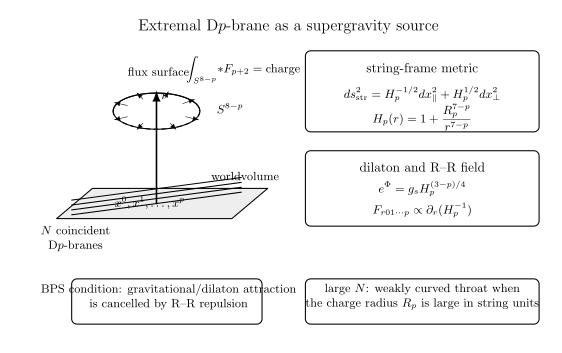
An extremal D-brane is translationally invariant along and spherically symmetric in the transverse space . Its geometry is controlled by a harmonic function , and its R—R charge is measured by flux through the linking sphere .
Why harmonic functions appear
Section titled “Why harmonic functions appear”Consider an infinite flat -brane in ten dimensions. It fills spatial directions and time, so the number of transverse spatial directions is
The brane is localized at in . Away from the source, the fields are constrained by the sourceless supergravity equations. Supersymmetry reduces the coupled nonlinear equations to a remarkably simple statement: the function is harmonic in the transverse space,
For a rotationally invariant solution, with . The flat radial Laplacian in dimensions is
For , the Green function behaves as . Since , this gives
The constant term is fixed by the boundary condition that the metric approaches ten-dimensional Minkowski space at infinity. The coefficient is fixed by charge quantization. The same logic that gives the Coulomb potential in four-dimensional electromagnetism gives the D-brane harmonic function in the transverse dimensions.
For separated parallel BPS branes, the no-force property allows a multi-center solution,
again for . This linear superposition inside a nonlinear theory is one of the most practical signatures of BPS saturation. The branes can sit at arbitrary positions because their attractive NS—NS forces and repulsive R—R forces cancel.
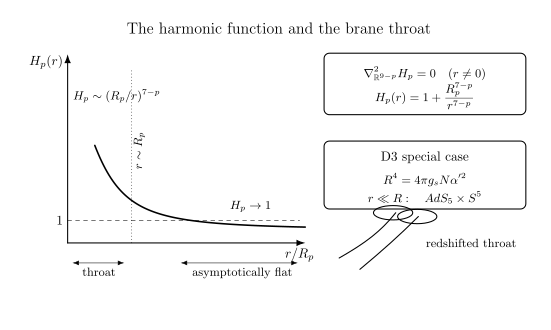
The harmonic function interpolates between an asymptotically flat region, , and a near-core region where . For BPS centers, harmonic functions can be superposed.
There are special cases. For , the transverse space is two-dimensional and the harmonic function is logarithmic. For , the transverse space is one-dimensional and the solution belongs to massive type IIA supergravity. The pages here will mostly use , with the D3-brane playing the central role later.
The extremal D-brane solution
Section titled “The extremal Dppp-brane solution”Let , , be coordinates along the brane, and let , , be transverse coordinates. Define
In string frame, the extremal D-brane solution is
with dilaton
and R—R potential, in a gauge regular at infinity,
The associated R—R field strength is electric with respect to the D-brane,
A magnetic description uses the dual field strength , whose flux through the linking sphere measures the brane charge. Schematically,
where is the number of branes and
is the R—R charge normalization appearing in the Wess—Zumino coupling . As on the previous D-brane pages, the -independent DBI normalization is , while the physical tension measured at asymptotic string coupling is
For , charge quantization gives
This formula is worth checking in the two most famous cases:
The D3 case is special because the dilaton is constant. This is the first hint that D3-branes will produce a particularly clean holographic duality: the near-horizon geometry has constant string coupling and, for large , small curvature.
String frame and Einstein frame
Section titled “String frame and Einstein frame”The string-frame metric is the metric that appears directly in the sigma-model action of the fundamental string. The Einstein-frame metric is the one in which the gravitational action has the canonical Einstein—Hilbert form. If we normalize the two metrics to agree at infinity, then
Using
we obtain
This form makes the universal BPS structure more symmetrical. The exponents add up in exactly the way needed for an extremal charged object in ten-dimensional Einstein gravity. The string-frame form is often more useful for worldsheet questions and T-duality, while the Einstein-frame form is often more useful for black-brane thermodynamics and comparisons with lower-dimensional gravity.
The distinction matters physically. For example, the D3-brane is self-dual in type IIB and has constant dilaton, so the string and Einstein frames differ only by a constant. For , the dilaton varies with , and the local effective string coupling
can become large or small near the brane depending on .
Near , . Hence
This simple table is a useful diagnostic. D1- and D2-brane geometries become strongly coupled in the deep interior; their complete description requires S-duality or M-theory in the appropriate regimes. D4-, D5-, and D6-brane geometries have weak string coupling near the core, but their curvature and ultraviolet behavior still require care.
The D3-brane as the cleanest example
Section titled “The D3-brane as the cleanest example”For , the solution becomes
with
In the near-horizon region , the constant may be dropped:
Then
This is in Poincare coordinates. The detailed holographic interpretation will be developed later, but it is useful to see already what makes the D3-brane special: the same radius controls both the anti-de Sitter space and the sphere, and the dilaton is constant.
The curvature scale in string units is
Classical supergravity requires
At the same time, string loops are suppressed when
Thus the most useful supergravity regime for D3-branes is
This is the familiar large-, large ‘t Hooft coupling, weak closed-string coupling window.
The NS-sector dual pair: F1 and NS5
Section titled “The NS-sector dual pair: F1 and NS5”D-branes are R—R charged. The NS—NS sector also has charged extended objects. The fundamental string is electrically charged under , while the NS5-brane is magnetically charged under .
The fundamental string solution in string frame has the schematic form
where in the eight transverse dimensions. This is the NS—NS analogue of an electrically charged brane.
The magnetic dual is the NS5-brane. It fills and has four transverse directions. Its string-frame solution is
with
The NS—NS three-form flux is magnetic through the transverse three-sphere:
Equivalently, if is the volume form of the unit , normalized by , then in the near-throat region one may write
This flux is the NS5-brane charge. The harmonic function has the form because the transverse space is .
The NS5-brane is not merely the member of the D family. Compare it with the D5-brane. For a D5-brane,
so the string coupling decreases near the core. For an NS5-brane,
so the string coupling grows near the core. In type IIB, these two solutions are related by S-duality. The Einstein-frame description is the natural place to compare them, because the Einstein metric is invariant under the duality group.
The linear-dilaton throat of NS5-branes
Section titled “The linear-dilaton throat of NS5-branes”The near-horizon region of NS5-branes is obtained by taking
Then the transverse part of the string-frame metric becomes
Introduce a radial coordinate by
Then
and the near-horizon metric is
The throat is a cylinder: , with the radius fixed by the number of fivebranes. The dilaton is not constant. Since
we get
up to an additive constant. As , one has , so . The throat becomes strongly coupled at its bottom.
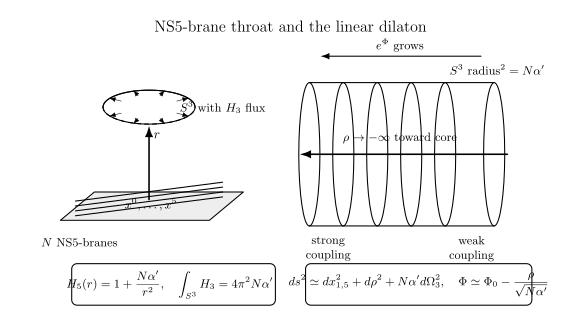
The near-horizon NS5 geometry is a cylinder times the flat six-dimensional worldvolume. The carries units of flux, while the dilaton varies linearly along the throat and grows toward the core.
This geometry is qualitatively different from the D3-brane throat. The D3 throat is anti-de Sitter and has constant coupling. The NS5 throat is a linear-dilaton background with a strong-coupling end. Its decoupled theory is not an ordinary local quantum field theory but a six-dimensional nonlocal theory known as little string theory.
Exact worldsheet description of the NS5 throat
Section titled “Exact worldsheet description of the NS5 throat”The NS5 near-horizon throat is one of the rare curved string backgrounds that has an exact worldsheet CFT description. The geometry is
and the with units of flux is described by a supersymmetric Wess—Zumino—Witten model. In a common convention one writes the throat CFT as
There is a standard level-shift subtlety: the supersymmetric theory can be represented as a bosonic WZW model at level plus three free fermions. This is why different books sometimes quote nearby-looking levels. The physical integer is the number of NS5-branes and the number of units of flux.
The central charge works beautifully. The supersymmetric sector has
while the linear-dilaton boson plus its fermionic partner contributes
in the common worldsheet convention. Their sum is
which is precisely the central charge of four transverse supersymmetric coordinates. Adding the six flat worldvolume directions gives the critical type II worldsheet theory.
This exact CFT viewpoint explains why the NS5-brane throat is more than a supergravity approximation. The sphere radius and flux are not arbitrary classical decorations; they are encoded by the WZW level. The linear dilaton is also not a guess: it is required by conformal invariance.
Validity of supergravity
Section titled “Validity of supergravity”A supergravity solution is useful only when both stringy and quantum corrections are small. There are two local conditions:
The first condition suppresses higher-derivative corrections. The second suppresses string loops. For D-branes, the curvature radius is controlled by a charge scale , so large often helps. But the dilaton may still run, and for different radial regions can require different dual descriptions.
For NS5-branes, the sphere radius in the throat is
Thus large suppresses curvature corrections. However,
in the throat, so string loops become important near no matter how small is at infinity. In type IIA, the strong-coupling core is better described by lifting to M-theory, where NS5-branes become M5-branes. In type IIB, S-duality maps the NS5-brane to a D5-brane, which may provide a weakly coupled description in the appropriate regime.
The practical lesson is not that the supergravity solutions are unreliable. Rather, they are reliable in their proper domains. The best string-theory calculations often proceed by patching together dual descriptions, each valid in a different region of moduli space or spacetime.
What to remember
Section titled “What to remember”The essential facts are as follows.
| Object | Harmonic function | String-frame behavior | Charge |
|---|---|---|---|
| D | electric under | ||
| D3 | constant dilaton | self-dual charge | |
| F1 | electric under | ||
| NS5 | linear-dilaton throat | magnetic under |
The D solutions teach us that branes are not merely boundary conditions for open strings. They are charged gravitating objects. The NS5 solution teaches us that exact worldsheet CFTs can describe highly nontrivial curved backgrounds. Together, these examples prepare the ground for black branes, entropy, absorption, and the decoupling limits that lead to AdS/CFT.
Exercises
Section titled “Exercises”Exercise 1: the radial harmonic function in
Section titled “Exercise 1: the radial harmonic function in R9−p\mathbb R^{9-p}R9−p”Let and suppose is harmonic away from the origin in :
For , show that
Then rewrite the exponent in terms of .
Solution
The radial equation says
Therefore
for a constant , so
For ,
Renaming gives
Since , the exponent is
Thus the D-brane harmonic function has the form
Exercise 2: D3-brane near-horizon geometry
Section titled “Exercise 2: D3-brane near-horizon geometry”Starting from
show that the near-horizon region is with common radius .
Solution
For ,
Then
Substituting into the metric gives
The first two terms are the Poincare-patch metric on of radius , and the last term is the metric on a round of the same radius. Hence the near-horizon geometry is
Exercise 3: Einstein-frame exponents for D-branes
Section titled “Exercise 3: Einstein-frame exponents for Dppp-branes”Use
and
to derive
Solution
The Weyl factor is
Multiplying the parallel part of the string-frame metric gives
Multiplying the transverse part gives
Therefore
Exercise 4: the local string coupling near a D-brane
Section titled “Exercise 4: the local string coupling near a Dppp-brane”For the D-brane solution,
Assuming near the core, determine for which values of the local string coupling grows, stays constant, or decreases.
Solution
The behavior is controlled by the exponent
If , the exponent is positive, so grows as . If , the exponent vanishes, so
is constant. If , the exponent is negative, so decreases near the core.
Thus
This is why D3-branes are especially clean, while D1/D2 systems and D4/D5/D6 systems often require dual descriptions in different regimes.
Exercise 5: the NS5 linear-dilaton throat
Section titled “Exercise 5: the NS5 linear-dilaton throat”Starting from
show that for the metric becomes
with
Then derive the linear dilaton.
Solution
In the near-horizon region,
Therefore
The coordinate definition gives
so
Thus
For the dilaton,
Using
we find
Taking the logarithm gives
where is an additive constant.
Exercise 6: NS5 charge from flux
Section titled “Exercise 6: NS5 charge from H3H_3H3 flux”Let be the volume form on the unit three-sphere, normalized as
Show that
has units of NS5-brane charge under the convention
Solution
Compute the flux:
Since
we get
Thus the flux is precisely units.
Exercise 7: multi-center harmonic functions and no-force
Section titled “Exercise 7: multi-center harmonic functions and no-force”Explain why
is a natural candidate for several parallel BPS D-branes. What physical property of BPS branes makes this possible?
Solution
Away from all centers, each term
is harmonic in the transverse space. Since the Laplace equation is linear, the sum is also harmonic away from the sources. The constants encode the individual brane charges.
The nontrivial point is that this harmonic superposition solves the full BPS supergravity equations, not merely a linearized approximation. Supersymmetry enforces a balance between forces: gravitational and dilaton attraction are exactly canceled by R—R repulsion for parallel branes of the same orientation. Therefore the branes can be placed at arbitrary positions without acceleration. This no-force condition is the physical reason the multi-center harmonic function is allowed.