
Holographic Correlators and the Breitenlohner--Freedman Bound
The preceding page gave the dictionary-level slogan
for a scalar field in dual to a scalar primary operator of dimension in a -dimensional CFT. This page derives that relation and then uses it to compute the simplest holographic correlation functions.
The key lesson is that an AdS field has two independent near-boundary behaviors. One is interpreted as the source for the dual CFT operator; the other is interpreted as the response, or expectation value. This is the seed of the whole GKPW prescription.
Scalar fields in Euclidean AdS
Section titled “Scalar fields in Euclidean AdS”Work in Euclidean Poincare coordinates
The conformal boundary is at . The deep interior is . A free scalar with action
obeys
For the Poincare metric this becomes
Fourier transforming along the boundary,
gives
This is a Bessel equation after writing . The solution regular in the Euclidean interior is
The other independent solution is , which grows exponentially as and is therefore not allowed for the Euclidean vacuum. In Lorentzian signature the analogous choice is not regularity but an appropriate real-time boundary condition, such as infalling behavior at a horizon.
The near-boundary falloffs
Section titled “The near-boundary falloffs”Near , the term in the wave equation is subleading. Try a power law . Then
Thus the two possible exponents are
It is conventional to call
Then the two falloffs are
The coefficient is the boundary source. The coefficient is the response. In the CFT, the source couples as
up to a sign convention. The operator has dimension because the source has dimension .
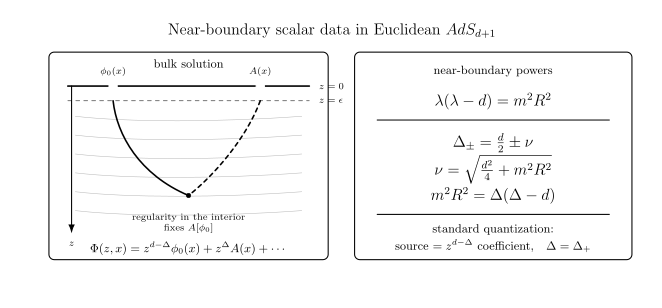
The near-boundary expansion separates the source coefficient from the response coefficient . In ordinary quantization, sources the dual operator , while determines after holographic renormalization.
A useful way to remember the powers is to ask how the bulk field behaves under the AdS scaling isometry
The leading source term transforms as
Since the source coupling must be scale invariant, has dimension and has dimension .
Source, response, and one-point functions
Section titled “Source, response, and one-point functions”The statement that is the response can be made precise. In a cutoff description, specify the boundary value at and solve the bulk field equation. The on-shell action reduces to a boundary term,
where is the induced metric at the cutoff and is the outward-pointing unit normal. This expression diverges as . The divergences are local in the source and are removed by adding local counterterms at the cutoff surface.
After holographic renormalization, the renormalized on-shell action is a functional of the source. In the classical supergravity limit,
Therefore
For ordinary quantization, the one-point function takes the form
The local terms depend on the counterterm scheme. They affect contact terms in correlation functions, but not the nonlocal power-law tails at separated points.
Boundary-to-bulk propagator
Section titled “Boundary-to-bulk propagator”The regular solution with prescribed source can be written using the boundary-to-bulk propagator
where
This object is fixed almost entirely by symmetry. It solves the massive scalar equation, is regular in the Euclidean interior, and has the near-boundary distributional behavior
The same solution in momentum space is proportional to . For noninteger , the small- expansion has the schematic form
Thus the response coefficient is nonlocal in momentum space:
When is an integer, the nonlocal term is instead of the form
with analytic polynomial terms mixed in. The polynomial terms are contact terms; the logarithm is the physically important nonlocal part.
Two-point functions
Section titled “Two-point functions”Differentiating the renormalized on-shell action twice gives the connected two-point function. With the normalization used above, the separated-point result is
up to an overall sign convention tied to the Euclidean source term. The power is forced by conformal invariance; holography computes the coefficient in terms of the bulk kinetic normalization.
The example most directly relevant for the D3-brane absorption calculation is a massless scalar in . Then and
The ordinary choice is . In momentum space , so the nonlocal part of the quadratic on-shell action is proportional to
Fourier transforming gives
which is exactly what a dimension-four operator in a four-dimensional CFT requires. In , the dilaton couples to the SYM Lagrangian density, schematically
which has protected dimension .
Negative mass squared is not automatically an instability
Section titled “Negative mass squared is not automatically an instability”In flat spacetime, a scalar with is tachyonic. In AdS, the curvature changes the story. The near-boundary wave equation admits real powers as long as
Therefore AdS is perturbatively stable for
This is the Breitenlohner—Freedman bound. The intuitive reason is that AdS acts like a gravitational box. A moderately negative mass is allowed because the gradient energy associated with the boundary behavior can compensate for it. Instability begins only when the falloff exponents become complex, producing oscillatory behavior near the boundary and destroying the positive-energy theorem.
For , the bound is
The dimension formula becomes
At the bound, , one has and the two roots coincide. Coincident roots are accompanied by logarithmic branches in the near-boundary expansion, much as in an ordinary differential equation with repeated indicial roots.
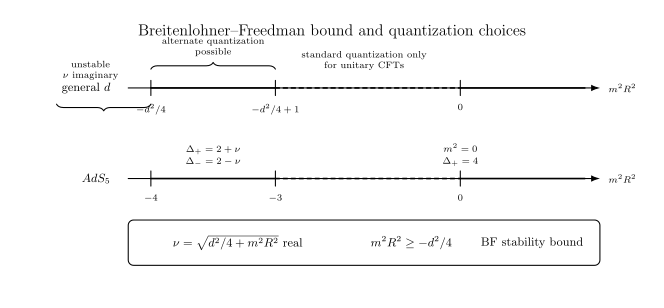
The BF bound is the left edge of the stable region. For , the alternate quantization window is , where both near-boundary falloffs are normalizable.
Alternate quantization
Section titled “Alternate quantization”For most scalar masses, only one of the two falloffs is normalizable. Then the slower falloff must be treated as a source, and the faster falloff is the response. But in the special window
both falloffs are normalizable. Equivalently,
In this range there are two consistent CFTs associated with the same bulk scalar. In ordinary quantization, the operator dimension is
In alternate quantization, the roles of source and response are exchanged, and the operator dimension is
This is consistent with the scalar unitarity bound in dimensions,
because lies above that bound precisely when . For , the alternate window is
and . At the upper endpoint , the alternate dimension reaches the four-dimensional scalar unitarity bound .
This is not merely a curiosity. In holographic RG flows, changing the boundary condition of a scalar in the alternate window is dual to adding a double-trace deformation such as
The radial evolution of the boundary condition then encodes the beta function of the double-trace coupling.
Three-point functions and Witten diagrams
Section titled “Three-point functions and Witten diagrams”The same logic extends beyond two-point functions. Suppose the bulk action contains a cubic interaction
At tree level, the connected three-point function is obtained by inserting three boundary-to-bulk propagators and integrating over the interaction point in AdS:
The integral has the form required by conformal invariance,
where . The powers are kinematic; they are dictated by scale invariance and special conformal invariance. The coefficient is dynamical and is determined by the bulk cubic coupling and by the normalization of the fields.
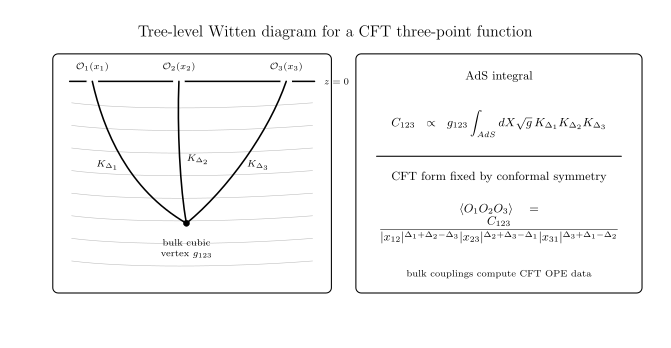
A cubic bulk vertex joined to three boundary points by boundary-to-bulk propagators gives the leading large-, strong-coupling contribution to a CFT three-point function.
For canonically normalized scalar propagators, the AdS integral contains the standard factor
multiplied by the three normalization constants and by the coupling . Divergences in this expression signal contact terms, extremal correlators, or the need to treat boundary terms and field redefinitions with more care.
What is universal and what is not
Section titled “What is universal and what is not”Several parts of the calculation are universal:
- the mass-dimension relation ;
- the power laws and the three-point conformal structure;
- the BF bound ;
- the existence of alternate quantization when .
The numerical coefficients are more delicate. They depend on the normalization of the bulk fields, the normalization of CFT operators, and the holographic counterterm scheme. Scheme dependence only changes contact terms at separated points, but it matters when comparing precise Ward identities, anomalies, and integrated correlators. The next page uses this machinery to compute anomaly coefficients and the central charge of SYM from the five-dimensional gravitational action.
Exercises
Section titled “Exercises”Exercise 1. The indicial equation
Section titled “Exercise 1. The indicial equation”Starting from
ignore the boundary-derivative term near and set . Derive the relation between and .
Solution
With ,
Thus
The leading near-boundary equation is therefore
so
The two roots are .
Exercise 2. Dimensions of a massless scalar in
Section titled “Exercise 2. Dimensions of a massless scalar in AdS5AdS_5AdS5”For and , solve
Which root is used for the ordinary quantization of the dilaton in ?
Solution
The roots are
The ordinary quantization uses
The corresponding source has dimension , as expected for a coupling. In the D3-brane system, the dilaton source changes the Yang—Mills coupling and couples to a dimension-four operator, schematically plus its supersymmetric completion.
Exercise 3. The BF bound in
Section titled “Exercise 3. The BF bound in AdS5AdS_5AdS5”Use
for to find the stability bound. What happens to the two dimensions at the bound?
Solution
Stability requires to be real:
Therefore
At the bound, , so
The two power-law solutions coincide. The second independent near-boundary solution then contains a logarithm.
Exercise 4. The alternate quantization window
Section titled “Exercise 4. The alternate quantization window”Show that the alternate quantization window in is
Then specialize to .
Solution
Alternate quantization is possible when both falloffs are normalizable and the lower dimension does not violate the scalar unitarity bound. This is the window
Squaring gives
Therefore
For this becomes
In this range the ordinary dimension is and the alternate dimension is .
Exercise 5. Scaling of the boundary-to-bulk propagator
Section titled “Exercise 5. Scaling of the boundary-to-bulk propagator”Verify that
has the correct scaling under , , and .
Solution
The numerator scales as
The denominator scales as
Therefore the ratio scales as
Hence
This is appropriate for an object that propagates a boundary insertion of dimension into the bulk.
Exercise 6. Momentum-space nonlocality
Section titled “Exercise 6. Momentum-space nonlocality”For a scalar in with noninteger , the regular solution behaves near the boundary as
Use dimensional analysis in momentum space to show that the nonlocal part of must be proportional to .
Solution
The two coefficients multiply powers whose exponents differ by
Momentum has inverse-length dimension . To convert the source coefficient into the response coefficient, the regular solution can only use the scale , so the nonlocal relation must have the form
When is an integer, the two Bessel-series branches mix and the nonlocal term becomes times the source, up to analytic contact terms.
Exercise 7. Three-point conformal powers
Section titled “Exercise 7. Three-point conformal powers”Assume three scalar primaries have dimensions , , and . Show that the three-point form
has the correct scaling at each point if
Solution
Near , the distances involving are and . The total power associated with is therefore
This is the correct local scaling for a scalar operator of dimension . Similarly,
Under a common scaling , the denominator scales as
which is exactly the expected scaling of a three-point function of scalar primaries.