
Black-Hole Entropy and the Holographic Principle
Why black holes come first
Section titled “Why black holes come first”The fastest way to discover that quantum gravity is not ordinary local quantum field theory with a graviton added is to ask a simple counting question:
For a nongravitational quantum field theory regulated at length scale , the answer looks extensive. A region of volume contains roughly spatial cells in spacetime dimensions, so the number of independent microscopic variables appears to grow like a volume. Gravity changes the question. If we keep adding energy to the same region, the geometry reacts. Once the Schwarzschild radius associated with the energy is comparable to the size of the region, the system is no longer a high-energy gas in a fixed box. It is a black hole.
The entropy of that black hole is
where is the area of the event horizon and is Newton’s constant in spacetime dimensions. Restoring constants,
Throughout this course we usually set . In these units has dimensions of length, so is dimensionless. The formula says that the entropy is measured in Planck-area units, not Planck-volume units.
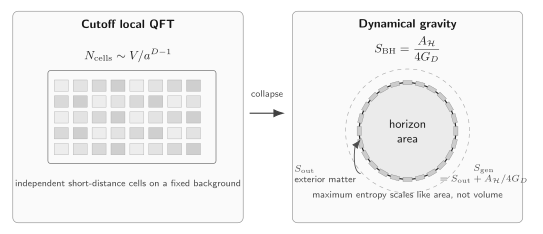
A local cutoff QFT naturally suggests volume counting, . In dynamical gravity, sufficiently energetic states collapse into black holes, whose entropy is . The generalized entropy is the quantity that behaves thermodynamically when matter crosses a horizon.
This area law is the first major clue behind the holographic principle. It says that the largest entropy in a gravitating region scales like the area of its boundary. AdS/CFT will later make this idea precise by giving a nongravitational boundary theory whose Hilbert space and observables define quantum gravity in an asymptotically AdS spacetime.
This page is deliberately more technical than the orientation discussion. The goal is to understand where the factor comes from, what kind of entropy it represents, how it leads to entropy bounds, and what it does and does not prove about holography.
Stationary black holes as thermodynamic systems
Section titled “Stationary black holes as thermodynamic systems”A stationary black hole has a horizon generated by a Killing vector field. For a rotating and charged black hole, the relevant horizon generator is
with possible generalizations when there are several angular momenta. The surface gravity is defined on the horizon by
Roughly, measures the acceleration needed at infinity to hold a unit mass just outside the horizon. More invariantly, it is the normalization of the near-horizon Rindler geometry once the asymptotic time is fixed.
Classically, stationary black holes obey a first law of black-hole mechanics,
Here is the conserved mass, the angular momentum, the charge, the horizon angular velocity, and the electrostatic potential at the horizon. The resemblance to thermodynamics is immediate:
Classically this was only an analogy. The area theorem says that, under suitable energy conditions and cosmic-censorship assumptions, the horizon area cannot decrease. That resembles the second law, but it does not yet identify a physical temperature. A purely classical black hole absorbs and does not emit, so its temperature would seem to be zero. The analogy becomes real only after quantum effects are included.
Temperature from Euclidean smoothness
Section titled “Temperature from Euclidean smoothness”Near any nonextremal horizon, the Euclidean geometry has a universal form. In Lorentzian signature, the metric near the horizon can be written locally as
where is the horizon and are coordinates along a spatial cross-section of the horizon. After Wick rotation , the first two terms become
This is just the flat plane in polar coordinates if the angular coordinate
has period . Therefore the Euclidean time coordinate must have period
In thermal field theory, periodic Euclidean time with period computes a thermal partition function with temperature . Hence the Hawking temperature is
Combining this quantum temperature with the classical first law gives
So the entropy must be
This derivation is powerful because it uses only the universal local form of a nonextremal horizon plus the global normalization of the time coordinate. It also foreshadows a major theme in AdS/CFT: thermal physics of the boundary theory is often encoded in smoothness or horizon boundary conditions in the bulk.
Worked example: the four-dimensional Schwarzschild black hole
Section titled “Worked example: the four-dimensional Schwarzschild black hole”For the four-dimensional Schwarzschild solution,
The horizon radius is
so the horizon area is
The surface gravity is
Therefore
Several important lessons are already visible.
First, the entropy is enormous for a macroscopic black hole. In Planck units, is of order the horizon area.
Second, the temperature decreases as the mass increases. The heat capacity is
The negative sign means that an asymptotically flat Schwarzschild black hole is thermodynamically unstable in the canonical ensemble. If it loses energy by radiation, it becomes hotter, so it radiates faster. This is one reason AdS is so useful: large AdS black holes can have positive heat capacity and can be in stable thermal equilibrium with the boundary theory.
Third, the relation
is radically different from the entropy of ordinary matter in a box. Black holes are not merely heavy particles. They are high-entropy gravitational objects whose thermodynamics is controlled by geometry.
General dimension and the scaling of maximum entropy
Section titled “General dimension and the scaling of maximum entropy”Let denote the bulk spacetime dimension. The neutral asymptotically flat Schwarzschild-Tangherlini black hole has metric
Its mass, temperature, and entropy are
and
Here is the area of the unit -sphere. The numerical constants are useful, but the scaling is the real message:
Now consider a spatial region of radius . A black hole that fits inside the region has , so the largest black-hole entropy scales as
This is the central area-scaling result.
Compare it with a cutoff local QFT in the same spatial region. If the cutoff length is , volume counting gives
where is the number of degrees of freedom per cell. If one naively sets to the Planck length, the cutoff QFT entropy grows like , which exceeds the black-hole entropy for sufficiently large . This contradiction is not a minor regularization issue. It says that a fundamental quantum theory of gravity cannot assign independent microscopic degrees of freedom to all Planck-volume cells of a large region.
Local bulk fields can still exist. They exist as effective variables in a low-energy code subspace, not as the fundamental independent variables of the full Hilbert space.
The generalized second law
Section titled “The generalized second law”The black-hole entropy formula also repairs a tension with the ordinary second law. Suppose an object with entropy falls into a black hole. From the exterior, the object disappears behind the horizon. If one counts only ordinary matter entropy outside the black hole, entropy can decrease.
The gravitational replacement is the generalized entropy
The generalized second law states that
This is a much deeper statement than the area theorem. The area theorem is classical and assumes appropriate energy conditions. The generalized second law is semiclassical: matter entropy outside the horizon can decrease, but the horizon area changes in just the way needed to preserve the generalized entropy.
In modern language, is also the prototype of the generalized entropy used in quantum extremal surfaces and island formulas:
Here is a codimension-two surface and is the entropy of bulk quantum fields in the corresponding region. The dots include counterterms and higher-derivative corrections. This will become central in the entanglement and black-hole-information modules.
The Bekenstein bound and the route to area scaling
Section titled “The Bekenstein bound and the route to area scaling”The Bekenstein bound is a bound on the entropy of a weakly gravitating isolated system with total energy and radius :
The bound is motivated by the generalized second law. If one lowers an object toward a black hole and drops it in, the object disappears from the exterior. The horizon entropy must increase by at least the object’s entropy. A careful version of this thought experiment leads to a bound of the form above, in units .
The Bekenstein bound is not itself the same as the holographic entropy bound. But together with gravitational collapse it points toward area scaling. In spacetime dimensions, avoiding black-hole formation in a region of radius requires roughly
Substituting this into gives
So a weak-gravity entropy bound plus the collapse threshold already suggests that the maximum entropy in a gravitating region scales like boundary area.
The factor in the black-hole formula is more precise than this scaling argument. Scaling arguments explain why area appears. The full Bekenstein-Hawking formula fixes the normalization.
Covariant entropy bounds
Section titled “Covariant entropy bounds”A naive spacelike entropy bound,
is too crude in general spacetimes. Cosmological geometries and strongly time-dependent situations can make the words “inside a region” ambiguous. Gravity does not naturally provide a preferred global spatial slice.
The covariant refinement uses light-sheets. Start with a codimension-two spatial surface of area . Shoot null geodesics orthogonally away from in a direction for which the expansion is nonpositive. The resulting null hypersurface is a light-sheet , at least until caustics or singularities occur. The covariant entropy bound states schematically that
The details require care: one must define the entropy crossing the light-sheet, specify the regime of validity, and handle quantum corrections. But the conceptual improvement is important. The bound is not tied to a preferred spatial volume. It uses causal geometry.
For AdS/CFT, the covariant viewpoint is natural. The boundary theory is not merely associated with a spatial box; it controls the causal and asymptotic structure of the bulk. Later, HRT surfaces, entanglement wedges, and quantum extremal surfaces will provide more precise versions of this causal-information relation.
What entropy means microscopically
Section titled “What entropy means microscopically”Entropy counts states:
Therefore the Bekenstein-Hawking formula demands
This is a staggering statement. A classical solution has a continuous geometry, but the entropy says that a black hole with fixed macroscopic charges corresponds to an exponentially large number of quantum microstates.
There are three increasingly precise layers of interpretation.
First, in semiclassical gravity, is a thermodynamic entropy. It is inferred from temperature, the first law, and Euclidean path integrals. This is analogous to knowing the entropy of a gas before knowing the atoms.
Second, in string theory, certain supersymmetric black holes can be counted microscopically. The Strominger-Vafa calculation famously matched the Bekenstein-Hawking entropy of a class of five-dimensional extremal black holes by counting D-brane bound states. This did not solve every black-hole microstate problem, but it proved that the area law can arise from honest quantum states in string theory.
Third, in AdS/CFT, black-hole microstates are states of the boundary CFT. In this setting the nonperturbative Hilbert space is supplied by a nongravitational quantum theory. The bulk black hole is a thermodynamic phase or ensemble description of many CFT states.
This last point is the key reason AdS/CFT is more than an entropy bound. An entropy bound says how many states are allowed. A dual CFT gives the states, the Hamiltonian, the observables, and the time evolution.
Corrections to the area law
Section titled “Corrections to the area law”The formula
is the leading entropy for Einstein gravity in the semiclassical limit. In AdS/CFT language, it is usually the leading large-, strong-coupling answer.
There are two important classes of corrections.
The first class consists of quantum corrections in the bulk. Schematically,
These terms are suppressed by powers of relative to the leading area term when the black hole is large in Planck units. In the boundary theory, they correspond to effects.
The second class consists of higher-derivative corrections to the gravitational action. In string theory, these are often corrections. For a general higher-derivative theory, black-hole entropy is not simply area divided by ; it is replaced by a Wald-like entropy, with further refinements for time-dependent or entanglement settings. In the boundary theory, these corrections correspond to finite-coupling effects and changes in CFT data.
The moral is not that is unreliable. The moral is that one should always ask which approximation makes it the correct leading answer.
How the area law appears in AdS/CFT
Section titled “How the area law appears in AdS/CFT”For AdS/CFT, the effective number of CFT degrees of freedom is controlled by
where is the AdS radius. In the canonical AdS example,
matching the fact that a large- matrix gauge theory has degrees of freedom.
A planar AdS black brane has metric
Its temperature is
and its entropy density is horizon area per boundary spatial volume divided by :
Using , this becomes
This is exactly the scaling expected for a thermal CFT with effective degrees of freedom. The gravitational entropy is an area, but because the horizon extends along the boundary directions, it becomes a boundary entropy density. In AdS/CFT, the black-hole area law is not an isolated thermodynamic curiosity; it is the entropy of the dual CFT thermal state in the regime where the bulk is well approximated by classical gravity.
What the holographic principle says, and what it does not say
Section titled “What the holographic principle says, and what it does not say”A careful version of the holographic principle says:
This is a statement about fundamental degrees of freedom, not about the usefulness of local bulk fields. Low-energy observers can use local quantum fields in the bulk, just as fluid dynamicists can use density and velocity fields without treating them as microscopic variables.
The principle does not say that the world is literally a two-dimensional optical image. It does not by itself specify the microscopic Hilbert space. It does not give a Hamiltonian. It does not tell us which boundary variables reconstruct which bulk observables. Those are the things a concrete duality must provide.
AdS/CFT provides them in a special but extraordinarily rich class of spacetimes. It replaces the vague sentence “the bulk is encoded on a boundary” by a precise computational framework:
The black-hole area law explains why one should have expected something holographic. The CFT dictionary explains how the encoding works.
Common mistakes
Section titled “Common mistakes”Mistake 1: treating the area law as ordinary entanglement entropy only
Section titled “Mistake 1: treating the area law as ordinary entanglement entropy only”Quantum fields in a fixed background have entanglement entropy across a surface, and that entropy is UV divergent with a leading area divergence. This is related to black-hole entropy, but it is not the whole story. Black-hole entropy is finite after quantum gravity supplies the correct cutoff and renormalizes . It counts gravitational states, not merely the entanglement of a fixed set of nongravitating fields.
Mistake 2: saying that every region has entropy
Section titled “Mistake 2: saying that every region has entropy A/4GDA/4G_DA/4GD”The area law gives the entropy of a horizon, or the maximum entropy suggested by gravitational collapse. A low-energy state in a large region can have much less entropy than . Most semiclassical bulk states are nowhere near saturating the bound.
Mistake 3: forgetting the regime of validity
Section titled “Mistake 3: forgetting the regime of validity”The simple formula assumes two-derivative Einstein gravity and a semiclassical horizon. Higher-derivative terms, quantum loops, stringy corrections, and small black holes can all modify the answer.
Mistake 4: identifying the horizon with a literal storage surface
Section titled “Mistake 4: identifying the horizon with a literal storage surface”It is often useful to say that black-hole information is “stored on the horizon.” But in AdS/CFT the exact degrees of freedom live in the boundary CFT, not on a stretched horizon as independent fundamental variables. The horizon is a powerful emergent thermodynamic surface in the bulk description.
Mistake 5: confusing an entropy bound with a duality
Section titled “Mistake 5: confusing an entropy bound with a duality”An entropy bound constrains the number of states. A duality identifies the states and all observables. This is why black-hole thermodynamics motivates holography but does not replace AdS/CFT.
Exercises
Section titled “Exercises”Exercise 1: Euclidean regularity and Hawking temperature
Section titled “Exercise 1: Euclidean regularity and Hawking temperature”Suppose the near-horizon Euclidean metric of a nonextremal black hole is
Show that smoothness at requires
and hence .
Solution
Focus on the part of the metric:
Define
Then
which is the flat plane in polar coordinates if and only if has period . Otherwise the origin has a conical singularity. Therefore
so
In the Euclidean thermal path integral, the period of Euclidean time is . Hence
Exercise 2: Schwarzschild entropy and heat capacity
Section titled “Exercise 2: Schwarzschild entropy and heat capacity”For the four-dimensional Schwarzschild black hole,
Use
to compute , , and the heat capacity .
Solution
First compute
At ,
Therefore
The horizon area is
Thus
Finally,
implies
Hence
The heat capacity is negative.
Exercise 3: Area scaling in spacetime dimensions
Section titled “Exercise 3: Area scaling in DDD spacetime dimensions”In spacetime dimensions, a neutral black hole of horizon radius has
Show that the maximum entropy that can fit inside a region of radius scales like the area of the boundary of that region.
Solution
A black hole that fits inside a region of radius must have
The entropy of such a black hole is therefore bounded parametrically by
The boundary of a spatial ball in spacetime dimensions is a -sphere, whose area scales as
Thus
Keeping the exact Bekenstein-Hawking normalization gives for a horizon.
Exercise 4: From the Bekenstein bound to an area bound
Section titled “Exercise 4: From the Bekenstein bound to an area bound”Assume the Bekenstein bound
for a weakly gravitating system of energy and radius . Also assume that avoiding gravitational collapse requires
Show that these assumptions imply an area-scaling entropy bound.
Solution
Starting from the Bekenstein bound,
The condition for avoiding collapse gives
Substitute this into the Bekenstein bound:
Since the area of the boundary of the region scales as
we obtain
up to numerical constants. This reproduces the holographic scaling.
Exercise 5: Entropy density of a planar AdS black brane
Section titled “Exercise 5: Entropy density of a planar AdS black brane”Consider the planar AdS black brane
Show that its entropy density scales as
Solution
At the horizon , the induced spatial metric along the boundary spatial directions is
Therefore the horizon area per unit boundary coordinate volume is
The Bekenstein-Hawking entropy density is
The Hawking temperature is
so
Substituting this into the entropy density gives
up to the numerical factor . This matches the scaling of a thermal CFT with effective number of degrees of freedom
Exercise 6: What an entropy bound does not tell you
Section titled “Exercise 6: What an entropy bound does not tell you”Give three pieces of information that are needed for a complete quantum theory of gravity but are not supplied by the statement
Solution
Possible answers include:
- The microscopic Hilbert space. The bound restricts how many states may exist, but it does not identify the states.
- The Hamiltonian. A bound does not specify time evolution.
- The observable dictionary. It does not tell us which boundary or microscopic variables compute bulk fields, Wilson loops, stress tensors, or entanglement entropies.
- The emergence of locality. It does not explain when a local bulk effective field theory is valid.
- The approximation scheme. It does not tell us which corrections are controlled by , , , or .
AdS/CFT supplies these missing ingredients in special asymptotically AdS settings by identifying the quantum-gravity theory with a nongravitational CFT.
Further reading
Section titled “Further reading”- Jacob D. Bekenstein, “Black Holes and Entropy”, Physical Review D 7, 2333 (1973). The foundational argument that black holes carry entropy.
- Stephen W. Hawking, “Particle Creation by Black Holes”, Communications in Mathematical Physics 43, 199 (1975). The original derivation of Hawking radiation.
- Gerard ‘t Hooft, “Dimensional Reduction in Quantum Gravity”, arXiv:gr-qc/9310026. The classic dimensional-reduction argument for quantum gravity.
- Leonard Susskind, “The World as a Hologram”, arXiv:hep-th/9409089. The influential formulation of the holographic principle in string-theoretic language.
- Raphael Bousso, “The Holographic Principle”, Reviews of Modern Physics 74, 825 (2002). A careful review of entropy bounds and the covariant formulation.
- Andrew Strominger and Cumrun Vafa, “Microscopic Origin of the Bekenstein-Hawking Entropy”, Physics Letters B 379, 99 (1996). A landmark string-theory microstate count for extremal black holes.