
6. Metallic Transport without Quasiparticles
A metal conducts because it has mobile charge. That sentence is true, but in strongly coupled quantum matter it is far too vague to be useful. A good transport theory must say what carries the current, what relaxes it, which quantities are conserved, and which measured conductivity is actually finite.
In an ordinary weakly interacting metal, the answer is organized by quasiparticles. Long-lived electrons or holes move, scatter, and relax. Boltzmann theory then gives a kinetic equation for their distribution function. This is an enormously successful framework, but it is not the only possible one. Holographic quantum matter gives controlled examples of conducting states in which the low-energy dynamics is not organized by long-lived quasiparticles. The appropriate degrees of freedom are instead conserved densities, hydrodynamic modes, horizon response, and quasinormal modes.
This page is about the clean conceptual problem that appears as soon as finite density is combined with translations:
In a translationally invariant finite-density system, the electric current usually overlaps with the conserved momentum. Therefore the DC electrical conductivity is infinite, even when the system is strongly interacting and locally equilibrates rapidly.
This is not a technical nuisance. It is the first rule of metallic transport. A horizon may be dissipative, and the field theory may have no quasiparticles, but if translations are exact, total momentum cannot decay. Since a finite charge density lets momentum drag charge current along with it, the conductivity contains a ballistic contribution. To get a finite DC conductivity, one must either measure an incoherent current that does not overlap with momentum, or introduce a mechanism that relaxes momentum.
The goal of this page is to separate four ideas that are often mixed together:
- local equilibration without quasiparticles,
- momentum conservation and the Drude weight,
- incoherent transport independent of momentum drag,
- momentum relaxation from weak or strong translation breaking.
The next pages apply these ideas to holographic lattices, strange metals, fermionic response, and magnetic transport. Here we build the clean transport grammar.
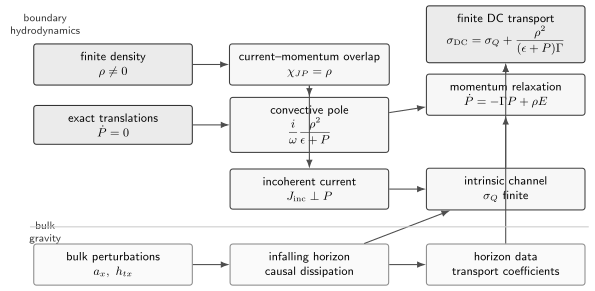
Metallic transport at finite density separates into a momentum-drag channel and an incoherent channel. Exact translations give a Drude weight because overlaps with . The incoherent current is orthogonal to momentum and can have a finite intrinsic conductivity . Momentum relaxation broadens the Drude pole and gives a finite DC conductivity.
What counts as a metal here?
Section titled “What counts as a metal here?”For this section, a metal means a compressible state with a conserved global charge and nonzero charge density. The minimal thermodynamic data are
where is temperature, is chemical potential, is entropy density, is charge density, is energy density, and is pressure. The state is compressible when the susceptibility
is nonzero and finite. A compressible state can respond continuously to changes in chemical potential.
This definition deliberately avoids saying that a metal must have a Fermi surface. A Fermi liquid is one kind of metal. A holographic charged black brane is another kind of compressible state. Its charge density is encoded by radial electric flux, its entropy is encoded by horizon area, and its response functions are obtained from bulk perturbations with infalling horizon boundary conditions. But it does not need a quasiparticle distribution function.
A useful diagnostic is not whether the system conducts at all, but how current relaxes. In a weakly disordered Fermi liquid, current relaxes because quasiparticles scatter off impurities, phonons, or other quasiparticles in ways that degrade current. In a strongly coupled holographic metal, the local equilibration time may be of order
in units with . This is very short compared with the lifetime of quasiparticles in a Fermi liquid, where the quasiparticle lifetime often grows parametrically as . But short local equilibration is not the same as finite DC conductivity. Conservation laws still dominate transport.
Linear response and the transport matrix
Section titled “Linear response and the transport matrix”Consider a homogeneous isotropic state in spatial dimensions. The boundary theory has a conserved current and stress tensor . The heat current is
At linear order, electric and heat currents respond to an electric field and a temperature gradient. A common convention is
Here:
- is the electric conductivity,
- is the thermoelectric conductivity,
- is the thermal conductivity at zero electric field.
The experimentally common open-circuit thermal conductivity is not but
because open circuit means , not .
The retarded Green’s function of two operators and is
Conductivities are low-frequency limits of retarded correlators. For example, up to contact-term conventions,
Different communities place contact terms and diamagnetic terms in slightly different ways. The robust physical information is in the pole structure, the spectral weight, the real part after the proper subtractions, and the order of limits.
The DC conductivity is
but this expression is meaningful only after asking whether the homogeneous current has an exactly conserved overlap. If it does, contains a zero-frequency singularity.
The momentum bottleneck
Section titled “The momentum bottleneck”At finite charge density, electric current and momentum are not independent. A boost of a charged fluid carries charge. Therefore the current has overlap with the conserved total momentum. In a relativistic fluid, the momentum density is
The static susceptibility between the current and momentum is
while
The enthalpy density plays the role of inertia. If translations are exact, is conserved. Since overlaps with , part of the current cannot decay. This gives a zero-frequency Drude weight.
In a clean relativistic finite-density fluid, the electrical conductivity takes the schematic form
Equivalently,
where is a finite intrinsic conductivity. The delta function is not a quasiparticle peak. It is forced by conservation of momentum.
This is the momentum bottleneck. Strong interactions may destroy quasiparticles and rapidly equilibrate local disturbances, but exact translations still prevent total momentum from decaying. The current rides on the conserved momentum.
This fact is especially important in holography. A black brane horizon is dissipative: infalling boundary conditions absorb perturbations. But in a translationally invariant charged black brane, the boundary DC electrical conductivity is still infinite. The horizon provides local relaxation, not momentum relaxation.
Hydrodynamic derivation of the Drude weight
Section titled “Hydrodynamic derivation of the Drude weight”The cleanest derivation uses hydrodynamics. In the local rest frame of a relativistic charged fluid, the constitutive relations to first order in gradients are
and
The velocity is the hydrodynamic variable associated with momentum density. The coefficient is the intrinsic conductivity of the part of the current that is not due to dragging the whole fluid.
In a spatially homogeneous electric field and with no temperature or chemical-potential gradients, momentum conservation gives
Fourier transforming with time dependence gives
so
Substituting into the current,
yields
This formula says something very precise. In a clean finite-density fluid, electric current has two parts:
The drag part is the convective current . It is tied to momentum. The incoherent part is the dissipative current controlled by .
The incoherent current
Section titled “The incoherent current”A natural way to isolate finite transport in a clean finite-density metal is to construct a current with no overlap with momentum. In a relativistic system, define
Then
The incoherent current is not dragged by uniform motion of the fluid. It can decay even when translations are exact. The corresponding incoherent conductivity is the intrinsic finite transport coefficient. In simple relativistic hydrodynamics it is .
The word incoherent can be misleading. It does not mean random or uncontrolled. It means that the current is not protected by momentum conservation. It is the current left after projecting out the long-lived momentum channel.
At particle-hole symmetry, , the electric current does not overlap with momentum:
Then a clean quantum critical system can have a finite DC electric conductivity even with exact translations:
At finite density, by contrast, and the same system has an infinite homogeneous DC electrical conductivity unless momentum is relaxed.
Weak momentum relaxation
Section titled “Weak momentum relaxation”Real materials are not exactly translationally invariant. Momentum relaxes through impurities, lattice potentials, phonons, umklapp processes, disorder, boundaries, or external reservoirs. In a hydrodynamic description, weak momentum relaxation can be modeled by
where is the momentum relaxation rate. The homogeneous velocity then obeys
The conductivity becomes
This is the hydrodynamic Drude formula. The DC value is
If is small and , the second term dominates. The resistivity is approximately
This result is simple but powerful. In a coherent metal, the temperature dependence of resistivity is mostly the temperature dependence of the momentum relaxation rate , corrected by thermodynamic factors. If , then can follow. But if is not linear in , linear resistivity does not magically appear just because a black brane exists.
The thermoelectric coefficients in this simple relativistic hydrodynamic regime are, with the convention used above,
and
The signs of the pieces depend on the convention for the thermal force. The pole residues are more robust: they are fixed by the overlap of electric and heat currents with momentum.
Memory matrix viewpoint
Section titled “Memory matrix viewpoint”Hydrodynamics gives an intuitive derivation when momentum is the only slow nonconserved mode. The memory matrix formalism expresses the same idea more generally.
Let be a long-lived operator with susceptibility and relaxation rate . If overlaps with , the conductivity contains
For a relativistic finite-density fluid,
so this reduces to the hydrodynamic Drude expression. The memory matrix perspective is useful because it cleanly separates:
- the overlap factor ,
- the slow relaxation rate ,
- the intrinsic or incoherent conductivity .
It also clarifies why microscopic scattering rates are not automatically transport rates. A system may locally equilibrate rapidly, but if the current mostly overlaps with a nearly conserved momentum, the current decays slowly. Transport is controlled by the slowest relevant mode, not by the fastest local equilibration process.
In weak translation breaking, the memory matrix gives a controlled expression for in terms of the operator that breaks translations. Suppose the Hamiltonian is perturbed by
where is weak and spatially dependent. Then momentum is no longer conserved. Schematically,
The relaxation rate is controlled by the low-frequency spectral weight of the operator that breaks translations:
This formula is schematic because factors of volume, disorder averaging, tensor indices, and wavevector sums depend on the precise breaking pattern. But the message is exact: momentum relaxation is determined by the spectral weight of the translation-breaking perturbation.
Coherent and incoherent metals
Section titled “Coherent and incoherent metals”A useful classification is based on the relative size of the momentum relaxation rate and the local equilibration rate.
A coherent metal has a long-lived momentum mode:
or more generally is much smaller than the microscopic equilibration rate. The optical conductivity then has a narrow Drude peak:
A strongly incoherent metal has no parametrically long-lived momentum channel in the current response. This can happen because momentum relaxes strongly, because the relevant current has little overlap with momentum, or because the experimentally measured channel is dominated by intrinsic transport. In such a regime,
up to model-dependent factors.
This classification is not the same as quasiparticle versus non-quasiparticle. A Fermi liquid with weak disorder can be coherent. A holographic charged black brane with weak momentum relaxation can also be coherent, even though it has no quasiparticles. Coherence here means a long-lived transport pole, not a long-lived quasiparticle.
Likewise, an incoherent metal need not be mysterious. It may simply be a metal whose current is not controlled by a slowly relaxing momentum mode. The challenge is to compute and the relevant relaxation mechanisms in a controlled way.
Holographic translation
Section titled “Holographic translation”In holography, the basic finite-density background is a charged black brane. The boundary charge density is radial electric flux. The temperature is horizon temperature. Local equilibration is governed by quasinormal modes. Transport coefficients are obtained by solving linearized bulk equations with infalling boundary conditions at the horizon.
For clean charged black branes, homogeneous electric perturbations mix the bulk gauge field with metric perturbations. This mixing is the bulk avatar of the current-momentum overlap. The boundary current is not just a Maxwell fluctuation; it is coupled to a gravitational perturbation because the electric field accelerates the charged plasma.
The clean DC conductivity is infinite because the bulk solution corresponding to a steady electric field cannot be regular without accounting for momentum flow. The horizon can absorb energy, but the boundary system with exact translations cannot dissipate total momentum. A finite horizon conductivity is not by itself the same as a finite boundary DC conductivity.
There are two major holographic routes to finite DC transport:
- Construct an incoherent current or combination of fields that decouples from momentum.
- Break translations explicitly or spontaneously so that momentum relaxes.
The first route isolates . The second route produces a finite for the physical electric current. Translation breaking can be implemented by spatial lattices, Q-lattices, axion fields, disorder, massive gravity-like models, or boundary conditions that impose a periodic source. Those are the subject of the next page.
A worked example: clean versus weakly dirty charged fluid
Section titled “A worked example: clean versus weakly dirty charged fluid”Consider a relativistic charged fluid in spatial dimensions at temperature and chemical potential . Assume isotropy and a single conserved charge. The thermodynamic identity is
First take exact translations. A homogeneous electric field obeys
The current is
Therefore
The real part has a delta function:
Now add weak momentum relaxation:
Then
and
At zero frequency,
This example teaches three lessons.
First, finite density and exact translations produce infinite DC conductivity.
Second, strong interactions enter through , thermodynamics, and possible values of , but they do not remove the conservation-law pole.
Third, a finite DC conductivity is not a proof of quasiparticle scattering. It can arise hydrodynamically from slow momentum relaxation in a system without quasiparticles.
What makes this non-quasiparticle transport?
Section titled “What makes this non-quasiparticle transport?”The formulas above look Drude-like, so it is tempting to interpret them in terms of particles with a scattering time. That is not necessary.
The hydrodynamic pole arises because momentum is slow. It does not require quasiparticles. Hydrodynamics is an effective theory of conserved quantities. It is valid when the system has locally equilibrated, regardless of whether local equilibrium was reached by particle collisions, horizon absorption, or some strongly coupled process with no quasiparticle interpretation.
The intrinsic conductivity is even more sharply non-quasiparticle in holographic examples. It is computed from a regular horizon response problem. In many simple Einstein-Maxwell models at zero density or in the incoherent channel, the result can be read from horizon data. The horizon acts like a dissipative membrane. The absence of a quasiparticle distribution function is not a weakness; it is precisely why holography is useful.
Still, the transport formulas are constrained by ordinary field theory principles: conservation laws, Ward identities, thermodynamics, Onsager relations, positivity of entropy production, and analyticity of retarded correlators. Holography does not replace these constraints. It supplies a controlled class of strongly coupled systems that obey them.
Relation to strange metals
Section titled “Relation to strange metals”A strange metal is often characterized by resistivity approximately linear in temperature,
and by the absence of well-defined quasiparticles. Holography gives many mechanisms that can produce linear or nearly linear resistivity, but the mechanism must always be specified.
In a coherent regime,
so linear resistivity usually means a linear-in- momentum relaxation rate, possibly dressed by thermodynamics.
In an incoherent regime,
so the temperature dependence is controlled by intrinsic critical transport rather than by momentum drag. In scaling geometries, may follow a power law determined by the IR critical exponents and gauge-field couplings.
A slogan like “black holes give linear resistivity” is therefore too crude. Holography gives a framework in which transport without quasiparticles can be computed. The result depends on the IR geometry, the current, the translation-breaking mechanism, and the way charge is distributed between horizon and matter sectors.
Common pitfalls
Section titled “Common pitfalls”| Pitfall | Correction |
|---|---|
| “A dissipative horizon means finite DC conductivity.” | Not at finite density with exact translations. Momentum conservation gives a zero-frequency singularity. |
| “A Drude peak proves quasiparticles.” | No. A Drude peak can be hydrodynamic, coming from slow momentum relaxation. |
| “No quasiparticles means no transport theory.” | Hydrodynamics and memory matrix methods are transport theories based on conservation laws and slow modes. |
| “ is the full conductivity.” | Only at zero density, in an incoherent channel, or when momentum drag is absent or subleading. |
| “Linear resistivity is universal in holography.” | It is model-dependent. One must identify whether dependence comes from , , thermodynamics, or IR scaling. |
| “Momentum relaxation and local equilibration are the same.” | They are different. Local equilibration can be fast while momentum relaxation is slow. |
| “The heat conductivity is always .” | Experiments often measure the open-circuit . |
Summary
Section titled “Summary”Metallic transport without quasiparticles is not transport without structure. Its structure is built from conservation laws, susceptibilities, hydrodynamic modes, and intrinsic dissipative coefficients.
The central formula is
It should be read as a decomposition:
When , the second term is a zero-frequency singularity. When is small, it is a narrow Drude peak. When momentum is strongly relaxed or the current is orthogonal to momentum, the intrinsic conductivity becomes central.
Holography is powerful because it gives controlled strongly coupled examples in which , quasinormal modes, thermodynamics, and momentum relaxation can be computed without quasiparticles. But the interpretation must respect conservation laws. The horizon dissipates; translations protect momentum; finite density couples current to momentum. The whole subject lives in the tension between those three facts.
Exercises
Section titled “Exercises”Exercise 1. Current-momentum susceptibility
Section titled “Exercise 1. Current-momentum susceptibility”Use relativistic hydrodynamics to show that the static susceptibility between electric current and momentum is .
Solution
A uniform boost with small velocity changes the momentum density and current by
The momentum susceptibility is therefore
while the current response to the same velocity is
In the static susceptibility language, momentum is the generator of boosts, and the overlap of current with momentum is fixed by the charge density:
This is the hydrodynamic origin of the current-momentum overlap.
Exercise 2. Drude pole from momentum relaxation
Section titled “Exercise 2. Drude pole from momentum relaxation”Starting from
and
derive and .
Solution
Solve the velocity equation:
Substitute into the current:
Therefore
At ,
If , the DC conductivity diverges.
Exercise 3. Incoherent current
Section titled “Exercise 3. Incoherent current”Define
Choose so that has no static overlap with momentum.
Solution
We require
Using ,
For a relativistic finite-density fluid,
Thus
so
The incoherent current is therefore
Exercise 4. Why zero density is special
Section titled “Exercise 4. Why zero density is special”Explain why a clean relativistic quantum critical system at can have finite DC electrical conductivity even when translations are exact.
Solution
At ,
The electric current has no static overlap with the conserved momentum. Therefore exact momentum conservation does not force a zero-frequency delta function in the electrical conductivity. The current can decay through intrinsic many-body processes while momentum remains conserved.
In hydrodynamic language,
Setting removes the pole:
Thus a clean particle-hole-symmetric quantum critical system can have finite DC conductivity.
Exercise 5. Open-circuit thermal conductivity
Section titled “Exercise 5. Open-circuit thermal conductivity”Given the transport matrix
where , derive the open-circuit thermal conductivity defined by at .
Solution
Open circuit means , so
Thus
Substitute into the heat current:
Therefore
The open-circuit thermal conductivity is
Further reading
Section titled “Further reading”For a broad review of holographic quantum matter, including metallic transport, hydrodynamics, memory matrix methods, momentum relaxation, magnetotransport, symmetry-broken phases, and experimental connections, see Hartnoll, Lucas, and Sachdev, Holographic quantum matter.
For a condensed-matter-centered account of holographic transport, finite density, strange metals, fermions, superconductivity, and translation breaking, see Zaanen, Liu, Sun, and Schalm, Holographic Duality in Condensed Matter Physics.
For a textbook route through finite temperature, density, linear response, hydrodynamics, transport coefficients, and condensed-matter applications of gauge/gravity duality, see Ammon and Erdmenger, Gauge/Gravity Duality: Foundations and Applications.