
12. Holographic Superconductors and Superfluids
A holographic superconductor is the simplest setting in which finite-density holography produces an ordered phase. The basic mechanism is beautifully economical. Start with a charged black brane. Add a charged bulk field. At sufficiently low temperature, the electric field near the horizon can make the charged field effectively tachyonic in the infrared. The black brane then grows hair. In the boundary theory, that hair is a source-free expectation value of a charged operator.
The name “holographic superconductor” is historically standard, but one must be careful. In the most common bottom-up models, the boundary is a global symmetry. Spontaneously breaking it gives a superfluid. To obtain a literal superconductor, the boundary must be weakly gauged, or equivalently coupled to an external dynamical electromagnetic field. Many papers still say “superconductor” because the optical conductivity and condensate structure mimic superconducting phenomenology, but the distinction matters conceptually.
This page explains the mechanism in a way that is independent of a particular model. The core lesson is not that holography derives BCS theory. It does not. The core lesson is that black branes can undergo symmetry-breaking instabilities, and that the resulting hairy geometries give controlled large- examples of strongly coupled ordered matter.
Where this page fits
Section titled “Where this page fits”The preceding pages developed finite density, charged black branes, metallic transport, holographic fermions, backreacted charge carriers, and probe flavor. This page adds a new possibility: the normal finite-density state may be unstable to an ordered phase.
The logic is:
- finite density creates a charged horizon or charged probe sector;
- the near-horizon region controls low-energy response;
- charged operators can become unstable in that infrared region;
- the stable low-temperature solution can contain bulk hair;
- source-free bulk hair is interpreted as spontaneous symmetry breaking in the boundary theory.
The next page will discuss spatially modulated and competing orders. Here we focus on homogeneous charged condensates.
Throughout the page, denotes the boundary spacetime dimension and the bulk is asymptotically . The boundary has spatial dimensions.
The physical question
Section titled “The physical question”A conventional weak-coupling superconductor is organized around quasiparticles, Cooper pairing, and a Fermi surface instability. Holographic superconductors ask a different question:
Can a strongly coupled finite-density large- system develop charged order even when quasiparticles are not the organizing degrees of freedom?
The answer is yes. The minimal holographic mechanism only needs:
- a boundary global current ;
- a bulk gauge field dual to that current;
- a charged operator in the boundary theory;
- a charged bulk field dual to ;
- a finite chemical potential ;
- a black brane horizon.
The normal phase is a charged black brane with . The condensed phase is a hairy black brane with . The boundary order parameter is the coefficient of the normalizable part of the scalar near the AdS boundary, with the source set to zero.
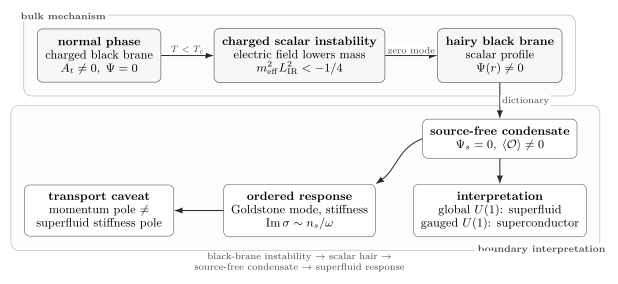
The basic mechanism. A charged black brane with becomes unstable when the charged scalar violates the infrared stability condition, often in an emergent throat. Below , the stable solution carries scalar hair with zero source and nonzero . The ordered phase has a superfluid response, visible through and the corresponding delta function in .
The minimal Abelian-Higgs model in AdS
Section titled “The minimal Abelian-Higgs model in AdS”The standard bottom-up model is Einstein-Maxwell theory coupled to a charged scalar. A convenient action is
where
The dictionary is:
| Bulk object | Boundary interpretation |
|---|---|
| conserved current | |
| boundary value of | chemical potential |
| radial electric flux | charge density |
| charged scalar | charged operator |
| source-free scalar profile | spontaneous condensate |
| hairy black brane | ordered finite-density phase |
The simplest ansatz for a homogeneous, isotropic, static phase is
A gauge transformation can remove the phase of in a homogeneous equilibrium solution, so one often takes real. This does not mean that the broken phase has no phase mode. It means that the bulk gauge redundancy has been used to choose a convenient representative. The boundary broken global symmetry still has a Goldstone mode in the appropriate response functions.
There are two common regimes.
The probe limit takes the matter sector to be weakly backreacting on the geometry. Operationally this often means taking large while keeping suitable combinations fixed. The metric can be fixed to an AdS-Schwarzschild black brane, while and are solved on that background. This is technically simple and captures the onset of condensation, but it hides some thermodynamic and transport subtleties because the charge sector does not fully backreact.
The backreacted limit solves the coupled Einstein-Maxwell-scalar equations. This is necessary for reliable thermodynamics, charge accounting, entropy, and the interplay between condensate and momentum transport.
Boundary conditions and the order parameter
Section titled “Boundary conditions and the order parameter”Near the boundary of , a scalar of mass behaves as
where is a near-boundary Fefferman-Graham coordinate and
In standard quantization, is the source for and determines , up to a normalization convention and possible local terms. A spontaneous condensate means
This point is worth emphasizing. A bulk scalar profile is not automatically an order parameter. It becomes an order parameter only after the near-boundary source is set to zero and the normalizable coefficient remains nonzero.
For the gauge field, the near-boundary expansion is schematically
for , with logarithmic or convention-dependent modifications in special dimensions. The leading coefficient is the chemical potential, and the subleading coefficient determines the charge density. In the grand-canonical ensemble, is fixed. In the canonical ensemble, is fixed.
At a regular black brane horizon, the one-form must be regular. In a gauge where degenerates smoothly in Euclidean signature, this usually means
Thus the chemical potential is not simply “the value of at the horizon.” It is the gauge-invariant potential difference between boundary and horizon,
in a gauge with .
Why the normal phase becomes unstable
Section titled “Why the normal phase becomes unstable”The normal phase has . The question is whether a small charged scalar fluctuation around this phase grows.
The charged scalar equation contains the term
For a static homogeneous fluctuation in a background with , the gauge field shifts the effective mass. Schematically,
Outside a black brane horizon, . Therefore the electric potential lowers the effective mass. At sufficiently low temperature, the near-horizon region may become unstable even when the scalar is stable in the asymptotic region.
The cleanest version occurs near an extremal Reissner-Nordstrom-AdS black brane. The near-horizon geometry often contains an throat. A scalar can be stable with respect to the ultraviolet Breitenlohner-Freedman bound,
while violating the infrared bound,
This is the most transparent route to holographic superconductivity. The normal state is stable as a UV field theory state, but its low-energy charged horizon is unstable to charged scalar hair.
There are other possible instabilities. Some occur because of Chern-Simons couplings, non-Abelian gauge fields, pseudoscalars, neutral scalars, or spatially modulated modes. Those will become important when discussing competing orders. The basic superconducting instability, however, is already visible in the minimal charged scalar model.
The critical temperature as an eigenvalue problem
Section titled “The critical temperature as an eigenvalue problem”At the onset of the phase transition, is infinitesimal. Therefore one can solve the scalar equation linearly on the normal-phase background. The boundary conditions are:
- regularity at the horizon;
- no scalar source at the boundary;
- normalizability of the scalar mode.
These conditions are compatible only at special values of the dimensionless ratio or . The largest such temperature is the critical temperature .
Mathematically, this is a zero-mode problem. Physically, it says that the normal phase first becomes marginally unstable at . Below , the scalar zero mode grows into a nonlinear profile and the geometry becomes hairy.
Near , classical gravity often gives mean-field behavior,
This exponent is not a deep universal statement about real superconductors. It reflects the large- saddle-point nature of the classical bulk theory. Fluctuation effects are suppressed at leading order in .
The condensed phase and free energy
Section titled “The condensed phase and free energy”Finding a scalar zero mode proves that the normal phase is unstable. It does not by itself prove that the new phase is thermodynamically preferred. One must construct the nonlinear hairy solution and compare free energies.
In the grand-canonical ensemble, the relevant thermodynamic potential is the grand potential,
Holographically, it is obtained from the renormalized Euclidean on-shell action,
The condensed phase is thermodynamically preferred when
In the canonical ensemble, one compares the Helmholtz free energy at fixed charge density. Boundary terms matter here: changing from fixed to fixed is a Legendre transform in the gauge-field sector.
Most minimal holographic superconductor models have a second-order transition. But this is not guaranteed. Backreaction, scalar self-interactions, higher-derivative terms, multiple order parameters, or competing instabilities can produce first-order transitions or richer phase diagrams.
Superfluid versus superconductor
Section titled “Superfluid versus superconductor”In the minimal model, the boundary current is a global-symmetry current. The source is an external background gauge field, not a dynamical photon. Therefore the spontaneous breaking of the boundary produces a superfluid.
A genuine superconductor requires a dynamical electromagnetic gauge field in the boundary theory. One way to model this holographically is to impose mixed boundary conditions on the bulk gauge field or to couple the boundary current weakly to a dynamical photon. In many condensed-matter applications, one first studies the global-current response and then interprets it as the matter-sector contribution to electromagnetic response.
The distinction can be summarized as follows.
| Feature | Holographic superfluid | Literal superconductor |
|---|---|---|
| Broken symmetry | global boundary | electromagnetic gauge symmetry in effective description |
| Boundary photon | nondynamical source | dynamical field |
| Goldstone mode | physical mode | eaten by photon in Anderson-Higgs mechanism |
| Conductivity | current response to external source | electromagnetic response of a gauged system |
| Minimal bottom-up model | yes | only after additional gauging/boundary conditions |
The word “superconductor” remains useful when discussing optical conductivity and charged condensates, but a careful exposition should keep the distinction visible.
Optical conductivity and the superfluid pole
Section titled “Optical conductivity and the superfluid pole”The optical conductivity is computed from the retarded current correlator. For an electric field in the direction,
up to sign conventions fixed by the definition of the retarded function and source. In the bulk, this is obtained by perturbing
and, in the backreacted case, including the metric perturbations that couple to it.
In a superfluid phase, the conductivity has a pole
as . By the Kramers-Kronig relation, this implies a delta function in the real part,
The coefficient is the superfluid stiffness or superfluid density in appropriate units.
There is an important caveat. In a clean finite-density system with exact translations, the normal phase may already have an infinite DC conductivity because the electric current overlaps with conserved momentum. This produces a zero-frequency delta function unrelated to superfluidity. Therefore, in a translationally invariant charged system, one must distinguish:
- the momentum delta function, caused by conserved momentum;
- the superfluid delta function, caused by broken symmetry.
This is one of the most common sources of confusion in holographic superconductivity. In probe-limit models, momentum may be effectively absent from the flavor or matter sector, making the superfluid pole easier to see. In a fully backreacted finite-density model, the clean-limit transport contains both effects unless translations are broken or an incoherent current is isolated.
The optical gap and what it does not mean
Section titled “The optical gap and what it does not mean”Minimal holographic superconductors often show a depletion of low-frequency spectral weight in below . In early models, one finds a ratio roughly of the form
where is a phenomenological gap scale extracted from the optical conductivity. This number is larger than the weak-coupling BCS value .
The comparison is suggestive but not decisive. The holographic optical gap is not necessarily the same object as a quasiparticle gap in BCS theory. In a non-quasiparticle large- system, spectral weight can be suppressed without a sharp quasiparticle threshold. The numerical ratio is also model-dependent: it changes with backreaction, scalar mass, charge, higher-derivative terms, lattice effects, and additional sectors.
The right lesson is more modest and more robust: holographic ordered phases can transfer spectral weight, develop a superfluid stiffness, and produce gapped-looking optical response without relying on weakly coupled quasiparticles.
Goldstone modes and superfluid hydrodynamics
Section titled “Goldstone modes and superfluid hydrodynamics”A broken global symmetry implies a Goldstone mode. In a relativistic superfluid, the low-energy hydrodynamic variables include the ordinary fluid variables plus a phase field . The gauge-invariant superfluid velocity is schematically
The Josephson relation connects the time derivative of the phase to the chemical potential,
in a homogeneous equilibrium frame, up to convention-dependent signs and velocity factors.
In holography, the Goldstone mode appears as a coupled fluctuation of the scalar phase and gauge field. In the gauge where the background scalar is real, the phase fluctuation still exists; it has simply moved into the gauge-invariant fluctuation sector. One should not conclude from a real scalar background that the phase mode has vanished.
At finite temperature, a superfluid generally has first and second sound. Holographically, these modes appear as hydrodynamic quasinormal modes of the hairy black brane. Their precise velocities and attenuation constants are model-dependent, but the structure is dictated by superfluid hydrodynamics.
Low dimensions and fluctuations
Section titled “Low dimensions and fluctuations”Classical holographic superconductors are large- saddle points. They suppress fluctuations of the order parameter. This has an important consequence: the bulk saddle can show mean-field long-range order even in situations where an ordinary finite- low-dimensional system would have strong phase fluctuations.
For example, in boundary dimensions at finite temperature, a compact global order parameter in an ordinary system is subject to vortex physics and Berezinskii-Kosterlitz-Thouless behavior. The leading classical holographic solution does not automatically include this physics. Vortices and finite- fluctuations can be studied holographically, but they are not captured by the simplest homogeneous saddle.
Thus, the large- holographic superfluid is best viewed as a controlled mean-field-like ordered phase of a strongly coupled theory, not as a complete microscopic model of every fluctuation effect in real low-dimensional superconductors.
Variants: p-wave, d-wave, and top-down models
Section titled “Variants: p-wave, d-wave, and top-down models”The minimal Abelian-Higgs model is an -wave model: the condensing operator is a scalar. Many variants have been studied.
A p-wave holographic superfluid can arise from a non-Abelian gauge field. A spatial component of a charged vector field condenses, breaking both the symmetry and spatial rotations. The simplest models use an gauge field in the bulk, where one component plays the role of the electromagnetic and another component condenses.
A d-wave model aims to describe a spin-two or tensorial order parameter. Bottom-up d-wave models are more subtle because consistent interacting charged spin-two fields in curved spacetime are difficult. Such models can be useful phenomenologically, but their control must be judged carefully.
Top-down models embed the instability in a consistent string or supergravity truncation. These are more controlled but often less flexible. They also make clear that the same gravitational mechanism can occur in bona fide sectors of string theory, not only in phenomenological Abelian-Higgs models.
Finally, some transitions are controlled by an infrared scaling dimension becoming complex or marginal. These can produce holographic Berezinskii-Kosterlitz-Thouless-like scaling,
rather than mean-field power laws. Such transitions are especially natural when an throat controls the low-energy physics.
Worked example: probe scalar in an black brane
Section titled “Worked example: probe scalar in an AdS4AdS_4AdS4 black brane”Consider the probe Abelian-Higgs model in an AdS-Schwarzschild black brane in four bulk dimensions,
with
Take
and choose real. For , the scalar dimensions are
A commonly used standard quantization sets the coefficient of the term to zero and interprets the coefficient of the term as the condensate.
The schematic equations are
and
Boundary conditions are
at the horizon, and
near the boundary. In the standard quantization, source-free condensation means
At high temperature, the only regular source-free solution is . At low temperature, there is a nontrivial solution with and . Numerically, is found by shooting from the horizon and imposing the source-free boundary condition.
This example is simple enough to be solved by ordinary differential equations, yet it captures the core mechanism: charged matter condenses outside a black brane horizon and becomes a boundary order parameter.
Common pitfalls
Section titled “Common pitfalls”| Pitfall | Correction |
|---|---|
| “A bulk scalar profile is automatically a condensate.” | Only a source-free normalizable coefficient is a spontaneous condensate. |
| “Holographic superconductors are literally superconductors.” | Minimal models break a global boundary and are more precisely superfluids. |
| “The scalar is gauge invariant.” | The scalar is charged; gauge-invariant statements involve its modulus, phase gradients, and boundary one-point data. |
| “A delta function in conductivity always means superconductivity.” | Clean finite-density systems also have a momentum delta function. |
| “The optical gap ratio is universal.” | It is model-dependent and not always a quasiparticle gap. |
| “Mean-field exponents are predictions for all dimensions.” | They reflect the leading large- classical saddle. |
| “Violating the UV BF bound is the mechanism.” | The common mechanism is UV stability plus IR instability, often in an throat. |
| “Probe limit transport is the same as full transport.” | Probe sectors can have finite conductivity even when the full momentum-conserving system has singular DC response. |
Summary
Section titled “Summary”The minimal holographic superconductor is a charged black brane instability. The normal phase has . At low temperature, the charged scalar can become unstable because the electric field near the horizon lowers its effective mass. If a source-free scalar profile develops, the boundary theory has a charged condensate.
The safest conceptual statement is:
Holographic superconductors provide controlled large- gravitational models of strongly coupled superfluid order, and with additional boundary gauging they can model superconducting electromagnetic response.
The most important diagnostics are the condensate , the free-energy difference, the superfluid pole in , the Goldstone/superfluid hydrodynamic modes, and the stability of the condensed background.
Exercises
Section titled “Exercises”Exercise 1 — Scalar dimensions in the standard example
Section titled “Exercise 1 — Scalar dimensions in the standard example”In , the boundary spacetime dimension is . For a scalar with , compute . Why can both coefficients be important?
Solution
The scalar dimensions are
With and ,
Thus
Both modes are normalizable in the usual mass window that allows alternative quantization. One can choose the or operator interpretation, with the roles of source and vev adjusted accordingly. In the common quantization, the coefficient is the source and the coefficient determines the condensate.
Exercise 2 — Why the gauge field lowers the effective mass
Section titled “Exercise 2 — Why the gauge field lowers the effective mass”For a static charged scalar in a background with , explain why the effective mass contains a negative contribution from the electric potential.
Solution
The charged scalar equation contains
where . For a static homogeneous fluctuation, the time derivative vanishes but the gauge-covariant time derivative does not:
The time component of the kinetic term gives a contribution proportional to
in the equation of motion, or equivalently an effective mass of the schematic form
Outside the horizon, . Therefore the second term is negative. A sufficiently large electric potential can drive the effective mass below the infrared stability bound even when the scalar is stable in the ultraviolet AdS region.
Exercise 3 — The superfluid pole and the delta function
Section titled “Exercise 3 — The superfluid pole and the delta function”Suppose the low-frequency conductivity contains
Use the Kramers-Kronig relation to explain why contains a delta function.
Solution
Causality implies that the real and imaginary parts of the conductivity are related by Kramers-Kronig relations. The distributional identity behind the argument is that a pole in the imaginary part of a causal response function corresponds to a delta function in the real part.
More concretely, the causal prescription gives a term of the form
Using
one obtains
Therefore
The coefficient is interpreted as the superfluid stiffness, subject to normalization conventions.
Exercise 4 — Source-free boundary condition as an eigenvalue problem
Section titled “Exercise 4 — Source-free boundary condition as an eigenvalue problem”Explain why finding can be formulated as an eigenvalue problem for a linear scalar equation on the normal black brane background.
Solution
At the transition, the condensate is infinitesimal. Therefore the scalar equation can be linearized around the normal phase with . The background metric and gauge field are fixed by the normal black brane solution.
The scalar equation is a linear second-order ordinary differential equation for a homogeneous mode. Regularity at the horizon fixes one allowed local behavior. Near the boundary, the solution has a source coefficient and a vev coefficient. For a spontaneous condensate, the source coefficient must vanish.
For generic values of , the regular horizon solution has a nonzero source at the boundary. Only for special values of does the source vanish. These special values are eigenvalues of the boundary value problem. The largest one is the critical temperature .
Exercise 5 — Momentum pole versus superfluid pole
Section titled “Exercise 5 — Momentum pole versus superfluid pole”In a translationally invariant finite-density system, why is it not enough to observe a zero-frequency delta function in and declare the phase superconducting?
Solution
At finite charge density, the electric current generally overlaps with momentum. If translations are exact, momentum is conserved. An applied electric field accelerates the system rather than producing a finite steady-state current. This produces an infinite DC conductivity and a delta function at zero frequency even in the normal phase.
A superfluid or superconducting phase also produces a delta function, but for a different reason: the broken symmetry gives a superfluid stiffness and a pole in the imaginary conductivity.
Thus the observation of a delta function is not by itself diagnostic. One must separate the momentum contribution from the superfluid contribution. This can be done by breaking translations, studying incoherent currents, comparing normal and condensed phases, or extracting the superfluid stiffness from the broken-symmetry hydrodynamic response.
Further reading
Section titled “Further reading”The original minimal holographic superconductor construction is due to Hartnoll, Herzog, and Horowitz, building on Gubser’s observation that charged black holes in AdS can become unstable to charged scalar hair. The broader treatment of symmetry-broken phases, superconductors, probe branes, transport, and non-quasiparticle matter is reviewed in Hartnoll, Lucas, and Sachdev. Zaanen, Liu, Sun, and Schalm give a condensed-matter-facing treatment with extensive discussion of holographic superconductivity, holographic fermions, electron stars, and translational symmetry breaking. Ammon and Erdminger provide a textbook treatment of gauge/gravity duality applications, including finite density, linear response, holographic superfluids and superconductors, and fermions.