
8. Strange Metals and Non-Fermi-Liquid Transport
Strange metals are one of the main reasons holography entered the condensed-matter conversation. They are also one of the fastest routes to saying too much.
The phrase strange metal is not the name of a single microscopic theory. It is a phenomenological label for metallic states whose low-energy physics is not well organized by long-lived Landau quasiparticles. Depending on the system, the evidence may include nearly linear-in-temperature resistivity, broad optical conductivity, unusual Hall response, anomalous thermopower, a short equilibration time, or the absence of sharp quasiparticle peaks in spectral probes.
The phrase non-Fermi liquid is related but not identical. A non-Fermi liquid can be diagnosed from single-particle Green’s functions, from thermodynamics, from scaling, or from transport. Those diagnostics need not agree in a simple one-to-one way. In holography this distinction is crucial: a probe bulk spinor can show non-Fermi-liquid spectral behavior, while the electric conductivity of the same large- state may be dominated by conserved momentum, horizon pair creation, probe-sector charge, or explicit translation breaking.
This page is therefore not a promise that one black brane is secretly a cuprate. It is a careful map of mechanisms. Holography gives controlled examples of compressible, strongly coupled, finite-density matter in which the transport theory is not a Boltzmann equation for quasiparticles. The output is a set of sharp lessons about what strange-metal-like transport can mean.
This page assumes the standard source/operator dictionary and the earlier pages, especially pages 04—07: charged black branes, IR scaling geometries, metallic transport without quasiparticles, and momentum relaxation.
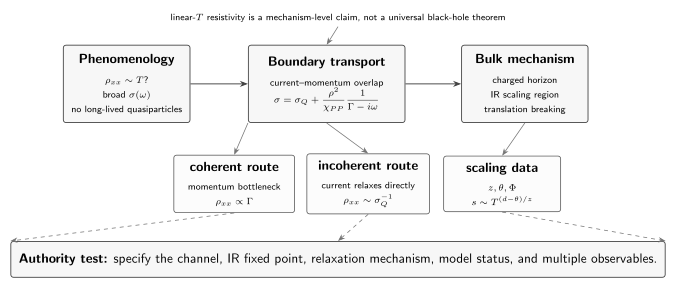
A holographic strange-metal analysis separates phenomenology from mechanism. The same experimental-looking behavior, such as , can arise from a coherent momentum-relaxing channel, an incoherent current-relaxing channel, an IR scaling geometry, a probe sector, or a crossover between regimes. The responsible slow modes and the status of the bulk model must be stated explicitly.
Learning goals
Section titled “Learning goals”After working through this page, you should be able to:
- explain why “strange metal” and “non-Fermi liquid” are overlapping but non-identical terms;
- state the minimal transport data needed before a finite-density system deserves a resistivity plot;
- distinguish coherent transport from incoherent transport;
- explain why exact translation symmetry makes the clean finite-density DC conductivity infinite;
- identify several holographic mechanisms for linear-in- resistivity and explain why none is automatic;
- separate transport non-Fermi-liquid behavior from probe-fermion spectral non-Fermi-liquid behavior;
- use IR scaling to estimate thermodynamic and transport exponents without overinterpreting them;
- say precisely what “Planckian” language does and does not mean in holography;
- recognize common overclaims about cuprates, pnictides, heavy fermions, and graphene.
Throughout this page, denotes the number of boundary spatial dimensions. The charge density is , entropy density is , pressure is , energy density is , chemical potential is , and the momentum susceptibility in a relativistic homogeneous state is
The problem is not just linear- resistivity
Section titled “The problem is not just linear-TTT resistivity”A famous empirical clue in strange metals is resistivity that is nearly linear in temperature,
over a broad window. This behavior is striking because an ordinary low-temperature Fermi liquid typically has electron-electron scattering rates proportional to , while electron-phonon scattering gives other temperature dependences depending on the regime. A robust -linear resistivity can therefore suggest that the current is not relaxing through conventional long-lived quasiparticles.
But linear resistivity is not, by itself, a complete definition of a strange metal. There are at least five logically separate questions:
- Is the state compressible?
- Are there long-lived quasiparticles?
- What is the dominant slow mode controlling transport?
- How is momentum relaxed?
- Does the same mechanism explain optical conductivity, thermopower, Hall response, and spectral functions?
The holographic answer is usually not a one-line formula. It is a chain of reasoning:
The same apparent scaling law can come from different links in this chain. A coherent Drude-like metal with can have . An incoherent metal with can also have . A probe-brane sector can produce finite conductivity without backreacting on the order- momentum. A strongly disordered holographic state can show finite DC response with no narrow Drude peak. These are different physical statements, even if a log-log plot of looks similar.
Strange metal versus non-Fermi liquid
Section titled “Strange metal versus non-Fermi liquid”A conventional Fermi liquid has a sharp low-energy organizing principle: quasiparticles near a Fermi surface. Their lifetime becomes parametrically long compared with their energy as . A useful schematic form of the retarded fermion Green’s function is
with
near the Fermi surface in the low-energy limit. In a non-Fermi liquid this inequality fails, or the Green’s function has a more singular scaling form not describable by long-lived quasiparticle poles.
A strange metal is usually a transport-facing notion. A non-Fermi liquid is often a spectral or field-theoretic notion. The two can overlap, but the overlap is not automatic.
For example, holographic probe fermions in a charged black brane background can produce Green’s functions of the form
in appropriate near-horizon regimes. Depending on , this can describe quasiparticle-like, marginal, or strongly non-Fermi-liquid behavior. But this single-particle spectral function is not the same object as the electric conductivity. Transport depends on current-current correlators, momentum relaxation, thermoelectric mixing, and vertex-like effects that are invisible in a probe Green’s function.
Holography is valuable precisely because it can study both sides while keeping them distinct. The current can be controlled by horizon dynamics and conserved momentum even when probe fermions show no sharp quasiparticles.
The minimal transport grammar
Section titled “The minimal transport grammar”Before asking whether a metal is strange, write the linear-response problem correctly. At finite density, electric and heat transport mix. In an isotropic system at zero magnetic field one writes
where
is the heat current. The thermal conductivity measured at zero electric current is
in the one-dimensional isotropic notation. With magnetic field, all these quantities become tensors and the distinction between conductivities, resistivities, Hall angles, and magnetization currents becomes mandatory.
For the present page, the most important object is the low-frequency electric conductivity. If translations are weakly broken, but momentum remains a long-lived mode, then a very general hydrodynamic or memory-matrix form is
Here is the momentum-relaxation rate and is the incoherent conductivity. This formula is the cleanest way to see the two routes to finite strange-metal transport.
The DC limit is
when the weak-momentum-relaxation description is valid. The resistivity is
If the momentum term dominates,
If the incoherent term dominates,
These two equations can both produce linear-in- resistivity, but they mean different things.
Coherent strange metals
Section titled “Coherent strange metals”A coherent metal is a metal whose low-frequency transport is dominated by a long-lived momentum mode. Its conductivity has a relatively narrow Drude-like peak, although the microscopic theory need not have electron quasiparticles. Coherence here refers to momentum, not to Landau quasiparticles.
The condition is roughly
where sets the local equilibration scale in many strongly coupled models. In this regime the optical conductivity has a pole near
and the DC resistivity is controlled by :
A coherent holographic strange metal with therefore needs
up to slowly varying thermodynamic prefactors. This can happen if the operator that breaks translations has the right low-frequency spectral weight. In a weak lattice or weak disorder calculation, a memory-matrix estimate gives schematically
Thus the temperature dependence of resistivity is inherited from the finite-momentum spectral weight of the operator that relaxes momentum.
This is a useful mechanism, not an automatic prediction. One must specify the translation-breaking source, the operator it couples to, its scaling dimension in the IR, and the temperature window in which the formula applies.
Incoherent strange metals
Section titled “Incoherent strange metals”An incoherent metal is one in which the electric current relaxes without being controlled by a parametrically slow momentum mode. The optical conductivity need not have a narrow Drude peak. In holography, this regime can arise when momentum relaxation is strong, when the current is dominated by a part orthogonal to momentum, or when the relevant charge sector is probe-like.
The incoherent current is the combination of electric and heat currents that does not overlap with momentum. In a relativistic charged fluid, a convenient form is
up to normalization. Because is orthogonal to the conserved momentum, it can decay even when total momentum is conserved. The associated intrinsic conductivity is .
In a strongly incoherent regime, a linear resistivity could come from
This is not Drude physics. There is no requirement that a single relaxation time appear in the Boltzmann form . If one still writes a timescale, it should be understood as a collective equilibration or current-relaxation scale, not a quasiparticle lifetime.
Holographically, incoherent transport often has a direct horizon interpretation. In simple models, the finite part of the conductivity can be expressed in terms of horizon data such as gauge coupling functions, scalar profiles, entropy density, and charge density. The reason is that DC transport in a stationary black-brane background can be recast as a radially conserved flux problem.
Holographic mechanisms for strange-metal-like scaling
Section titled “Holographic mechanisms for strange-metal-like scaling”There is no single holographic strange metal. There is a toolbox. The responsible mechanism must be named.
Charged horizons and semi-local criticality
Section titled “Charged horizons and semi-local criticality”The planar Reissner—Nordstrom AdS black brane is the first finite-density normal state. At low temperature, its near-horizon region often approaches
The factor gives an emergent time-scaling symmetry but no spatial scaling. This is often called semi-local criticality. It can produce unusual low-energy spectral functions and a large density of low-energy states. It is a useful IR grammar for non-Fermi-liquid behavior, but by itself it does not solve finite DC transport in the presence of exact translations.
EMD scaling geometries
Section titled “EMD scaling geometries”Einstein—Maxwell—dilaton models generalize the charged black brane by allowing the scalar field to run. The IR metric can show Lifshitz or hyperscaling-violating scaling,
with hyperscaling violation exponent . The entropy density often scales as
This gives a controlled way to build finite-temperature scaling regimes. Transport exponents then depend not only on and , but also on charge-sector scaling, gauge coupling functions, and translation-breaking operators. A scaling geometry is not a complete explanation of a material; it is an IR fixed-point or scaling-region hypothesis.
Momentum-relaxing holographic models
Section titled “Momentum-relaxing holographic models”Linear axions, Q-lattices, helical lattices, ionic lattices, and disorder models make the DC conductivity finite. In many homogeneous holographic models, a useful schematic horizon formula is
For a broad class of axion-EMD models this takes the more concrete schematic form
where is the Maxwell coupling, is the axion coupling, measures translation breaking, and is the scalar evaluated at the horizon. The first term is an incoherent or pair-creation-like contribution; the second is the momentum-drag contribution broadened by translation breaking.
This formula is powerful, but it is not universal. It belongs to a class of models. The lesson is structural: finite DC transport can often be read from horizon data, but the physical interpretation depends on the bulk action and boundary sources.
Probe sectors
Section titled “Probe sectors”In probe-brane systems, the flavor or charge sector can be order while the adjoint plasma is order . In the strict probe limit, the charge current of the probe sector can have a finite conductivity even though the full theory still has conserved momentum. This is because the probe sector can dissipate into the large neutral bath without significantly dragging the total momentum of the entire system.
This is a legitimate holographic mechanism, but it is not the same as a fully backreacted finite-density metal. When using a probe result to discuss strange metals, one must state what sector carries the measured current.
Linear- resistivity: three logically different routes
Section titled “Linear-TTT resistivity: three logically different routes”The most common mistake is to treat as though it identifies a unique mechanism. Here are three distinct routes.
Route A: coherent momentum relaxation
Section titled “Route A: coherent momentum relaxation”If the Drude-like term dominates,
then
A linear resistivity then means
assuming is slowly varying. This is the most direct Planckian-looking route. It says the slow momentum mode decays at a rate of order temperature.
Route B: incoherent current relaxation
Section titled “Route B: incoherent current relaxation”If the incoherent part dominates,
then
A linear resistivity means
This does not require . The relevant current is not the momentum-drag current.
Route C: crossover or mixed transport
Section titled “Route C: crossover or mixed transport”In many holographic models neither term cleanly dominates over the entire temperature window. Then the apparent scaling can come from a crossover between terms:
A finite range of nearly linear resistivity does not by itself prove a scaling fixed point. It may be a robust crossover, a sum of channels, or a consequence of slowly varying horizon data.
An authoritative analysis should therefore ask:
- Which term dominates?
- Is there a parametrically controlled IR regime?
- What operator relaxes momentum?
- Are the thermodynamic prefactors slowly varying?
- Does optical conductivity show the corresponding pole structure?
Planckian language, carefully
Section titled “Planckian language, carefully”The phrase Planckian dissipation often means a relaxation rate of order
or, in units ,
Holographic black branes naturally produce equilibration times of order because the only scale in a thermal critical state is . Quasinormal mode frequencies often take the form
where is dimensionless. This makes holography a natural factory for Planckian-looking relaxation.
But there are two caveats.
First, which time is Planckian? Local equilibration, momentum relaxation, current relaxation, Lyapunov growth, and quasiparticle decay are different quantities. A black-brane equilibration time of order does not automatically imply a transport scattering time of order .
Second, a coefficient matters. Saying is not the same as predicting a universal numerical slope for resistivity. Most slopes depend on charge density, entropy density, momentum susceptibility, lattice strength, gauge coupling functions, and operator normalization.
So the safe statement is:
Holography naturally realizes collective relaxation at the thermal timescale. Whether that timescale controls the measured DC resistivity is a model-dependent transport question.
Optical conductivity and the Drude diagnostic
Section titled “Optical conductivity and the Drude diagnostic”The frequency dependence of the conductivity is often more informative than the DC resistivity alone.
A coherent metal has a low-frequency pole,
with Drude weight
The real part has a peak of width . If , the pole is sharp and the metal is coherent.
An incoherent metal may instead have broad low-frequency spectral weight without a separated Drude pole. In holography this corresponds to current relaxation controlled by nonhydrodynamic quasinormal modes or by horizon data with no parametrically long-lived momentum mode.
Power-law optical conductivity is sometimes discussed in strange-metal phenomenology. Holographic scaling geometries can produce approximate power laws in intermediate regimes, but the exponent is sensitive to the operator, gauge coupling, charge sector, and crossover window. A clean power law in should not be inferred from scale covariance alone without solving the perturbation equation or matching to the correct IR Green’s function.
Hall response and why one resistivity is not enough
Section titled “Hall response and why one resistivity is not enough”Even at zero magnetic field, charge and heat transport are coupled. With magnetic field, the problem becomes tensorial:
The Hall angle is
Some strange-metal phenomenology is motivated by systems where
or by other multi-rate patterns. Holography can model such behavior, but a single relaxation time is usually too simple. One may need distinct coherent and incoherent channels, charge-conjugation asymmetry, magnetic response, probe-sector DBI dynamics, anomalies, or multiple slow modes.
For this reason, the ordinary longitudinal resistivity page is not the end of the story. Later pages in this sequence separate magnetic/Hall transport and anomalous/topological transport from the present discussion.
Worked example: two mechanisms for the same linear resistivity
Section titled “Worked example: two mechanisms for the same linear resistivity”Suppose a finite-density holographic metal has
Assume and are approximately constant in the temperature range of interest.
Coherent route
Section titled “Coherent route”Let
Then
and therefore
The linear resistivity is caused by a momentum-relaxation rate proportional to .
Incoherent route
Section titled “Incoherent route”Now suppose instead that
Then
so
The same linear resistivity appears, but now it is not caused by slow momentum relaxation. It is caused by the temperature scaling of the intrinsic current-relaxing conductivity.
This example is simple, but it is the conceptual core. A resistivity exponent is not a mechanism. The mechanism is the mode or channel that controls the conductivity.
What holography can honestly claim
Section titled “What holography can honestly claim”Holography can make several strong statements.
It gives explicit, calculable states of quantum matter without quasiparticles. It shows that black-brane horizons provide dissipative response without a Boltzmann equation. It gives a geometric language for IR scaling, charge fractionalization, momentum relaxation, and superconducting instabilities. It provides controlled large- examples in which transport is governed by hydrodynamics, memory-matrix logic, horizon data, or quasinormal modes.
Holography can also make weaker but useful phenomenological claims. A bottom-up model may show that a particular set of exponents can coexist with thermodynamic stability and causal bulk dynamics. A top-down model may show that a mechanism is compatible with string-theory embeddings. A horizon formula may reveal why a transport coefficient depends only on IR data in a given regime.
What holography usually cannot claim is a direct microscopic derivation of the strange metal phase of a specific material. Real materials have finite , lattice-scale chemistry, phonons, disorder, impurities, orbital structure, finite bandwidths, and competing orders. A holographic model may capture a universal or semi-universal regime, but that status must be argued, not assumed.
A trustworthy page on strange metals should therefore use this hierarchy:
Most strange-metal model building lives in the last two categories. That does not make it useless. It means the claims must be stated at the right level.
Common pitfalls
Section titled “Common pitfalls”Pitfall 1: “A horizon means finite DC conductivity.”
Not at finite density with exact translations. Momentum conservation gives a zero-frequency singularity unless the measured current is incoherent, probe-like, or momentum is relaxed.
Pitfall 2: “Linear- resistivity proves Planckian scattering.”
It may be consistent with , but it could also come from , multiple channels, or crossovers.
Pitfall 3: “Non-Fermi-liquid fermion spectra imply strange-metal transport.”
Single-particle spectral functions and current-current correlators are different observables. In holography, probe fermions often do not carry the full charge or momentum of the state.
Pitfall 4: “Hyperscaling violation determines all transport exponents.”
Thermodynamic scaling is not enough. Conductivity also depends on the gauge sector, translation-breaking sector, charge density, and the perturbation equations.
Pitfall 5: “Bottom-up means arbitrary.”
A bottom-up model can still be sharply constrained by symmetries, thermodynamics, energy conditions, stability, causality, and the existence of a sensible UV completion or UV regime. The issue is not whether it is useful; the issue is what level of claim it supports.
Pitfall 6: “A broad optical conductivity means no slow modes.”
A broad response may indicate incoherence, but broad peaks can also result from multiple nearby modes, temperature-dependent relaxation, disorder averaging, or crossover physics.
Summary
Section titled “Summary”Strange-metal holography is best understood as a mechanism map for strongly coupled metallic transport without a quasiparticle foundation. The central distinctions are:
- strange metal is a phenomenological label, not a unique universality class;
- non-Fermi liquid can mean spectral, thermodynamic, or transport non-Fermi-liquid behavior;
- exact translations make finite-density DC conductivity singular;
- coherent transport is controlled by slow momentum relaxation;
- incoherent transport is controlled by current relaxation orthogonal to momentum;
- linear- resistivity can arise in several inequivalent ways;
- Planckian language must specify which relaxation time is being discussed;
- holographic models are strongest when they identify mechanisms and weakest when they overclaim material identity.
The next pages build on these distinctions. Fermionic response asks what spectral functions look like when the bath is strongly coupled. Electron stars ask how much charge can be carried by explicit fermionic matter rather than by the horizon. Probe flavor asks what changes when the charge sector is parametrically smaller than the adjoint bath. Magnetic response and anomalous transport ask which strange-metal lessons survive once conductivities become tensors.
Exercises
Section titled “Exercises”Exercise 1. Coherent and incoherent routes to -linear resistivity
Section titled “Exercise 1. Coherent and incoherent routes to TTT-linear resistivity”Assume
where is approximately constant. Find two different assignments of and that give . Explain the physical difference between them.
Solution
The resistivity is
One coherent assignment is
Then
Here the linear resistivity comes from a momentum-relaxation rate proportional to temperature.
A different incoherent assignment is
Then
Here the linear resistivity comes from intrinsic current relaxation, not from a slow momentum mode. Both give , but the responsible low-frequency modes are different.
Exercise 2. Why clean finite-density transport is singular
Section titled “Exercise 2. Why clean finite-density transport is singular”Use the hydrodynamic constitutive relations
and the homogeneous momentum equation
to show that the clean conductivity contains an pole.
Solution
Take time dependence . The momentum equation becomes
so
Substituting into the current,
gives
Therefore
The pole is forced by momentum conservation and current-momentum overlap. It is not evidence for quasiparticles.
Exercise 3. A quasiparticle criterion
Section titled “Exercise 3. A quasiparticle criterion”Consider a fermion Green’s function near a putative Fermi surface,
Suppose as . For which values of is the excitation parametrically long-lived relative to its energy? What does this say about ?
Solution
The decay rate is controlled by . The excitation is parametrically long-lived relative to its energy if
If , then
This goes to zero for . It stays order one for and diverges for . Thus is quasiparticle-like by this criterion, while is marginal: the decay rate is of the same order as the excitation energy. This is why marginal Fermi-liquid behavior is not a conventional long-lived quasiparticle regime.
Exercise 4. Horizon formula and channel dominance
Section titled “Exercise 4. Horizon formula and channel dominance”In an axion-EMD model, suppose the DC conductivity is schematically
Assume
with and constant. Which channel gives if dominates? What happens if the second term dominates?
Solution
If dominates, then
so
This is an incoherent or intrinsic-conductivity route to linear resistivity.
If instead the second term dominates, then
With , this term is approximately constant, so the resistivity is also approximately constant. To obtain from the second term, one would need
or equivalently a temperature-dependent momentum-relaxing sector.
Exercise 5. Why one exponent is not enough
Section titled “Exercise 5. Why one exponent is not enough”Two holographic models both produce . Model A has a narrow Drude peak with width . Model B has no isolated Drude pole and has . List three measurements or calculations that could distinguish the two models.
Solution
Possible distinguishing diagnostics include:
-
Optical conductivity. Model A should show a narrow Drude-like peak whose width scales as . Model B should have broad low-frequency spectral weight with no parametrically isolated pole.
-
Momentum susceptibility and thermoelectric response. In Model A, electric, heat, and momentum transport are strongly tied together through the slow momentum mode. The thermoelectric conductivities should show related Drude structures. In Model B, the incoherent current dominates, so those relations are weaker or absent.
-
Hydrodynamic pole structure. Model A has a low-frequency pole near . Model B need not. Quasinormal-mode calculations can reveal whether such a pole is separated from the rest of the spectrum.
Other diagnostics include magnetotransport, open-circuit thermal conductivity, dependence on weak translation breaking, and whether a memory-matrix expression for controls the resistivity.
Further reading
Section titled “Further reading”For a broad review of holographic quantum matter, including zero-density matter, compressible matter, metallic transport, memory matrix methods, symmetry breaking, probe branes, nonequilibrium dynamics, and experimental connections, see Sean A. Hartnoll, Andrew Lucas, and Subir Sachdev, Holographic Quantum Matter.
For a condensed-matter-facing textbook treatment of holographic matter, including finite temperature, hydrodynamics, charged black branes, holographic fermions, superconductivity, electron stars, and translation breaking, see Jan Zaanen, Yan Liu, Ya-Wen Sun, and Koenraad Schalm, Holographic Duality in Condensed Matter Physics.
For a general gauge/gravity textbook discussion of applications to finite density, hydrodynamics, superconductors, fermions, hyperscaling violation, and entanglement, see Martin Ammon and Johanna Erdmenger, Gauge/Gravity Duality: Foundations and Applications.