
Physical States and Type II Superstring Spectra
The previous pages built the ingredients of the RNS superstring: worldsheet fermions, NS and R spin structures, ghosts and superghosts, BRST cohomology, and vertex operators. We now use those ingredients to answer a concrete question:
What are the physical spacetime particles in the ten-dimensional superstring?
The answer is remarkably rigid. The open RNS string, after the GSO projection, contains the on-shell fields of ten-dimensional super-Yang—Mills theory. Tensoring left and right movers gives the closed-string theories: type IIA and type IIB. Their common NS—NS sector contains the metric, Kalb—Ramond two-form, and dilaton, while their R—R sectors differ by chirality: IIA has odd R—R potentials , whereas IIB has even potentials with a self-dual five-form field strength.
The key ideas are simple, but the bookkeeping is unforgiving. We will keep the normal-ordering constants, the little-group representations, and the chirality choices visible at every step.
Conventions and oscillator numbers
Section titled “Conventions and oscillator numbers”We work in ten-dimensional flat space with mostly-plus signature. For open strings the physical mass is . In the RNS matter sector the oscillator numbers are
and
The normal-ordering constants are
Thus the open-string mass formulae are
The difference between the two sectors is already dramatic. The NS vacuum has , while the Ramond ground state is massless before any oscillator is added. The superstring becomes a sensible supersymmetric theory only after a projection that removes the NS tachyon and chooses a Ramond chirality.
For closed strings we have independent left- and right-moving oscillator numbers. It is useful to introduce
The closed-string mass and level-matching conditions are
Equivalently,
For example, a massless NS—NS state has , a massless R—R state has , and a massless NS—R state has , .
Physical-state conditions in old covariant language
Section titled “Physical-state conditions in old covariant language”For quick spectrum counting one often uses old covariant quantization and then translates the result into BRST language. The matter conditions are
with the additional mass-shell condition
Here in the NS sector and in the R sector. In the Ramond sector there is also the zero-mode condition
Strictly speaking, after fixing conformal gauge the physical Hilbert space is BRST cohomology, not just the matter Hilbert space satisfying these equations. For the massless spectrum in flat space, however, the old covariant conditions give precisely the familiar transversality, gauge equivalence, and Dirac equations. BRST language refines the statement: null or pure-gauge states are BRST exact.
Let us see this explicitly for the first open-string states.
The open NS sector: vector bosons and the tachyon problem
Section titled “The open NS sector: vector bosons and the tachyon problem”The NS ground state is a spacetime scalar,
with
This is the open-string tachyon. The superstring projection must remove it.
The first excited NS state is
The mass formula gives
The physical-state conditions impose the usual gauge-boson constraints. The condition gives
There is also a null state generated by a gauge parameter. In BRST language it is exact; in spacetime language it is the gauge redundancy
Thus the first surviving NS state is not an arbitrary ten-vector. A massless vector in ten dimensions has physical polarizations. These transform as the vector representation of the massless little group .
This is the first hint that the light-cone spectrum is the cleanest way to read off the physical degrees of freedom. The ten-dimensional Lorentz representation is covariant, but the physical polarizations are organized by .
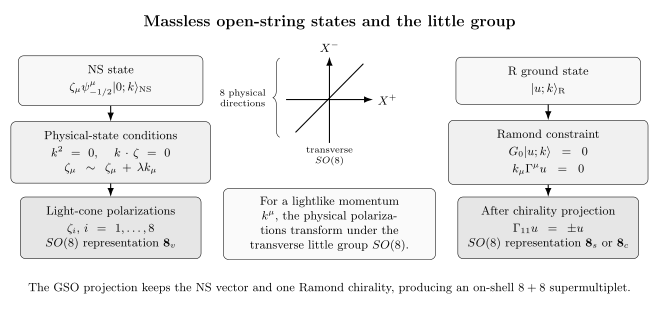
The massless NS vector loses two components through transversality and gauge equivalence, leaving eight transverse polarizations in . The Ramond ground state obeys a massless Dirac equation; after a Weyl projection it also carries eight physical polarizations.
The open Ramond sector: spacetime spinors
Section titled “The open Ramond sector: spacetime spinors”The Ramond sector has integer-moded worldsheet fermions. The crucial new feature is the zero mode:
This is a Clifford algebra. We may represent it as
Therefore the Ramond ground states are spacetime spinors. We write them as
where is a ten-dimensional spinor. Since , the Ramond ground state is massless:
Now impose the zero-mode physical-state condition. On the ground state the oscillator part of drops out, and is proportional to . Thus
This is the massless Dirac equation in ten dimensions.
A Dirac spinor in ten dimensions has complex components before reality conditions. In Lorentzian ten-dimensional string theory one can impose a Majorana condition and, independently for massless states, a Weyl chirality projection. A Majorana—Weyl spinor has real components off shell. The massless Dirac equation then removes half of them, leaving on-shell physical polarizations. These transform as either or of , depending on the chirality convention.
This matches the open NS vector:
The equality of dimensions is not an accident; after the GSO projection the open superstring has ten-dimensional spacetime supersymmetry.
The open-string GSO projection
Section titled “The open-string GSO projection”The raw RNS spectrum is not yet a spacetime-supersymmetric theory. The NS sector contains a tachyon, and the Ramond sector contains too many spinor states unless a chirality is chosen. The GSO projection is the worldsheet projection that fixes both problems.
Let be worldsheet fermion parity. In the NS sector one convention is
Every fermionic oscillator flips the sign. Therefore
The projection
removes the NS tachyon and keeps the massless vector.
In the Ramond sector, the projection is a chirality projection. Let
A choice of GSO projection keeps either
For an oriented open superstring one may choose either chirality. The two choices are equivalent up to a convention for what is called and what is called . The physical massless content is a ten-dimensional vector multiplet:
where has on-shell bosonic degrees of freedom and is a Majorana—Weyl gaugino with on-shell fermionic degrees of freedom.
With Chan—Paton factors included, and become adjoint-valued fields. In the low-energy limit their interactions are those of ten-dimensional super-Yang—Mills theory.
Closed strings: tensoring left and right movers
Section titled “Closed strings: tensoring left and right movers”A closed-string state is a tensor product of a left-moving state and a right-moving state. Before the final GSO choice, the four sectors are
The tilde emphasizes that the right-moving GSO projection is independent of the left-moving one.
The massless states are obtained by the minimal oscillator numbers compatible with each sector:
The little group organizes these states elegantly. After the GSO projection the NS massless state is . The Ramond ground state is either or . Thus the closed-string massless spectrum is a collection of tensor products of representations.
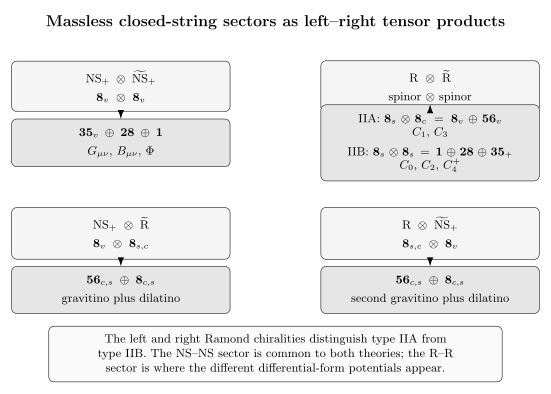
The NS—NS sector is common to type IIA and type IIB. The distinction between the two theories is the relative chirality of the left- and right-moving Ramond sectors.
The NS—NS sector: , , and
Section titled “The NS—NS sector: GμνG_{\mu\nu}Gμν, BμνB_{\mu\nu}Bμν, and Φ\PhiΦ”The massless NS—NS state has the form
The physical-state conditions imply
with gauge equivalences inherited from left and right null states. In light-cone gauge the polarization tensor is an tensor under :
Decompose this tensor into symmetric traceless, antisymmetric, and trace parts:
These are the on-shell degrees of freedom of
Here is the spacetime metric, is the Kalb—Ramond two-form, and is the dilaton. This sector appears in both type IIA and type IIB.
The counting is worth internalizing. In spacetime dimensions, a massless graviton has
physical polarizations. For this is . A massless two-form has
physical polarizations. The dilaton has one. Thus the NS—NS sector contains
bosonic degrees of freedom.
The R—R sector: spinor bilinears and differential forms
Section titled “The R—R sector: spinor bilinears and differential forms”The R—R ground states are tensor products of left and right spacetime spinors. A useful representation-theoretic fact is that spinor bilinears in ten dimensions are equivalent to differential forms. Schematically,
The allowed values of are controlled by the relative chiralities of and .
In type IIA the left and right Ramond ground states have opposite ten-dimensional chirality. The R—R potentials are odd-degree forms:
Their magnetic dual potentials are and in the democratic description, but the minimal two-derivative formulation may use and .
In type IIB the left and right Ramond ground states have the same ten-dimensional chirality. The R—R potentials are even-degree forms:
The field strength of is constrained by self-duality,
At the level of physical polarizations this becomes
The dimensions are again in either theory:
Thus the total number of massless bosonic degrees of freedom in either type II theory is
This number will match the fermions.
The mixed sectors: gravitini and dilatini
Section titled “The mixed sectors: gravitini and dilatini”The NS—R and R—NS sectors are spacetime fermions. A typical NS—R state is
In light-cone language this is a tensor product
The decomposition is
The representation is the on-shell content of a gravitino; the is the on-shell content of a dilatino. Because there are two mixed sectors, closed type II strings have two gravitini and two dilatini.
The relative chirality distinguishes the theories:
This is the origin of the names:
Each mixed sector contains fermionic degrees of freedom, so the total is
Therefore each type II theory has
This is the massless spectrum of ten-dimensional type II supergravity.
Type IIA versus type IIB in one table
Section titled “Type IIA versus type IIB in one table”The entire distinction is encoded in the relative chirality of the two Ramond sectors. Let and denote Ramond ground states of positive and negative ten-dimensional chirality. Then, schematically,
A parity transformation flips one chirality, so type IIA is parity invariant in ten dimensions, while type IIB is chiral. The chirality of IIB is visible in the self-duality of and in the fact that its two supersymmetry generators have the same chirality.
It is often useful to summarize the GSO choices as follows.
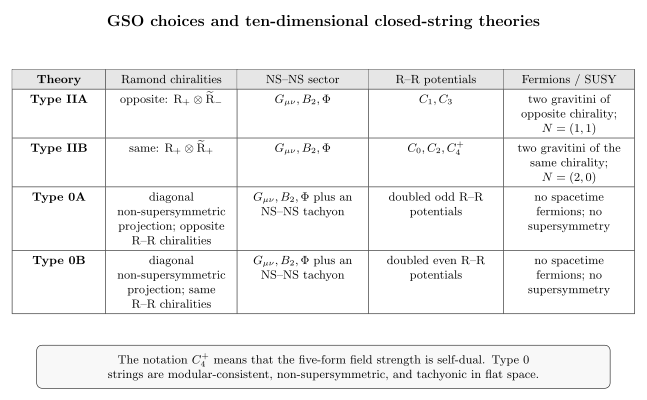
Type IIA and type IIB are the two maximally supersymmetric oriented closed superstrings. Type 0A and type 0B are non-supersymmetric but modular-consistent alternatives with an NS—NS tachyon and no spacetime fermions.
Type 0 strings as a useful contrast
Section titled “Type 0 strings as a useful contrast”The GSO projection is not uniquely fixed by modular invariance alone. There are non-supersymmetric oriented closed-string theories, called type 0A and type 0B, obtained by a diagonal projection that removes all mixed NS—R and R—NS sectors. Since those mixed sectors carry spacetime fermions, type 0 strings have no spacetime fermions.
They do keep an NS—NS tachyon. The schematic sectors are
Here denotes the GSO-even NS sector, whose first state is the massless vector in the open-string case or the massless NS—NS fields in the closed-string case. The sector contains the tachyon.
The R—R spectrum of type 0 theories is doubled relative to type II: type 0A has doubled odd R—R potentials, while type 0B has doubled even R—R potentials. These theories are unstable in flat space because of the tachyon, but they are useful conceptual laboratories. They show that the absence of tachyons and the presence of spacetime supersymmetry are additional dynamical virtues, not automatic consequences of writing a modular-invariant RNS partition function.
How the covariant fields know about gauge invariance
Section titled “How the covariant fields know about gauge invariance”The little-group counting gives the physical degrees of freedom, but the covariant fields are more useful in spacetime effective actions. The map between the two descriptions works because the physical-state constraints and BRST equivalences impose gauge invariance.
For the open string,
obeys
This is exactly the momentum-space gauge invariance of a Maxwell field.
For the closed NS—NS field,
has two independent gauge equivalences, one from the left movers and one from the right movers. Decomposing
identifies
The corresponding gauge transformations are the linearized forms of
Thus the string spectrum does not merely contain particles with the right number of components; it contains the gauge redundancies required for gravity and antisymmetric tensor gauge theory.
The same philosophy applies to R—R fields. The R—R vertex operators describe gauge-invariant field strengths most naturally, while the low-energy supergravity action is often written in terms of potentials with gauge transformations
and, in the presence of , modified gauge-invariant field strengths.
Summary of the massless type II spectra
Section titled “Summary of the massless type II spectra”The massless bosonic fields are
The fermions are
Both theories have real supercharges and on-shell massless degrees of freedom. The difference between them is not the number of states but their chirality and R—R form content. This difference will become physically decisive when we study T-duality and D-branes: T-duality along one circle flips one Ramond chirality, and therefore exchanges type IIA with type IIB.
Exercises
Section titled “Exercises”Exercise 1. The massless vector from the NS sector
Section titled “Exercise 1. The massless vector from the NS sector”Consider the open-string NS state
Use the mass formula and the physical-state condition to show that this state is a massless transverse vector. Explain why it has eight physical polarizations in ten dimensions.
Solution
The state has oscillator number
because one fermionic oscillator has level . The NS mass formula gives
Thus .
The supercurrent mode satisfies schematically
When acting on the one-oscillator state, the relevant term contracts with , giving
The physical-state condition therefore requires
There is also a gauge equivalence . A ten-vector has components; transversality removes one and gauge equivalence removes another, leaving physical polarizations. These transform as of the massless little group .
Exercise 2. Ramond zero modes and the Dirac equation
Section titled “Exercise 2. Ramond zero modes and the Dirac equation”Using
show that Ramond ground states transform as spacetime spinors. Then show that the physical-state condition gives the massless Dirac equation.
Solution
The zero modes obey a Clifford algebra. If
then
A Hilbert space carrying this algebra is a spinor representation of the ten-dimensional Lorentz group. Therefore the Ramond ground state can be written as , where is a spacetime spinor.
On the Ramond ground state the oscillator terms in vanish. The zero-mode contribution is proportional to
Thus
This is the massless Dirac equation. After imposing a Majorana—Weyl condition and the massless Dirac equation, the state has eight physical polarizations.
Exercise 3. Counting the NS—NS fields
Section titled “Exercise 3. Counting the NS—NS fields”Show that
Identify the corresponding spacetime fields.
Solution
The tensor product of two eight-dimensional vector representations is the space of tensors . It decomposes into symmetric traceless, antisymmetric, and trace parts:
The dimensions are
so the symmetric traceless part has dimension . The antisymmetric part has dimension
and the trace has dimension . Therefore
The symmetric traceless part is the graviton , the antisymmetric part is the two-form , and the trace is the dilaton .
Exercise 4. R—R forms in IIA and IIB
Section titled “Exercise 4. R—R forms in IIA and IIB”Use the rule that a product of two ten-dimensional spinors of the same chirality gives even-degree forms, while a product of spinors of opposite chirality gives odd-degree forms. Explain why IIA has R—R potentials , while IIB has .
Solution
R—R ground states are spinor bilinears. Gamma matrices with antisymmetrized indices map spinors of one chirality to spinors of either the same or the opposite chirality depending on . Even preserves ten-dimensional chirality, while odd flips it.
Equivalently, the bispinor expansion has the schematic form
Type IIB has left and right Ramond ground states of the same chirality, so its R—R potentials are even-degree forms. In the minimal formulation these are
The five-form field strength of is self-dual, so we write as a reminder of the self-duality constraint on .
Type IIA has left and right Ramond ground states of opposite chirality, so its R—R potentials are odd-degree forms. The minimal potentials are
Their magnetic duals may be included in the democratic formulation, but they are not independent degrees of freedom.
Exercise 5. Degree-of-freedom matching in type II strings
Section titled “Exercise 5. Degree-of-freedom matching in type II strings”Show that the massless bosonic and fermionic degrees of freedom in type II string theory both equal .
Solution
The NS—NS bosons contribute
For type IIA the R—R degrees are
which contribute
For type IIB the R—R degrees are
which contribute
Thus either theory has
massless bosonic degrees of freedom.
For fermions, each mixed sector contains
which decomposes as
This has states. There are two mixed sectors, NS—R and R—NS, so the fermionic count is
Therefore type II strings have bosonic and fermionic massless degrees of freedom.
Exercise 6. Why type 0 strings are not supersymmetric
Section titled “Exercise 6. Why type 0 strings are not supersymmetric”Type 0 theories keep NS—NS and R—R sectors but remove NS—R and R—NS sectors. Explain why this removes spacetime fermions and why a tachyon remains.
Solution
Spacetime statistics in the RNS string are tied to the number of Ramond factors. NS—NS and R—R sectors are spacetime bosonic. The mixed sectors NS—R and R—NS are spacetime fermionic because exactly one side carries a Ramond spinor.
If a projection removes the mixed sectors, no spacetime fermions remain. Without spacetime fermions there cannot be spacetime supersymmetry, since supersymmetry generators map bosons to fermions.
The type 0 diagonal GSO projection also keeps the sector
The lowest state in this sector is the NS—NS tachyon. Its mass is negative because each NS vacuum contributes to the left or right intercept. Therefore type 0 strings are non-supersymmetric and unstable in flat ten-dimensional spacetime.