
Information Loss in AdS/CFT
The main idea
Section titled “The main idea”The black-hole information problem is not just the statement that black holes are strange. It is a precise conflict between three ideas that are individually well motivated:
-
Quantum mechanics is unitary. A closed system evolves by
In particular, a pure state remains pure.
-
Semiclassical quantum field theory near a smooth horizon is local. A low-energy observer crossing the horizon should see ordinary vacuum physics at scales small compared with the curvature radius.
-
A black hole can evaporate away. Hawking radiation appears thermal at leading semiclassical order. If the black hole disappears and the outgoing radiation is still mixed, pure initial states have evolved into mixed final states.
AdS/CFT changes the status of this conflict. In a holographic theory with an ordinary unitary boundary CFT Hamiltonian, the complete quantum-gravitational system is defined by the boundary theory. Thus the exact evolution cannot be a fundamental pure-to-mixed map. The boundary statement is brutally simple:
so the fine-grained von Neumann entropy of the full closed system is constant:
That is the AdS/CFT answer to the existence question: quantum gravity in asymptotically AdS spacetime has a nonperturbative unitary description.
But it is not the end of the story. It does not by itself explain how the semiclassical Hawking calculation fails, how information is encoded in the outgoing radiation, what the correct interior operators are, or why a low-energy observer experiences an approximately smooth horizon. The slogan should therefore be:
This page explains the AdS version of the paradox and the precise role of the boundary CFT. The next page will discuss Page curves, quantum extremal surfaces, islands, and replica wormholes as the modern semiclassical mechanism for recovering fine-grained entropy.
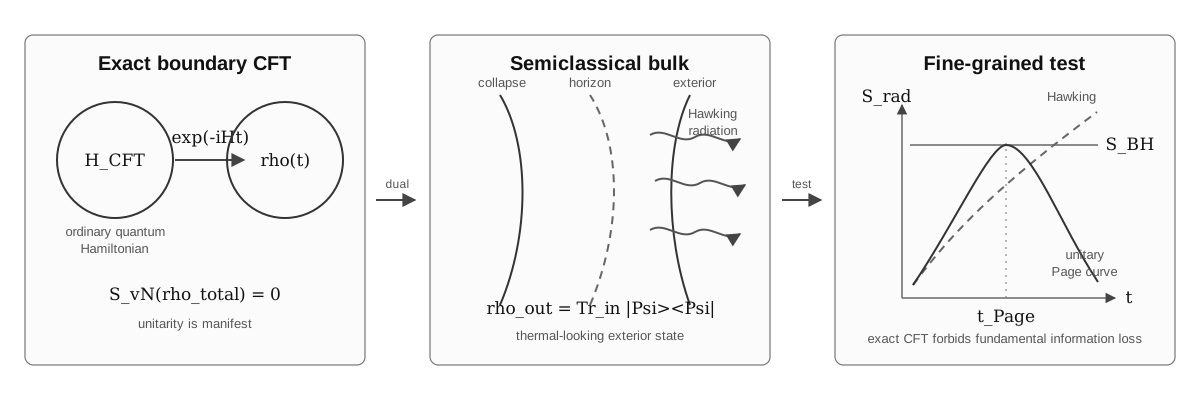
The AdS/CFT form of the information problem. Semiclassical bulk evolution suggests tracing over the interior and producing a mixed exterior state; the naive fine-grained radiation entropy then keeps rising. Exact boundary CFT evolution is unitary, so a closed system must instead have Page-curve behavior. The tension is not whether the exact theory is unitary, but how the semiclassical assumptions of locality and smooth horizons are modified in a way invisible at leading order in .
The paradox in density-matrix language
Section titled “The paradox in density-matrix language”Suppose a pure state collapses to form a black hole and the black hole later evaporates completely. In ordinary quantum mechanics, a closed system evolves as
Equivalently,
This map preserves the eigenvalues of and therefore preserves the von Neumann entropy
If , then
The semiclassical Hawking calculation appears to give something different. It gives a final radiation density matrix
with
The dangerous map is therefore
for many different initial states . This is not unitary evolution on a closed Hilbert space. It is a many-to-one, entropy-producing map.
A useful way to state the paradox is this:
The word “looks” matters. Semiclassical gravity may correctly describe many coarse-grained observables while failing for fine-grained entropy.
Hawking pairs and tracing over the interior
Section titled “Hawking pairs and tracing over the interior”The local origin of the paradox is pair creation near the horizon. In a fixed black-hole background, an outgoing Hawking mode is entangled with an interior partner mode . A toy model for one emitted pair is
The full two-mode state is pure:
But the exterior observer does not have access to . Tracing over the interior gives
Thus
For a macroscopic black hole, the emitted radiation is not exactly a product of identical qubit pairs, of course. But the lesson is robust: the leading semiclassical calculation says that each newly emitted exterior mode is dominantly entangled with an interior partner, not with the earlier radiation.
If the black hole persists forever, this is not immediately inconsistent. The full state of “radiation plus black hole interior” can remain pure. The sharp contradiction arises when the black hole evaporates completely, or when one asks how a finite-entropy black hole can contain an ever-growing amount of independent interior information.
Coarse-grained entropy versus fine-grained entropy
Section titled “Coarse-grained entropy versus fine-grained entropy”A major source of confusion is the word entropy. The information problem is about fine-grained entropy, but the classical black-hole entropy is often used as a coarse-grained thermodynamic entropy.
The Bekenstein-Hawking entropy is
Thermodynamically, this is the entropy assigned to a black hole macrostate specified by quantities such as mass, angular momentum, and charge. In AdS/CFT, the microscopic interpretation is that this entropy counts, to leading order, the number of CFT states in the corresponding energy and charge window:
This does not mean that a classical black-hole geometry is literally one pure state. More accurately:
- A Euclidean black-hole saddle often computes a thermal trace or an ensemble-like coarse-grained observable.
- A single high-energy CFT microstate is a pure state.
- Simple observables in typical high-energy microstates can look thermal.
- The difference between a typical microstate and the thermal black-hole saddle can be invisible in classical supergravity.
Thus there is no contradiction in saying both
and
The first is a coarse-grained entropy of a macrostate. The second is the exact fine-grained entropy of a pure state.
What changes in AdS?
Section titled “What changes in AdS?”In asymptotically flat spacetime, one often states the evaporation problem in terms of an -matrix from past null infinity to future null infinity. In AdS, the boundary is timelike, and the natural observables are boundary correlation functions or CFT time evolution on a spatial sphere.
For global AdS, the dual CFT lives on
At finite , the CFT has an ordinary Hilbert space and Hamiltonian. If the spatial sphere is compact, the exact spectrum is discrete, subject to the usual subtleties of degeneracies and large- limits. The exact time evolution is unitary:
A bulk process that looks like black-hole formation and evaporation must therefore be encoded in a unitary boundary evolution.
There is an important AdS-specific caveat. With reflecting boundary conditions, Hawking radiation in global AdS does not escape to infinity forever. Large AdS black holes are thermodynamically stable in the canonical ensemble; radiation reflects from the boundary and can equilibrate with the black hole. Thus the literal “black hole evaporates away and leaves only radiation” story is not automatic in global AdS.
There are several standard ways to formulate the information problem in AdS anyway:
- Study small AdS black holes, which have negative specific heat and can evaporate in an appropriate regime.
- Couple the boundary CFT to an auxiliary nongravitating bath, allowing energy to leave the AdS gravitational region.
- Use transparent or absorbing boundary conditions for bulk radiation, when the setup permits such a description.
- Study the problem through exact CFT correlators and black-hole microstates rather than through complete evaporation.
- Consider two-sided black holes and ask how the semiclassical interior is encoded in the two CFTs.
In all cases, the complete boundary description remains unitary once the full system is included. If the CFT is coupled to a bath, then the combined system evolves as
The radiation subsystem can have changing entropy, but the total fine-grained entropy cannot change under exact unitary evolution.
Boundary unitarity as a nonperturbative statement
Section titled “Boundary unitarity as a nonperturbative statement”The strongest AdS/CFT statement is not that a particular semiclassical black-hole geometry is unitary. A classical geometry is not a complete quantum theory. The statement is instead that the boundary CFT gives a nonperturbative definition of the gravitational theory in AdS.
For a boundary CFT density matrix,
Therefore
for every positive integer . In particular,
This is a simple but powerful obstruction to fundamental information loss. If a bulk calculation predicts exact pure-to-mixed evolution for the complete system, that calculation cannot be the exact AdS quantum gravity answer.
This is why AdS/CFT is often said to “solve” the information-loss paradox. But that sentence is too compressed. A better version is:
The hard questions become sharper:
- Which assumption in Hawking’s semiclassical reasoning fails?
- Where are the corrections large enough to restore purity?
- How can the horizon remain smooth for infalling observers?
- How are interior operators reconstructed from boundary degrees of freedom?
- Which bulk factorization assumptions are only approximate?
These are not philosophical questions. They are questions about the structure of the expansion, gravitational constraints, entanglement wedges, quantum extremal surfaces, and the operator algebra of the boundary theory.
The correlator version of the paradox
Section titled “The correlator version of the paradox”Even without complete evaporation, AdS/CFT gives a sharp diagnostic of information loss: late-time correlators.
Consider a thermal two-point function in a CFT on a compact spatial sphere:
Using energy eigenstates,
At finite entropy and finite volume, this is a sum of phases. It can decay for a long time, but it cannot be exactly equal to a purely exponentially decaying function forever. At very late times, the discreteness of the spectrum produces effects such as plateaus and recurrences. Parametrically, for a chaotic system with entropy , the late-time connected signal is often of order
with details depending on the observable and normalization.
Now compare this with a classical AdS black-hole calculation. A bulk field perturbation outside the horizon has quasinormal modes. At intermediate late times,
The classical black-hole answer decays exponentially. If taken literally forever, it forgets too much.
The resolution is not that the quasinormal-mode calculation is useless. It is very good for the regime it controls:
But it misses effects nonperturbative in the entropy, schematically
These are invisible in ordinary perturbation theory around one classical black-hole saddle. From the boundary viewpoint, exact unitarity requires them. From the bulk viewpoint, one must understand what saddles, microstates, or quantum-gravitational effects restore them.
The information problem as an overcounting problem
Section titled “The information problem as an overcounting problem”The semiclassical Hawking argument implicitly treats the interior partners of Hawking radiation as new independent degrees of freedom. After many emissions, the radiation is entangled with many interior partners. If the black hole shrinks, the number of remaining black-hole microstates decreases, but the semiclassical interior Hilbert space seems to keep growing.
This is suspicious in a theory where black holes have finite entropy. A black hole of fixed mass, charge, and angular momentum has roughly
available microstates. It cannot also contain an arbitrarily large independent Hilbert space of interior partners without overcounting.
In semiclassical effective field theory one often writes a factorization like
This factorization is useful locally and approximately. But in gravity, exact Hilbert-space factorization is subtle because of constraints, gauge redundancy, gravitational dressing, and boundary charges. AdS/CFT strongly suggests that the exact number of independent degrees of freedom is counted by the boundary theory, not by freely tensoring together every semiclassical region.
This is one reason the information problem is closely connected to entanglement-wedge reconstruction and quantum error correction. The same bulk degree of freedom may be reconstructible in different boundary regions. Interior operators may be encoded in a highly nonlocal and state-dependent way in the boundary theory. Semiclassical locality is an emergent approximation, not a fundamental tensor-factor decomposition.
Page’s argument and the expected fine-grained curve
Section titled “Page’s argument and the expected fine-grained curve”For an evaporating black hole initially formed from a pure state, unitarity predicts a characteristic behavior of the radiation entropy.
Let denote the emitted Hawking radiation and the remaining black hole. If the total state is pure, then
At early times, the radiation subsystem is small, so its entropy can increase as more modes are emitted:
But after roughly the Page time, the remaining black hole has fewer available microstates than the radiation. For a typical pure state in
one expects approximately
As the black hole shrinks,
decreases. Therefore the fine-grained radiation entropy must eventually decrease. The unitary expectation is the Page curve:
as a cartoon.
The leading Hawking calculation instead predicts monotonic growth. This is the sharp entropy form of the information problem.
The next page will discuss how the modern island prescription computes this Page curve in semiclassical gravity by replacing the naive radiation entropy with a generalized entropy extremization:
Here is an island region inside the gravitational spacetime. The point for this page is only the logic: AdS/CFT says the fine-grained answer must be unitary; islands explain how semiclassical entropy calculations can know this.
The AMPS tension in one paragraph
Section titled “The AMPS tension in one paragraph”The firewall argument is a sharper modern version of the same conflict. After the Page time, unitarity suggests that a newly emitted Hawking mode should be correlated with the early radiation , because the radiation must start purifying itself. But smoothness of the horizon suggests that is entangled with an interior partner in the local vacuum. Quantum entanglement is monogamous: one system cannot be maximally entangled with two independent systems at once.
Schematic tension:
while
If and are independent Hilbert-space factors, the two statements are incompatible. Thus one must give up or refine at least one assumption: exact semiclassical locality, naive interior-exterior factorization, unrestricted smooth horizons, or the simple identification of interior partners as independent degrees of freedom.
In AdS/CFT, the natural expectation is not that boundary unitarity fails, but that the semiclassical interior description has a limited domain of validity.
What AdS/CFT settles
Section titled “What AdS/CFT settles”AdS/CFT gives several firm lessons.
The exact theory is unitary
Section titled “The exact theory is unitary”The dual CFT has an ordinary unitary time evolution. Therefore exact pure-to-mixed evolution of the complete AdS quantum-gravity system is not allowed.
Black-hole entropy counts states
Section titled “Black-hole entropy counts states”For black holes in regimes where the dual description is understood, the Bekenstein-Hawking entropy is interpreted as a density of boundary states:
This is not just thermodynamic poetry. It is the same logic that underlies the matching of thermal entropy in AdS black branes, BTZ black holes, supersymmetric black holes, and many protected or near-protected string-theory examples.
Classical geometry is a coarse-grained description
Section titled “Classical geometry is a coarse-grained description”A black-hole geometry is usually a saddle that computes coarse-grained or thermal observables. It need not contain enough information to distinguish all microstates. The fine-grained data are present in the boundary theory, but often invisible to classical supergravity.
Perturbation theory around one saddle is not enough
Section titled “Perturbation theory around one saddle is not enough”Corrections order-by-order in may not restore unitarity in quantities whose leading violation is nonperturbatively small. Effects of order
are natural in a finite-entropy quantum system but invisible in a naive expansion about a single classical black-hole background.
Interior locality is emergent and code-subspace dependent
Section titled “Interior locality is emergent and code-subspace dependent”Bulk local operators are not fundamental boundary-local operators. They are reconstructed within a code subspace and with gravitational dressing. This is not a defect; it is how holography avoids overcounting.
What AdS/CFT does not automatically settle
Section titled “What AdS/CFT does not automatically settle”AdS/CFT also leaves real work to do.
It does not give a one-line local bulk mechanism
Section titled “It does not give a one-line local bulk mechanism”The statement “the CFT is unitary” tells us the final answer cannot be information loss. But it does not immediately show which term in a semiclassical bulk calculation changes the entropy curve.
The island formula and replica wormholes are important precisely because they provide such a semiclassical mechanism for certain observables.
It does not make every black-hole microstate geometrical
Section titled “It does not make every black-hole microstate geometrical”Most high-energy CFT states need not have simple classical geometries. A few special microstates may have smooth horizonless descriptions, but typical black-hole microstates are not expected to be captured by a single weakly curved classical solution.
It does not remove the need for effective field theory
Section titled “It does not remove the need for effective field theory”Semiclassical EFT remains excellent for local, low-energy, not-too-late observables outside large black holes. The information problem is not solved by declaring EFT useless. The challenge is to understand its precise regime of validity.
It does not directly solve flat-space or de Sitter quantum gravity
Section titled “It does not directly solve flat-space or de Sitter quantum gravity”AdS/CFT is sharpest with asymptotically AdS boundary conditions. It gives powerful evidence and lessons for quantum gravity more broadly, but it is not a direct nonperturbative definition of arbitrary asymptotically flat or cosmological spacetimes.
A useful hierarchy of descriptions
Section titled “A useful hierarchy of descriptions”It helps to distinguish four levels of description.
| Level | Description | What it captures | What it misses |
|---|---|---|---|
| Exact CFT | Boundary Hamiltonian evolution | Nonperturbative unitarity, finite spectrum, microstates | Local bulk interpretation may be highly nontrivial |
| Full string theory in AdS | Bulk quantum gravity with all strings/branes | Same physics in bulk language | Hard to calculate generically |
| Semiclassical gravity | Expansion in small around saddles | Black-hole thermodynamics, QNMs, classical geometry | Nonperturbative effects, fine-grained entropy subtleties |
| Local QFT on fixed background | Hawking pair creation | Thermal radiation and local horizon physics | Backreaction, constraints, microstate counting, exact factorization |
The paradox arises when the bottom level is extrapolated beyond its regime of validity and mistaken for the exact theory.
Common mistakes
Section titled “Common mistakes”Mistake 1: “AdS black holes do not evaporate, so there is no information problem.”
Section titled “Mistake 1: “AdS black holes do not evaporate, so there is no information problem.””Reflecting boundary conditions change the evaporation story, but not the conceptual problem. One can couple to a bath, study small black holes, study boundary correlators, or ask how black-hole microstates encode information. The finite-entropy and unitarity issues remain.
Mistake 2: “The CFT is unitary, so the problem is trivial.”
Section titled “Mistake 2: “The CFT is unitary, so the problem is trivial.””Boundary unitarity is decisive, but the bulk mechanism is highly nontrivial. The whole point is to explain how semiclassical gravity reorganizes itself so that fine-grained entropy is unitary while local observers still see approximately smooth horizons.
Mistake 3: “Thermal entropy means the state is mixed.”
Section titled “Mistake 3: “Thermal entropy means the state is mixed.””A pure high-energy CFT state can have thermal-looking simple observables. Thermal entropy is often coarse-grained. Fine-grained entropy depends on the exact density matrix.
Mistake 4: “The black-hole geometry is a typical microstate.”
Section titled “Mistake 4: “The black-hole geometry is a typical microstate.””A classical black-hole saddle usually represents a coarse-grained description or a thermal trace. It is not generally a complete geometrical representation of a single microstate.
Mistake 5: “Small corrections to Hawking radiation can never matter.”
Section titled “Mistake 5: “Small corrections to Hawking radiation can never matter.””Small corrections to each emission are not enough if they are independent and perturbative in the wrong way. But nonperturbative effects, changes in the entropy prescription, or changes in factorization can matter enormously for fine-grained entropy.
Mistake 6: “Interior and exterior Hilbert spaces always factorize exactly.”
Section titled “Mistake 6: “Interior and exterior Hilbert spaces always factorize exactly.””This is a useful effective-field-theory approximation in suitable regimes. In gravity, exact factorization is obstructed by gauge constraints and holographic encoding.
Exercises
Section titled “Exercises”Exercise 1: Unitary evolution preserves purity
Section titled “Exercise 1: Unitary evolution preserves purity”Let
with . Show that if is pure, then is pure. Also show that for all positive integers .
Solution
A pure density matrix satisfies
Then
Thus is also pure.
For the trace invariants,
so cyclicity of the trace gives
These invariants determine the eigenvalues of in finite-dimensional systems, and the von Neumann entropy is unchanged.
Exercise 2: A one-pair model of Hawking entanglement
Section titled “Exercise 2: A one-pair model of Hawking entanglement”Consider
Compute the reduced density matrix and its entropy.
Solution
The full density matrix is
Tracing over gives
The eigenvalues are and , so
The pair state is pure, but either subsystem alone is mixed. This is the elementary entanglement structure behind Hawking radiation in the fixed-background approximation.
Exercise 3: Why a finite-volume CFT correlator cannot decay exponentially forever
Section titled “Exercise 3: Why a finite-volume CFT correlator cannot decay exponentially forever”Let
with a discrete spectrum and finite coefficients in an energy window. Explain why this cannot equal for all with .
Solution
The function is a sum of pure phases. If the sum is finite, it is almost periodic. It can show cancellations over long intervals, but it cannot decay monotonically to zero like forever.
For an infinite but discrete spectrum with sufficiently controlled coefficients, the same intuition remains: exact finite-volume unitary evolution produces recurrences or late-time fluctuations rather than permanent exponential decay. Exponential decay is an effective approximation obtained after coarse-graining, taking large-volume or large- limits, or focusing on intermediate times.
A classical AdS black hole gives quasinormal-mode decay. This captures intermediate-time thermalization of simple observables but misses nonperturbatively small late-time effects required by exact boundary unitarity.
Exercise 4: Coarse-grained versus fine-grained entropy
Section titled “Exercise 4: Coarse-grained versus fine-grained entropy”A high-energy CFT pure state is dual, for simple observables, to a black-hole macrostate with entropy . Explain why this is not a contradiction with
Solution
The von Neumann entropy of a pure state is exactly zero. The black-hole entropy is a coarse-grained entropy: it counts the number of microstates compatible with the same macroscopic data. Schematically,
A typical pure state in this energy window can have thermal-looking expectation values for simple operators, but the exact density matrix remains pure. The black-hole geometry is a coarse-grained description that does not distinguish all microstates.
Exercise 5: Evaporation in AdS with a bath
Section titled “Exercise 5: Evaporation in AdS with a bath”Why is it useful to couple an AdS/CFT system to an auxiliary bath when discussing evaporating black holes? What is the correct unitarity statement for the combined system?
Solution
With reflecting AdS boundary conditions, Hawking radiation can return from the boundary and equilibrate with the black hole. Coupling the boundary CFT to an auxiliary nongravitating bath allows energy and radiation to leave the AdS gravitational region, producing a closer analogue of an evaporating black hole.
The radiation subsystem alone need not evolve unitarily. The correct statement is that the combined CFT-plus-bath system evolves unitarily:
Thus the fine-grained entropy of the combined closed system is constant, while the entropy of the bath radiation can change.
Exercise 6: The monogamy tension
Section titled “Exercise 6: The monogamy tension”Suppose a late Hawking mode is maximally entangled with an early radiation system . Show that cannot also be independently maximally entangled with an interior mode .
Solution
If is maximally entangled with , then the joint state of is pure on the relevant two-system subspace, and the reduced state of is maximally mixed. Since is already pure, it cannot be further entangled with an independent system . Equivalently, a pure state on tensored with any has the form
so is uncorrelated with .
This is the monogamy core of the firewall tension. Smooth horizon physics wants to be entangled with an interior partner , while unitarity after the Page time wants late radiation to be correlated with earlier radiation . If and are independent Hilbert-space factors, the two requirements conflict.
Further reading
Section titled “Further reading”- S. W. Hawking, Breakdown of Predictability in Gravitational Collapse.
- J. M. Maldacena, The Large Limit of Superconformal Field Theories and Supergravity.
- J. M. Maldacena, Eternal Black Holes in Anti-de Sitter.
- D. Marolf, Black Holes, AdS, and CFTs.
- D. Harlow, Jerusalem Lectures on Black Holes and Quantum Information.
- W. G. Unruh and R. M. Wald, Information Loss.
- L. Susskind, L. Thorlacius, and J. Uglum, The Stretched Horizon and Black Hole Complementarity.
- A. Almheiri, D. Marolf, J. Polchinski, and J. Sully, Black Holes: Complementarity or Firewalls?.
- S. D. Mathur, The Information Paradox: A Pedagogical Introduction.
- D. N. Page, Information in Black Hole Radiation.
- A. Almheiri, R. Mahajan, J. Maldacena, and Y. Zhao, The Page Curve of Hawking Radiation from Semiclassical Geometry.