
Worldvolume Flux, BIons, and F/D Bound States
D-branes are not just rigid hypersurfaces on which open strings end. They are dynamical solitons with gauge fields living on their worldvolume, and those gauge fields carry spacetime charges. This is one of the most useful lessons of D-brane physics: a lower-dimensional brane can be hidden inside a higher-dimensional brane as worldvolume flux.
The previous pages treated D-branes as sources for Ramond—Ramond potentials and as objects whose open strings give a gauge theory. The bridge between these statements is the Wess—Zumino coupling
Here is the D-brane worldvolume, denotes pullback to it, is the Chan—Paton field strength, and
is the unit Ramond—Ramond charge. In a constant dilaton background the physical tension is
The exponential in is not a decorative shorthand. It is the statement that a D-brane can carry D, D, and still lower charges when its worldvolume gauge bundle is topologically nontrivial.
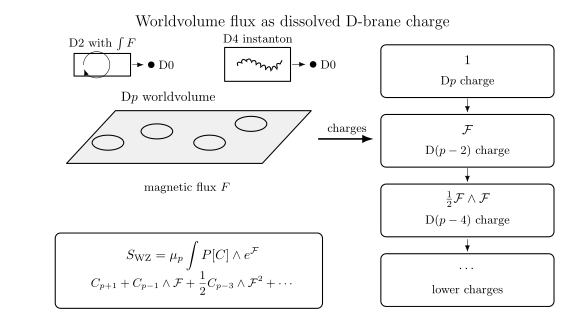
Magnetic worldvolume flux induces lower-dimensional Ramond—Ramond charge. The first Chern class carries D charge, while instanton number on a D4-brane carries D0 charge.
The Wess—Zumino coupling and dissolved branes
Section titled “The Wess—Zumino coupling and dissolved branes”Expanding the exponential gives
The leading term tells us that a D-brane is electrically charged under . The next term tells us something subtler: if the D-brane has magnetic flux through a two-cycle , then it carries D charge.
Set for the moment. Flux quantization says
Then
because
Thus one unit of magnetic flux carries one unit of D charge. The lower-dimensional brane is dissolved: it is not localized at a point in the two-cycle unless the flux is localized, but the conserved Ramond—Ramond charge is exactly the same.
This idea is the D-brane version of a very old field-theory fact: topological flux can behave like particle number. The novelty is that in string theory the topological number is literally a spacetime brane charge.
D2-branes with magnetic flux: dissolved D0-branes
Section titled “D2-branes with magnetic flux: dissolved D0-branes”The cleanest example is a D2-brane extended along with constant magnetic field . Let
The DBI energy is
Flux quantization gives
Using , the energy becomes
This is exactly the BPS mass formula for a bound state carrying D2 charge and units of D0 charge. Notice the important word bound. The mass is not ; instead it is the length of a charge vector in the central-charge plane. The D0 charge is not a collection of independent D0-branes sitting on the D2. It has been absorbed into the D2 as magnetic flux.
The same configuration has a simple T-dual interpretation. T-dualize along . The magnetic field becomes the slope of a D1-brane in the plane:
So a fluxed D2 is dual to a tilted D1. The square-root energy above is then just the geometric length of the tilted brane times its tension. This is often the fastest way to remember why the DBI square root knows about BPS charge addition.
Higher Chern classes: D0-branes inside D4-branes
Section titled “Higher Chern classes: D0-branes inside D4-branes”The next term in the Wess—Zumino expansion is
For a D4-brane this contains
Therefore a gauge instanton on the four spatial directions of the D4-brane carries D0 charge. With standard trace conventions,
corresponds to dissolved D0-branes.
This fact is a cornerstone of the D-brane/gauge-theory dictionary. The moduli space of D0-branes bound to D4-branes is the moduli space of instantons in gauge theory. In the open-string description, the D0—D0 and D0—D4 strings reproduce the ADHM variables; in the D4 worldvolume theory, the same physics is a smooth instanton gauge field.
For a stack of branes the WZ coupling is more properly written schematically as
with refinements involving curvature couplings and the non-Abelian pullback. For the present purpose, the essential point is already visible in the Abelian formula: Chern characters of the worldvolume gauge bundle are D-brane charges.
Electric flux and fundamental-string charge
Section titled “Electric flux and fundamental-string charge”Magnetic flux dissolves lower-dimensional D-branes. Electric flux dissolves fundamental strings.
Consider a D-brane with an electric field . The DBI Lagrangian depends on , so the canonical electric displacement
is the conserved flux conjugate to the gauge potential . By Gauss’s law, electric flux lines cannot simply end in the middle of the brane. If they do end, the endpoint must be charged under the worldvolume gauge field. But the endpoint of an open fundamental string is precisely such a charge.
Thus a fundamental string ending on a D-brane appears in the D-brane gauge theory as an electric charge, and a bundle of dissolved F-strings appears as quantized electric flux.
For a D1-brane, this statement becomes especially sharp. Let
For one D-string in flat space with , the DBI Lagrangian density is
The electric displacement is
The Hamiltonian density is
Quantization of electric flux sets
Therefore
This is the tension of a bound state of fundamental strings and one D-string. For coincident D-strings carrying units of electric flux, the BPS tension is
The notation means units of NS—NS string charge and units of Ramond—Ramond string charge. A fundamental string is , a D-string is , and the simplest genuinely mixed object is a string.
BIon spikes: a string ending on a brane
Section titled “BIon spikes: a string ending on a brane”The electric-flux picture has a beautiful spacetime avatar: the BIon spike. Consider a D3-brane with one transverse scalar and an electric field on the brane. A fundamental string ending on the brane pulls out a spike in the transverse direction. The spike is not an extra object added by hand; it is a classical solution of the DBI equations.
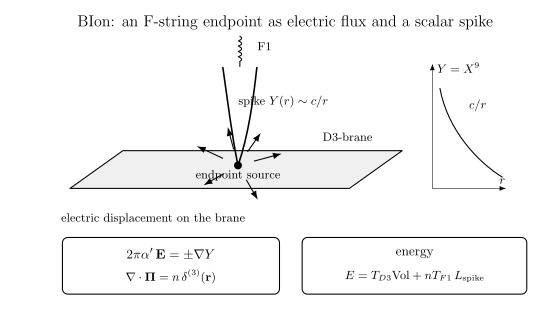
A fundamental string ending on a D3-brane is described on the brane by electric flux and a transverse scalar profile. The BPS condition ties the electric field to the slope of the spike.
The BPS equation takes the schematic form
Away from the endpoint, Gauss’s law implies
so the scalar is harmonic. For a spherically symmetric spike on a D3-brane,
with proportional to the number of attached fundamental strings. The endpoint at is a source for electric flux; geometrically it is the place where the spike becomes a semi-infinite F-string.
The energy of the BPS configuration splits as
up to the usual regularization of the infinite brane volume and infinite string length. This is the physical reason for the BPS equation: it rewrites the DBI energy as a sum of brane tension plus string tension, with no additional binding energy.
The magnetic analogue is also important. A D1-brane ending on a D3-brane is described by a magnetic monopole on the D3 worldvolume and a scalar spike obeying a Bogomolny equation
This is the D-brane origin of the relation between monopoles in four-dimensional gauge theory and D-strings suspended between D3-branes.
The charge lattice of F/D bound states
Section titled “The charge lattice of F/D bound states”For strings in type IIB theory, F-string and D-string charges form an integral lattice. At the tension of a string is
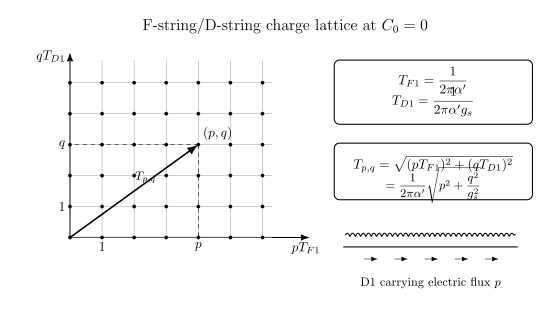
F1 and D1 charges form an integral lattice. A primitive vector labels a single half-BPS bound string; nonprimitive vectors describe multiple coincident copies of a primitive string.
A few comments prevent common misunderstandings.
First, the formula is a BPS formula. The charges enter through a central charge, so the tension is the magnitude of a charge vector, not the sum of constituent tensions.
Second, a primitive charge vector, , represents a single stable bound string. If with , the configuration is at threshold for splitting into identical strings.
Third, the D1 electric-flux derivation is only one corner of a larger structure. Type IIB theory has an duality that rotates F1 and D1 charges into each other and combines the axion and dilaton into
We will treat that duality systematically next. For now, the essential result is already visible from the D-brane worldvolume: turning on electric flux on a D-string literally builds a string with both NS—NS and R—R charge.
A useful organizing principle
Section titled “A useful organizing principle”The examples above are not isolated tricks. They are manifestations of one organizing principle:
More concretely:
| Worldvolume data | Spacetime interpretation |
|---|---|
| on a D | units of D charge |
| on a D4 | units of D0 charge |
| electric flux on a D | dissolved F-string charge |
| electric point source on a D | endpoint of an F-string |
| magnetic monopole on a D3 | endpoint of a D-string |
| non-Abelian instanton moduli | D0-branes bound to D4-branes |
This principle is one of the reasons D-branes are so powerful. They convert questions about extended objects in spacetime into questions about gauge fields, topology, and solitons on a lower-dimensional worldvolume.
Exercises
Section titled “Exercises”Exercise 1: one unit of flux gives one D-brane
Section titled “Exercise 1: one unit of flux gives one D(p−2)(p-2)(p−2)-brane”Let a D-brane wrap a two-cycle with and
Use the Wess—Zumino coupling to show that the configuration carries units of D charge.
Solution
The relevant WZ term is
Integrating over gives
Since
the coupling becomes
which is precisely the coupling of D-branes.
Exercise 2: the D2—D0 square-root mass formula
Section titled “Exercise 2: the D2—D0 square-root mass formula”A D2-brane of area has constant magnetic field with
Show that the DBI energy is
Solution
The DBI energy is
Flux quantization gives
Therefore
Using , we get
Exercise 3: flux as brane angle under T-duality
Section titled “Exercise 3: flux as brane angle under T-duality”For an open string ending on a D2-brane with constant , the boundary condition can be written schematically as
T-dualize along . Show that the dual object is a D1-brane tilted by an angle satisfying
Solution
Under T-duality along ,
The first boundary condition becomes
so the endpoint is constrained to move along a line in the plane. Equivalently, the transverse combination is fixed. Up to orientation convention, the brane equation is
Hence its slope is
Exercise 4: D0 charge from a D4 instanton
Section titled “Exercise 4: D0 charge from a D4 instanton”A D4-brane has Wess—Zumino coupling
Explain why an instanton number
corresponds to units of D0-brane charge, up to the standard trace normalization.
Solution
The coupling measures D0-brane charge. The coefficient of is proportional to
Using
this becomes
Since
the coupling is . This is exactly the coupling of D0-branes.
Exercise 5: electric flux on a D-string
Section titled “Exercise 5: electric flux on a D-string”Start from
where . Compute the Hamiltonian density in terms of the electric displacement .
Solution
The displacement is
Solving for gives
The Hamiltonian density is
If , then
This is the tension of a string at .
Exercise 6: primitive and nonprimitive charge vectors
Section titled “Exercise 6: primitive and nonprimitive charge vectors”Use the tension formula
to show that has exactly times the tension of .
Solution
Substitute :
So a nonprimitive vector is at threshold for splitting into copies of the primitive string. This is why primitive vectors label single stable bound strings.
Exercise 7: the BIon BPS equation
Section titled “Exercise 7: the BIon BPS equation”For a D3-brane with one scalar and electric field , explain why the BPS equation
implies that the scalar profile is harmonic away from the string endpoint.
Solution
Away from sources, Gauss’s law is
For a BPS configuration the electric displacement is parallel to the electric field, and the electric field is proportional to . Thus Gauss’s law reduces schematically to
or
away from the endpoint. On a D3-brane with spherical symmetry in the three spatial worldvolume directions, the harmonic solution is
The singularity at is the endpoint of the fundamental string.