
What Is AdS/CFT?
The short sentence, and why it is not enough
Section titled “The short sentence, and why it is not enough”AdS/CFT is a nonperturbative equivalence between certain quantum theories of gravity on asymptotically anti-de Sitter spacetimes and certain nongravitational conformal field theories. The gravitational theory lives in bulk dimensions; the CFT is defined on the -dimensional conformal boundary. The simplest slogan is
That sentence is true in spirit, but it is too compressed to be useful. A working version of the correspondence must say what is being equated. The safest answer is: the complete quantum theories are equivalent, so their observables, states, partition functions, and correlation functions can be translated into one another. In practice we usually use a more concrete statement: the CFT generating functional with sources equals the quantum-gravity partition function with corresponding asymptotic boundary conditions,
Here is a source for a CFT operator , and is the bulk field dual to . The notation is deliberately schematic: the precise boundary condition depends on the spin of the field, the dimension of the operator, possible gauge redundancies, and the choice of quantization. For a scalar field in Poincaré AdS, the near-boundary behavior has the form
for an operator of dimension in the standard quantization. The coefficient is interpreted as the source; the coefficient is related, after renormalization and normalization choices, to the expectation value .
The phrase “after renormalization” is not decoration. The on-shell gravitational action diverges near the AdS boundary. To extract finite CFT quantities, one introduces a radial cutoff, adds local covariant counterterms on the cutoff surface, and then removes the cutoff. This is the holographic version of renormalization, and it is one of the central technical tools of the subject.
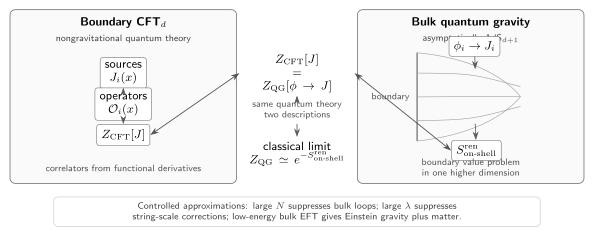
The most useful first form of AdS/CFT is not a picture of a CFT glued to a bulk spacetime. It is a dictionary between CFT sources and bulk boundary conditions for fields , summarized by . In the classical gravity limit this becomes .
The equality of partition functions is the gateway, not the whole subject. Once the dictionary is established, the same duality relates many different kinds of data:
| Boundary object | Bulk object | Leading classical-gravity avatar |
|---|---|---|
| CFT state $ | \Psi\rangle$ | Quantum-gravity state with specified asymptotics |
| Source for | Boundary condition for | Non-normalizable mode of a bulk field |
| One-point function | Canonical radial momentum of | Coefficient of the normalizable mode, after counterterms |
| Local primary | Bulk field | for a scalar |
| Conserved current | Bulk gauge field | Boundary gauge potential sources the current |
| Stress tensor | Bulk metric | Boundary metric sources |
| Thermal density matrix | Euclidean or Lorentzian black hole saddle | Horizon temperature and Bekenstein-Hawking entropy |
| Wilson loop | String worldsheet ending on | Minimal Nambu-Goto area |
| Entanglement entropy | Quantum extremal surface | Area term plus bulk entropy corrections |
The point of the course is to make every entry in this table precise enough that you can compute with it.
The canonical example in one paragraph
Section titled “The canonical example in one paragraph”The most famous example is the duality between four-dimensional super-Yang-Mills theory with gauge group conventionally taken as or , and type IIB string theory on
The boundary theory has a dimensionless Yang-Mills coupling and the ‘t Hooft coupling
The bulk theory has a string length , string coupling , and curvature radius shared by and . Parametrically,
Thus large suppresses bulk quantum loops, and large suppresses string-scale corrections. The familiar classical-supergravity regime is not the whole duality; it is the corner
where the bulk becomes weakly curved and semiclassical. This is the corner in which many spectacular calculations become simple, but it is also the corner where the boundary CFT is strongly coupled and difficult by conventional methods. That reversal is the engine of holography: a hard quantum-field-theory problem can become a classical geometry problem.
The same logic appears in other examples: M2-branes lead to AdS/CFT dualities, M5-branes lead to AdS/CFT dualities, and AdS/CFT has special features tied to Virasoro symmetry. The canonical example is special because it is highly symmetric and well controlled, not because AdS/CFT is only about super-Yang-Mills.
What is being equated?
Section titled “What is being equated?”A common beginner mistake is to imagine that the CFT is a lower-dimensional system living “on the wall” of an already existing gravitational spacetime. That picture is useful for intuition, but it is not the exact statement. The CFT is not a material membrane at the boundary. It is a complete quantum description of the same physics.
A sharper statement has several layers.
Equality of Hilbert spaces
Section titled “Equality of Hilbert spaces”In a Hamiltonian formulation, AdS/CFT asserts an isomorphism between the Hilbert space of the CFT on a spatial manifold and the Hilbert space of quantum gravity with corresponding asymptotically AdS boundary conditions. For global AdS, the boundary geometry is the cylinder
The CFT Hamiltonian generating time translations on the cylinder is dual to the global AdS energy. A CFT energy eigenstate corresponds to a quantum-gravity energy eigenstate. Low-energy states may look like particles moving in AdS; very high-energy states may look like black holes.
This statement is conceptually important because it prevents a misleading separation between “bulk degrees of freedom” and “boundary degrees of freedom.” The boundary theory is not an auxiliary probe of the bulk. It is the theory.
Equality of observables
Section titled “Equality of observables”Local CFT operators map to asymptotic bulk fields. Not every bulk-looking object is local in the CFT, and not every CFT object has a simple local bulk description. Still, in the large- semiclassical regime, single-trace primary operators are naturally associated with single-particle bulk fields. Multi-trace operators are associated with multiparticle states or with modified boundary conditions.
Schematically,
This notation should not be read as “the operator equals the value of the field at a point.” The CFT operator is inserted on the boundary. The bulk field is a dynamical object whose boundary behavior is controlled by sources and whose normalizable excitations encode states and expectation values.
Equality of dynamics
Section titled “Equality of dynamics”The equality is not only kinematical. It relates time evolution, thermodynamics, scattering-like observables in AdS, response functions, entanglement, and nonperturbative questions about quantum gravity. For example, a thermal CFT state on is dual at strong coupling and large to a planar AdS black brane. The relaxation of perturbations in the CFT is encoded in quasinormal modes of the black brane. The entropy density of the CFT is encoded in the horizon area density.
This is why AdS/CFT is more than a clever method for computing correlators. It is a definition of quantum gravity in asymptotically AdS spacetimes whenever the CFT is precisely defined.
Why anti-de Sitter space?
Section titled “Why anti-de Sitter space?”Anti-de Sitter space is special for several related reasons.
First, AdS has a timelike conformal boundary. Boundary conditions at infinity are part of the definition of the gravitational problem. This makes it natural for the boundary values of bulk fields to act as sources for a dual field theory.
Second, the isometry group of AdS is
which is also the conformal group of a -dimensional Lorentzian CFT, up to global and covering subtleties. This symmetry match is not a proof of the duality, but it is a necessary and powerful clue. The radial direction of AdS is not an extra boundary spacetime direction; it is geometrized scale. Near the boundary, the Poincaré metric
is invariant under the simultaneous scaling
Thus moving toward smaller corresponds roughly to probing shorter boundary distances, or higher field-theory energies. The slogan is
The word “roughly” matters. The radial/RG relation is extremely useful, but local bulk position is not itself a gauge-invariant CFT observable. The precise dictionary is formulated through boundary observables and bulk boundary value problems.
Third, AdS acts like a gravitational box. Massive particles and light rays can return from the boundary in finite global time once appropriate reflecting boundary conditions are imposed. Thermal equilibrium and black-hole thermodynamics are therefore especially natural in AdS. This feature is central to the Hawking-Page transition, black branes, and the thermodynamics of strongly coupled plasmas.
The generating-functional prescription
Section titled “The generating-functional prescription”Let a CFT be deformed by sources,
Depending on Euclidean versus Lorentzian conventions, signs and factors of vary. In Euclidean signature one may write
or absorb the sign into the definition of . What matters is the variational rule. The connected generating functional is
and connected correlation functions are obtained by functional differentiation. For example, with a convention in which ,
AdS/CFT says that the same can be computed from the bulk. In the full theory,
In the saddle-point approximation,
so
in Euclidean conventions. Therefore,
up to the sign convention used in defining the source deformation. Higher derivatives give higher-point functions. This is the Gubser-Klebanov-Polyakov/Witten prescription in its most economical form.
The prescription is powerful because a strongly coupled CFT calculation can become a classical boundary value problem. But the following ingredients are always required:
| Ingredient | Question to ask |
|---|---|
| Bulk action | Which low-energy fields are being retained, and which stringy or Kaluza-Klein modes are neglected? |
| Boundary condition | Which coefficient in the near-boundary expansion is held fixed? |
| Interior condition | Is the solution regular, smooth in Euclidean signature, infalling at a Lorentzian horizon, or something else? |
| Counterterms | Which local boundary terms must be added to make the variational problem and correlators finite? |
| Ensemble | Are we fixing temperature, charge, chemical potential, angular velocity, or boundary metric? |
| Normalization | How are , , gauge couplings, and operator normalizations defined? |
Most wrong calculations in elementary holography fail at one of these points.
Sources, states, and expectation values
Section titled “Sources, states, and expectation values”The source/vev distinction is the first technical subtlety every reader should master.
For a scalar field in AdS with mass , the two independent near-boundary behaviors are
where
In the standard quantization, is the source. The other coefficient is not freely chosen once the full solution and regularity or horizon conditions are imposed. Instead, it is determined dynamically and encodes the response.
This is directly analogous to ordinary linear response. If one perturbs a system by a source , the expectation value is determined by the equations of motion and boundary conditions. Holography geometrizes that response: solving the radial equation in the bulk computes the response of the boundary theory.
The same distinction appears for gauge fields and the metric. For a bulk gauge field,
where sources a conserved current . For the metric in Fefferman-Graham form,
with
where is the boundary metric that sources the stress tensor . Varying the renormalized on-shell action with respect to gives the holographic stress tensor.
A useful mental model is:
In gravity language, the source is part of the asymptotic boundary condition; the vev is encoded in the normalizable data of the solution.
Exact duality versus useful approximation
Section titled “Exact duality versus useful approximation”AdS/CFT is most dangerous when one forgets which approximation is being used. The hierarchy is:
then, under additional assumptions,
and, with a further large gap to stringy states,
This gives a practical ladder:
| Boundary regime | Bulk regime | Expansion parameter |
|---|---|---|
| finite , finite coupling | full quantum string/M-theory | no simple universal expansion |
| large , finite | classical string theory on a curved background | suppresses loops |
| large , large | classical supergravity | suppresses stringy corrections |
| low-energy sector with other fields controlled | Einstein gravity plus a few matter fields | derivative expansion in the bulk EFT |
For the canonical AdS/CFT duality,
Thus corrections are field-theory finite-coupling corrections, while bulk loop corrections are field-theory corrections. In many bottom-up holographic models, one assumes the existence of a classical bulk action without deriving it from a complete string compactification. Such models can be extremely useful, but their universality must be argued observable by observable.
A reliable holographic statement should therefore specify at least three things:
- the class of CFTs or top-down construction under discussion;
- the limit in which the bulk description is valid;
- whether the result is universal or model-dependent.
For example, the leading result is universal for a broad class of two-derivative Einstein-gravity duals, not for every quantum field theory and not for every holographic theory with higher-derivative corrections.
Why this is holography
Section titled “Why this is holography”In ordinary local quantum field theory, one expects the number of independent degrees of freedom in a spatial region to scale with the volume once a UV cutoff is imposed. Gravity suggests a different scaling. A black hole has entropy
which scales with the area of the horizon, not the volume behind it. This area scaling is one of the conceptual roots of holography.
AdS/CFT realizes this idea sharply. The bulk gravitational theory has one more dimension than the CFT, yet the CFT contains the complete information. The extra radial dimension is emergent. In the semiclassical limit, it becomes geometric because the CFT has a special large- structure: correlation functions factorize, single-trace operators behave like weakly interacting single-particle fields, and the density of degrees of freedom scales like a power of that matches the inverse Newton constant.
For a matrix large- CFT with an Einstein-like dual,
in the most familiar adjoint-gauge-theory examples. This is why a classical geometry knows about a huge number of CFT degrees of freedom: the smallness of is the largeness of the boundary central charge.
The holographic principle is therefore not merely the statement that information is stored on a boundary. In AdS/CFT it becomes a detailed calculational equivalence: boundary correlation functions, spectra, thermodynamics, transport coefficients, Wilson loops, and entanglement quantities are encoded in a higher-dimensional gravitational system.
What AdS/CFT is not
Section titled “What AdS/CFT is not”It is useful to clear away several tempting but incorrect statements.
It is not a proof that every QFT has a simple gravity dual
Section titled “It is not a proof that every QFT has a simple gravity dual”Most quantum field theories do not have known weakly curved Einstein-gravity duals. A simple local bulk dual requires special large- behavior and, roughly speaking, a sparse spectrum of low-dimension single-trace operators. Otherwise the bulk may be highly stringy, higher-spin, or not geometric in any simple sense.
It is not only a strong/weak duality
Section titled “It is not only a strong/weak duality”Many examples are strong/weak in useful regimes: strongly coupled SYM at large maps to weakly curved classical gravity. But the exact duality relates complete theories, not just opposite corners of perturbation theory. Protected quantities, supersymmetric sectors, integrability, localization, and anomalies can sometimes be compared away from the simplest supergravity limit.
It is not literally “gravity lives in the bulk and gauge theory lives on its boundary” as two coupled systems
Section titled “It is not literally “gravity lives in the bulk and gauge theory lives on its boundary” as two coupled systems”The two sides are not coupled to each other. They are two descriptions of the same quantum system. Turning on a source in the CFT corresponds to changing a boundary condition in the bulk, not to attaching an external device to a preexisting spacetime.
It is not automatically a model of QCD or condensed matter
Section titled “It is not automatically a model of QCD or condensed matter”Holographic QCD and holographic condensed matter are powerful research programs, but many models are phenomenological. They borrow robust mechanisms from AdS/CFT, such as black-brane horizons, scaling geometries, and bulk gauge fields, then apply them to systems that are not known to be exactly dual to those geometries. This is not a flaw, but it changes the standard of evidence: one must distinguish universal lessons from model-building assumptions.
A first example: the two-point function as a boundary value problem
Section titled “A first example: the two-point function as a boundary value problem”A minimal calculation already shows the logic. Consider a scalar operator of dimension in a Euclidean CFT. Conformal symmetry fixes the position-space two-point function up to normalization:
Holographically, we compute the same object by solving the bulk scalar equation in Euclidean AdS with boundary value . The classical solution can be written using a bulk-to-boundary propagator,
Substituting this solution into the renormalized on-shell action gives a quadratic functional of the source,
Taking two functional derivatives gives
The calculation does not merely reproduce the conformal form. It determines the normalization in terms of the bulk action normalization. In interacting examples, cubic and higher bulk couplings similarly determine CFT three-point and higher-point data. This is the practical meaning of “geometry encodes CFT data.”
A second example: thermal physics as black-hole physics
Section titled “A second example: thermal physics as black-hole physics”Put the CFT at temperature . The thermal partition function is
In Euclidean signature this corresponds to placing the theory on a circle of circumference in Euclidean time. The bulk dual must approach this boundary geometry. At large , the gravitational path integral is approximated by competing classical saddles with the same asymptotic boundary. Depending on the spatial topology and temperature, the dominant saddle may be thermal AdS or an AdS black hole.
When a black hole dominates, the leading CFT entropy is
The ellipsis includes quantum and higher-derivative corrections. In a planar black-brane geometry dual to a deconfined plasma, the entropy density often scales like
for an adjoint large- CFT. This is a direct geometric expression of the fact that the deconfined plasma has active degrees of freedom.
This example also shows why AdS/CFT changed the study of black holes. In the bulk, a black hole is a gravitational object with a horizon. In the boundary theory, the same object is a thermal state of an ordinary quantum system. Questions about black-hole entropy, relaxation, chaos, and information can therefore be rephrased as questions about CFT dynamics.
The role of conformal symmetry
Section titled “The role of conformal symmetry”The boundary theory in AdS/CFT is conformal because pure AdS has the symmetry group . In the Poincaré patch, scale transformations act geometrically as
Translations and Lorentz transformations act on the directions. Special conformal transformations arise from less obvious AdS isometries. Together they form the conformal group.
Conformal symmetry imposes strong constraints on CFT correlators. For scalar primaries,
assuming an orthogonal basis of primaries. Three-point functions are fixed up to constants :
The dynamical content of a CFT is therefore packaged into CFT data: operator dimensions, spins, OPE coefficients, central charges, and global-symmetry data. In holographic CFTs, this data is reorganized as bulk masses, spins, couplings, gauge symmetries, and gravitational constants.
This perspective is central to modern holography. Instead of saying vaguely that a CFT “has a gravity dual,” one can ask sharper questions: Does the CFT have large central charge? Does it have large- factorization? Does it have a sparse low-dimension single-trace spectrum? Are stress-tensor correlators close to those of Einstein gravity? Which higher-derivative terms are allowed by causality and unitarity? These questions convert holography from a slogan into a research program.
The first dictionary entries
Section titled “The first dictionary entries”The following dictionary entries will be derived carefully later. For now, they serve as orientation.
Scalar operators
Section titled “Scalar operators”A scalar primary of dimension maps to a bulk scalar field with mass
The two roots are
The Breitenlohner-Freedman bound,
allows some negative mass-squared fields without instability. This is possible because AdS curvature changes the stability criterion.
Currents
Section titled “Currents”A conserved current with dimension maps to a bulk gauge field . The boundary value sources the current:
Bulk gauge invariance implies the boundary Ward identity
when there are no anomalies or explicit symmetry-breaking sources.
Stress tensor
Section titled “Stress tensor”The CFT stress tensor maps to the bulk metric. The boundary metric is the source:
The expectation value is obtained from the renormalized gravitational action:
up to Euclidean/Lorentzian sign conventions. Boundary diffeomorphism invariance implies stress-tensor conservation, while Weyl transformations encode the trace Ward identity and conformal anomaly in even boundary dimensions.
The identity sector
Section titled “The identity sector”The identity operator and the stress tensor generate a universal sector of every CFT. In the bulk, this corresponds to the gravitational sector. When a holographic CFT has a large gap to other single-trace operators, the low-energy bulk dynamics can often be approximated by Einstein gravity with a negative cosmological constant,
The dots include matter fields, higher-derivative corrections, boundary terms, and counterterms. The Einstein action is not the definition of AdS/CFT; it is a low-energy effective description in a favorable regime.
Top-down, bottom-up, and universal statements
Section titled “Top-down, bottom-up, and universal statements”A top-down holographic model is derived from a known string or M-theory construction. The canonical D3-brane example is top-down. Such models have a UV-complete definition, though practical calculations may still require approximations.
A bottom-up holographic model starts with an effective gravitational theory designed to capture some desired field-theory behavior: a conserved current, a finite density, momentum relaxation, confinement-like spectra, superconducting instabilities, or scaling exponents. Bottom-up models are useful because they isolate mechanisms. They are risky when treated as exact duals without evidence.
A universal holographic statement is one that follows from a broad class of bulk effective theories and symmetries. For instance, the area law for black-hole entropy at leading order follows from two-derivative Einstein gravity. Corrections depend on the precise higher-derivative action. Similarly, many hydrodynamic relations follow from conservation laws and horizon regularity, while detailed spectral functions depend on model-specific bulk couplings.
As you read the course, keep labeling statements:
This habit is one of the best protections against confusion.
A minimal checklist for any holographic claim
Section titled “A minimal checklist for any holographic claim”When you encounter a claim such as “the holographic dual predicts ,” ask:
- Which CFT or class of CFTs is being discussed?
- What is the bulk theory: full string theory, supergravity, Einstein-Maxwell-scalar theory, probe branes, or an effective model?
- Which observable is ?
- What are the sources and boundary conditions?
- What is the state or ensemble?
- Is the calculation Euclidean or Lorentzian?
- Are there horizons, and if so what boundary condition is imposed there?
- What counterterms and contact-term conventions are used?
- Which limits suppress , , derivative, and backreaction corrections?
- Is the result universal, protected, or model-dependent?
This checklist may feel pedantic now. Later, when computing real-time Green functions or holographic stress tensors, it becomes survival gear.
Exercises
Section titled “Exercises”Exercise 1: Classify the statement
Section titled “Exercise 1: Classify the statement”For each statement, classify it as one of the following:
- an exact-duality statement;
- a large- statement;
- a classical-supergravity statement;
- a bottom-up phenomenological statement.
Statements:
- .
- Connected correlators of suitably normalized single-trace operators are suppressed at large .
- A strongly coupled plasma has .
- A Maxwell field in an AdS black-brane background can model charge transport in a strange metal.
- The entropy of a thermal state is given at leading order by the area of a classical black-hole horizon.
Solution
-
This is an exact-duality statement when the two sides are a precisely defined dual pair. In practice one often evaluates the right-hand side approximately, but the equality itself is the exact statement.
-
This is a large- statement. It follows from large- factorization in suitable matrix-like theories and is the boundary reason that bulk interactions become weak.
-
This is a classical-supergravity statement for a broad class of two-derivative Einstein-gravity duals. It is not true for arbitrary QFTs and can receive higher-derivative corrections.
-
This is a bottom-up phenomenological statement unless the Maxwell sector and geometry are derived from a specific top-down dual of the material or field theory under study.
-
This is a classical-supergravity or semiclassical-gravity statement. The leading term is for Einstein gravity; quantum and higher-derivative corrections modify it.
Exercise 2: Functional derivatives and connected correlators
Section titled “Exercise 2: Functional derivatives and connected correlators”Let
Show that
and
Solution
First,
Since ,
At this gives the ordinary one-point function. Differentiating again,
Setting gives
which is the connected two-point function.
Exercise 3: The first symmetry check
Section titled “Exercise 3: The first symmetry check”Show that the Poincaré AdS metric
is invariant under
where is constant. Interpret this transformation in the boundary CFT.
Solution
Under the transformation,
Therefore the numerator transforms as
while the denominator transforms as . The factors cancel, so is invariant.
On the boundary, this is the scale transformation . The radial coordinate transforms with the boundary length scale, which is the geometric origin of the radial/energy-scale relation.
Exercise 4: Which correction is which?
Section titled “Exercise 4: Which correction is which?”In the AdS/CFT example, use
to identify the boundary meaning of the following bulk corrections:
- stringy higher-derivative corrections controlled by powers of ;
- quantum loop corrections controlled by powers of .
Solution
From
we get
Therefore stringy higher-derivative corrections are finite-‘t Hooft-coupling corrections in the boundary theory.
From
we get
Therefore bulk loop corrections are corrections in the boundary theory.
Exercise 5: Source or response?
Section titled “Exercise 5: Source or response?”For a scalar field with near-boundary expansion
explain which coefficient is fixed when computing the generating functional in standard quantization, and which coefficient is determined by the bulk solution.
Solution
In standard quantization, is fixed. It is the boundary source for the operator . Once is specified, the bulk equations of motion must be solved with the appropriate interior condition, such as regularity in Euclidean AdS or an infalling condition at a Lorentzian horizon. The coefficient is then determined by the solution. After holographic renormalization, is related to the expectation value , with normalization and possible local contact terms depending on conventions.
Further reading
Section titled “Further reading”The foundational papers are the original brane-based proposal by Maldacena, the generating-functional formulation by Gubser-Klebanov-Polyakov, and Witten’s formulation of AdS observables and boundary data:
- Juan M. Maldacena, The Large Limit of Superconformal Field Theories and Supergravity.
- S. S. Gubser, I. R. Klebanov, and A. M. Polyakov, Gauge Theory Correlators from Non-Critical String Theory.
- Edward Witten, Anti de Sitter Space and Holography.
- Ofer Aharony, Steven S. Gubser, Juan Maldacena, Hirosi Ooguri, and Yaron Oz, Large Field Theories, String Theory and Gravity.
For this page, do not try to read every technical detail of these papers immediately. Read them first for the logic: branes give two low-energy descriptions, boundary values of bulk fields act as CFT sources, and large plus strong coupling turns quantum gravity into classical geometry.