
Holographic Quantum Matter
Holographic quantum matter is the part of gauge/gravity duality that treats strongly coupled many-body systems as gravitational problems. Its characteristic move is not to guess long-lived quasiparticles and then perturb around them. Instead, it asks whether a state of quantum matter can be described by a classical bulk geometry, often with a horizon, and whether observables such as entropy, conductivity, spectral weight, diffusion, chaos, and order can be computed from that geometry.
A useful first slogan is
A more careful version is
The second line is less punchy, but it is the one that keeps us honest. Holography gives controlled examples of quantum matter without quasiparticles, but most models in this subject are not literal microscopic duals of cuprates, heavy fermion compounds, graphene, or cold atoms. The goal of this course is to make the controlled statements precise, and then to explain what can and cannot be transported to real quantum materials.
In weakly interacting matter, a small perturbation usually creates long-lived excitations. A Fermi liquid is the canonical example: near the Fermi surface, the lifetime becomes long compared with the inverse excitation energy. Holographic quantum matter is built around the opposite possibility. In many holographic states, local equilibration occurs on the thermal time scale
and the low-energy poles are not quasiparticle poles near the real frequency axis but quasinormal modes in the lower half complex frequency plane. On the gravity side, dissipation is geometrized by infalling boundary conditions at a horizon.
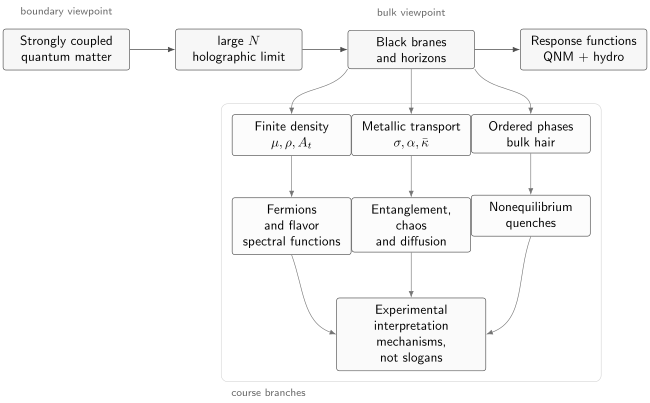
A roadmap for holographic quantum matter. The subject begins with strongly coupled large- quantum matter, represents thermal and dissipative dynamics by black branes, and then branches into finite density, transport, fermions, ordered phases, nonequilibrium dynamics, and experimental interpretation.
Prerequisites
Section titled “Prerequisites”This group assumes the basic AdS/CFT dictionary. You should already be comfortable with the idea that a boundary operator is sourced by the leading boundary behavior of a bulk field , and that the subleading renormalized data encode . You should also know the difference between global AdS and planar black branes, the meaning of a Hawking temperature, and the basic large- logic behind classical gravity.
The condensed-matter prerequisites are lighter but still important. You should know what a Fermi liquid is, what an order parameter is, what a conserved current is, and why transport coefficients are defined by linear response. We will review the necessary condensed-matter language, but the pace is aimed at readers who have already seen graduate quantum field theory and the basics of AdS/CFT.
The first few pages will slow down at the bridge concepts:
- quasiparticles versus quasinormal modes;
- quantum critical scaling versus black-brane thermodynamics;
- chemical potential and charge density versus bulk electric flux;
- momentum conservation versus infinite clean DC conductivity;
- spontaneous order versus bulk hair.
What counts as a holographic claim?
Section titled “What counts as a holographic claim?”Not all holographic models have the same status. This course will label models by their level of microscopic control.
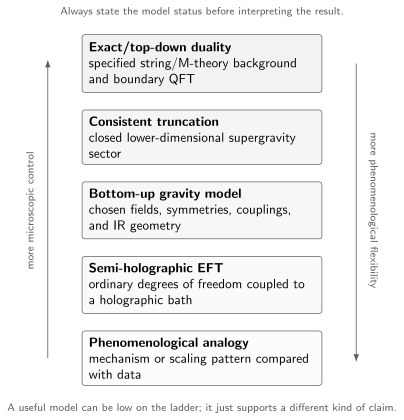
A model-status ladder. Moving upward increases microscopic control; moving downward often increases phenomenological flexibility. Good holographic work says where it stands on this ladder before drawing physical conclusions.
| Label | Meaning | Typical use | Main danger |
|---|---|---|---|
| Exact or top-down duality | The bulk follows from a specified string or M-theory construction with a known boundary theory. | Establish controlled examples and universal mechanisms. | The boundary theory may be far from a real material. |
| Consistent truncation | A lower-dimensional gravitational model is a closed subsector of a top-down compactification. | Compute reliably inside a protected sector. | Fields omitted by the truncation may matter for the physical question. |
| Bottom-up model | A bulk action is chosen to encode symmetries, relevant operators, and desired IR behavior. | Explore mechanisms for transport, scaling, and order. | Many different bulk actions can realize the same qualitative feature. |
| Semi-holographic effective theory | A conventional sector is coupled to a strongly interacting holographic bath. | Model electrons coupled to non-quasiparticle critical degrees of freedom. | The bath is controlled, but the full microscopic completion may not be. |
| Phenomenological analogy | A gravitational mechanism is compared to an experimental pattern. | Generate intuition and organize data. | Agreement with one exponent or curve is weak evidence. |
This distinction is not academic bookkeeping. It changes what a result means. The statement “this black brane has ” is a calculation in a model. The statement “this explains the strange metal in a cuprate” requires much more: the correct symmetries, density regime, disorder or lattice physics, thermodynamics, spectral functions, and independent transport signatures.
The core dictionary
Section titled “The core dictionary”The course repeatedly returns to the following entries.
| Boundary quantity | Bulk representation | Comment |
|---|---|---|
| Temperature | Hawking temperature of a black brane | Thermal equilibrium is encoded geometrically. |
| Entropy density | Horizon area density divided by | Large entropy is classical geometry in Planck units. |
| Conserved current | Bulk gauge field | A global boundary symmetry is a gauge symmetry in the bulk. |
| Chemical potential | Boundary value of | Usually choose a gauge regular at the horizon. |
| Charge density | Renormalized radial electric flux | Gauss’s law organizes fractionalized and cohesive charge. |
| Retarded correlator | Infalling linearized bulk fluctuation | The future horizon selects causal response. |
| Spectral density | Low-energy spectral weight diagnoses excitations. | |
| Quasiparticle pole | Quasinormal mode, when no long-lived quasiparticle exists | Poles move in the complex plane. |
| Order parameter | Normalizable mode of a bulk field | Source-free condensation indicates spontaneous breaking. |
| Momentum relaxation | Lattices, disorder, axions, massive gravity, or inhomogeneous horizons | Necessary for finite DC conductivity at finite density. |
A central warning already appears in this table. In a clean finite-density system, the electric current overlaps with conserved momentum. Therefore the DC conductivity is not finite merely because the system is strongly interacting. In hydrodynamic language, a clean metal has
when momentum is exactly conserved. With weak momentum relaxation rate , the pole is broadened into
This one formula prevents a lot of confusion. Strong interactions can make equilibration fast, but finite DC resistivity also requires a mechanism that relaxes momentum or an incoherent current that does not drag momentum.
Course structure
Section titled “Course structure”The group is organized as a cumulative course. Early pages define the rules of the game; later pages apply the rules to finite density, transport, fermions, order, and dynamics.
Part I — Orientation
Section titled “Part I — Orientation”- What Is Holographic Quantum Matter? The conceptual bridge between non-quasiparticle quantum matter, event horizons, and large- field theories.
- A Condensed-Matter Primer for Holographers. Fermi liquids, order parameters, quantum criticality, strange metals, and why transport is hard.
- Large , Horizons, and Model Status. Why classical bulk gravity appears, what large- does and does not buy, and how to read top-down and bottom-up claims.
Part II — Thermal quantum-critical matter
Section titled “Part II — Thermal quantum-critical matter”- Quantum Critical Matter. Scale invariance, CFT thermodynamics, and the zero-density fixed point.
- Black Branes and Thermodynamics. Planar AdS black branes, Euclidean smoothness, horizon area, and free energy.
- Retarded Green Functions and Horizons. Linear response, infalling boundary conditions, spectral functions, and quasinormal modes.
- Quantum-Critical Transport. Conductivity, diffusion, viscosity, membrane ideas, and the replacement of quasiparticles by collective damped modes.
Part III — Finite density and metallic transport
Section titled “Part III — Finite density and metallic transport”- Chemical Potential and Charged Black Branes. The dictionary for , , radial electric flux, and Reissner—Nordström AdS.
- Throats and Local Criticality. Extremal horizons, semi-local criticality, IR scaling dimensions, and near-horizon instabilities.
- Einstein—Maxwell—Dilaton, Lifshitz, and Hyperscaling Violation. Scaling geometries with exponents and .
- Metallic Transport Without Quasiparticles. Momentum bottlenecks, incoherent currents, thermoelectric matrices, and hydrodynamic transport.
- Momentum Relaxation, Lattices, and Disorder. Weak lattices, memory matrix methods, axions, Q-lattices, massive gravity, horizon formulae, and inhomogeneous numerics.
- Strange Metals and Planckian Transport. Linear-in- resistivity, Planckian time scales, semi-holography, and what holography can responsibly say about experiments.
Part IV — Fermions, flavor, and compressible matter
Section titled “Part IV — Fermions, flavor, and compressible matter”- Holographic Fermions and Spectral Functions. Bulk spinors, boundary Green functions, Fermi momenta, and non-Fermi-liquid self-energies.
- Electron Stars, Dirac Hair, and Luttinger Counts. Backreacted fermion charge, cohesive versus fractionalized matter, and charge sum rules.
- Probe Branes, Flavor, and DBI Transport. Fundamental matter, probe limits, DBI actions, zero sound, and nonlinear response.
Part V — Ordered and topological response
Section titled “Part V — Ordered and topological response”- Holographic Superconductors and Superfluids. Charged scalar instabilities, hairy black branes, source-free condensates, and optical conductivity.
- Spatially Modulated Phases and Competing Orders. Stripes, helices, density waves, spontaneous translation breaking, pinning, and phase relaxation.
- Magnetic Fields, Hall Transport, and Anomalies. Dyonic branes, conductivity tensors, magnetization currents, Chern—Simons terms, and anomaly-induced transport.
Part VI — Diagnostics, dynamics, and experiments
Section titled “Part VI — Diagnostics, dynamics, and experiments”- Entanglement, Chaos, and Diffusion. Entanglement diagnostics of compressible matter, butterfly velocity, Lyapunov growth, and diffusion bounds.
- Nonequilibrium Holographic Quantum Matter. Quenches, Vaidya geometries, hydrodynamization, Kibble—Zurek dynamics, and driven ordered phases.
- Experimental Connections and Epistemic Limits. What can be compared to graphene, cuprates, pnictides, heavy fermions, Weyl semimetals, and cold atoms; and what cannot.
Part VII — Toolkit
Section titled “Part VII — Toolkit”- Computing Holographic Observables. A practical workflow: choose an action, solve a background, linearize, impose horizon conditions, renormalize, and extract observables.
- Dictionary Tables and Common Normalizations. A reference page for conventions, source/vev identifications, conductivities, heat currents, and scaling exponents.
- Numerical Holography and Open Problems. ODEs versus PDEs, DeTurck methods, QNMs, inhomogeneous horizons, and research-level problems.
Reading tracks
Section titled “Reading tracks”The full path is linear, but most readers arrive with a project in mind.
The shorthand below uses Part.Page codes, so III.4 means the fourth page in Part III.
| Goal | Suggested path |
|---|---|
| Learn the subject seriously | Parts I through VII in order. |
| Compute transport | I.1, I.3, II.2, II.3, II.4, III.1, III.4, III.5, VII.1, VII.2. |
| Understand finite-density IR physics | I.1, I.3, III.1, III.2, III.3, IV.1, IV.2, VI.1. |
| Study holographic superconductors | I.1, II.3, III.1, III.2, V.1, V.2, V.3, VII.1. |
| Work on fermions and spectral functions | II.3, III.1, III.2, IV.1, IV.2, IV.3, VII.2. |
| Compare to experiments | I.2, III.4, III.5, III.6, VI.1, VI.3. |
| Build numerical solutions | II.2, III.1, III.5, V.1, V.2, VII.1, VII.3. |
Notation used throughout
Section titled “Notation used throughout”The following conventions will be kept as stable as possible.
| Symbol | Meaning |
|---|---|
| bulk spacetime dimension | |
| boundary spacetime dimension, unless a page explicitly says “ spatial dimensions” | |
| AdS radius | |
| bulk Newton constant | |
| radial coordinate near the boundary, usually | |
| alternative radial coordinate; the page will state whether the boundary is or | |
| temperature | |
| entropy density | |
| chemical potential | |
| charge density | |
| energy density | |
| pressure | |
| static susceptibility between quantities and | |
| momentum relaxation rate | |
| retarded Green function | |
| frequency | |
| spatial momentum | |
| or | dynamical critical exponent; when confusion with the radial coordinate is possible, the page will write |
| hyperscaling violation exponent | |
| butterfly velocity | |
| Lyapunov exponent |
What this course will not hide
Section titled “What this course will not hide”Large is not a decorative limit. It suppresses bulk quantum loops and makes classical gravity useful. It also changes the microscopic character of the boundary theory. Large- matter can teach universal mechanisms, but it is not automatically the same as finite- electron matter.
Bottom-up models are not mistakes. They are effective gravitational theories designed to isolate mechanisms. The right question is not “is this model top-down?” but “what question is this model controlled enough to answer?”
A horizon is not a quasiparticle. Horizons absorb. Quasinormal modes decay. If a result looks too much like weakly interacting particle physics, check whether a long-lived pole has secretly been assumed.
Transport requires conservation laws. Scaling arguments for resistivity are often incomplete unless they specify the slow modes, their overlaps with current, and the mechanism that relaxes them.
Experiments are not explained by matching one exponent. Strong evidence comes from linked predictions: thermodynamics, optical conductivity, Hall response, magnetoresistance, spectral functions, scaling crossovers, and constraints from Ward identities.
Exercises
Section titled “Exercises”Exercise 1: Why clean holographic metals conduct too well
Section titled “Exercise 1: Why clean holographic metals conduct too well”Consider a translationally invariant finite-density state with charge density . Explain why the DC electric conductivity is infinite even if local equilibration is very fast.
Solution
In a translationally invariant system, total momentum is conserved. At finite density, the electric current usually overlaps with momentum. Physically, an electric field accelerates the charged fluid; if momentum cannot decay, the current cannot relax to a finite steady value.
Hydrodynamically this appears as a pole in the conductivity,
where is the momentum susceptibility. The imaginary pole implies a delta function in at . Fast equilibration controls how quickly the system becomes a locally thermal fluid; it does not by itself relax the conserved total momentum. A finite DC resistivity requires momentum relaxation, an incoherent current, or both.
Exercise 2: Entropy scaling from hyperscaling violation
Section titled “Exercise 2: Entropy scaling from hyperscaling violation”A hyperscaling-violating quantum critical phase in boundary spatial dimensions has entropy density
For , , and , what is the low-temperature scaling of ? What feature of a Fermi surface does often imitate?
Solution
Substituting the exponents gives
Thus
The value often imitates the effective dimensional reduction associated with a Fermi surface. A conventional Fermi surface has many low-energy modes living near a codimension-one surface in momentum space; hyperscaling violation can reproduce some thermodynamic features of that structure even when the holographic state does not have ordinary quasiparticles.
Exercise 3: Source and response at finite density
Section titled “Exercise 3: Source and response at finite density”Near the AdS boundary, a bulk Maxwell field often has an expansion of the schematic form
with the precise power and coefficient depending on conventions and dimension. Which quantity is the source, which is the response, and what is the bulk interpretation of ?
Solution
The chemical potential is the source for the boundary charge density operator . The charge density is the response.
In the bulk, is encoded in the renormalized radial electric flux. Schematically,
This is why Gauss’s law is so powerful in finite-density holography. The boundary charge can be carried by electric flux entering a charged horizon, by charged bulk matter outside the horizon, or by a mixture of the two.
Exercise 4: Classify the claim
Section titled “Exercise 4: Classify the claim”Classify each statement by model status: top-down, consistent truncation, bottom-up, semi-holographic, or phenomenological analogy.
- “Type IIB string theory on is dual to super-Yang—Mills.”
- “An Einstein—Maxwell—Dilaton action is chosen because it produces .”
- “A weakly coupled electron band is coupled to an IR critical sector with a holographic Green function.”
- “A holographic model with linear resistivity is proposed as an analogy for cuprate strange metals.”
Solution
- This is top-down and, in the appropriate regime, an exact duality.
- This is usually bottom-up unless the action and couplings are derived from a specified compactification or consistent truncation.
- This is semi-holographic: part of the theory is conventional, while the strongly coupled bath is represented holographically.
- This is a phenomenological analogy unless the model is supplemented by a controlled microscopic relation to the material and additional observable predictions.
The classification is not a ranking of usefulness. It is a statement about what kind of inference the model supports.
Exercise 5: Build a research route
Section titled “Exercise 5: Build a research route”You want to compute the optical conductivity of a holographic superconductor with weak momentum relaxation. Which pages should you read first, and why?
Solution
A good route is:
- Retarded Green Functions and Horizons, because optical conductivity is a real-time response function and requires infalling boundary conditions.
- Quantum-Critical Transport, because it introduces Kubo formulae and the Maxwell fluctuation calculation.
- Chemical Potential and Charged Black Branes, because the normal phase is finite density.
- Metallic Transport Without Quasiparticles, because the current can overlap with momentum.
- Momentum Relaxation, Lattices, and Disorder, because finite DC transport requires translation breaking.
- Holographic Superconductors and Superfluids, because the condensed phase changes the fluctuation equations and introduces a superfluid component.
- Computing Holographic Observables, because the final result requires a careful numerical or analytic workflow.
Further reading
Section titled “Further reading”The pages in this group are written as self-contained lecture notes, but the following references are especially useful companions.
- Sean A. Hartnoll, Andrew Lucas, and Subir Sachdev, “Holographic Quantum Matter,” arXiv:1612.07324.
- Jan Zaanen, Yan Liu, Ya-Wen Sun, and Koenraad Schalm, Holographic Duality in Condensed Matter Physics.
- Sean A. Hartnoll, “Lectures on Holographic Methods for Condensed Matter Physics,” arXiv:0903.3246.
- Subir Sachdev, “What string theory taught us about quantum matter,” arXiv:1110.6411.
- Martin Ammon and Johanna Erdmenger, Gauge/Gravity Duality: Foundations and Applications.
- Makoto Natsuume, AdS/CFT Duality User Guide.
- Mukund Rangamani and Tadashi Takayanagi, Holographic Entanglement Entropy.
- Ofer Aharony, Steven S. Gubser, Juan Maldacena, Hirosi Ooguri, and Yaron Oz, “Large Field Theories, String Theory and Gravity,” arXiv:hep-th/9905111.
The next page starts with the basic question: what does it mean to study quantum matter without quasiparticles, and why do horizons know so much about dissipation?