
NSR Vertex Operators and Picture Changing
The NSR formalism has a small but important extra layer that is absent in the bosonic string: a physical vertex operator is not specified only by its matter part. It also carries a superghost picture. Different pictures represent the same BRST cohomology class, but they are useful in different computations.
The key facts are these:
- NS vertices are often written in the and pictures.
- Ramond vertices are often written in the picture.
- At tree level on the sphere, the total left-moving picture number must be , and the total right-moving picture number must also be .
- At tree level on the disk, the total open-string picture number must be .
This page collects the standard NSR vertices and explains how picture-changing connects them.
Review: the superghost scalar and picture number
Section titled “Review: the superghost scalar and picture number”The commuting superghost system can be bosonized as
where
The exponential has conformal weight
The integer or half-integer is called the picture number. Thus
These two numbers explain why the most economical massless vertices are in the NS sector and in the Ramond sector.
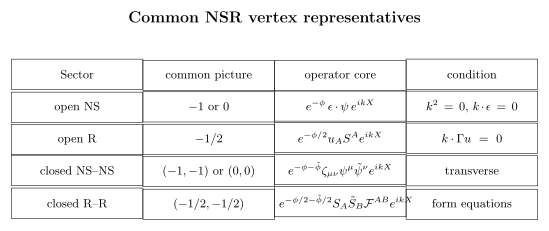
The NS sector is naturally written in pictures and , while the Ramond sector is naturally written in picture . Closed-string vertices are products of left- and right-moving open-string building blocks.
Open-string NS vertices
Section titled “Open-string NS vertices”For an open-string gauge boson with momentum and polarization , the picture unintegrated vertex is
Here is a coordinate on the boundary of the disk or upper half-plane, and is a Chan—Paton matrix. The physical-state conditions are
The weight check is simple. On the boundary, the integrated vertex must have weight . For the massless state,
so the matter-plus-superghost part has . Multiplication by then gives an unintegrated vertex of total weight zero.
The zero-picture gauge-boson vertex is obtained by picture-changing:
up to a harmless overall normalization convention. The important structure is the sum
The first term is the bosonic gauge-boson vertex. The second term is required by worldsheet supersymmetry.
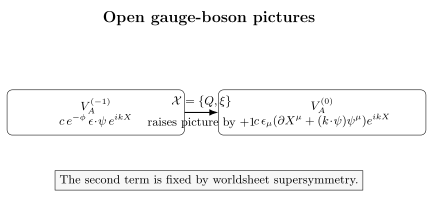
The picture-changing operator turns into the supersymmetric combination .
The picture-changing operator
Section titled “The picture-changing operator”The picture-changing operator is the BRST commutator
Its leading matter term is
where the matter supercurrent is schematically
If is a BRST-closed vertex operator in picture , then a representative in picture is
provided the limit is nonsingular after taking the appropriate OPE coefficient. The new vertex is BRST-equivalent to the old one.
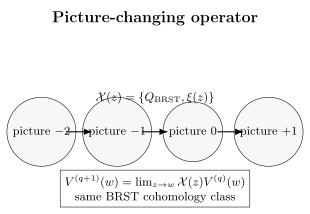
Picture changing raises the picture number by one. Different pictures give different representatives of the same physical BRST cohomology class.
One should not think of picture-changing as an optional decoration. The path integral over the superghost zero modes forces a definite total picture number. The choice of which vertices carry which pictures is a gauge choice in the odd directions of supermoduli space.
A compact normalization checkpoint
Section titled “A compact normalization checkpoint”Different books normalize the open-string zero-picture vertex in slightly different ways. The invariant statement is that picture-changing produces the supersymmetric combination
The constant depends on whether one uses boundary or holomorphic-plane normalizations for . All physical amplitudes are unchanged once the vertex normalization and coupling are chosen consistently.
Ramond vertices
Section titled “Ramond vertices”A massless open-string Ramond vertex in the picture is
Here is a ten-dimensional spin field and is a spacetime spinor wavefunction. The conformal weights add to one:
so the integrated Ramond vertex has weight when .
The physical-state condition is the massless Dirac equation
For a closed-string R—R state, the standard vertex is a product of two Ramond vertices:
The bispinor is equivalent to a sum of antisymmetric R—R field strengths,
with the allowed values of determined by the Type IIA or Type IIB chirality choice.
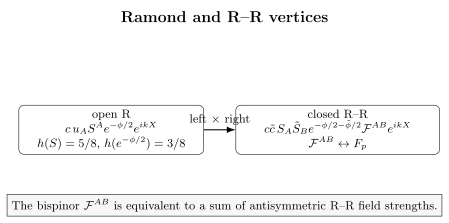
The open Ramond vertex contains one spin field and . The closed R—R vertex contains a left and right spin field and packages R—R field strengths into a spacetime bispinor.
Closed-string NS vertices
Section titled “Closed-string NS vertices”The massless NS—NS vertex in the picture is
The physical conditions are
with gauge equivalences inherited from BRST-exact vertices. The polarization decomposes as
corresponding to the graviton, -field, and dilaton.
The picture vertex is obtained by applying picture-changing separately in the left and right sectors. Its matter part is schematically
Again, the exact numerical coefficients depend on normalization conventions, but the tensor structure is fixed.
Picture bookkeeping on the sphere
Section titled “Picture bookkeeping on the sphere”For a closed-string sphere amplitude, the left and right picture numbers must each add to :
A standard NS—NS tree-level choice is
The first three vertices also usually carry the ghosts needed to fix the conformal Killing group.
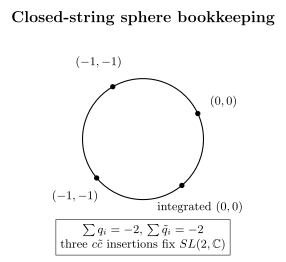
On the sphere, the total picture number is separately in each chiral sector. Three unintegrated vertices supply the ghost zero modes.
For amplitudes involving Ramond states, one distributes half-integer pictures so that the same total rule is satisfied. For example, a two-Ramond two-NS closed-string amplitude may use Ramond vertices in and NS vertices chosen to complete the total.
Picture bookkeeping on the disk
Section titled “Picture bookkeeping on the disk”For an open-string disk amplitude, the total picture number is
A common -gluon choice is
The three unintegrated boundary vertices contain ghosts and fix the automorphism group of the disk.
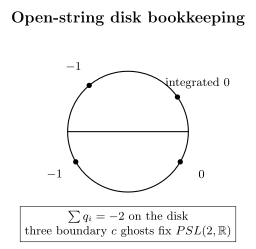
Open-string disk amplitudes require total picture number . Three boundary positions are fixed by and are represented by unintegrated vertices carrying ghosts.
This is the practical rule used in almost all tree-level NSR amplitude computations.
Why amplitudes do not depend on PCO positions
Section titled “Why amplitudes do not depend on PCO positions”If , then moving a picture-changing operator changes the integrand by a BRST-exact term, at least away from singularities:
In a BRST-invariant amplitude, BRST-exact insertions decouple. Thus the amplitude is independent of PCO positions, provided no spurious singularities are crossed. At higher genus this statement becomes subtle because of supermoduli space, but at tree level it is a reliable computational principle.
Exercises
Section titled “Exercises”Exercise 1
Section titled “Exercise 1”Verify that the open-string Ramond vertex
has total conformal weight zero when .
Solution
The unintegrated vertex contains a ghost of weight . For the matter-superghost part,
for a massless state. Therefore
Multiplication by gives total weight .
Exercise 2
Section titled “Exercise 2”In an open-string disk amplitude with four gauge bosons, choose pictures and unintegrated/integrated vertices satisfying both the picture-number and -ghost zero-mode rules.
Solution
The disk has three conformal Killing vectors, so three boundary vertices should be unintegrated and carry ghosts. The total picture number must be . A standard choice is
The first three vertices are unintegrated. The picture numbers add to .
Exercise 3
Section titled “Exercise 3”Show that the NS—NS vertex in the picture has the correct total conformal weights for an unintegrated closed-string vertex.
Solution
In each chiral sector,
when . Thus the left matter-superghost factor has , and the right factor has . Multiplication by gives
as required for an unintegrated closed-string insertion.
Exercise 4
Section titled “Exercise 4”Explain why applying one picture-changing operator to a NS—NS vertex produces a vertex, not a vertex.
Solution
The left and right superghost systems are independent. A single holomorphic picture-changing operator raises only the left picture:
A single antiholomorphic picture-changing operator raises only the right picture:
To obtain a vertex one must apply picture-changing in both sectors.