
Heavy Quark Potential
The rectangular loop as a potential
Section titled “The rectangular loop as a potential”The cleanest dynamical use of a Wilson loop is to extract the static potential between a heavy external quark and antiquark. In Euclidean signature, take a rectangular contour with spatial separation and long Euclidean time extent . For , the spectral decomposition gives
This equation is not a definition of every Wilson loop. It is a special large-time limit. The Wilson loop creates a heavy pair, lets it propagate for Euclidean time , and annihilates it. Excited states are exponentially suppressed, leaving the ground-state energy in that external-charge sector.
For a confining theory one expects
with string tension . For a conformal theory in four dimensions, dimensional analysis instead forces
for infinitely massive external probes in flat space. The nontrivial question is the coupling dependence of . In weakly coupled perturbation theory one finds a Coulombic potential proportional to . In strongly coupled planar SYM, holography predicts instead
for the usual Maldacena-Wilson loop with a fixed scalar coupling.
The striking part is not the form. Conformal invariance already demands that. The striking part is the nonanalytic dependence. It is the signature of a classical fundamental string: the string tension in AdS units is
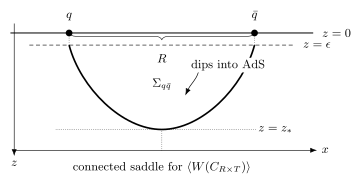
The static potential is computed by a connected U-shaped fundamental string ending on two long antiparallel lines at the AdS boundary. The infinite masses of the isolated external probes are removed by subtracting two straight strings. The maximal depth is proportional to the boundary separation .
This page derives the boxed formula. The calculation is important because it is the simplest example where a nonlocal gauge-theory observable is obtained from an extended classical object in the bulk.
The setup in Euclidean AdS
Section titled “The setup in Euclidean AdS”Work in Euclidean Poincaré AdS and keep the string fixed at a point of the :
The rectangular loop lies at . Choose the quark and antiquark to sit at
and extend along Euclidean time . Translation invariance in suggests the static gauge
The induced metric on the worldsheet is
where . The Euclidean Nambu-Goto action becomes
Thus the bare energy functional is
The solution is symmetric about . Let its deepest point be
and impose at the boundary, regulated in intermediate steps by .
The first integral
Section titled “The first integral”The Lagrangian density
has no explicit dependence. Therefore the corresponding mechanical Hamiltonian is conserved:
At the turning point and , so
Hence
or equivalently
Solving for the profile gives
This equation already contains the main geometry. Near the boundary , one has , so the string approaches the boundary almost vertically. Near the midpoint, , so the string turns around smoothly.
Separation versus turning point
Section titled “Separation versus turning point”The half-separation is obtained by integrating from the boundary to the turning point:
Set . Then
The integral is a beta-function integral:
Therefore
or
The result is exactly what one expects from the AdS scaling symmetry
Large boundary separation forces the connected string deeper into the bulk. This is one of the cleanest incarnations of the UV/IR relation.
The divergent bare energy
Section titled “The divergent bare energy”Using the first integral, the energy of the connected surface can be written as
The divergence near is easy to see:
Thus
This divergence is not a mysterious new UV divergence of the potential. It is the infinite rest mass of the two external quarks. A single isolated external quark is represented by a straight string stretching from the boundary into the interior. In pure AdS its regulated energy is
The potential is the interaction energy, so one subtracts :
Equivalently,
The bracket evaluates to a negative constant. Using gamma-function identities, one obtains
Numerically,
So the potential is attractive:
Why the result is Coulombic but not perturbative
Section titled “Why the result is Coulombic but not perturbative”The form is fixed by conformal invariance. The coefficient is dynamical.
At weak coupling, the static potential may be obtained from gauge-boson and scalar exchange between the two heavy sources. Schematically,
At strong coupling, the holographic answer is
There is no reason for the weak-coupling Taylor series in to analytically continue into the strong-coupling answer. The minimal surface computes a genuinely nonperturbative strong-coupling regime.
The is easy to understand from the worldsheet point of view. The shape of the minimal surface is set by AdS geometry and is independent of after measuring lengths in units of . The action is the dimensionless string tension times the dimensionless area:
This also explains why the result is order rather than order . We inserted external fundamental probes. A probe fundamental string does not backreact on the leading classical geometry at large .
The force and concavity
Section titled “The force and concavity”The force between the external quark and antiquark is
The force is negative in the convention where negative means attractive. The potential is monotone increasing as increases from zero to infinity:
and concave downward:
These properties are expected for a static potential extracted from Wilson loops in a reflection-positive theory. Holographically, they are encoded in the fact that deeper connected surfaces cost less energy after subtracting the external masses, while the family of surfaces respects the AdS scaling symmetry.
Connected versus disconnected worldsheets
Section titled “Connected versus disconnected worldsheets”In pure AdS, the connected U-shaped surface exists for every and gives the attractive Coulombic potential. There is also a disconnected configuration: two straight strings, one for the quark and one for the antiquark. After subtracting the same two quark masses, the disconnected configuration has zero interaction energy:
The connected surface has
so it dominates the Wilson loop saddle in the vacuum.
At finite temperature the story changes. The AdS black brane has a horizon, and two disconnected straight strings can end on the horizon. The connected U-shaped surface exists only up to a maximum separation in many backgrounds, and even before that it may cease to dominate. This is the geometric origin of color screening in the deconfined plasma.
This is why the zero-temperature calculation should not be described as confinement. It is a strong-coupling Coulomb potential in a conformal theory. Confinement requires an IR scale and a different large-distance geometry, such as an end-of-space cap, a hard wall, or another mechanism that makes long strings prefer to lie along an IR region with nonzero effective tension.
Finite quark mass and flavor branes
Section titled “Finite quark mass and flavor branes”The calculation above describes infinitely massive external quarks. The string endpoints are at the AdS boundary, and the straight-string mass diverges. In a more realistic probe-flavor setup, one introduces flavor branes. The string endpoint then lives on a brane at finite radial position , giving a finite quark mass roughly
The Wilson loop is no longer a purely external insertion in the original adjoint theory; it is related to adding fundamental matter. The U-shaped string is cut off before reaching the boundary, and the potential is modified at distances comparable to .
This distinction matters. The canonical Maldacena-Wilson loop is an external probe observable in pure SYM. Dynamical quarks require extra degrees of freedom, usually from D7-branes or other flavor branes, and the physics of string breaking depends on whether fundamental matter is dynamical and whether its backreaction is included.
Magnetic and dyonic probes
Section titled “Magnetic and dyonic probes”The same calculation has close cousins. A magnetic external monopole is represented not by a fundamental string but by a D1-string. A dyonic probe is represented by a string. In type IIB theory, the string tension depends on the axio-dilaton, so the corresponding line-operator potential transforms under S-duality.
For the fundamental string at large , the coefficient scales as . For a D1-string in the same background, the effective tension contains , and the result is naturally expressed in the S-dual coupling. This is the line-operator version of the broader statement that Wilson and ‘t Hooft loops are exchanged under electric-magnetic duality.
What this computation teaches
Section titled “What this computation teaches”This calculation is elementary, but it teaches several lessons that recur throughout holography.
| Feature | Boundary interpretation | Bulk mechanism |
|---|---|---|
| Long rectangular loop | Static external sector | Time-translation-invariant worldsheet |
| limit | Ground-state energy | Classical saddle action proportional to |
| potential | Conformal invariance | AdS scale symmetry |
| coefficient | Strong-coupling nonanalyticity | Fundamental string tension |
| UV divergence | Infinite external-quark mass | Straight string near the boundary |
| Subtraction | Interaction energy | Remove two disconnected straight strings |
| Turning point | Size of the probe | Radial UV/IR relation |
| No area law | No confinement in vacuum SYM | Pure AdS has no IR wall |
The key moral is this: the string worldsheet is not a cartoon of a flux tube in four-dimensional space. It is a two-dimensional surface in the higher-dimensional bulk. Its radial sagging is what converts strong coupling into a computable classical geometry.
Common mistakes
Section titled “Common mistakes”Mistake 1: forgetting the mass subtraction. The bare minimal area diverges as . This divergence is the rest mass of the infinitely heavy sources. The physical potential is the connected energy minus two isolated straight-string energies.
Mistake 2: calling the result confining. The potential is Coulombic, . That is exactly what a conformal theory permits. A confining potential would grow linearly at large .
Mistake 3: treating the ordinary Wilson loop and the Maldacena-Wilson loop as identical. In SYM the clean string dual uses a loop that also couples to scalars. A purely gauge-field loop has subtler boundary conditions and is not the same protected object.
Mistake 4: confusing with a new physical scale. In pure AdS, is determined by . It is not an independent mass scale. In confining or thermal geometries, additional scales enter through the background.
Mistake 5: assuming the connected saddle always dominates. In pure AdS vacuum it does. At finite temperature or in other backgrounds, disconnected worldsheets may dominate, producing screening or phase transitions in Wilson-loop observables.
Exercises
Section titled “Exercises”Exercise 1: Extracting the potential
Section titled “Exercise 1: Extracting the potential”Assume the Wilson-loop correlator has a spectral representation
with and . Show that
Solution
Factor out the lowest energy:
As , the bracket approaches if . Therefore
and the second term vanishes in the large- limit. Hence .
Exercise 2: The first integral
Section titled “Exercise 2: The first integral”Starting from
show that the minimal surface obeys
Solution
Since has no explicit dependence,
is conserved. We have
so
At the turning point and , this constant is . Thus
which implies
Therefore
Exercise 3: The separation integral
Section titled “Exercise 3: The separation integral”Evaluate
in terms of gamma functions.
Solution
Let . Then and
Thus
Using
we get
Since and ,
Exercise 4: Dimensional analysis of the answer
Section titled “Exercise 4: Dimensional analysis of the answer”Use only conformal invariance and large- probe counting to argue that the potential in planar SYM must have the form
Why does this argument not determine ?
Solution
In a four-dimensional conformal theory in flat space, the static potential has energy dimension one. The only length scale introduced by two infinitely heavy external probes is their separation , so the potential must scale as . The coefficient can depend on dimensionless parameters such as the ‘t Hooft coupling and on corrections.
A fundamental Wilson loop is a probe observable, not an order- deformation of the state. Therefore the leading planar potential is order , with corrections suppressed by powers of in the closed-string genus expansion.
This determines the form
but not the function . Perturbation theory gives the small- expansion. The classical string calculation gives the large- behavior .
Exercise 5: The force
Section titled “Exercise 5: The force”Given
compute the force and check the concavity of .
Solution
Differentiate:
Therefore
The force is attractive. The second derivative is
so the potential is concave downward.
Exercise 6: What would change in a confining geometry?
Section titled “Exercise 6: What would change in a confining geometry?”Suppose a holographic background ends smoothly at an IR scale , and long strings prefer to sit near that endpoint. Explain qualitatively why the large- potential can become linear.
Solution
For large boundary separation , the connected string stretches from the boundary down to the IR region, runs horizontally for a long distance near , and then returns to the boundary. The two vertical pieces contribute approximately the quark masses and are subtracted. The horizontal piece has an effective tension determined by the local redshifted string tension at the IR endpoint.
Thus the renormalized energy behaves as
for large , where schematically
This is the holographic origin of an area law for Wilson loops in many confining geometries.
Further reading
Section titled “Further reading”The original strong-coupling Wilson-loop calculation and heavy-quark potential were developed in Juan Maldacena, “Wilson loops in large N field theories”, and Soo-Jong Rey and Jung-Tay Yee, “Macroscopic strings as heavy quarks: Large-N gauge theory and anti-de Sitter supergravity”. Finite-temperature Wilson and Wilson-Polyakov loop physics was developed early in Rey, Theisen, and Yee, “Wilson-Polyakov Loop at Finite Temperature in Large N Gauge Theory and Anti-de Sitter Supergravity”, and Brandhuber, Itzhaki, Sonnenschein, and Yankielowicz, “Wilson Loops, Confinement, and Phase Transitions in Large N Gauge Theories from Supergravity”. For regularization, scalar couplings, supersymmetric loops, and minimal-surface subtleties, see Drukker, Gross, and Ooguri, “Wilson Loops and Minimal Surfaces”.