
Closed-String T-Duality and Enhanced Symmetry
Compactification is where strings first look unmistakably different from point particles. A point particle moving on a circle of radius has quantized momentum , so by measuring the spectrum one can infer the size of the circle. A closed string has a second integer quantum number: it can wind around the circle. T-duality is the statement that the theory on a circle of radius is equivalent to the theory on a circle of radius , provided momentum and winding are exchanged.
This is not merely an approximate symmetry of the low-energy spectrum. It is an exact perturbative string equivalence. It also foreshadows many later dualities: variables that look elementary in one description may be nonlocal, solitonic, or topological in another.
Closed strings on
Section titled “Closed strings on SR1S^1_RSR1”Let one target-space coordinate be compact,
and let the remaining coordinates be noncompact. For a closed string, , but the map into the compact target-space circle need only close up to an integer winding:
The integer is the winding number. It has no point-particle analog. It is topological: as long as the string stays closed and the target circle remains intact, a string wound times cannot be continuously deformed into a string wound times.
The center-of-mass wavefunction on the circle is periodic, so the momentum is quantized:
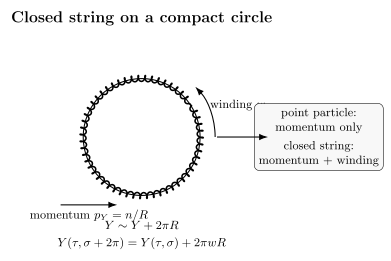
A closed string on has both point-particle-like momentum and intrinsically stringy winding .
The compact coordinate separates into left- and right-moving parts,
With the conventions used throughout these notes,
The average of and is the physical momentum:
The difference is fixed by the winding condition. Increasing by changes the zero-mode part by
Therefore
The pair is the compactification-lattice vector associated with the integers .
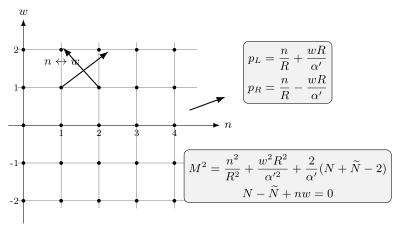
The integers determine . The sum contributes to the mass, while the difference enters level matching.
Mass formula and level matching
Section titled “Mass formula and level matching”For the bosonic closed string, the physical-state conditions are
Let be the mass squared measured in the noncompact spacetime. Separating the compact zero modes gives
and
Adding the two equations gives
Subtracting them gives
Since
we obtain the modified level-matching condition
In noncompact flat space, level matching says . On a circle, compact zero modes can compensate a mismatch between the left and right oscillator levels.
The radius-inversion symmetry
Section titled “The radius-inversion symmetry”The mass formula is invariant under
Indeed,
The oscillator term is unchanged, and is invariant, so level matching is unchanged.
The left- and right-moving momenta transform in a particularly simple way. Under and ,
Thus T-duality acts on the compact coordinate as
The dual coordinate parametrizes a circle of radius
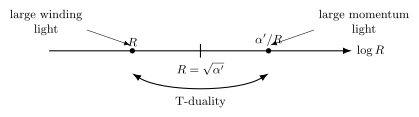
T-duality identifies the radius with the inverse radius . The fixed point is .
A very small circle is therefore equivalent to a very large dual circle. This is the first sign that string geometry is not ordinary Riemannian geometry plus small corrections. The set of physical probes is enlarged by winding strings, and those probes identify geometries that a point particle would distinguish.
Normalization checkpoint. With explicit, the self-dual radius is . If one temporarily sets , then .
The self-dual radius and extra massless states
Section titled “The self-dual radius and extra massless states”At a generic radius, compactification on a circle gives two abelian gauge fields in the lower-dimensional spacetime. They come from the metric and antisymmetric tensor components
Equivalently, the worldsheet compact boson has a holomorphic current and an antiholomorphic current:
At the self-dual radius, new string states become massless. For example, choose
Level matching is satisfied:
The mass is
The compact momenta are
Thus the new state is purely left-moving in the compact direction. The state with gives the opposite left-moving charge. Together with , these become the currents of :
The chiral boson normalization gives
For , this gives , so are dimension-one currents.
Similarly, the states with
are purely right-moving and enhance to .
Therefore
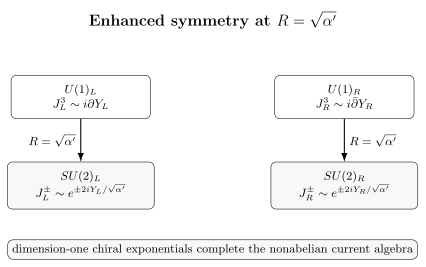
At , additional momentum-winding states become dimension-one currents. The compact boson realizes at level one.
This is a quintessential string effect. The gauge symmetry is enhanced not because of Kaluza-Klein momentum modes alone, but because momentum and winding states become equally light.
T-duality as worldsheet Hodge duality
Section titled “T-duality as worldsheet Hodge duality”There is also a local worldsheet way to understand T-duality. For a free compact scalar,
The equation of motion is
Define a dual field locally by
In Lorentzian worldsheet coordinates this may be written, up to a sign convention for , as
The equation of motion of becomes the Bianchi identity for :
Conversely, the Bianchi identity for becomes the equation of motion for . This is why T-duality is often compared to Kramers—Wannier duality: the dual variable is not the same local field, but its derivative is related to the Hodge dual of the original derivative.
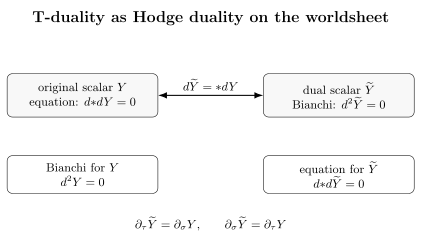
Locally, T-duality is a Hodge-duality relation on the worldsheet. Globally, it exchanges momentum and winding.
The local relation alone does not know the compactification radius. The global information is supplied by the periodicity of and , which turns winding of one field into momentum of the other.
Summary
Section titled “Summary”Closed strings on a circle have two integer quantum numbers:
Their spectrum is invariant under
The duality acts asymmetrically on left and right movers, leaving fixed and flipping the sign of . At the self-dual radius, extra momentum-winding states become massless and enhance the abelian symmetry to .
The next page applies the same idea to open strings. There the result is even more dramatic: T-duality changes boundary conditions and produces D-branes.
Exercises
Section titled “Exercises”Exercise 1. Derive and
Section titled “Exercise 1. Derive pLp_LpL and pRp_RpR”Starting from
and , derive
Solution
The zero-mode part is
When ,
This must equal , so
The average momentum is
Solving these two equations gives
Exercise 2. Check T-duality invariance
Section titled “Exercise 2. Check T-duality invariance”Show that
and
are invariant under and .
Solution
Under and , , the zero-mode contribution becomes
The oscillator term is unchanged. Also , so the level-matching condition is unchanged.
Exercise 3. Extra massless states at
Section titled “Exercise 3. Extra massless states at R=α′R=\sqrt{\alpha'}R=α′”At the self-dual radius, show that
gives a massless state. Determine and .
Solution
Level matching gives
The mass is
The momenta are
The state is purely left-moving in the compact direction. It is one of the charged states that enhances to .
Exercise 4. Dimension of the enhanced currents
Section titled “Exercise 4. Dimension of the enhanced currents”Using
show that
have conformal weight .
Solution
Here
Therefore
Thus are dimension-one holomorphic currents. Together with , they form the current algebra at the self-dual radius.
Exercise 5. Equations of motion and Bianchi identities
Section titled “Exercise 5. Equations of motion and Bianchi identities”Assume
Show that the equation of motion of implies the Bianchi identity of .
Solution
The equation of motion is
Using the duality relation,
Up to the sign determined by the worldsheet signature convention,
so this is proportional to
which vanishes by the equation of motion. Hence the dual field satisfies the Bianchi identity