
Holographic Superconductors
The main idea
Section titled “The main idea”The minimal holographic superconductor is a charged black brane coupled to a charged scalar field. At high temperature the scalar vanishes and the bulk solution is an ordinary finite-density black brane. Below a critical temperature, the black brane can become unstable to forming charged scalar hair:
In the boundary theory this means that a charged operator has acquired an expectation value with no explicit source:
That is the essential dictionary entry. A normalizable charged scalar profile in the bulk is the gravitational description of spontaneous symmetry breaking in the boundary finite-density state.
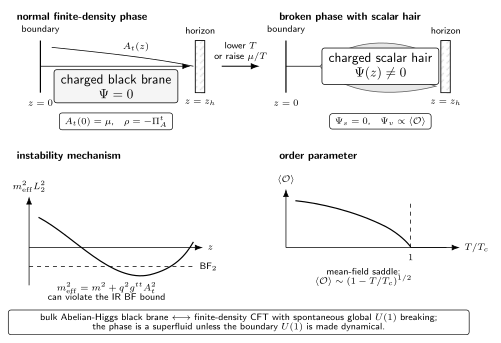
The minimal holographic superconducting instability. In the normal phase, the charged black brane has and . Below , the effective scalar mass can violate an infrared stability bound, and the bulk develops scalar hair with source coefficient and response coefficient . Strictly, the boundary phase is a superfluid unless the boundary is weakly gauged.
This page is about one of the simplest and most useful mechanisms in AdS/CMT:
The resulting boundary phase has many familiar properties of superconductors: a condensate below , infinite DC conductivity, a delta function at in , a low-frequency suppression of optical conductivity, vortices in magnetic field, and superfluid hydrodynamic modes. But there is an important terminology warning:
In the standard AdS/CFT dictionary, a bulk gauge field is dual to a global boundary current. Therefore the minimal holographic “superconductor” is more precisely a holographic superfluid unless the boundary is made dynamical.
The name “holographic superconductor” is entrenched because the model captures superconducting-looking electromagnetic response after one treats the boundary current as weakly coupled to an external photon. But the sharp symmetry statement is spontaneous breaking of a global in the boundary theory.
The boundary problem
Section titled “The boundary problem”Start with a finite-density CFT with a conserved current and charge
The grand-canonical density matrix is
Suppose the CFT contains a charged scalar operator with charge :
A superconducting or superfluid instability asks whether the finite-density state prefers a phase with
To test spontaneous symmetry breaking, one must distinguish the source from the expectation value. Deforming the CFT by
explicitly breaks the if . A genuine spontaneous condensate requires
At finite and finite volume, spontaneous breaking of a continuous global symmetry is subtle. In holography we usually work at large , where the classical bulk saddle acts like a thermodynamic limit and can select one phase of the order parameter. The phase of labels degenerate saddles related by the boundary .
The boundary questions are then:
| Boundary question | Holographic translation |
|---|---|
| Is the normal phase stable? | Does the charged scalar have a normalizable zero mode? |
| What is the order parameter? | The normalizable coefficient of with source set to zero |
| What is ? | The temperature where a static source-free scalar mode first appears |
| Is the transition second order? | Compare renormalized grand potentials of normal and hairy saddles |
| What is the conductivity? | Solve linearized Maxwell perturbations on the hairy background |
| Is it really a superconductor? | Only if the boundary is gauged, at least weakly |
The minimal bulk model
Section titled “The minimal bulk model”The simplest model is Einstein-Maxwell theory coupled to a charged scalar:
where
The entries in the dictionary are:
| Bulk field or parameter | Boundary meaning |
|---|---|
| source for a conserved current | |
| chemical potential | |
| radial electric flux | charge density |
| complex scalar | charged scalar operator |
| scalar charge | charge of under the boundary |
| scalar mass | UV dimension via |
| source coefficient of | explicit source |
| response coefficient of | condensate |
| hairy black brane | symmetry-broken finite-density state |
The near-boundary scalar expansion is
where
In standard quantization, is the source and is proportional to the expectation value:
The source-free condensate condition is therefore
The proportionality constant depends on the normalization of the bulk scalar action and the holographic counterterms. For most physical questions the invariant statement is not the absolute value of , but whether a source-free branch exists and has lower grand potential than the normal phase.
Why a charged scalar wants to condense
Section titled “Why a charged scalar wants to condense”The scalar equation is
In a static charged background with , a static scalar mode sees an effective mass of the schematic form
Since outside a Lorentzian horizon, the electric potential lowers the effective mass squared:
This is the basic physical mechanism. A charged black brane carries an electric field. A sufficiently charged scalar can lower its energy by spreading outside the horizon. In the boundary theory, the finite-density state becomes unstable toward condensing a charged operator.
For an extremal Reissner-Nordström-AdS black brane, the near-horizon geometry is often
Then a clean infrared instability criterion is available. If the charged scalar violates the Breitenlohner-Freedman bound,
then the normal extremal state is unstable. The ultraviolet AdS BF bound can still be satisfied:
So the scalar can be perfectly stable in the UV CFT while becoming unstable in the finite-density IR.
A finite-temperature superconducting transition is slightly more global. One solves a radial eigenvalue problem: a nontrivial static scalar profile must be regular at the horizon and source-free at the boundary. Such a mode exists only for special values of or . The largest such temperature is the critical temperature .
The probe-limit model in AdS
Section titled “The probe-limit model in AdS4_44”The original minimal construction is often presented in the probe limit in AdS, dual to a dimensional finite-density theory. The background is the planar AdS-Schwarzschild black brane
with temperature
The probe limit means that the Maxwell field and scalar are solved on this fixed geometry. One common way to obtain it is to take a large scalar charge after rescaling the matter fields so that their stress tensor is suppressed. Physically, this keeps the charged matter dynamics but ignores its backreaction on the metric.
Use the homogeneous ansatz
where a bulk gauge choice has made real. With and conventional normalizations, the equations take the form
The precise factors change with conventions, but the structure does not: lowers the scalar effective mass, while a nonzero gives the gauge-field fluctuation an effective radial mass.
The boundary conditions are:
for regularity of the gauge field at the Euclidean horizon, and
for a dimensional boundary theory. The scalar behaves as
where
A favorite example is
Both quantizations are allowed in this mass window. In the quantization, one sets
In the quantization, one instead sets
This is a good place to be painfully explicit: setting the wrong coefficient to zero changes the boundary theory. It is not a harmless convention.
The critical temperature as an eigenvalue problem
Section titled “The critical temperature as an eigenvalue problem”At the onset of the transition the scalar is infinitesimal, so one can first solve the normal phase:
in the probe AdS example. Then the scalar equation becomes linear:
Introduce the dimensionless coordinate
The scalar equation now depends on the dimensionless combination
Regularity at and the source-free boundary condition at define a Sturm-Liouville-type eigenvalue problem. The lowest eigenvalue determines the highest temperature at which a nontrivial source-free scalar profile exists:
In the canonical ensemble, the same transition is usually written as
for the dimensional probe model. The numerical coefficient is not universal. It depends on the dimension, charge normalization, scalar mass, boundary quantization, interactions, and whether backreaction is included.
The eigenvalue formulation is more important than any quoted number. It tells you exactly what means holographically: it is the temperature at which the normal black-brane saddle develops a static, normalizable, charged zero mode.
Free energy and the order of the transition
Section titled “Free energy and the order of the transition”A static solution is not automatically the preferred state. One must compare the renormalized Euclidean on-shell actions at fixed ensemble. In the grand-canonical ensemble,
The thermodynamically preferred phase has the lower grand potential:
In the simplest minimal model the transition is second order. Near , the condensate behaves with the classical mean-field exponent
This exponent is not magic. It reflects the large- classical saddle approximation. Bulk loops, boundary fluctuations, low dimensionality, disorder, and other effects can change the physics. Minimal holographic superconductors are strongly coupled but still mean-field in their order-parameter critical exponents at leading large .
A useful Landau-Ginzburg way to summarize the near- branch is
If , the transition is second order. If interactions, backreaction, superflow, magnetic field, or additional order parameters effectively make the quartic term negative before higher terms stabilize the free energy, the transition can become first order. Holography gives a controlled gravitational way to study these possibilities, but the minimal model is not a theorem about all strongly coupled superconductors.
Conductivity in the broken phase
Section titled “Conductivity in the broken phase”To compute the optical conductivity, perturb the gauge field by
In the probe AdS model at zero spatial momentum, the fluctuation equation has the schematic form
The scalar condensate produces an effective radial mass term for the gauge-field fluctuation. As always for retarded correlators, one imposes infalling boundary conditions at the horizon:
Near the boundary,
in the dimensional example. The electric field is
and the induced current is proportional to . In a common normalization,
The detailed normalization depends on the Maxwell coupling and counterterms. The pole structure does not.
In the broken phase one finds
where is the superfluid stiffness or superfluid density in appropriate units. By the Kramers-Kronig relation, this implies
This delta function is the linear-response signature of infinite DC conductivity.
There is a crucial finite-density caveat. In a translationally invariant charged fluid, momentum conservation can already produce a delta function in , even without superconductivity. To isolate the superconducting contribution one must either examine the pole associated with the broken sector, include momentum relaxation, work in a probe/neutral limit where appropriate, or carefully separate normal and superfluid components.
The optical conductivity in the minimal model also shows a low-frequency suppression below the condensate scale. This is often called a gap, but it is not automatically the same as a weak-coupling BCS quasiparticle gap. The boundary theory is strongly coupled, the condensing operator is typically a composite operator, and the minimal bottom-up model does not contain weakly coupled electrons unless such degrees of freedom are explicitly added.
The superfluid versus superconductor distinction
Section titled “The superfluid versus superconductor distinction”This point deserves its own section because it is the source of endless confusion.
In AdS/CFT,
Thus a bulk gauge field is dual to a conserved global symmetry current of the boundary CFT. The boundary source is normally nondynamical. It is an external background field used to generate current correlators.
Therefore, when the charged scalar condenses, the standard boundary interpretation is
which is the defining symmetry structure of a relativistic superfluid.
A true electromagnetic superconductor has a dynamical photon. To obtain that literally, one must gauge the boundary , for example by coupling the CFT current to a weakly dynamical boundary Maxwell field. In holographic language this can be represented by changing boundary conditions for the bulk gauge field or adding a boundary kinetic term for in suitable dimensions.
The practical hierarchy is:
| Model | Boundary | Name |
|---|---|---|
| Standard Dirichlet boundary condition for | global | superfluid |
| Boundary weakly gauged | dynamical electromagnetic field | superconductor |
| External only | nondynamical probe field | optical response of a charged fluid |
The phrase “holographic superconductor” is still useful if understood as shorthand. But when writing a careful paper, say what boundary condition and what boundary photon you mean. Tiny language precision, large conceptual payoff.
Is a gauge symmetry being broken in the bulk?
Section titled “Is a gauge symmetry being broken in the bulk?”No local gauge symmetry is physically broken. Gauge symmetry is redundancy. The gauge-invariant bulk statement is that there is a new classical solution with nonzero charged scalar magnitude
and source-free boundary behavior. In a convenient gauge one can set the phase of to zero:
This is unitary gauge. The phase degree of freedom is then hidden in the longitudinal gauge field. Boundary-wise, the global is spontaneously broken, and the Goldstone mode appears in the low-energy current/order-parameter correlators. If the boundary is gauged, the Goldstone mode is eaten by the boundary photon, giving the usual superconducting Meissner physics.
Bulk Higgsing is a useful calculational phrase, but the precise holographic statement is:
Magnetic fields, vortices, and the Meissner question
Section titled “Magnetic fields, vortices, and the Meissner question”One can turn on a boundary magnetic field by imposing
In the broken phase, sufficiently large magnetic field destroys the condensate. Near an upper critical field, the scalar equation reduces to a Landau-level problem in the boundary spatial directions. Spatially inhomogeneous solutions describe vortex lattices, much like Abrikosov vortices.
Again, the strict interpretation depends on whether the boundary is gauged. With only a global , is an external source for the current, not the magnetic field of a fully dynamical boundary electromagnetism. A true Meissner effect requires dynamical electromagnetic fields. Many holographic computations nevertheless capture the same mathematical structure because the condensate modifies the current response kernel.
Backreaction and zero temperature
Section titled “Backreaction and zero temperature”The probe limit is pedagogically clean, but it is not the whole theory. With backreaction included, the normal phase at finite density is a Reissner-Nordström-AdS black brane, and the broken phase is a fully backreacted hairy black brane.
The zero-temperature limit is especially important. The normal extremal RN-AdS black brane has a finite horizon area density, hence a finite entropy density at in the classical approximation. Condensation can remove or reduce this degeneracy by driving the solution to a different infrared geometry. Depending on the model, the IR may be:
- another AdS region,
- a Lifshitz-like or hyperscaling-violating geometry,
- a domain wall to a neutral fixed point,
- a singular but acceptable geometry,
- or a more complicated phase with additional fields.
There is no universal zero-temperature endpoint of “the holographic superconductor.” The endpoint is model-dependent and is often the most interesting part of the construction.
Relation to holographic BKT transitions
Section titled “Relation to holographic BKT transitions”The BF-bound mechanism can produce more exotic critical behavior than ordinary mean-field condensation. If a parameter tunes the IR scaling dimension through the BF bound, the condensate scale can become exponentially small:
This is often called a holographic Berezinskii-Kosterlitz-Thouless transition. The important point is that the instability is driven by the emergent IR CFT, not by the UV dimension of the operator alone. This theme will reappear in discussions of strange metals and semi-local quantum criticality.
What is universal and what is not?
Section titled “What is universal and what is not?”The minimal holographic superconductor is powerful because it isolates a robust gravitational mechanism. But the model is not QED plus electrons plus phonons. Its universal and nonuniversal statements should be separated.
Robust structural lessons:
| Structural feature | Why it is robust |
|---|---|
| finite-density instability | charged fields can violate an IR stability bound |
| source-free condensate | normalizable scalar hair maps to |
| large- mean-field exponents | classical bulk saddle suppresses fluctuations |
| delta function in conductivity | broken gives a superfluid stiffness |
| horizon boundary condition | retarded response requires infalling behavior |
Model-dependent details:
| Quantity | Why it is model-dependent |
|---|---|
| depends on , , dimension, interactions, and backreaction | |
| optical gap scale | depends on the bulk potential and charged spectrum |
| order of transition | can change with interactions, backreaction, superflow, or magnetic field |
| zero-temperature IR geometry | depends on the full scalar potential and other fields |
| relation to electrons | requires specifying fermionic operators or explicit electron sectors |
A good research habit is to ask: is this statement controlled by symmetry and horizon regularity, or by a particular bottom-up Lagrangian? The former travels far. The latter may still be useful, but it needs a model label.
A compact dictionary
Section titled “A compact dictionary”| Boundary concept | Bulk realization |
|---|---|
| chemical potential | boundary value |
| charge density | radial electric flux |
| order parameter | normalizable coefficient of |
| explicit symmetry breaking | nonzero scalar source |
| spontaneous symmetry breaking | , |
| critical temperature | zero mode of scalar on normal black brane |
| normal phase | charged black brane |
| broken phase | hairy charged black brane |
| superfluid stiffness | pole in |
| optical conductivity | Maxwell perturbation |
| retarded correlator | infalling horizon condition |
| vortex | spatially winding scalar profile in magnetic field |
| true superconductor | boundary made dynamical |
Common mistakes
Section titled “Common mistakes”Mistake 1: Saying that a bulk gauge symmetry is spontaneously broken.
Gauge symmetry is redundancy. A charged scalar profile Higgses the bulk description in a chosen gauge, but the invariant boundary statement is spontaneous breaking of a global .
Mistake 2: Forgetting to set the scalar source to zero.
A nonzero scalar profile is not automatically a condensate. It may simply be the response to an explicit source. Check the near-boundary expansion.
Mistake 3: Calling every holographic superfluid a superconductor.
The standard Dirichlet problem for gives a global boundary current. Literal superconductivity requires a dynamical boundary photon.
Mistake 4: Treating the optical gap as a BCS gap.
The minimal model has no weakly coupled Cooper-pair quasiparticles unless additional structure is introduced. The gap-like feature in is a strong-coupling response scale.
Mistake 5: Ignoring momentum conservation in conductivity.
At finite density, translational invariance can produce an infinite DC conductivity even in a normal charged fluid. Separate this from superconducting stiffness.
Mistake 6: Quoting as universal.
is an eigenvalue of a model-dependent radial problem. Its scaling with or is often fixed by dimensional analysis, but its coefficient is not universal.
Mistake 7: Confusing horizon regularity with boundary normalizability.
Both are required. Horizon regularity selects a smooth equilibrium saddle; source-free boundary behavior selects spontaneous rather than explicit breaking.
Exercises
Section titled “Exercises”Exercise 1: The sign of the effective mass shift
Section titled “Exercise 1: The sign of the effective mass shift”Consider a static charged scalar in a background with . Show why the gauge potential lowers the effective mass squared outside a Lorentzian horizon.
Solution
The scalar equation is
For a static mode with no spatial dependence, the time component contributes schematically
Moving this contribution into the mass term gives
Outside a Lorentzian black-brane horizon, , so
The electric potential lowers the effective mass squared. If the lowering is strong enough, the scalar can become unstable even when the UV AdS BF bound is satisfied.
Exercise 2: Source and condensate for in AdS
Section titled “Exercise 2: Source and condensate for m2L2=−2m^2L^2=-2m2L2=−2 in AdS4_44”For a scalar in AdS, compute when . Explain the two common source-free boundary conditions.
Solution
For AdS with ,
With ,
so
Thus
The near-boundary expansion is
In the standard quantization one sets
In the alternate quantization one sets
Both are allowed because lies in the alternate-quantization window for AdS.
Exercise 3: Why is an eigenvalue
Section titled “Exercise 3: Why TcT_cTc is an eigenvalue”In the probe AdS model, set and in the scalar equation. Explain why the onset of superconductivity determines a discrete value of .
Solution
At the transition, is infinitesimal, so the scalar equation is linear:
Writing makes the interval fixed, , and the only dimensionless parameter in the equation is
The boundary conditions are regularity at the horizon and vanishing source at the boundary. A second-order linear equation with two endpoint conditions has nontrivial solutions only for special values of the parameter . Thus the onset is an eigenvalue problem.
Using
the lowest eigenvalue determines
The proportionality constant depends on the model and conventions.
Exercise 4: The delta function from the pole
Section titled “Exercise 4: The delta function from the 1/ω1/\omega1/ω pole”Suppose the broken phase conductivity satisfies
as . Use causality to infer the corresponding contribution to .
Solution
Causality implies Kramers-Kronig relations between the real and imaginary parts of the retarded response. The distribution identity behind the result is
A pole in the imaginary part of the conductivity of the form
therefore corresponds to a delta function in the real part:
up to Fourier-transform conventions. This is the linear-response signature of infinite DC conductivity associated with superfluid stiffness.
Exercise 5: Superfluid or superconductor?
Section titled “Exercise 5: Superfluid or superconductor?”A bulk solution has , , and . The boundary gauge field is treated as a nondynamical source. What phase does this describe?
Solution
It describes a finite-density phase with spontaneous breaking of a boundary global symmetry. Since the boundary gauge field is nondynamical, the precise field-theory name is a superfluid.
It is often called a holographic superconductor because the current response resembles superconductivity, and because one can weakly gauge the boundary to obtain a true electromagnetic superconductor. But with standard Dirichlet boundary conditions for , the boundary is global, not dynamical.
Exercise 6: Separating two delta functions
Section titled “Exercise 6: Separating two delta functions”Why can a translationally invariant normal charged fluid have infinite DC conductivity even without superconductivity? How would this complicate the interpretation of in a holographic superconductor?
Solution
At finite charge density, an electric field accelerates the total momentum of a translationally invariant fluid. If momentum cannot relax, the current has overlap with a conserved quantity. This produces a zero-frequency delta function in even in the normal phase.
A superconducting or superfluid phase also produces a delta function, associated with the broken and the superfluid stiffness. Therefore, in a translationally invariant finite-density holographic model, the zero-frequency weight can receive contributions from both momentum conservation and superfluid response. To isolate the superconducting contribution, one can introduce momentum relaxation, study the pole structure of the broken sector, use a probe setup where the normal momentum drag is absent, or separate the normal and superfluid components hydrodynamically.
Further reading
Section titled “Further reading”- Steven S. Gubser, “Breaking an Abelian gauge symmetry near a black hole horizon”. The instability mechanism: charged scalar condensation outside an AdS black-hole horizon.
- Sean A. Hartnoll, Christopher P. Herzog, and Gary T. Horowitz, “Building an AdS/CFT superconductor”. The canonical minimal holographic superconductor construction.
- Christopher P. Herzog, “Lectures on Holographic Superfluidity and Superconductivity”. A careful introduction that emphasizes the superfluid/superconductor distinction and linear response.
- Sean A. Hartnoll, “Lectures on holographic methods for condensed matter physics”. Broad AdS/CMT context, including finite density and holographic superconductors.
- Gary T. Horowitz, “Introduction to Holographic Superconductors”. A pedagogical review of probe limit, backreaction, zero-temperature limits, and magnetic fields.
- Gary T. Horowitz and Matthew M. Roberts, “Zero Temperature Limit of Holographic Superconductors”. A useful entry point for understanding the model-dependent infrared endpoint.