
Flat Space, de Sitter, and Open Problems
The main idea
Section titled “The main idea”AdS/CFT is the sharpest known realization of holography because several favorable structures line up at once:
The previous pages explored many examples beyond the canonical pair, but most of them were still AdS examples. The final question in this module is more radical:
Two cases are especially important.
First, asymptotically flat space is the natural arena for the gravitational -matrix. Its boundary is not a timelike cylinder. It is null infinity, . The most robust observables are scattering amplitudes, soft charges, memory effects, and asymptotic symmetry data. A modern program, celestial holography, rewrites the flat-space -matrix as correlation functions on the celestial sphere.
Second, de Sitter space is the simplest model of a universe with positive cosmological constant. Its asymptotic boundaries are spacelike, and a single observer has a cosmological horizon with finite entropy. This makes its holographic interpretation structurally different from AdS. The natural objects are not boundary time-ordered correlators on a Lorentzian cylinder, but late-time wavefunction coefficients, static-patch observables, horizon degrees of freedom, and possibly Euclidean or finite-dimensional dual descriptions.
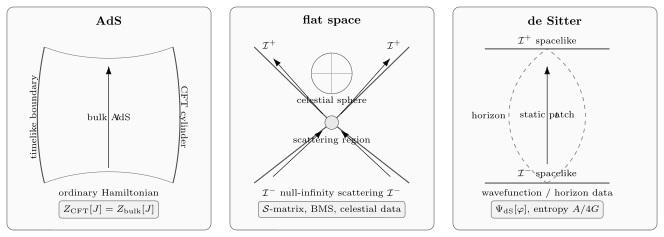
Three asymptotic situations. In AdS, the boundary supports an ordinary Lorentzian CFT and the basic dictionary is . In flat space, the natural data live at null infinity and include the gravitational -matrix, BMS charges, and celestial amplitudes. In de Sitter, the natural data may be late-time wavefunction coefficients or static-patch/horizon degrees of freedom. The central difficulty beyond AdS is identifying the correct nonperturbative observables and Hilbert-space interpretation.
The punchline is not that flat-space or de Sitter holography is hopeless. It is that the AdS dictionary should not be copied mechanically. The correct lesson from AdS/CFT is not “put a CFT on every boundary.” The correct lesson is:
That sentence is a much better guide to research than the slogan “gravity equals field theory.”
Why AdS is unusually sharp
Section titled “Why AdS is unusually sharp”Global AdS has a timelike conformal boundary with topology
After imposing boundary conditions, the bulk problem behaves like a gravitational theory in a box. Signals can reach the boundary and return in finite global time. The boundary has a natural Lorentzian time coordinate, and the dual CFT has a Hamiltonian generating time translations on the cylinder.
The basic AdS/CFT observables are ordinary CFT observables:
with the Lorentzian version giving real-time correlators after choosing the correct contour and interior boundary conditions. States, density matrices, thermal ensembles, modular Hamiltonians, and entanglement entropies all have standard boundary definitions.
This is not merely a convenience. It is why AdS/CFT can provide a nonperturbative definition of quantum gravity with AdS boundary conditions. The CFT Hilbert space exists independently of the bulk approximation. Classical gravity, string perturbation theory, black holes, Witten diagrams, hydrodynamics, and RT/HRT surfaces are calculational regimes inside that exact quantum system.
For non-AdS asymptotics, some of these ingredients fail or change form:
| bulk asymptotics | boundary type | natural data | immediate difficulty |
|---|---|---|---|
| AdS | timelike conformal boundary | CFT correlators and states | technically hard, but conceptually sharp |
| flat | null infinity | -matrix, soft charges, memory, radiative data | no ordinary timelike boundary QFT |
| de Sitter | spacelike or observer horizon | wavefunction coefficients, static-patch observables | no external boundary time; finite horizon entropy |
The problem is not “find the AdS/CFT dictionary again.” The problem is to understand which part of the AdS logic survives after the asymptotic structure changes.
The flat-space limit of AdS/CFT
Section titled “The flat-space limit of AdS/CFT”There is a conservative way to discuss flat-space quantum gravity using AdS/CFT: start with an AdS duality and take the AdS radius large in Planck or string units.
Locally, any large AdS space looks approximately flat. A bulk excitation of energy corresponds to a CFT state with large dimension
so the flat-space limit is a high-energy, large-dimension limit of CFT data. In this regime, CFT correlators can contain the flat-space bulk -matrix.
A useful language is Mellin space. For a CFT four-point function, the Mellin amplitude behaves in many ways like a scattering amplitude: it has factorization poles, residues controlled by exchanged states, and a flat-space limit in which Mellin variables scale like bulk Mandelstam invariants. Schematically,
where is a flat-space transition amplitude and are flat-space kinematic invariants. The exact normalization and transform depend on dimension, external masses, and conventions, but the conceptual point is robust: flat-space scattering can be extracted from a suitable scaling limit of AdS/CFT correlators.
This is powerful, but it is not the same as an intrinsic flat-space holographic dual. The flat-space limit of AdS/CFT answers a question of the form:
Intrinsic flat-space holography asks a sharper question:
These questions are related, but not identical. The first uses AdS as a regulator. The second tries to formulate holography natively at null infinity.
Asymptotically flat space and null infinity
Section titled “Asymptotically flat space and null infinity”In four-dimensional asymptotically flat gravity, future null infinity is reached by taking at fixed retarded time and angle on the celestial sphere. Near , the metric has the Bondi form
where is the round metric on , and the omitted terms encode radiative data, mass aspect, angular momentum aspect, and subleading fields.
Unlike the AdS boundary, is null. It is not a spacetime on which an ordinary relativistic QFT lives. It is a null hypersurface whose natural coordinates are
The gravitational -matrix maps incoming data on to outgoing data on :
This is the flat-space analog of the AdS question “what does the boundary theory compute?” But the answer is different: the most direct observable is the scattering map, not a finite-volume thermal partition function or local Hamiltonian evolution on a timelike boundary.
BMS symmetry
Section titled “BMS symmetry”The asymptotic symmetry group of four-dimensional asymptotically flat gravity is larger than the Poincaré group. The Bondi-Metzner-Sachs group contains ordinary Lorentz transformations together with angle-dependent translations called supertranslations:
Here is an arbitrary function on the celestial sphere. In extended versions, the Lorentz transformations may also be enlarged to local conformal transformations or more general diffeomorphisms of the sphere, with corresponding subtleties about regularity and boundary conditions.
A deep modern lesson is the triangular relation
This is one of the cleanest pieces of flat-space holography. It says that the infrared structure of gravitational scattering is controlled by symmetries living at null infinity. The Weinberg soft graviton theorem becomes a Ward identity for supertranslation symmetry; subleading soft theorems are related to angular-momentum-like extensions; and memory effects are the observable imprint of transitions between asymptotic vacua.
This is already holographic in spirit: a bulk scattering process is constrained by charges at infinity. But it is not yet a full microscopic dual in the same sense as AdS/CFT. It controls universal infrared data, not by itself the complete nonperturbative quantum gravity Hilbert space.
Celestial holography
Section titled “Celestial holography”Celestial holography takes a beautiful next step. Instead of writing massless scattering amplitudes in an energy-momentum basis, one writes them in a conformal basis adapted to the celestial sphere.
A null momentum in four dimensions can be parameterized as
where labels a point on the sphere. One convenient choice is
The celestial amplitude is a Mellin transform over the external energies:
Here is the four-dimensional helicity, while the two-dimensional conformal weights are
Lorentz transformations act as global conformal transformations on the celestial sphere:
Thus celestial amplitudes transform like two-dimensional conformal correlators. Collinear limits of scattering amplitudes become OPE-like limits on the celestial sphere. Soft gravitons and photons become special low-dimension operators or currents. Infrared symmetries become current-algebra-like structures.
This is a remarkable reorganization of flat-space scattering. It is not, however, an ordinary unitary Euclidean two-dimensional CFT. Several features are unusual:
| issue | why it matters |
|---|---|
| Lorentzian scattering origin | celestial correlators are Mellin transforms of -matrix elements, not ordinary Euclidean path-integral correlators |
| energy conservation | momentum-conserving delta functions become distributional structures in celestial variables |
| principal series | normalizable massless wavefunctions often use rather than real positive dimensions |
| infrared divergences | gravitational and gauge-theory amplitudes require careful soft dressing or inclusive definitions |
| massive particles | massive asymptotic states naturally live at timelike infinity, not only on |
| nonperturbative completion | perturbative amplitudes do not automatically define a complete Hilbert space |
A useful attitude is therefore:
The word “perhaps” is doing real work. The program has a large amount of structural evidence, but its final nonperturbative formulation is still being clarified.
Carrollian holography and the null-boundary viewpoint
Section titled “Carrollian holography and the null-boundary viewpoint”Celestial holography is a codimension-two perspective: the celestial sphere is the space of null directions. There is also a codimension-one perspective in which the putative dual theory lives directly on null infinity , with coordinates .
A null boundary has a degenerate metric structure. The corresponding symmetry is not an ordinary relativistic conformal symmetry but a Carrollian/BMS-like symmetry. Roughly, Carrollian structures arise when the speed of light is taken to zero in the boundary theory, so that time and space scale in a way adapted to null hypersurfaces.
The contrast is useful:
| approach | boundary arena | natural variables | strength |
|---|---|---|---|
| celestial | celestial sphere | makes Lorentz symmetry look like 2d conformal symmetry | |
| Carrollian/null | null infinity | keeps retarded time and radiative phase space manifest | |
| AdS flat limit | large-radius AdS boundary | large , Mellin variables | derives flat amplitudes from known AdS/CFT structures |
These are not necessarily competing pictures. They may be different transforms or regimes of the same underlying flat-space holographic structure.
de Sitter as a holographic problem
Section titled “de Sitter as a holographic problem”de Sitter space is qualitatively different from both AdS and flat space. In global coordinates, -dimensional de Sitter has metric
The future and past boundaries, and , are spacelike. In planar coordinates,
future infinity is at . This looks formally similar to Euclidean AdS after analytic continuation, but the physical interpretation is different: is time, not a radial coordinate.
A single de Sitter observer sees only a static patch,
There is a cosmological horizon at with temperature and entropy
This entropy is one of the deepest clues. In AdS, the boundary CFT has an ordinary Hilbert space whose high-energy states account for large AdS black holes. In a single de Sitter static patch, the horizon entropy suggests a finite number of accessible states of order
at least in a coarse semiclassical sense. How to make this precise is one of the central questions in de Sitter quantum gravity.
The dS/CFT wavefunction idea
Section titled “The dS/CFT wavefunction idea”One influential proposal relates quantum gravity in de Sitter to a Euclidean CFT living at future infinity. The most common schematic formula is
Here is a late-time wavefunction of the universe, and denotes boundary data for bulk fields near . This formula resembles the AdS/CFT relation, but the interpretation is different. In AdS, the boundary value is a source in a Lorentzian or Euclidean CFT partition function. In de Sitter, the object is a cosmological wavefunction, and probabilities are obtained from something like
not directly from a single Euclidean generating functional.
A scalar field illustrates the difference. In planar de Sitter, the late-time homogeneous scalar equation gives
With , one finds
so
For sufficiently heavy stable fields, the square root becomes imaginary. This is one reason de Sitter holography is not expected to be a straightforward unitary Euclidean CFT in the usual sense.
There is nevertheless a productive analytic-continuation relation between Euclidean AdS and de Sitter wavefunction coefficients. Very schematically,
maps certain Euclidean AdS calculations to de Sitter late-time data. This is useful for perturbative computations of cosmological correlators. But analytic continuation is not by itself a nonperturbative definition of quantum gravity in de Sitter.
Static-patch holography
Section titled “Static-patch holography”A different de Sitter perspective focuses on the causal patch of a single observer. This is closer in spirit to black-hole thermodynamics. The observer has a horizon, a temperature, and a finite entropy. Instead of asking for a theory living at , one asks for a microscopic description of the static patch.
The static patch viewpoint emphasizes:
| ingredient | de Sitter static-patch version |
|---|---|
| horizon | cosmological horizon at |
| temperature | |
| entropy | |
| observables | worldline correlators, horizon response, static-patch density matrix |
| puzzle | finite entropy versus exact de Sitter symmetry |
A useful analogy is the AdS black hole. An exterior observer outside an AdS black hole sees a horizon and thermal physics, but the full nonperturbative definition comes from the boundary CFT. In de Sitter, there is no analogous external timelike boundary. The horizon is not hiding behind an AdS boundary theory; it is part of the observer’s universe.
This makes the Hilbert-space question sharper. Is the static patch described by a finite-dimensional Hilbert space? If so, how is exact de Sitter invariance realized, given that continuous noncompact symmetries act poorly on finite-dimensional unitary Hilbert spaces? Or is the finite entropy only an effective thermodynamic statement about a larger structure? Different proposals answer these questions differently.
Comparing the three cases
Section titled “Comparing the three cases”Here is a compact comparison that is useful when reading the literature.
| feature | AdS | flat space | de Sitter |
|---|---|---|---|
| cosmological constant | |||
| asymptotic boundary | timelike | null | spacelike, or observer horizon |
| natural observable | boundary correlators | -matrix and asymptotic charges | wavefunction coefficients or static-patch observables |
| symmetry | Poincaré/BMS | ||
| lower-dimensional structure | Lorentzian CFT | celestial CFT or Carrollian/BMS theory | Euclidean CFT-like object or finite/horizon system |
| entropy clue | black holes have | black holes and soft sectors | cosmological horizon has |
| sharpest achievement | nonperturbative AdS quantum gravity | infrared symmetry/soft theorem/memory structure; amplitude reformulations | perturbative wavefunction technology; horizon thermodynamics; partial models |
| central difficulty | finite , finite dynamics | full nonperturbative dual of the -matrix | Hilbert space, observables, unitarity, finite entropy |
This table should make one thing clear: AdS is not the generic case. AdS is the case where the boundary structure happens to match the standard machinery of quantum field theory extraordinarily well.
Open problems as precise research questions
Section titled “Open problems as precise research questions”The phrase “open problem” is often too vague. For this topic, the useful open problems are concrete.
1. What are the exact observables?
Section titled “1. What are the exact observables?”In AdS, the answer is CFT observables. In flat space, the perturbative answer is the -matrix, but quantum gravity complicates local asymptotic states through soft radiation, memory, infrared dressing, and black-hole production. In de Sitter, neither an -matrix nor boundary time evolution is available in the usual way.
A precise research question is:
For flat space, candidates include dressed -matrix data, celestial correlators, or null-boundary phase-space observables. For de Sitter, candidates include wavefunction coefficients, static-patch density matrices, horizon algebras, and observer-centered quantum systems.
2. What is the Hilbert space?
Section titled “2. What is the Hilbert space?”In AdS/CFT, the CFT Hilbert space is the Hilbert space of the theory. In flat space, scattering states are defined at asymptotic infinity, but massless gauge theories and gravity require careful infrared dressing. In de Sitter, a finite horizon entropy suggests a finite number of static-patch states, but global de Sitter symmetry suggests a tension with finite-dimensional unitary representations.
The question is not merely philosophical. The Hilbert space determines which questions are well-posed.
3. How does bulk locality emerge?
Section titled “3. How does bulk locality emerge?”In AdS, bulk locality is tied to large , a sparse spectrum, HKLL reconstruction, entanglement wedges, and quantum error correction. In flat space, one must explain how local bulk scattering and causal propagation emerge from celestial or null-boundary data. In de Sitter, one must explain local physics inside an observer patch without an external boundary system of the AdS type.
4. How are horizons encoded?
Section titled “4. How are horizons encoded?”Flat space has black-hole horizons. De Sitter has a cosmological horizon even in the vacuum. Holography should explain horizon entropy microscopically, not merely reproduce semiclassically.
For AdS black holes, the dual CFT gives a precise statistical framework. For de Sitter, the analogous microscopic counting remains much less settled.
5. What is the role of string theory?
Section titled “5. What is the role of string theory?”Many AdS examples come from controlled brane constructions and compactifications. Flat-space string theory has a perturbative -matrix, but an intrinsic holographic dual is not as explicit as AdS/CFT. de Sitter compactifications and metastable positive-vacuum constructions are technically subtle and conceptually debated. A complete holographic formulation should explain which backgrounds are allowed and which semiclassical effective descriptions are actually realized in quantum gravity.
Common mistakes
Section titled “Common mistakes”Mistake 1: “Every gravitational boundary has a CFT.”
The boundary geometry matters. A timelike AdS boundary naturally supports an ordinary Lorentzian CFT. Null infinity and spacelike de Sitter infinity require different structures.
Mistake 2: “Celestial amplitudes are just ordinary 2d CFT correlators.”
They transform like conformal correlators under the Lorentz group, but they come from Mellin transforms of scattering amplitudes. Distributional support, infrared divergences, principal-series dimensions, and unitarity are different from textbook compact Euclidean CFT.
Mistake 3: “The flat-space limit of AdS/CFT already solves flat-space holography.”
It gives a way to extract flat-space scattering from a family of AdS dualities. It does not automatically identify a native lower-dimensional theory that nonperturbatively defines asymptotically flat quantum gravity.
Mistake 4: “dS/CFT is AdS/CFT with .”
Analytic continuation is useful for perturbative wavefunction calculations, but it does not settle the Hilbert-space interpretation, probabilities, static-patch physics, horizon entropy, or unitarity.
Mistake 5: “Finite de Sitter entropy means we already know the microscopic Hilbert space.”
The entropy is a profound clue. Turning it into a complete microscopic theory is a much harder task.
A practical reading strategy
Section titled “A practical reading strategy”For readers trained in AdS/CFT, the best way to enter this literature is not to start with the most speculative claims. Start from the most controlled structures:
- Flat-space limit of AdS/CFT: learn how bulk scattering is encoded in high-energy limits of CFT correlators.
- BMS/soft/memory triangle: learn the exact infrared constraints on gravitational scattering.
- Celestial amplitudes: learn the Mellin transform from momentum-space amplitudes to celestial correlators.
- de Sitter wavefunction: learn perturbative late-time cosmological correlators and their analytic continuation from Euclidean AdS.
- Static patch and entropy: learn why de Sitter horizons make the Hilbert-space problem unavoidable.
This route keeps the speculative parts connected to calculational facts.
Exercises
Section titled “Exercises”Exercise 1: Boundary type and observable
Section titled “Exercise 1: Boundary type and observable”For each spacetime, identify the boundary type and the most natural class of observables: global AdS, asymptotically flat Minkowski space, and global de Sitter.
Solution
Global AdS has a timelike conformal boundary, usually , and the natural observables are CFT correlation functions, states, partition functions, and density matrices.
Asymptotically flat Minkowski space has null infinity . The natural perturbative observable is the -matrix mapping incoming data on to outgoing data on . Soft charges, memory effects, and BMS Ward identities are also natural asymptotic observables.
Global de Sitter has spacelike future and past infinity, and . Natural objects include late-time wavefunction coefficients and, from an observer-centered viewpoint, static-patch observables associated with the cosmological horizon.
Exercise 2: A null vector on the celestial sphere
Section titled “Exercise 2: A null vector on the celestial sphere”Show that
is null in mostly-plus signature .
Solution
Let , so . Then
The spatial norm is
Writing , the numerator is
Thus the spatial norm is , so
Exercise 3: de Sitter late-time dimensions
Section titled “Exercise 3: de Sitter late-time dimensions”For a massive scalar in planar de Sitter,
the late-time homogeneous equation is
Assume and derive the two exponents .
Solution
Substituting gives
The equation becomes
Therefore
For , the exponents are complex. This is one reason the dS/CFT interpretation differs from an ordinary unitary Euclidean CFT with real scaling dimensions.
Exercise 4: Flat limit versus intrinsic flat holography
Section titled “Exercise 4: Flat limit versus intrinsic flat holography”Explain the difference between extracting a flat-space -matrix from the large-radius limit of AdS/CFT and constructing an intrinsic holographic dual of asymptotically flat quantum gravity.
Solution
In the large-radius limit of AdS/CFT, one begins with a well-defined AdS/CFT duality. The CFT lives on the AdS boundary, and suitable high-energy or large-dimension limits of CFT correlators reproduce approximately flat bulk scattering. AdS is being used as a regulator and as a nonperturbative definition.
An intrinsic flat-space holographic dual would instead define asymptotically flat quantum gravity directly in terms of lower-dimensional data at null infinity, without embedding the problem into a family of AdS spacetimes. Candidate languages include celestial correlators, Carrollian theories on , BMS charge algebras, and dressed -matrix data. The two ideas are related, but the second is conceptually stronger.
Exercise 5: The soft theorem triangle
Section titled “Exercise 5: The soft theorem triangle”Give a conceptual explanation of the relation
Solution
A soft theorem describes the universal behavior of a scattering amplitude when an emitted gauge boson or graviton has vanishing energy. In gravity, the leading soft graviton theorem controls the insertion of a very low-energy graviton.
An asymptotic symmetry has an associated charge at null infinity. The Ward identity for that charge constrains the -matrix. For BMS supertranslations, the Ward identity is equivalent to the leading soft graviton theorem.
A memory effect is a classical observable: after radiation passes through null infinity, detectors can be permanently displaced or clocks shifted. This permanent change is the classical imprint of the same asymptotic charge transition. Thus the same structure appears as a quantum soft theorem, a symmetry Ward identity, and a measurable classical memory effect.
Further reading
Section titled “Further reading”- Andrew Strominger, Lectures on the Infrared Structure of Gravity and Gauge Theory.
- Sabrina Pasterski, Lectures on Celestial Amplitudes.
- Ana-Maria Raclariu, Lectures on Celestial Holography.
- Laura Donnay, Celestial Holography: An Asymptotic Symmetry Perspective.
- A. Liam Fitzpatrick, Jared Kaplan, João Penedones, Suvrat Raju, and Balt van Rees, A Natural Language for AdS/CFT Correlators.
- Takuya Okuda and João Penedones, String Scattering in Flat Space and a Scaling Limit of Yang-Mills Correlators.
- Andrew Strominger, The dS/CFT Correspondence.
- Dionysios Anninos, De Sitter Musings.
- Arjun Bagchi, Shankhadeep Banerjee, Rudranil Basu, and Sudipta Dutta, Holography in Flat Spacetimes: The Case for Carroll.