
D-Brane Interactions and the Annulus Amplitude
A D-brane is not merely a boundary condition for open strings. It is also a source for closed-string fields. The annulus is the cleanest place where these two meanings become the same calculation.
For two parallel D-branes separated by a transverse distance , the annulus may be read in two ways:
- in the open-string channel, it is a one-loop vacuum energy of strings stretched from one brane to the other;
- in the closed-string channel, it is tree-level exchange of closed strings between two boundary states.
The equality of these descriptions is much stronger than a qualitative slogan. The oscillator partition function knows the entire force law: NS—NS attraction, R—R repulsion, BPS cancellation, and the brane—antibrane tachyon.
Throughout this page, take two static flat D-branes extended along and separated in the transverse directions , . Let
The regulated brane worldvolume is denoted by .
The stretched-string spectrum
Section titled “The stretched-string spectrum”An open string stretched between two parallel branes has a classical piece in each transverse Dirichlet direction,
The classical length is , so the string carries the stretching energy
In the open-string mass formula this appears as
Thus the NS and R sectors have
For two identical BPS D-branes, the GSO projection removes the NS ground-state tachyon. For a brane—antibrane pair, the GSO projection in the stretched sector is reversed, and the tachyon returns when is sufficiently small. We will see both statements directly in the annulus.
The annulus as an open-string trace
Section titled “The annulus as an open-string trace”The open-channel annulus has modulus . Its universal Schwinger form is
The factor counts the two orientations of a string stretched between the two branes. The factor is the annulus modulus measure, including the residual conformal Killing symmetry of the cylinder.
The Gaussian integral over momentum tangent to the brane gives
Therefore every parallel-brane annulus has the form
All the physics is in the oscillator partition function .
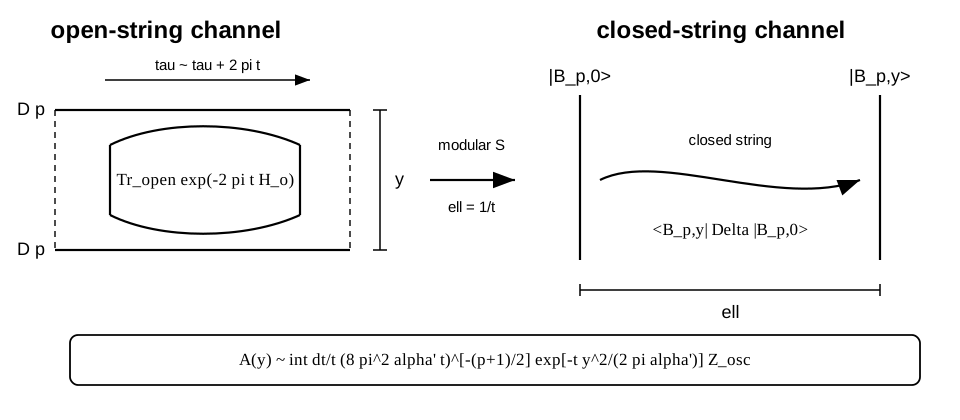
The open-channel annulus is a one-loop trace over stretched open strings. For identical BPS branes, the NS and R oscillator sums combine into the Jacobi identity.
Warm-up: the bosonic string
Section titled “Warm-up: the bosonic string”For the bosonic string in dimensions, the transverse oscillator trace gives copies of a bosonic oscillator. With
the bosonic partition function is
Hence
The leading factor in is the open-string tachyon. This is not a small technical blemish: the bosonic D-brane vacuum is unstable because the underlying bosonic string vacuum is unstable.
The superstring changes the story in two ways. First, longitudinal matter and ghosts cancel, leaving only the eight physical transverse bosons. Second, the eight physical transverse fermions appear with different spin structures. Their delicate sum is the origin of the BPS no-force condition.
The four -functions
Section titled “The four fff-functions”In the RNS superstring it is convenient to use the standard functions
The denominator is the contribution of the eight transverse bosonic oscillators. The numerator distinguishes the fermionic spin structures:
| Open-string trace | Oscillator factor | Interpretation |
|---|---|---|
| NS trace without | all NS fermion oscillators | |
| NS trace with | insertion distinguishing worldsheet fermion number | |
| R trace | Ramond zero modes and oscillators |
The Jacobi abstruse identity says
This identity is much more than a theta-function curiosity. It is the worldsheet expression of spacetime supersymmetry for a pair of identical BPS branes.
Identical BPS D-branes: exact cancellation
Section titled “Identical BPS D-branes: exact cancellation”For two identical parallel D-branes, the GSO-projected open-string partition function is
The full annulus amplitude is therefore
This vanishing is exact for every value of the separation . Since is a modulus, the static potential between parallel BPS D-branes is flat:
It is important not to misread this statement. The D-branes do couple to the graviton, dilaton, and Ramond—Ramond fields. The point is that the attractive NS—NS exchange and the repulsive R—R exchange cancel exactly.
One way to see the level-by-level cancellation is to expand the two pieces. The GSO-projected NS spectrum contributes
while the R spectrum contributes
The same number of bosonic and fermionic open-string states appears at every mass level. The annulus vacuum energy vanishes because the trace includes the usual minus sign for spacetime fermions.
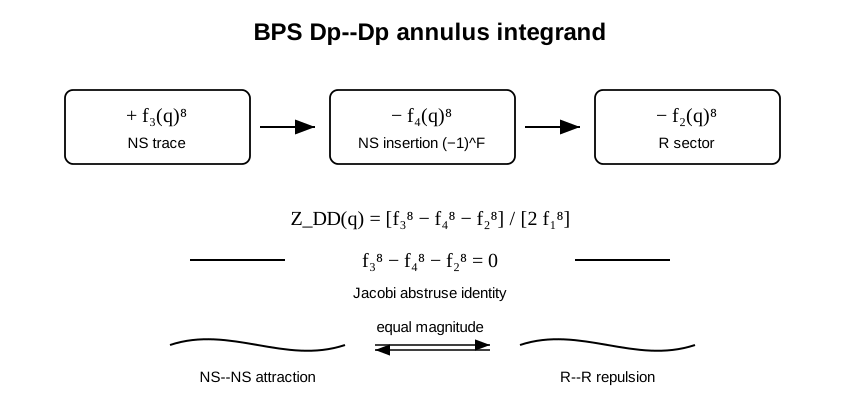
The abstruse identity is the oscillator form of the BPS no-force condition. In spacetime language, NS—NS attraction cancels R—R repulsion.
Closed-string channel and the force law
Section titled “Closed-string channel and the force law”Set
The same annulus is then a closed string propagating for proper time between two boundary states:
The modular transformations of the -functions are
The region is thus the region . What looks ultraviolet in the open-string loop is infrared in the closed-string channel. At large separation , the amplitude is dominated by massless closed strings.
The massless exchange in the transverse dimensions is governed by
For two identical BPS D-branes, the long-distance interaction has the schematic form
The first term is NS—NS attraction, mainly graviton and dilaton exchange. The second term is R—R repulsion. Supersymmetry enforces
so the two terms cancel.
Conversely, if one computes the massless exchange normalization in the closed channel and compares it with the DBI/Wess—Zumino couplings, one obtains
Using
this becomes
This is the normalization used in the DBI and Wess—Zumino actions. The physical string-frame tension in a background with is .
Brane—antibrane pairs
Section titled “Brane—antibrane pairs”Now replace one brane by an antibrane. The NS—NS tension is unchanged, but the R—R charge flips:
In the closed-string channel, this reverses the sign of the R—R exchange. The force is no longer zero:
so the two contributions are both attractive.
In the open-string channel, the same fact appears as a reversed GSO projection for strings stretched between the brane and the antibrane. The relevant oscillator sum is
The plus sign in front of means that the NS ground state is no longer projected out. For the lightest stretched mode,
It becomes tachyonic when
The long-distance attraction is the closed-string symptom of the same instability. At short distance, the open-string tachyon is the correct degree of freedom: tachyon condensation annihilates the brane—antibrane pair, or, for topologically nontrivial tachyon profiles, leaves lower-dimensional D-branes as defects.
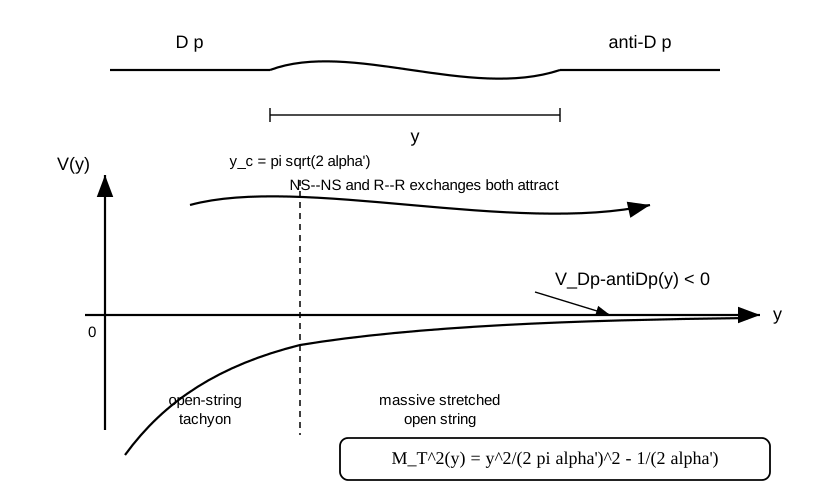
A D— pair attracts at large separation. For , the lightest stretched open string becomes tachyonic.
What the annulus teaches us
Section titled “What the annulus teaches us”The annulus is a compact lesson in string theory’s bookkeeping:
| Open-channel statement | Closed-channel statement |
|---|---|
| stretched open-string vacuum energy | closed-string exchange between boundary states |
| open-string infrared spectrum | |
| closed-string infrared spectrum | |
| GSO projection | spacetime spin-statistics and R—R charge |
| Jacobi identity | BPS no-force cancellation |
| reversed GSO for D— strings | R—R force changes from repulsive to attractive |
The most important point is conceptual. The vanishing force between parallel D-branes is not imposed by hand. It is simultaneously an identity of theta functions, a degeneracy of open-string bosons and fermions, and a cancellation between spacetime fields sourced by a BPS object. This is why D-branes became a central tool: a single worldsheet diagram knows about gauge theory, gravity, supersymmetry, and nonperturbative charge.
Exercises
Section titled “Exercises”Exercise 1. The stretched-string mass shift
Section titled “Exercise 1. The stretched-string mass shift”Derive the contribution
to the mass of an open string stretched between two parallel D-branes separated by .
Solution
The Dirichlet zero mode is not constant. It is the linear classical solution
The string has physical length . Since the fundamental-string tension is
the stretching energy is
This contributes to the spacetime mass as
Equivalently, in dimensionless form,
Exercise 2. The Gaussian momentum integral
Section titled “Exercise 2. The Gaussian momentum integral”Show that
Solution
Use
Here , so
Simplifying,
Setting gives the momentum factor in the annulus.
Exercise 3. Why the NS tachyon is removed for BPS branes
Section titled “Exercise 3. Why the NS tachyon is removed for BPS branes”Use the leading behavior of and to explain why the combination
has no tachyon term.
Solution
For small ,
while
Therefore
The leading terms cancel in the difference:
Since
the ratio begins at , not at . Thus the GSO-projected NS sector has no tachyon. Its leading states are massless.
Exercise 4. Level-by-level Bose—Fermi cancellation
Section titled “Exercise 4. Level-by-level Bose—Fermi cancellation”The Jacobi identity implies
Explain why this means that the number of bosonic and fermionic open-string states is equal at each mass level for strings stretched between identical parallel BPS D-branes.
Solution
The GSO-projected NS contribution to the open-string trace is
The R contribution is
The Jacobi identity says
Expanding both sides as power series in compares states at fixed open-string level. The equality of the coefficients means that, after the GSO projection, each mass level has the same number of bosonic and fermionic physical states. The annulus vacuum energy is the graded trace, so the bosonic and fermionic contributions cancel.
Exercise 5. Open UV as closed IR
Section titled “Exercise 5. Open UV as closed IR”Explain why the region of the open-channel annulus is controlled by the lightest closed strings.
Solution
The open-channel modulus is . The closed-channel modulus is
Thus means . In the closed-string channel, the amplitude is schematically
For large , massive closed-string states are exponentially suppressed. The amplitude is therefore dominated by the lightest closed-string states. In a tachyon-free type II theory, these are the massless NS—NS and R—R fields. This is why the open-string ultraviolet region encodes long-range spacetime forces.
Exercise 6. Critical separation for a brane—antibrane tachyon
Section titled “Exercise 6. Critical separation for a brane—antibrane tachyon”For a D— pair, the lightest stretched mode has
Find the critical separation at which it becomes massless.
Solution
Set :
Multiplying by gives
Therefore
For , the stretched mode is tachyonic and the brane—antibrane system is perturbatively unstable.
Exercise 7. Tension normalization from the annulus
Section titled “Exercise 7. Tension normalization from the annulus”Starting from
show that
Solution
Since
we have
Now simplify the powers:
Thus
and hence