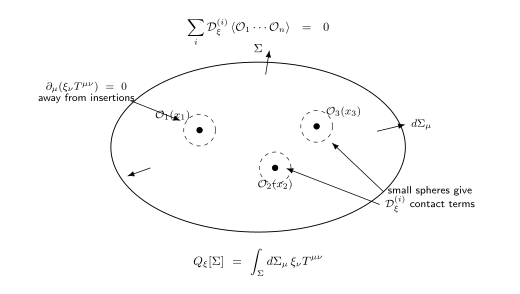
The previous pages introduced operators, sources, the stress tensor, and conserved currents. We now put these ingredients together into one of the most useful tools in conformal field theory: Ward identities .
A Ward identity is symmetry written as an equation for correlation functions. In a CFT, the conformal Ward identities say that inserting the stress tensor and integrating it over a surface implements an infinitesimal spacetime transformation on all operator insertions inside the surface.
This page has two goals. First, it gives the local and integrated forms of the Ward identities in a form that is usable in arbitrary dimension. Second, it explains why conformal symmetry fixes the kinematic structure of CFT correlators. The formulas here are the bridge between the geometric conformal group and the concrete correlators studied in the next module.
The AdS/CFT reason to care is sharp:
CFT Ward identities ⟷ bulk constraint equations. \boxed{
\text{CFT Ward identities}
\quad\longleftrightarrow\quad
\text{bulk constraint equations.}
} CFT Ward identities ⟷ bulk constraint equations. Boundary stress-tensor conservation becomes the bulk momentum constraint. The trace Ward identity becomes the radial Hamiltonian/Weyl constraint, including the holographic Weyl anomaly in even boundary dimensions.
Let
X = O 1 A 1 ( x 1 ) O 2 A 2 ( x 2 ) ⋯ O n A n ( x n ) X=
\mathcal O_1^{A_1}(x_1)
\mathcal O_2^{A_2}(x_2)
\cdots
\mathcal O_n^{A_n}(x_n) X = O 1 A 1 ( x 1 ) O 2 A 2 ( x 2 ) ⋯ O n A n ( x n ) be a product of local operators. The superscripts A i A_i A i δ μ ν \delta_{\mu\nu} δ μν η μ ν \eta_{\mu\nu} η μν
The stress tensor generates spacetime transformations. If ξ μ ( x ) \xi^\mu(x) ξ μ ( x )
j ξ μ ( x ) = T μ ν ( x ) ξ ν ( x ) . j_\xi^\mu(x)=T^{\mu\nu}(x)\xi_\nu(x). j ξ μ ( x ) = T μν ( x ) ξ ν ( x ) . At separated points, if ξ μ \xi^\mu ξ μ
∂ μ j ξ μ ( x ) = 0 , x ≠ x i . \partial_\mu j_\xi^\mu(x)=0,
\qquad x\neq x_i. ∂ μ j ξ μ ( x ) = 0 , x = x i . But inside a correlation function this statement is incomplete. When x x x x i x_i x i T μ ν T_{\mu\nu} T μν x i x_i x i
The conformal current j ξ μ = T μ ν ξ ν j_\xi^\mu=T^{\mu\nu}\xi_\nu j ξ μ = T μν ξ ν
A vector field ξ μ ( x ) \xi^\mu(x) ξ μ ( x )
∂ μ ξ ν + ∂ ν ξ μ = 2 σ ξ ( x ) δ μ ν , \partial_\mu \xi_\nu+
\partial_\nu \xi_\mu
=
2\sigma_\xi(x)\delta_{\mu\nu}, ∂ μ ξ ν + ∂ ν ξ μ = 2 σ ξ ( x ) δ μν , where
σ ξ ( x ) = 1 d ∂ ρ ξ ρ ( x ) . \sigma_\xi(x)=\frac{1}{d}\partial_\rho\xi^\rho(x). σ ξ ( x ) = d 1 ∂ ρ ξ ρ ( x ) . Equivalently, the infinitesimal coordinate transformation
x μ ↦ x μ + ξ μ ( x ) x^\mu\mapsto x^\mu+\xi^\mu(x) x μ ↦ x μ + ξ μ ( x ) changes the flat metric by a local Weyl rescaling:
δ ξ δ μ ν = ∂ μ ξ ν + ∂ ν ξ μ = 2 σ ξ δ μ ν . \delta_\xi \delta_{\mu\nu}
=
\partial_\mu\xi_\nu+
\partial_\nu\xi_\mu
=
2\sigma_\xi\delta_{\mu\nu}. δ ξ δ μν = ∂ μ ξ ν + ∂ ν ξ μ = 2 σ ξ δ μν . For d ≥ 3 d\ge 3 d ≥ 3
ξ μ ( x ) = a μ + ω μ ν x ν + λ x μ + 2 ( b ⋅ x ) x μ − b μ x 2 , \xi^\mu(x)
=
a^\mu
+
\omega^\mu{}_{\nu}x^\nu
+
\lambda x^\mu
+
2(b\cdot x)x^\mu-b^\mu x^2, ξ μ ( x ) = a μ + ω μ ν x ν + λ x μ + 2 ( b ⋅ x ) x μ − b μ x 2 , with
ω μ ν = − ω ν μ . \omega_{\mu\nu}=-\omega_{\nu\mu}. ω μν = − ω νμ . The four pieces are translations, rotations, dilatations, and special conformal transformations. Their corresponding values of σ ξ \sigma_\xi σ ξ
transformation ξ μ ( x ) \xi^\mu(x) ξ μ ( x ) σ ξ ( x ) \sigma_\xi(x) σ ξ ( x ) translation a μ a^\mu a μ 0 0 0 rotation ω μ ν x ν \omega^\mu{}_{\nu}x^\nu ω μ ν x ν 0 0 0 dilatation λ x μ \lambda x^\mu λ x μ λ \lambda λ special conformal 2 ( b ⋅ x ) x μ − b μ x 2 2(b\cdot x)x^\mu-b^\mu x^2 2 ( b ⋅ x ) x μ − b μ x 2 2 b ⋅ x 2b\cdot x 2 b ⋅ x
The fact that σ ξ \sigma_\xi σ ξ
A scalar primary operator of dimension Δ \Delta Δ
δ ξ O ( x ) = − [ ξ μ ( x ) ∂ μ + Δ σ ξ ( x ) ] O ( x ) . \delta_\xi \mathcal O(x)
=
-
\left[
\xi^\mu(x)\partial_\mu+
\Delta\sigma_\xi(x)
\right]
\mathcal O(x). δ ξ O ( x ) = − [ ξ μ ( x ) ∂ μ + Δ σ ξ ( x ) ] O ( x ) . For a spinning primary, there is also a local rotation of the spin indices. Define
ϖ μ ν ( x ) = 1 2 ( ∂ μ ξ ν − ∂ ν ξ μ ) . \varpi_{\mu\nu}(x)
=
\frac12\left(\partial_\mu\xi_\nu-\partial_\nu\xi_\mu\right). ϖ μν ( x ) = 2 1 ( ∂ μ ξ ν − ∂ ν ξ μ ) . If S μ ν S^{\mu\nu} S μν O A \mathcal O^A O A
δ ξ O A ( x ) = − [ ξ μ ∂ μ + Δ σ ξ ] O A ( x ) − 1 2 ϖ μ ν ( S μ ν ) A B O B ( x ) . \delta_\xi \mathcal O^A(x)
=
-
\left[
\xi^\mu\partial_\mu+
\Delta\sigma_\xi
\right]
\mathcal O^A(x)
-
\frac12\varpi_{\mu\nu}
(S^{\mu\nu})^A{}_{B}\mathcal O^B(x). δ ξ O A ( x ) = − [ ξ μ ∂ μ + Δ σ ξ ] O A ( x ) − 2 1 ϖ μν ( S μν ) A B O B ( x ) . It is convenient to define the positive differential operator D ξ \mathcal D_{\xi} D ξ
δ ξ O A ( x ) = − D ξ O A ( x ) , \delta_\xi\mathcal O^A(x)=-\mathcal D_\xi\mathcal O^A(x), δ ξ O A ( x ) = − D ξ O A ( x ) , so that
D ξ = ξ μ ∂ μ + Δ σ ξ + 1 2 ϖ μ ν S μ ν . \boxed{
\mathcal D_\xi
=
\xi^\mu\partial_\mu+
\Delta\sigma_\xi
+
\frac12\varpi_{\mu\nu}S^{\mu\nu}.
} D ξ = ξ μ ∂ μ + Δ σ ξ + 2 1 ϖ μν S μν . For a product of operators, D ξ , i \mathcal D_{\xi,i} D ξ , i i i i
With the convention above, the local conformal Ward identity is
∂ μ ⟨ T μ ν ( x ) ξ ν ( x ) X ⟩ = − ∑ i = 1 n δ ( d ) ( x − x i ) D ξ , i ⟨ X ⟩ . \boxed{
\partial_\mu
\left\langle
T^{\mu\nu}(x)\xi_\nu(x)\,X
\right\rangle
=
-
\sum_{i=1}^n
\delta^{(d)}(x-x_i)\,
\mathcal D_{\xi,i}
\left\langle X\right\rangle.
} ∂ μ ⟨ T μν ( x ) ξ ν ( x ) X ⟩ = − i = 1 ∑ n δ ( d ) ( x − x i ) D ξ , i ⟨ X ⟩ . This equation should be read as a distributional identity. Away from the points x = x i x=x_i x = x i
Integrating over a region R R R
∫ ∂ R d S μ ⟨ T μ ν ξ ν X ⟩ = − ∑ x i ∈ R D ξ , i ⟨ X ⟩ . \int_{\partial R}dS_\mu\,
\left\langle
T^{\mu\nu}\xi_\nu X
\right\rangle
=
-
\sum_{x_i\in R}
\mathcal D_{\xi,i}
\left\langle X\right\rangle. ∫ ∂ R d S μ ⟨ T μν ξ ν X ⟩ = − x i ∈ R ∑ D ξ , i ⟨ X ⟩ . If R R R
∑ i = 1 n D ξ , i ⟨ O 1 ( x 1 ) ⋯ O n ( x n ) ⟩ = 0. \boxed{
\sum_{i=1}^n
\mathcal D_{\xi,i}
\left\langle
\mathcal O_1(x_1)\cdots\mathcal O_n(x_n)
\right\rangle
=0.
} i = 1 ∑ n D ξ , i ⟨ O 1 ( x 1 ) ⋯ O n ( x n ) ⟩ = 0. This is the form most often used to constrain CFT correlators.
The sign convention is not sacred. Some authors define the infinitesimal operator variation with the opposite sign. Then both the definition of D ξ \mathcal D_\xi D ξ
At separated points, use the symmetry of the stress tensor and the conformal Killing equation:
∂ μ j ξ μ = ∂ μ ( T μ ν ξ ν ) = ( ∂ μ T μ ν ) ξ ν + T μ ν ∂ μ ξ ν . \partial_\mu j_\xi^\mu
=
\partial_\mu(T^{\mu\nu}\xi_\nu)
=
(\partial_\mu T^{\mu\nu})\xi_\nu
+
T^{\mu\nu}\partial_\mu\xi_\nu. ∂ μ j ξ μ = ∂ μ ( T μν ξ ν ) = ( ∂ μ T μν ) ξ ν + T μν ∂ μ ξ ν . In a flat-space CFT at separated points,
∂ μ T μ ν = 0 , T μ μ = 0. \partial_\mu T^{\mu\nu}=0,
\qquad
T^\mu{}_{\mu}=0. ∂ μ T μν = 0 , T μ μ = 0. Also,
T μ ν ∂ μ ξ ν = 1 2 T μ ν ( ∂ μ ξ ν + ∂ ν ξ μ ) = σ ξ T μ μ . T^{\mu\nu}\partial_\mu\xi_\nu
=
\frac12 T^{\mu\nu}
\left(\partial_\mu\xi_\nu+
\partial_\nu\xi_\mu\right)
=
\sigma_\xi T^\mu{}_{\mu}. T μν ∂ μ ξ ν = 2 1 T μν ( ∂ μ ξ ν + ∂ ν ξ μ ) = σ ξ T μ μ . Therefore
∂ μ j ξ μ = 0 ( x ≠ x i ) . \partial_\mu j_\xi^\mu=0
\qquad
(x\neq x_i). ∂ μ j ξ μ = 0 ( x = x i ) . This is the clean local reason conformal transformations have charges: the current T μ ν ξ ν T^{\mu\nu}\xi_\nu T μν ξ ν ξ \xi ξ
The compact identity above packages several more primitive Ward identities.
Take
ξ μ = a μ . \xi^\mu=a^\mu. ξ μ = a μ . For scalar insertions,
D ξ , i = a μ ∂ i μ . \mathcal D_{\xi,i}=a^\mu\partial_{i\mu}. D ξ , i = a μ ∂ i μ . Since a μ a^\mu a μ
∂ μ ⟨ T μ ν ( x ) X ⟩ = − ∑ i = 1 n δ ( d ) ( x − x i ) ∂ i ν ⟨ X ⟩ \boxed{
\partial_\mu
\left\langle
T^{\mu\nu}(x)X
\right\rangle
=
-
\sum_{i=1}^n
\delta^{(d)}(x-x_i)
\partial_{i}^{\nu}
\left\langle X\right\rangle
} ∂ μ ⟨ T μν ( x ) X ⟩ = − i = 1 ∑ n δ ( d ) ( x − x i ) ∂ i ν ⟨ X ⟩ for scalar insertions in our sign convention.
The corresponding global identity is
∑ i = 1 n ∂ i ν ⟨ X ⟩ = 0. \sum_{i=1}^n\partial_{i}^{\nu}
\left\langle X\right\rangle=0. i = 1 ∑ n ∂ i ν ⟨ X ⟩ = 0. Thus a correlator depends only on relative separations, not on the absolute origin.
Take
ξ μ = ω μ ν x ν , ω μ ν = − ω ν μ . \xi^\mu=\omega^\mu{}_{\nu}x^\nu,
\qquad
\omega_{\mu\nu}=-\omega_{\nu\mu}. ξ μ = ω μ ν x ν , ω μν = − ω νμ . The global Ward identity becomes
∑ i = 1 n [ x i μ ∂ i ν − x i ν ∂ i μ + S μ ν ( i ) ] ⟨ X ⟩ = 0. \boxed{
\sum_{i=1}^n
\left[
x_{i\mu}\partial_{i\nu}
-x_{i\nu}\partial_{i\mu}
+S^{(i)}_{\mu\nu}
\right]
\left\langle X\right\rangle
=0.
} i = 1 ∑ n [ x i μ ∂ i ν − x i ν ∂ i μ + S μν ( i ) ] ⟨ X ⟩ = 0. For scalar operators the spin term is absent. For vector, spinor, tensor, or mixed-symmetry operators, the spin term rotates their indices.
Take
ξ μ = λ x μ . \xi^\mu=\lambda x^\mu. ξ μ = λ x μ . Then σ ξ = λ \sigma_\xi=\lambda σ ξ = λ
∑ i = 1 n ( x i ⋅ ∂ i + Δ i ) ⟨ O 1 ( x 1 ) ⋯ O n ( x n ) ⟩ = 0. \boxed{
\sum_{i=1}^n
\left(
x_i\cdot\partial_i+\Delta_i
\right)
\left\langle
\mathcal O_1(x_1)\cdots\mathcal O_n(x_n)
\right\rangle
=0.
} i = 1 ∑ n ( x i ⋅ ∂ i + Δ i ) ⟨ O 1 ( x 1 ) ⋯ O n ( x n ) ⟩ = 0. Equivalently, under x i ↦ Λ x i x_i\mapsto \Lambda x_i x i ↦ Λ x i
⟨ O 1 ( Λ x 1 ) ⋯ O n ( Λ x n ) ⟩ = Λ − ∑ i Δ i ⟨ O 1 ( x 1 ) ⋯ O n ( x n ) ⟩ . \left\langle
\mathcal O_1(\Lambda x_1)\cdots\mathcal O_n(\Lambda x_n)
\right\rangle
=
\Lambda^{-\sum_i\Delta_i}
\left\langle
\mathcal O_1(x_1)\cdots\mathcal O_n(x_n)
\right\rangle. ⟨ O 1 ( Λ x 1 ) ⋯ O n ( Λ x n ) ⟩ = Λ − ∑ i Δ i ⟨ O 1 ( x 1 ) ⋯ O n ( x n ) ⟩ . This is the precise statement that local operators have scaling dimensions.
Take
ξ μ = 2 ( b ⋅ x ) x μ − b μ x 2 . \xi^\mu=2(b\cdot x)x^\mu-b^\mu x^2. ξ μ = 2 ( b ⋅ x ) x μ − b μ x 2 . For scalar primaries,
D ξ , i = b μ [ 2 x i μ ( x i ⋅ ∂ i ) − x i 2 ∂ i μ + 2 Δ i x i μ ] . \mathcal D_{\xi,i}
=
b_\mu
\left[
2x_i^\mu(x_i\cdot\partial_i)
-x_i^2\partial_i^\mu
+2\Delta_i x_i^\mu
\right]. D ξ , i = b μ [ 2 x i μ ( x i ⋅ ∂ i ) − x i 2 ∂ i μ + 2 Δ i x i μ ] . Since b μ b_\mu b μ
∑ i = 1 n [ 2 x i μ ( x i ⋅ ∂ i ) − x i 2 ∂ i μ + 2 Δ i x i μ ] ⟨ X ⟩ = 0 \boxed{
\sum_{i=1}^n
\left[
2x_i^\mu(x_i\cdot\partial_i)
-x_i^2\partial_i^\mu
+2\Delta_i x_i^\mu
\right]
\left\langle X\right\rangle
=0
} i = 1 ∑ n [ 2 x i μ ( x i ⋅ ∂ i ) − x i 2 ∂ i μ + 2 Δ i x i μ ] ⟨ X ⟩ = 0 for scalar primaries. For spinning primaries, the full operator is
∑ i = 1 n [ 2 x i μ ( x i ⋅ ∂ i ) − x i 2 ∂ i μ + 2 Δ i x i μ + 2 x i ν S i μ ν ] ⟨ X ⟩ = 0. \boxed{
\sum_{i=1}^n
\left[
2x_i^\mu(x_i\cdot\partial_i)
-x_i^2\partial_i^\mu
+2\Delta_i x_i^\mu
+2x_{i\nu}S_i^{\mu\nu}
\right]
\left\langle X\right\rangle
=0.
} i = 1 ∑ n [ 2 x i μ ( x i ⋅ ∂ i ) − x i 2 ∂ i μ + 2 Δ i x i μ + 2 x i ν S i μν ] ⟨ X ⟩ = 0. This identity is the extra constraint that distinguishes conformal invariance from ordinary scale invariance.
At separated points, the CFT stress tensor satisfies
∂ μ T μ ν = 0 , T μ μ = 0 , T μ ν = T ν μ . \partial_\mu T^{\mu\nu}=0,
\qquad
T^\mu{}_{\mu}=0,
\qquad
T^{\mu\nu}=T^{\nu\mu}. ∂ μ T μν = 0 , T μ μ = 0 , T μν = T νμ . Inside correlators, these equations become distributional. For example, in a correlator of scalar primaries,
∂ μ ⟨ T μ ν ( x ) X ⟩ \partial_\mu
\left\langle
T^{\mu\nu}(x)X
\right\rangle ∂ μ ⟨ T μν ( x ) X ⟩ has delta-function support at x = x i x=x_i x = x i
⟨ T μ μ ( x ) X ⟩ \left\langle T^\mu{}_{\mu}(x)X\right\rangle ⟨ T μ μ ( x ) X ⟩ has contact terms that encode the scaling dimensions of the insertions. Schematically,
⟨ T μ μ ( x ) X ⟩ = − ∑ i Δ i δ ( d ) ( x − x i ) ⟨ X ⟩ + derivative contact terms , \left\langle T^\mu{}_{\mu}(x)X\right\rangle
=
-
\sum_i
\Delta_i\delta^{(d)}(x-x_i)
\left\langle X\right\rangle
+
\text{derivative contact terms}, ⟨ T μ μ ( x ) X ⟩ = − i ∑ Δ i δ ( d ) ( x − x i ) ⟨ X ⟩ + derivative contact terms , where the derivative terms depend on the precise definition of the local operators and on possible spin structures.
This is why the phrase “T μ μ = 0 T^\mu{}_{\mu}=0 T μ μ = 0
Let
G 12 ( x 1 , x 2 ) = ⟨ O 1 ( x 1 ) O 2 ( x 2 ) ⟩ G_{12}(x_1,x_2)
=
\left\langle
\mathcal O_1(x_1)\mathcal O_2(x_2)
\right\rangle G 12 ( x 1 , x 2 ) = ⟨ O 1 ( x 1 ) O 2 ( x 2 ) ⟩ for scalar primaries of dimensions Δ 1 \Delta_1 Δ 1 Δ 2 \Delta_2 Δ 2
Translation and rotation invariance imply
G 12 ( x 1 , x 2 ) = f ( r ) , r = ∣ x 12 ∣ , x 12 = x 1 − x 2 . G_{12}(x_1,x_2)=f(r),
\qquad
r=|x_{12}|,
\qquad
x_{12}=x_1-x_2. G 12 ( x 1 , x 2 ) = f ( r ) , r = ∣ x 12 ∣ , x 12 = x 1 − x 2 . The dilation Ward identity gives
( r d d r + Δ 1 + Δ 2 ) f ( r ) = 0 , \left(
r\frac{d}{dr}+\Delta_1+\Delta_2
\right)f(r)=0, ( r d r d + Δ 1 + Δ 2 ) f ( r ) = 0 , so
f ( r ) = C 12 r Δ 1 + Δ 2 . f(r)=\frac{C_{12}}{r^{\Delta_1+\Delta_2}}. f ( r ) = r Δ 1 + Δ 2 C 12 . The special conformal Ward identity then forces
Δ 1 = Δ 2 \Delta_1=\Delta_2 Δ 1 = Δ 2 unless C 12 = 0 C_{12}=0 C 12 = 0
⟨ O 1 ( x 1 ) O 2 ( x 2 ) ⟩ = C 12 δ Δ 1 , Δ 2 ∣ x 12 ∣ 2 Δ 1 . \boxed{
\left\langle
\mathcal O_1(x_1)\mathcal O_2(x_2)
\right\rangle
=
\frac{C_{12}\delta_{\Delta_1,\Delta_2}}{|x_{12}|^{2\Delta_1}}.
} ⟨ O 1 ( x 1 ) O 2 ( x 2 ) ⟩ = ∣ x 12 ∣ 2 Δ 1 C 12 δ Δ 1 , Δ 2 . In a basis of scalar primaries with diagonal two-point functions, this becomes
⟨ O i ( x ) O j ( 0 ) ⟩ = C i δ i j ∣ x ∣ 2 Δ i . \left\langle
\mathcal O_i(x)\mathcal O_j(0)
\right\rangle
=
\frac{C_i\delta_{ij}}{|x|^{2\Delta_i}}. ⟨ O i ( x ) O j ( 0 ) ⟩ = ∣ x ∣ 2 Δ i C i δ ij . Often one chooses the normalization C i = 1 C_i=1 C i = 1
For three scalar primaries, conformal Ward identities imply
⟨ O 1 ( x 1 ) O 2 ( x 2 ) O 3 ( x 3 ) ⟩ = C 123 ∣ x 12 ∣ Δ 1 + Δ 2 − Δ 3 ∣ x 23 ∣ Δ 2 + Δ 3 − Δ 1 ∣ x 13 ∣ Δ 1 + Δ 3 − Δ 2 . \boxed{
\left\langle
\mathcal O_1(x_1)
\mathcal O_2(x_2)
\mathcal O_3(x_3)
\right\rangle
=
\frac{C_{123}}
{|x_{12}|^{\Delta_1+\Delta_2-\Delta_3}
|x_{23}|^{\Delta_2+\Delta_3-\Delta_1}
|x_{13}|^{\Delta_1+\Delta_3-\Delta_2}}
.} ⟨ O 1 ( x 1 ) O 2 ( x 2 ) O 3 ( x 3 ) ⟩ = ∣ x 12 ∣ Δ 1 + Δ 2 − Δ 3 ∣ x 23 ∣ Δ 2 + Δ 3 − Δ 1 ∣ x 13 ∣ Δ 1 + Δ 3 − Δ 2 C 123 . The coefficient C 123 C_{123} C 123
This is an important moral: Ward identities are powerful, but they do not solve the whole theory in d ≥ 3 d\ge 3 d ≥ 3
For four scalar operators, conformal invariance leaves nontrivial functions of cross-ratios. Define
u = x 12 2 x 34 2 x 13 2 x 24 2 , v = x 14 2 x 23 2 x 13 2 x 24 2 . u=
\frac{x_{12}^2x_{34}^2}{x_{13}^2x_{24}^2},
\qquad
v=
\frac{x_{14}^2x_{23}^2}{x_{13}^2x_{24}^2}. u = x 13 2 x 24 2 x 12 2 x 34 2 , v = x 13 2 x 24 2 x 14 2 x 23 2 . A common notation is u u u v v v
For identical scalar primaries of dimension Δ \Delta Δ
⟨ O ( x 1 ) O ( x 2 ) O ( x 3 ) O ( x 4 ) ⟩ = 1 ( x 12 2 x 34 2 ) Δ G ( u , v ) . \left\langle
\mathcal O(x_1)\mathcal O(x_2)
\mathcal O(x_3)\mathcal O(x_4)
\right\rangle
=
\frac{1}{(x_{12}^2x_{34}^2)^\Delta}
\mathcal G(u,v). ⟨ O ( x 1 ) O ( x 2 ) O ( x 3 ) O ( x 4 ) ⟩ = ( x 12 2 x 34 2 ) Δ 1 G ( u , v ) . The function G ( u , v ) \mathcal G(u,v) G ( u , v )
The source formalism from the previous page gives a compact way to write Ward identities on general backgrounds.
Let
W [ g , A , λ ] = − log Z [ g , A , λ ] W[g,A,\lambda]=-\log Z[g,A,\lambda] W [ g , A , λ ] = − log Z [ g , A , λ ] with metric g μ ν g_{\mu\nu} g μν A μ a A_\mu^a A μ a λ i \lambda^i λ i
⟨ T μ ν ⟩ = 2 g δ W δ g μ ν , ⟨ J a μ ⟩ = 1 g δ W δ A μ a , ⟨ O i ⟩ = 1 g δ W δ λ i . \langle T^{\mu\nu}\rangle
=
\frac{2}{\sqrt g}\frac{\delta W}{\delta g_{\mu\nu}},
\qquad
\langle J_a^\mu\rangle
=
\frac{1}{\sqrt g}\frac{\delta W}{\delta A_\mu^a},
\qquad
\langle\mathcal O_i\rangle
=
\frac{1}{\sqrt g}\frac{\delta W}{\delta\lambda^i}. ⟨ T μν ⟩ = g 2 δ g μν δ W , ⟨ J a μ ⟩ = g 1 δ A μ a δ W , ⟨ O i ⟩ = g 1 δ λ i δ W . Diffeomorphism invariance gives, schematically,
∇ μ ⟨ T μ ν ⟩ = F ν μ a ⟨ J a μ ⟩ + ⟨ O i ⟩ ∇ ν λ i + anomaly terms . \boxed{
\nabla_\mu\langle T^\mu{}_{\nu}\rangle
=
F_{\nu\mu}^a\langle J_a^\mu\rangle
+
\langle\mathcal O_i\rangle\nabla_\nu\lambda^i
+
\text{anomaly terms}.
} ∇ μ ⟨ T μ ν ⟩ = F νμ a ⟨ J a μ ⟩ + ⟨ O i ⟩ ∇ ν λ i + anomaly terms . In flat space with no background sources this reduces to
∂ μ ⟨ T μ ν ⟩ = 0. \partial_\mu\langle T^{\mu}{}_{\nu}\rangle=0. ∂ μ ⟨ T μ ν ⟩ = 0. Weyl invariance gives
⟨ T μ μ ⟩ = ∑ i ( d − Δ i ) λ i ⟨ O i ⟩ + A [ g , A , λ ] . \boxed{
\langle T^\mu{}_{\mu}\rangle
=
\sum_i(d-\Delta_i)\lambda^i\langle\mathcal O_i\rangle
+\mathcal A[g,A,\lambda].
} ⟨ T μ μ ⟩ = i ∑ ( d − Δ i ) λ i ⟨ O i ⟩ + A [ g , A , λ ] . Here A \mathcal A A
⟨ T μ μ ⟩ = 0. \langle T^\mu{}_{\mu}\rangle=0. ⟨ T μ μ ⟩ = 0. In even dimensions on curved backgrounds, A \mathcal A A a a a c c c
In holography, the generating functional relation is roughly
W C F T [ g ( 0 ) , A ( 0 ) , λ ] ≃ S b u l k , r e n o s [ g ( 0 ) , A ( 0 ) , λ ] W_{\mathrm{CFT}}[g_{(0)},A_{(0)},\lambda]
\simeq
S_{\mathrm{bulk,ren}}^{\mathrm{os}}[g_{(0)},A_{(0)},\lambda] W CFT [ g ( 0 ) , A ( 0 ) , λ ] ≃ S bulk , ren os [ g ( 0 ) , A ( 0 ) , λ ] in the classical bulk limit. The Ward identities of the CFT are then not optional constraints imposed after solving the bulk equations. They are already built into the bulk theory:
CFT diffeomorphism Ward identity ⟷ bulk momentum constraint , CFT current Ward identity ⟷ bulk gauge constraint , CFT Weyl Ward identity ⟷ radial Hamiltonian constraint and anomaly . \begin{array}{ccl}
\text{CFT diffeomorphism Ward identity}
&\longleftrightarrow&
\text{bulk momentum constraint},\\
\text{CFT current Ward identity}
&\longleftrightarrow&
\text{bulk gauge constraint},\\
\text{CFT Weyl Ward identity}
&\longleftrightarrow&
\text{radial Hamiltonian constraint and anomaly}.
\end{array} CFT diffeomorphism Ward identity CFT current Ward identity CFT Weyl Ward identity ⟷ ⟷ ⟷ bulk momentum constraint , bulk gauge constraint , radial Hamiltonian constraint and anomaly . This is why the stress tensor is the first operator one should understand before learning the AdS/CFT dictionary. It is the boundary imprint of bulk gravity.
A first common mistake is to say that ∂ μ T μ ν = 0 \partial_\mu T^{\mu\nu}=0 ∂ μ T μν = 0 T μ μ = 0 T^\mu{}_{\mu}=0 T μ μ = 0
A second common mistake is to confuse scale invariance with conformal invariance. The dilation Ward identity alone fixes homogeneity. The special conformal Ward identity imposes additional constraints. For example, it is the special conformal identity that forces scalar two-point functions of primaries with unequal dimensions to vanish.
A third common mistake is to ignore spin terms. For scalar correlators this is harmless. For currents, stress tensors, fermions, and supersymmetric operators, the spin part of D ξ \mathcal D_\xi D ξ
The conformal Ward identities can be compressed into the statement
∂ μ ⟨ T μ ν ( x ) ξ ν ( x ) X ⟩ = − ∑ i δ ( d ) ( x − x i ) D ξ , i ⟨ X ⟩ . \partial_\mu
\left\langle
T^{\mu\nu}(x)\xi_\nu(x)X
\right\rangle
=
-
\sum_i
\delta^{(d)}(x-x_i)
\mathcal D_{\xi,i}
\left\langle X\right\rangle. ∂ μ ⟨ T μν ( x ) ξ ν ( x ) X ⟩ = − i ∑ δ ( d ) ( x − x i ) D ξ , i ⟨ X ⟩ . For global conformal transformations, this becomes
∑ i D ξ , i ⟨ X ⟩ = 0. \sum_i\mathcal D_{\xi,i}\left\langle X\right\rangle=0. i ∑ D ξ , i ⟨ X ⟩ = 0. These identities fix the coordinate dependence of two- and three-point functions, identify the stress tensor as the generator of spacetime symmetries, and provide the boundary form of the gravitational constraints in AdS/CFT.
Let ξ μ \xi^\mu ξ μ
∂ μ ξ ν + ∂ ν ξ μ = 2 σ ξ δ μ ν . \partial_\mu\xi_\nu+\partial_\nu\xi_\mu=2\sigma_\xi\delta_{\mu\nu}. ∂ μ ξ ν + ∂ ν ξ μ = 2 σ ξ δ μν . Assume that at separated points
∂ μ T μ ν = 0 , T μ ν = T ν μ , T μ μ = 0. \partial_\mu T^{\mu\nu}=0,
\qquad
T^{\mu\nu}=T^{\nu\mu},
\qquad
T^\mu{}_{\mu}=0. ∂ μ T μν = 0 , T μν = T νμ , T μ μ = 0. Show that j ξ μ = T μ ν ξ ν j_\xi^\mu=T^{\mu\nu}\xi_\nu j ξ μ = T μν ξ ν
Solution Compute
∂ μ j ξ μ = ∂ μ ( T μ ν ξ ν ) = ( ∂ μ T μ ν ) ξ ν + T μ ν ∂ μ ξ ν . \partial_\mu j_\xi^\mu
=
\partial_\mu(T^{\mu\nu}\xi_\nu)
=
(\partial_\mu T^{\mu\nu})\xi_\nu
+T^{\mu\nu}\partial_\mu\xi_\nu. ∂ μ j ξ μ = ∂ μ ( T μν ξ ν ) = ( ∂ μ T μν ) ξ ν + T μν ∂ μ ξ ν . The first term vanishes by stress-tensor conservation. Because T μ ν T^{\mu\nu} T μν
T μ ν ∂ μ ξ ν = 1 2 T μ ν ( ∂ μ ξ ν + ∂ ν ξ μ ) . T^{\mu\nu}\partial_\mu\xi_\nu
=
\frac12T^{\mu\nu}
(\partial_\mu\xi_\nu+\partial_\nu\xi_\mu). T μν ∂ μ ξ ν = 2 1 T μν ( ∂ μ ξ ν + ∂ ν ξ μ ) . Use the conformal Killing equation:
T μ ν ∂ μ ξ ν = 1 2 T μ ν ( 2 σ ξ δ μ ν ) = σ ξ T μ μ = 0. T^{\mu\nu}\partial_\mu\xi_\nu
=
\frac12T^{\mu\nu}(2\sigma_\xi\delta_{\mu\nu})
=
\sigma_\xi T^\mu{}_{\mu}=0. T μν ∂ μ ξ ν = 2 1 T μν ( 2 σ ξ δ μν ) = σ ξ T μ μ = 0. Therefore
∂ μ j ξ μ = 0 \partial_\mu j_\xi^\mu=0 ∂ μ j ξ μ = 0 away from operator insertions.
Let
G ( x 1 , … , x n ) = ⟨ O 1 ( x 1 ) ⋯ O n ( x n ) ⟩ G(x_1,\ldots,x_n)
=
\left\langle
\mathcal O_1(x_1)\cdots\mathcal O_n(x_n)
\right\rangle G ( x 1 , … , x n ) = ⟨ O 1 ( x 1 ) ⋯ O n ( x n ) ⟩ where the O i \mathcal O_i O i Δ i \Delta_i Δ i
G ( Λ x 1 , … , Λ x n ) = Λ − ∑ i Δ i G ( x 1 , … , x n ) . G(\Lambda x_1,\ldots,\Lambda x_n)
=
\Lambda^{-\sum_i\Delta_i}G(x_1,\ldots,x_n). G ( Λ x 1 , … , Λ x n ) = Λ − ∑ i Δ i G ( x 1 , … , x n ) . Solution For a dilation,
ξ μ = x μ , σ ξ = 1. \xi^\mu=x^\mu,
\qquad
\sigma_\xi=1. ξ μ = x μ , σ ξ = 1. The global Ward identity is
∑ i ( x i ⋅ ∂ i + Δ i ) G = 0. \sum_i
\left(x_i\cdot\partial_i+\Delta_i\right)G=0. i ∑ ( x i ⋅ ∂ i + Δ i ) G = 0. Now define
F ( Λ ) = G ( Λ x 1 , … , Λ x n ) . F(\Lambda)=G(\Lambda x_1,\ldots,\Lambda x_n). F ( Λ ) = G ( Λ x 1 , … , Λ x n ) . Then
Λ d F d Λ = ∑ i x i ⋅ ∂ i G ( Λ x 1 , … , Λ x n ) . \Lambda\frac{dF}{d\Lambda}
=
\sum_i x_i\cdot\partial_i\,G(\Lambda x_1,\ldots,\Lambda x_n). Λ d Λ d F = i ∑ x i ⋅ ∂ i G ( Λ x 1 , … , Λ x n ) . Applying the Ward identity at the points Λ x i \Lambda x_i Λ x i
Λ d F d Λ = − ( ∑ i Δ i ) F . \Lambda\frac{dF}{d\Lambda}
=-\left(\sum_i\Delta_i\right)F. Λ d Λ d F = − ( i ∑ Δ i ) F . Solving this differential equation yields
F ( Λ ) = Λ − ∑ i Δ i F ( 1 ) , F(\Lambda)=\Lambda^{-\sum_i\Delta_i}F(1), F ( Λ ) = Λ − ∑ i Δ i F ( 1 ) , which is the desired result.
Assume translation, rotation, and scale invariance. Show that the two-point function of scalar primaries must have the form
G 12 ( x 1 , x 2 ) = C 12 ∣ x 12 ∣ Δ 1 + Δ 2 . G_{12}(x_1,x_2)=\frac{C_{12}}{|x_{12}|^{\Delta_1+\Delta_2}}. G 12 ( x 1 , x 2 ) = ∣ x 12 ∣ Δ 1 + Δ 2 C 12 . Then use the special conformal Ward identity to show that C 12 = 0 C_{12}=0 C 12 = 0 Δ 1 = Δ 2 \Delta_1=\Delta_2 Δ 1 = Δ 2
Solution Translation invariance implies that the correlator depends only on
x 12 = x 1 − x 2 . x_{12}=x_1-x_2. x 12 = x 1 − x 2 . Rotation invariance then implies that it depends only on
r = ∣ x 12 ∣ . r=|x_{12}|. r = ∣ x 12 ∣. So G 12 = f ( r ) G_{12}=f(r) G 12 = f ( r )
( r d d r + Δ 1 + Δ 2 ) f ( r ) = 0 , \left(r\frac{d}{dr}+\Delta_1+\Delta_2\right)f(r)=0, ( r d r d + Δ 1 + Δ 2 ) f ( r ) = 0 , whose solution is
f ( r ) = C 12 r Δ 1 + Δ 2 . f(r)=\frac{C_{12}}{r^{\Delta_1+\Delta_2}}. f ( r ) = r Δ 1 + Δ 2 C 12 . Now place one operator at the origin and the other at x x x
G 12 ( x , 0 ) = C 12 ∣ x ∣ Δ 1 + Δ 2 . G_{12}(x,0)=\frac{C_{12}}{|x|^{\Delta_1+\Delta_2}}. G 12 ( x , 0 ) = ∣ x ∣ Δ 1 + Δ 2 C 12 . The special conformal Ward identity for two scalar primaries is
∑ i = 1 2 [ 2 x i μ ( x i ⋅ ∂ i ) − x i 2 ∂ i μ + 2 Δ i x i μ ] G 12 = 0. \sum_{i=1}^2
\left[
2x_i^\mu(x_i\cdot\partial_i)-x_i^2\partial_i^\mu+2\Delta_i x_i^\mu
\right]G_{12}=0. i = 1 ∑ 2 [ 2 x i μ ( x i ⋅ ∂ i ) − x i 2 ∂ i μ + 2 Δ i x i μ ] G 12 = 0. At x 2 = 0 x_2=0 x 2 = 0
[ 2 x μ ( x ⋅ ∂ ) − x 2 ∂ μ + 2 Δ 1 x μ ] ∣ x ∣ − Δ 1 − Δ 2 = ( Δ 1 − Δ 2 ) x μ ∣ x ∣ − Δ 1 − Δ 2 . \left[
2x^\mu(x\cdot\partial)-x^2\partial^\mu+2\Delta_1x^\mu
\right]
|x|^{-\Delta_1-\Delta_2}
=
(\Delta_1-\Delta_2)x^\mu |x|^{-\Delta_1-\Delta_2}. [ 2 x μ ( x ⋅ ∂ ) − x 2 ∂ μ + 2 Δ 1 x μ ] ∣ x ∣ − Δ 1 − Δ 2 = ( Δ 1 − Δ 2 ) x μ ∣ x ∣ − Δ 1 − Δ 2 . Therefore the special conformal Ward identity requires
( Δ 1 − Δ 2 ) C 12 = 0. (\Delta_1-\Delta_2)C_{12}=0. ( Δ 1 − Δ 2 ) C 12 = 0. Thus C 12 C_{12} C 12
Δ 1 = Δ 2 . \Delta_1=\Delta_2. Δ 1 = Δ 2 . For
ξ μ = 2 ( b ⋅ x ) x μ − b μ x 2 , \xi^\mu=2(b\cdot x)x^\mu-b^\mu x^2, ξ μ = 2 ( b ⋅ x ) x μ − b μ x 2 , show that
σ ξ = 2 b ⋅ x . \sigma_\xi=2b\cdot x. σ ξ = 2 b ⋅ x . Then derive the scalar-primary differential operator
D ξ = b μ [ 2 x μ ( x ⋅ ∂ ) − x 2 ∂ μ + 2 Δ x μ ] . \mathcal D_\xi
=
b_\mu
\left[
2x^\mu(x\cdot\partial)-x^2\partial^\mu+2\Delta x^\mu
\right]. D ξ = b μ [ 2 x μ ( x ⋅ ∂ ) − x 2 ∂ μ + 2Δ x μ ] . Solution First compute the divergence:
∂ μ ξ μ = ∂ μ [ 2 ( b ⋅ x ) x μ − b μ x 2 ] . \partial_\mu\xi^\mu
=
\partial_\mu\left[2(b\cdot x)x^\mu-b^\mu x^2\right]. ∂ μ ξ μ = ∂ μ [ 2 ( b ⋅ x ) x μ − b μ x 2 ] . The first term gives
∂ μ [ 2 ( b ⋅ x ) x μ ] = 2 b μ x μ + 2 d ( b ⋅ x ) = 2 ( d + 1 ) b ⋅ x . \partial_\mu\left[2(b\cdot x)x^\mu\right]
=
2b_\mu x^\mu+2d(b\cdot x)
=2(d+1)b\cdot x. ∂ μ [ 2 ( b ⋅ x ) x μ ] = 2 b μ x μ + 2 d ( b ⋅ x ) = 2 ( d + 1 ) b ⋅ x . The second gives
∂ μ ( b μ x 2 ) = 2 b ⋅ x . \partial_\mu(b^\mu x^2)=2b\cdot x. ∂ μ ( b μ x 2 ) = 2 b ⋅ x . Therefore
∂ μ ξ μ = 2 d ( b ⋅ x ) , \partial_\mu\xi^\mu=2d(b\cdot x), ∂ μ ξ μ = 2 d ( b ⋅ x ) , and hence
σ ξ = 1 d ∂ μ ξ μ = 2 b ⋅ x . \sigma_\xi=\frac1d\partial_\mu\xi^\mu=2b\cdot x. σ ξ = d 1 ∂ μ ξ μ = 2 b ⋅ x . For a scalar primary,
D ξ = ξ μ ∂ μ + Δ σ ξ . \mathcal D_\xi=\xi^\mu\partial_\mu+\Delta\sigma_\xi. D ξ = ξ μ ∂ μ + Δ σ ξ . Substitute ξ μ \xi^\mu ξ μ σ ξ \sigma_\xi σ ξ
D ξ = [ 2 ( b ⋅ x ) x μ − b μ x 2 ] ∂ μ + 2 Δ ( b ⋅ x ) . \mathcal D_\xi
=\left[2(b\cdot x)x^\mu-b^\mu x^2\right]\partial_\mu
+2\Delta(b\cdot x). D ξ = [ 2 ( b ⋅ x ) x μ − b μ x 2 ] ∂ μ + 2Δ ( b ⋅ x ) . Factoring out b μ b_\mu b μ
D ξ = b μ [ 2 x μ ( x ⋅ ∂ ) − x 2 ∂ μ + 2 Δ x μ ] . \mathcal D_\xi
=
b_\mu
\left[
2x^\mu(x\cdot\partial)-x^2\partial^\mu+2\Delta x^\mu
\right]. D ξ = b μ [ 2 x μ ( x ⋅ ∂ ) − x 2 ∂ μ + 2Δ x μ ] . Suppose a CFT is deformed by
S ↦ S + ∫ d d x g λ ( x ) O ( x ) , S\mapsto S+
\int d^d x\sqrt g\,\lambda(x)\mathcal O(x), S ↦ S + ∫ d d x g λ ( x ) O ( x ) , where O \mathcal O O Δ \Delta Δ
δ σ g μ ν = 2 σ g μ ν , δ σ λ = − ( d − Δ ) σ λ . \delta_\sigma g_{\mu\nu}=2\sigma g_{\mu\nu},
\qquad
\delta_\sigma\lambda=-(d-\Delta)\sigma\lambda. δ σ g μν = 2 σ g μν , δ σ λ = − ( d − Δ ) σλ . Using
δ W = 1 2 ∫ d d x g ⟨ T μ ν ⟩ δ g μ ν + ∫ d d x g ⟨ O ⟩ δ λ , \delta W
=
\frac12\int d^d x\sqrt g\,\langle T^{\mu\nu}\rangle\delta g_{\mu\nu}
+
\int d^d x\sqrt g\,\langle\mathcal O\rangle\delta\lambda, δ W = 2 1 ∫ d d x g ⟨ T μν ⟩ δ g μν + ∫ d d x g ⟨ O ⟩ δ λ , show that Weyl invariance without anomaly implies
⟨ T μ μ ⟩ = ( d − Δ ) λ ⟨ O ⟩ . \langle T^\mu{}_{\mu}\rangle
=(d-\Delta)\lambda\langle\mathcal O\rangle. ⟨ T μ μ ⟩ = ( d − Δ ) λ ⟨ O ⟩ . Solution Substitute the Weyl variations into δ W \delta W δ W
1 2 ∫ d d x g ⟨ T μ ν ⟩ ( 2 σ g μ ν ) = ∫ d d x g σ ⟨ T μ μ ⟩ . \frac12\int d^d x\sqrt g\,\langle T^{\mu\nu}\rangle(2\sigma g_{\mu\nu})
=
\int d^d x\sqrt g\,\sigma\langle T^\mu{}_{\mu}\rangle. 2 1 ∫ d d x g ⟨ T μν ⟩ ( 2 σ g μν ) = ∫ d d x g σ ⟨ T μ μ ⟩ . The source term is
∫ d d x g ⟨ O ⟩ [ − ( d − Δ ) σ λ ] = − ∫ d d x g σ ( d − Δ ) λ ⟨ O ⟩ . \int d^d x\sqrt g\,\langle\mathcal O\rangle[-(d-\Delta)\sigma\lambda]
=
-
\int d^d x\sqrt g\,\sigma(d-\Delta)\lambda\langle\mathcal O\rangle. ∫ d d x g ⟨ O ⟩ [ − ( d − Δ ) σλ ] = − ∫ d d x g σ ( d − Δ ) λ ⟨ O ⟩ . Thus
δ σ W = ∫ d d x g σ [ ⟨ T μ μ ⟩ − ( d − Δ ) λ ⟨ O ⟩ ] . \delta_\sigma W
=
\int d^d x\sqrt g\,\sigma
\left[
\langle T^\mu{}_{\mu}\rangle
-(d-\Delta)\lambda\langle\mathcal O\rangle
\right]. δ σ W = ∫ d d x g σ [ ⟨ T μ μ ⟩ − ( d − Δ ) λ ⟨ O ⟩ ] . If the theory is Weyl invariant and there is no anomaly, δ σ W = 0 \delta_\sigma W=0 δ σ W = 0 σ ( x ) \sigma(x) σ ( x )
⟨ T μ μ ⟩ = ( d − Δ ) λ ⟨ O ⟩ . \langle T^\mu{}_{\mu}\rangle
=(d-\Delta)\lambda\langle\mathcal O\rangle. ⟨ T μ μ ⟩ = ( d − Δ ) λ ⟨ O ⟩ . When λ = 0 \lambda=0 λ = 0 ⟨ T μ μ ⟩ = 0 \langle T^\mu{}_{\mu}\rangle=0 ⟨ T μ μ ⟩ = 0