
Virasoro Representations
The previous page introduced the Virasoro algebra,
with an independent antiholomorphic copy generated by . This page explains how a two-dimensional CFT Hilbert space is built from representations of this algebra.
The main idea is beautifully close to the representation theory of the finite-dimensional conformal algebra, but much stronger. A local primary operator creates a highest-weight state. Negative Virasoro modes create descendants. The resulting tower is a Verma module. Sometimes the tower contains a null state, and quotienting by the null submodule gives a smaller irreducible representation. In correlation functions, null states become differential equations. These are the BPZ equations, one of the classic reasons two-dimensional CFT is exactly solvable.
For AdS/CFT, this page has three immediate uses. First, in AdS/CFT, Virasoro descendants of the vacuum are boundary gravitons. Second, Virasoro conformal blocks organize two-dimensional CFT correlators far more finely than global conformal blocks. Third, in worldsheet string theory, the physical state conditions are Virasoro constraints.
From local operators to highest-weight states
Section titled “From local operators to highest-weight states”In radial quantization, a local operator inserted at the origin creates a state:
For a primary operator with weights , the stress-tensor OPEs are
and
Using
the state created by obeys
and
This is the two-dimensional version of a highest-weight condition. The positive modes annihilate the primary state. The negative modes generate descendants.
The scaling dimension and spin are
The full representation of the local conformal algebra is usually a tensor product of a holomorphic Virasoro representation and an antiholomorphic Virasoro representation:
The holomorphic and antiholomorphic sectors commute:
So one can usually study the holomorphic representation first and then take the product with the barred copy.
Highest-weight representations
Section titled “Highest-weight representations”A holomorphic highest-weight state is defined by
The number is the holomorphic conformal weight. The central charge is fixed by the CFT, so the representation is labeled by
The negative modes
act as raising operators for . Indeed, from
we get
Thus raises the eigenvalue by .
A general descendant state has the form
Using the Virasoro commutation relations, one may order the modes as
The level of this descendant is
It has eigenvalue
The level is the holomorphic descendant number. In radial quantization it is the excitation energy above the primary state.
Verma modules
Section titled “Verma modules”The Verma module is the vector space generated by acting freely with all negative Virasoro modes on :
The first few levels are
At level , the independent ordered monomials correspond to partitions of . Therefore the number of states at level in a generic Verma module is
where is the partition number. The generating function is
The holomorphic character of a generic Verma module is therefore
The factor is the cylinder Casimir shift. It appears because the Hamiltonian on the cylinder is not but in the holomorphic sector.
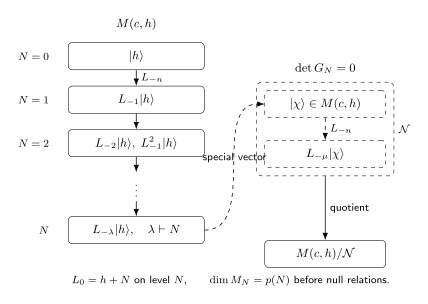
A generic Verma module is freely generated by negative Virasoro modes. At special values , a null singular vector appears at level . It generates a submodule . The irreducible representation is the quotient .
Descendants as local operators
Section titled “Descendants as local operators”The state-operator map turns every descendant state into a descendant operator. The simplest examples are
and
Higher descendants are less simply expressed as ordinary derivatives because modes such as involve the stress tensor. A useful operator definition is
For , the OPE gives
For , is a genuinely Virasoro descendant. It is a local operator in the same Virasoro family as .
A Virasoro family is much larger than a global conformal family. The global family uses only descendants, while the Virasoro family uses every with . This is why Virasoro conformal blocks resum infinitely many global conformal blocks.
Inner product and the Shapovalov form
Section titled “Inner product and the Shapovalov form”In a unitary CFT, radial quantization gives the adjoint relation
Thus inner products of descendants are determined by the Virasoro algebra. For example,
If we normalize , then
Unitarity therefore requires
At level , use the basis
The Gram matrix is
A direct Virasoro-algebra computation gives
For unitarity, every Gram matrix at every level must be positive semidefinite. This is a strong condition. It is the two-dimensional analogue of higher-dimensional unitarity bounds, but because there are infinitely many Virasoro descendants, the constraints are much sharper.
The determinant at level is
When such determinants vanish, a null state appears.
Null states and singular vectors
Section titled “Null states and singular vectors”A null state is a nonzero state with zero norm that is orthogonal to every state in the module. A singular vector is a descendant state that is itself highest-weight:
In a highest-weight module, null states that matter for representation theory are singular vectors. They generate submodules.
For example, suppose a level- singular vector has the form
Demanding gives
so
Demanding then gives
Equivalently,
is null when
This is the nontrivial level- factor of the determinant. The other level- zero occurs at , where the descendant is already null in the vacuum representation.
If the theory is unitary, null states have zero norm and decouple from all physical correlation functions. The irreducible representation is obtained by quotienting out the submodule generated by the null state:
This quotient is not a technicality. It changes the spectrum of descendants and makes the character smaller.
The vacuum module
Section titled “The vacuum module”The identity operator creates the vacuum:
The vacuum is invariant under the global conformal group:
The condition
says that translating the identity operator gives zero:
Thus the vacuum representation is not the generic Verma module . The level- state is removed. The first nontrivial holomorphic descendant is
which corresponds to the stress tensor:
If there are no further null states, the vacuum character is
The product begins at , not , because .
In AdS/CFT, this character is the chiral counting of boundary gravitons. The vacuum descendants are created by , which are precisely the nontrivial asymptotic Virasoro excitations of the AdS vacuum.
The Kac determinant
Section titled “The Kac determinant”At level , the Gram matrix of a Verma module is finite-dimensional, with dimension . Its determinant has a remarkable factorized form. One common parametrization is
and
Then the Kac determinant is
Here is a nonzero normalization-dependent constant. The important physics is the zero locus:
At , a singular vector appears at level
This formula is the representation-theoretic backbone of the minimal models. It tells us exactly when a Verma module becomes reducible.
A caution: the symbols in are labels of Virasoro degenerate representations. They are not spacetime indices, and they have nothing to do with the spin .
Unitarity and the unitary minimal series
Section titled “Unitarity and the unitary minimal series”For , a highest-weight Virasoro representation is unitary when
For , unitarity is dramatically more restrictive. The allowed central charges are discrete:
The allowed weights are
with
and the identification
These are the unitary minimal models. They are rational CFTs: only finitely many irreducible Virasoro representations appear.
The first example is , for which
The allowed weights are
These are the three chiral weights of the two-dimensional Ising CFT. In the diagonal Ising model, the primary fields are
The fact that a lattice critical point can lead to a finite list of primary operators is one of the miracles of two-dimensional critical phenomena.
Null-state decoupling and BPZ equations
Section titled “Null-state decoupling and BPZ equations”Null states are not merely representation-theoretic curiosities. They imply differential equations for correlation functions.
Let be a primary field whose module contains the level- null state
In the irreducible theory this means the descendant operator obeys
Now insert this field into a correlator with other primary operators :
Using the Ward identity to rewrite the insertion gives
Therefore the null-state condition gives the BPZ equation
This is a second-order differential equation. For four-point functions it becomes an ordinary differential equation in the cross-ratio. Its solutions are Virasoro conformal blocks.
This is the BPZ mechanism:
In minimal models, enough null vectors exist that many correlators can be solved exactly.
Fusion constraints from null states
Section titled “Fusion constraints from null states”Null states also constrain the operator product expansion. Suppose is a degenerate primary. Then the OPE
cannot contain arbitrary Virasoro representations. Only representations compatible with the null-state differential equations can appear.
For example, a level- degenerate primary leads to a second-order BPZ equation. A second-order equation has two independent local solutions near an OPE limit. Therefore its OPE with a generic primary can contain only two families.
This is the representation-theoretic origin of finite fusion rules in minimal models. The rough logic is
In rational CFTs this becomes a closed fusion algebra.
Virasoro blocks versus global blocks
Section titled “Virasoro blocks versus global blocks”In a general -dimensional CFT, a conformal block sums over descendants created by translations . In two dimensions, one can do something stronger: a Virasoro block sums over all Virasoro descendants inside one irreducible module.
For a four-point function of primaries, a schematic holomorphic decomposition is
Here is a Virasoro conformal block. It includes the full tower generated by
inside the representation labeled by .
A Virasoro block is therefore a much finer and more powerful object than a global block. In holographic large- CFTs, Virasoro vacuum blocks encode universal gravitational effects in AdS, including contributions from stress-tensor exchanges and their descendants.
Common pitfalls
Section titled “Common pitfalls”A primary state and a descendant state can have the same eigenvalue only if they live in different modules. Within one Verma module, descendants of have weights with .
A null state is not the same as zero before quotienting. In the Verma module it is a nonzero vector with zero norm. In the irreducible module it is set to zero by quotienting out the null submodule.
The vacuum module is not the same as the generic Verma module. Because the identity is translation-invariant,
The first nontrivial vacuum descendant is , the stress tensor.
The Kac determinant tells you when a module is reducible. It does not by itself tell you the full operator content of a CFT. A CFT also needs a spectrum of left-right representations, OPE coefficients, crossing symmetry, and modular consistency.
Finally, do not forget the barred sector. A local primary field is labeled by , and full correlators require both holomorphic and antiholomorphic data.
AdS/CFT checkpoint
Section titled “AdS/CFT checkpoint”The representation-theoretic statements on this page have direct holographic translations in AdS/CFT.
The vacuum module is the boundary-graviton sector. Its character
is the chiral counting of descendants generated by nontrivial asymptotic Virasoro modes.
The central charge controls the semiclassical gravitational limit:
Large means weakly coupled three-dimensional gravity. Virasoro blocks then reorganize CFT perturbation theory into gravitational saddle data.
Null states are also important in worldsheet CFT. Physical string states are constrained by Virasoro conditions, and null states are gauge redundancies. The phrase “null state decoupling” is therefore not only a two-dimensional statistical-mechanics trick; it is one of the oldest mechanisms by which conformal symmetry removes unphysical degrees of freedom.
Summary
Section titled “Summary”A primary state obeys
The Verma module is generated by negative modes:
At level , a generic Verma module has states, so
Null singular vectors occur at special values and generate submodules. Irreducible modules are quotients:
The Kac determinant detects these reducible points:
For , unitarity restricts the theory to the unitary minimal series
Null-state decoupling gives BPZ differential equations. This is the bridge from representation theory to exact correlation functions.
Exercises
Section titled “Exercises”Exercise 1: Level-one norm
Section titled “Exercise 1: Level-one norm”Let be a highest-weight state with . Use to compute
What does unitarity imply?
Solution
We compute
Since , we may commute:
The Virasoro algebra gives
Thus
Unitarity requires all norms to be nonnegative, so
Exercise 2: The level-two Gram matrix
Section titled “Exercise 2: The level-two Gram matrix”Using the basis
show that
Solution
First,
The Virasoro algebra gives
so
Next,
Using ,
The second term annihilates , while
Therefore
Finally,
One way to see this is to first compute
and then act once more with :
Thus
Combining these entries gives the stated matrix.
Exercise 3: A level-two null vector
Section titled “Exercise 3: A level-two null vector”Assume a level- singular vector has the form
Impose
Find and the relation between and .
Solution
First compute
Also,
Thus
The condition gives
Next,
Also,
Therefore
Substituting gives
Equivalently,
So the null vector is
with the stated condition on and .
Exercise 4: The vacuum character
Section titled “Exercise 4: The vacuum character”Explain why the generic Verma-module character
is not the correct vacuum character. Assuming no null states beyond , derive
Solution
The generic Verma module with would include the level- state
But the vacuum is created by the identity operator, and
Therefore
So descendants generated by alone are absent in the vacuum module. The allowed freely acting modes begin at
Each mode contributes a factor
Therefore
Exercise 5: Ising weights from the unitary minimal formula
Section titled “Exercise 5: Ising weights from the unitary minimal formula”For the unitary minimal model with , compute
and the distinct weights
Solution
For ,
The allowed labels are
with the identification
Compute representative values:
and
The distinct weights are therefore
These are the identity, spin, and energy weights of the Ising CFT.
Exercise 6: BPZ equation from a level-two null state
Section titled “Exercise 6: BPZ equation from a level-two null state”Let have a level- null vector
Show that
satisfies
Solution
The null-state condition gives the operator relation
Insert this into the correlator:
Now use the contour definition
Deform the contour away from to contours around the other insertions. Using the Ward identity for gives
Substitution yields
For the explicit level- singular vector discussed above,
Further reading
Section titled “Further reading”For the classic treatment of Virasoro representations, see Di Francesco, Mathieu, and Sénéchal, Chapters 6—8: operator formalism, Verma modules, Kac determinant, minimal models, null vectors, and BPZ equations. For AdS/CFT, this page prepares the vacuum character, Brown-Henneaux boundary gravitons, Virasoro blocks, and Cardy asymptotics.