
Charged Black Holes and Chemical Potential
The main idea
Section titled “The main idea”A finite-density quantum field theory is not merely a finite-temperature theory with one more parameter. It has a conserved charge , a chemical potential , and a density of the corresponding current. In holography, that one extra thermodynamic variable forces a major geometric change: the neutral black brane is replaced by a charged black brane.
The field-theory ensemble is
The holographic dictionary is
and
At large and strong coupling, a homogeneous finite-density thermal state is often described by a Reissner-Nordström-AdS black brane, abbreviated RN-AdS. The horizon carries entropy and the Maxwell field carries charge. This is the first workhorse geometry for holographic quantum matter.
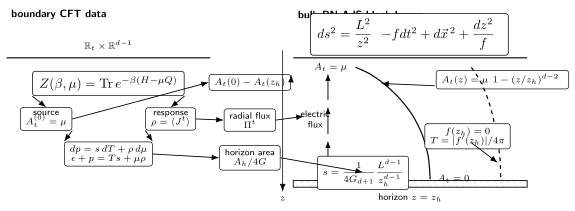
A finite-density CFT state is prepared by . The boundary value is the source for , while the response is the radial electric flux. Regularity fixes the gauge-invariant potential difference between the AdS boundary and the horizon.
The most important lesson on this page is conceptual:
The chemical potential is not just a local value of . In a black-hole background it is the gauge-invariant electrostatic potential difference between the boundary and the regular horizon.
This distinction is the finite-density analogue of the infalling boundary condition for retarded correlators. It is a small piece of grammar that controls many calculations.
The field-theory target
Section titled “The field-theory target”Let the boundary theory have a conserved global current,
Here is the boundary spacetime dimension and the bulk dimension is . The chemical potential defines a grand-canonical ensemble,
with grand potential
For a homogeneous system of spatial volume , write
The charge density is
and the entropy density is
The local first law is
and the Gibbs-Duhem relation is
For a homogeneous relativistic CFT on flat space, dimensional analysis gives
assuming no other scales are turned on. Conformal invariance also implies the tracelessness condition
again on flat space and away from anomalies or explicit scale-breaking deformations.
A finite chemical potential is therefore a controlled way to ask genuinely new questions:
| Question | Field-theory object | Holographic object |
|---|---|---|
| What is the charge density? | radial electric flux | |
| What is the thermodynamics? | , , | renormalized on-shell action and horizon area |
| What is the normal state? | charged thermal plasma | RN-AdS black brane |
| What are the low-energy degrees of freedom? | IR finite-density sector | near-horizon geometry |
| Is the normal state stable? | susceptibility to charged operators | charged-field instabilities near the horizon |
| How does charge move? | conductivity, diffusion, sound | coupled Maxwell-gravity perturbations |
The later pages in this module develop these questions. This page establishes the background geometry and the thermodynamic dictionary.
Chemical potential as a source
Section titled “Chemical potential as a source”In QFT, a conserved current is sourced by a nondynamical background gauge field,
For a static homogeneous state in the rest frame of the plasma, one writes
This simple formula hides two useful subtleties.
First, the boundary gauge field is a source for a global current, not a dynamical photon unless the boundary theory is explicitly coupled to electromagnetism. The bulk gauge field is dynamical in the gravitational description, but its boundary value is fixed when we define the CFT generating functional. Gauge redundancy in the bulk becomes global symmetry data at the boundary.
Second, is gauge-dependent. In an ordinary noncompact Lorentzian problem, adding a constant to can look like a gauge transformation. In a thermal black-hole saddle, however, regularity and boundary conditions make the potential difference meaningful. In a gauge regular at the horizon,
and the chemical potential is
In Poincaré coordinate , with the boundary at and horizon at , this same statement is
Euclidean signature makes the reason especially clear. The thermal circle shrinks smoothly at the horizon. A smooth one-form on the Euclidean cigar cannot have a nonzero component along the shrinking circle at the tip. Thus in a regular gauge,
Depending on Wick-rotation convention, one may write or absorb the into the definition of the Euclidean source. The invariant statement is not the sign of that , but the holonomy/potential difference between the boundary and the smooth tip of the Euclidean cigar.
The minimal bulk model
Section titled “The minimal bulk model”The universal bulk field dual to a conserved current is a gauge field. The simplest model coupling it to gravity is Einstein-Maxwell-AdS theory,
Here is the bulk Maxwell coupling. In top-down compactifications, this gauge field might come from an isometry of the internal space, a Ramond-Ramond gauge field, a flavor brane, or another consistent truncation. In bottom-up models, fixes the overall normalization of the current two-point function.
The Maxwell equation is
For a static homogeneous electric background,
the only nonzero field strength is
The radial canonical momentum conjugate to is, up to the sign convention for the outward normal,
The Maxwell equation says
This is just Gauss’s law in the radial direction. Holographically,
For the simple planar metric
one has
Choosing signs so that positive gives positive , the magnitude of the flux relation gives
Therefore
For , integration gives
Regularity at the horizon, , yields
This derivation is useful because it separates a universal statement from a model-dependent one. The fact that charge density is radial electric flux is universal. The precise relation between , , , and the blackening function depends on the Maxwell normalization and on whether the electric field backreacts on the geometry.
Planar RN-AdS black branes
Section titled “Planar RN-AdS black branes”When the electric field backreacts, the neutral black brane becomes a charged black brane. A convenient planar form is
The conformal boundary is at . The horizon is at , where
One common dimensionless parameterization writes
and
The gauge potential is
up to normalization-dependent factors relating and . The important structural features are independent of these factors:
The Hawking temperature follows from Euclidean smoothness or surface gravity. Since
and , we obtain
The neutral black brane is recovered at :
The extremal limit is reached when
At extremality the horizon remains at finite area in the classical solution, so the entropy density is nonzero at :
This is one of the first surprises of holographic finite-density physics. The classical RN-AdS geometry is a useful saddle, but its finite zero-temperature entropy is usually interpreted as a sign that the deep IR may require additional physics: charged matter outside the horizon, superconducting hair, lattice effects, quantum corrections, or some other instability/resolution.
The entropy density at any nonzero temperature is still given by the Bekenstein-Hawking area law,
The charge density is the electric flux,
evaluated at any radial position. The energy density and pressure follow from the renormalized holographic stress tensor. Conformal invariance on flat space implies
while thermodynamics gives
Together these relations are often the cleanest way to check a charged-brane calculation.
The global charged black hole
Section titled “The global charged black hole”The planar brane is the natural saddle for a plasma on . On the cylinder , the corresponding homogeneous charged saddle is the global RN-AdS black hole,
with schematic blackening function
where the coefficient of depends on the normalization of the Maxwell term. The gauge potential has the form
and regularity fixes
The global case has additional phase structure because the boundary sphere introduces the scale . The neutral global black hole already participates in the Hawking-Page transition. Charged global black holes add a richer canonical and grand-canonical phase diagram, including charged small/large black-hole transitions in some ensembles.
For most holographic quantum-matter applications, however, one studies planar horizons because condensed-matter-like systems are usually modeled on rather than on .
Why a horizon is natural at finite density
Section titled “Why a horizon is natural at finite density”A finite chemical potential by itself does not force a horizon. Pure AdS with a constant can be a formal solution of the Maxwell equation, but if no charged object or horizon is present, the constant potential has no gauge-invariant field strength. It is a source, not a density.
To obtain a nonzero charge density, the electric flux must end somewhere in the bulk. There are several possibilities:
| Bulk endpoint of electric flux | Boundary interpretation |
|---|---|
| black-hole horizon | fractionalized charge hidden behind horizon |
| charged scalar condensate | superconducting or superfluid phase |
| charged fermion fluid | electron-star-like phase |
| charged branes | top-down finite-density brane state |
| explicit charged matter shell | model-dependent charged phase |
The RN-AdS black brane is the simplest option: the flux threads the exterior geometry and disappears through the horizon. This is why it is often called the normal state of a holographic finite-density system. Later pages ask whether that normal state is stable and what its low-energy excitations look like.
Gauge choice and horizon regularity
Section titled “Gauge choice and horizon regularity”It is tempting to write the solution as
and move on. But in real calculations, the gauge choice matters.
Near a nonextremal horizon, define the tortoise coordinate
Ingoing Eddington-Finkelstein time is
The one-form is
Since is singular at the horizon, a regular gauge field one-form at the future horizon requires
This is the Lorentzian version of the Euclidean smoothness condition. A gauge where can be used locally only if one performs a compensating singular gauge transformation. Such gauges are usually a terrible idea for thermodynamics and horizon boundary conditions.
The physical chemical potential is therefore
up to orientation convention. It is a potential difference between the boundary and the horizon, not an arbitrary constant attached to .
This is also why the electrostatic potential appears in the black-hole first law. For total charge , mass , entropy , and potential , one has
for planar black branes per unit volume, with additional terms if angular momentum, pressure-volume variables, scalar sources, or other charges are present.
Dirichlet versus Neumann boundary conditions
Section titled “Dirichlet versus Neumann boundary conditions”The boundary condition for the bulk gauge field decides the thermodynamic ensemble.
In the grand-canonical ensemble, one fixes the source,
The Euclidean on-shell action computes
Its variation has the schematic form
so that
In the canonical ensemble, one fixes the charge density,
Holographically this is implemented by adding a boundary term that Legendre-transforms the Maxwell variational problem. In schematic Lorentzian notation,
Thermodynamically,
with and chosen so that the desired is obtained.
This is not a cosmetic distinction. Charged AdS black holes can have different phase diagrams in different ensembles. The stability conditions are also different:
while canonical stability involves the heat capacity and other Hessian entries at fixed charge.
Thermodynamics of the planar charged brane
Section titled “Thermodynamics of the planar charged brane”For a planar conformal finite-density state, the grand potential density has the scaling form
This immediately implies
and
with signs depending on the convention for in . The energy density follows from
Using conformality,
The charged black brane realizes this scaling geometrically. The only dimensionful scale in the planar solution is , while is dimensionless. Therefore
Eliminating gives exactly the CFT scaling structure: all densities are powers of times functions of .
Extremality and the first hint of AdS
Section titled “Extremality and the first hint of AdS2_22”The extremal limit of the planar RN-AdS black brane is obtained by lowering at fixed charge density until
At that point, has a double zero at the horizon. Expanding near gives
A double zero means the near-horizon geometry is no longer Rindler-like. Instead, after an appropriate scaling limit, it becomes
This emergent AdS region is the subject of the next page. It controls many low-frequency finite-density observables and is responsible for a form of IR scaling often called local criticality: time scales, but space does not scale in the same way.
The finite extremal entropy density,
is both useful and suspicious. It makes the saddle analytically tractable, but it also suggests a large degeneracy of low-energy states in the strict classical limit. In more complete models, the extremal RN-AdS throat may be modified by instabilities, quantum corrections, electron-star formation, superconducting hair, spatial modulation, or other effects.
Example: R-charge density in SYM
Section titled “Example: R-charge density in N=4\mathcal N=4N=4 SYM”In the canonical AdS/CFT duality, the most natural conserved charges are not electromagnetic charges. They are R-charges associated with the symmetry of SYM. In the bulk, the corresponding gauge fields arise from the isometries of the after Kaluza-Klein reduction.
Turning on a chemical potential for an R-charge means deforming the thermal trace as
In ten-dimensional language, such solutions can be understood as spinning D3-branes, where angular momentum in the internal becomes R-charge in the field theory. In five-dimensional gauged supergravity, they are charged AdS black holes with one or more gauge fields in the Cartan of .
This example illustrates a recurring point: the same Einstein-Maxwell-AdS formulas often capture universal features, but top-down embeddings tell us what the charge actually is, what scalars must be included, and whether the charged black hole is stable.
What is universal and what is not
Section titled “What is universal and what is not”Finite-density holography contains both robust dictionary entries and model-dependent physics.
The robust entries are:
| Universal statement | Reason |
|---|---|
| sources | GKPW prescription |
| is radial electric flux | Maxwell Gauss law |
| is a boundary-to-horizon potential difference | horizon regularity and gauge invariance |
| entropy is horizon area in classical gravity | Bekenstein-Hawking formula |
| grand-canonical versus canonical ensembles differ by a boundary term | variational principle |
| low-frequency transport often depends on horizon data | regularity plus radial flow equations |
The model-dependent entries are:
| Model-dependent statement | Depends on |
|---|---|
| exact coefficient relating , , and | Maxwell normalization and compactification |
| stability of RN-AdS | charged matter spectrum and scalar couplings |
| low-temperature ground state | quantum corrections, matter content, and backreaction |
| conductivity at finite density | momentum relaxation, charge sector, and mixing with metric modes |
| interpretation of charge | R-charge, baryon number, flavor charge, or emergent |
| phase diagram | ensemble, horizon topology, scalar potentials, and brane embeddings |
This distinction should guide every use of RN-AdS. It is a background, not a complete theory of all finite-density systems.
Common mistakes
Section titled “Common mistakes”Mistake 1: Calling the boundary electromagnetism.
In most AdS/CFT models, the boundary is a global symmetry. The boundary value of the bulk gauge field is a source. It is not automatically a dynamical photon. To model actual electromagnetism, one must weakly gauge the boundary current or specify how the global current couples to external electromagnetic fields.
Mistake 2: Identifying with a gauge-dependent constant.
A constant shift of is not itself physical. The regular black-hole problem fixes the physically meaningful potential difference between boundary and horizon.
Mistake 3: Forgetting that finite density mixes Maxwell and metric perturbations.
At zero charge density, a transverse Maxwell perturbation often decouples. At finite density, current perturbations generally mix with momentum and energy perturbations. This is why translationally invariant finite-density systems have an infinite DC conductivity unless momentum can relax.
Mistake 4: Assuming RN-AdS is the true zero-temperature ground state.
RN-AdS is the simplest charged saddle. It may be unstable to scalar hair, fermion fluid formation, spatial modulation, or other phases. The finite zero-temperature entropy should be treated as a clue, not an unquestioned final answer.
Mistake 5: Comparing canonical and grand-canonical results without the Legendre transform.
Fixing and fixing are different variational problems. The on-shell action, boundary terms, stability criteria, and phase diagram may differ.
Exercises
Section titled “Exercises”Exercise 1: Radial Gauss law and charge density
Section titled “Exercise 1: Radial Gauss law and charge density”Consider the Maxwell action
in the metric
For , show that the radial electric flux is conserved and derive the relation
up to the sign convention for the outward normal.
Solution
The Maxwell equation is
For a static electric ansatz , the only nontrivial component is :
Thus is independent of .
For the metric,
Therefore
and
The canonical momentum is proportional to this quantity. Choosing the convention in which positive gives positive ,
The right-hand side is independent of by the Maxwell equation.
Exercise 2: Chemical potential from horizon regularity
Section titled “Exercise 2: Chemical potential from horizon regularity”Assume and a static solution
Impose the regularity condition . Express and in terms of and .
Solution
Regularity gives
Thus
The derivative is
Using the flux relation from Exercise 1,
Therefore
Equivalently,
Exercise 3: Temperature of the planar RN-AdS black brane
Section titled “Exercise 3: Temperature of the planar RN-AdS black brane”Let
Show that
Find the extremal value of .
Solution
The horizon is at , and indeed
Differentiate with respect to :
At the horizon,
Since ,
The Hawking temperature is
For the nonextremal branch with ,
Extremality occurs at , so
Exercise 4: Conformal thermodynamics at finite density
Section titled “Exercise 4: Conformal thermodynamics at finite density”Assume a homogeneous CFT on flat space has grand-potential density
Show that the pressure obeys and that the energy density satisfies .
Solution
By definition,
so
The stress tensor of a homogeneous relativistic fluid is
In the rest frame, its trace in spacetime dimensions is
For a CFT on flat space with no anomaly contribution,
Therefore
The same result also follows from Euler homogeneity. Since is homogeneous of degree ,
Using
we get
Then
so .
Exercise 5: Why finite density does not automatically mean a charged black hole
Section titled “Exercise 5: Why finite density does not automatically mean a charged black hole”Explain why a constant in pure AdS is not by itself a finite-density state with .
Solution
A constant has
Therefore the radial electric flux vanishes:
The boundary source is nonzero, but the response is zero. In a finite-density state with , there must be nonzero radial electric flux in the bulk. That flux must end on something: a horizon, charged matter, charged branes, a condensate, or some other charged object. The RN-AdS black brane is the simplest solution because the flux threads the exterior geometry and is supported by the charged horizon.
Further reading
Section titled “Further reading”- A. Chamblin, R. Emparan, C. V. Johnson, and R. C. Myers, “Charged AdS Black Holes and Catastrophic Holography,”
arXiv:hep-th/9902170. - A. Chamblin, R. Emparan, C. V. Johnson, and R. C. Myers, “Holography, Thermodynamics and Fluctuations of Charged AdS Black Holes,”
arXiv:hep-th/9904197. - S. A. Hartnoll, “Lectures on holographic methods for condensed matter physics,”
arXiv:0903.3246. - N. Iqbal and H. Liu, “Universality of the hydrodynamic limit in AdS/CFT and the membrane paradigm,”
arXiv:0809.3808. - J. McGreevy, “Holographic duality with a view toward many-body physics,”
arXiv:0909.0518.