
9. Holographic Fermi Surfaces and Fermionic Response
Pages 04—08 explained how finite density, charged horizons, IR scaling geometries, momentum relaxation, and strange-metal transport are described holographically. This page turns to a different diagnostic: single-fermion spectral response.
Condensed matter physicists often learn a metal by looking at its electron Green’s function. A sharp quasiparticle pole near the Fermi momentum is the signature of a Landau Fermi liquid. Broad spectral weight, anomalous scaling, or a pole whose width is comparable to its energy instead suggests non-Fermi-liquid physics. Holography gives a controlled large- setting in which such fermionic spectral functions can be computed at strong coupling by solving a classical Dirac equation in a charged black-brane geometry.
The central idea is simple but subtle:
A charged bulk spinor is dual to a charged fermionic operator in the boundary theory. Solving the bulk Dirac equation with infalling boundary conditions at the horizon gives the retarded Green’s function .
A holographic Fermi surface is then a pole or sharp singularity of at and . It is not automatically a Landau Fermi surface, and it does not automatically account for all of the charge density. Those two warnings are the difference between a useful holographic diagnostic and a misleading slogan.
What this page explains
Section titled “What this page explains”This page develops the probe-fermion dictionary used throughout holographic quantum matter. The goal is not to claim that every holographic fermion is an electron in a material. The goal is to understand what a strongly coupled finite-density state does to charged fermionic probes.
By the end, you should know how to answer the following questions.
- What boundary quantity is computed by a bulk Dirac equation?
- What is the precise definition of a holographic Fermi surface?
- Why does the near-horizon region produce non-Fermi-liquid self energies?
- What is the meaning of the exponent ?
- Why can visible Fermi-surface poles fail to account for the total charge?
- When should a probe-fermion calculation be trusted, and when is backreaction essential?
Boundary fermionic response
Section titled “Boundary fermionic response”Consider a finite-density quantum system with a global charge. Let be a fermionic operator carrying charge under this . In a real electronic system might be analogous to an electron operator, but in holography it is usually a gauge-invariant large- operator with fermionic statistics and global charge.
The retarded Green’s function is
After Fourier transforming,
the spectral function is
A conventional Fermi liquid has a quasiparticle pole of the form
The pole is long lived. The residue is finite. The width is parametrically smaller than the excitation energy.
Holographic fermions often behave differently. They can show poles at , but the self energy is set by an emergent strongly coupled IR sector rather than by weak quasiparticle scattering. This is why the page title says fermionic response, not simply holographic electrons.
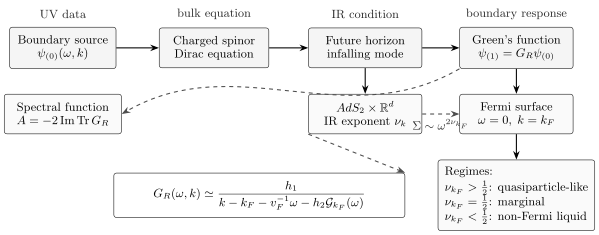
A charged bulk spinor evolves from boundary source/response data to an infalling horizon condition. The boundary Green’s function is extracted from the ratio of response to source. In extremal or near-extremal charged backgrounds, the IR matching region often controls the self energy through .
Bulk spinors and the fermionic dictionary
Section titled “Bulk spinors and the fermionic dictionary”Let the boundary have spatial dimensions, so its spacetime dimension is and the bulk dimension is . Near the boundary the geometry is asymptotically . A minimal charged bulk spinor has action
where
Here is the bulk gauge field dual to the boundary conserved current. The boundary chemical potential appears as the boundary value of , while the charge density appears as radial electric flux. The spinor charge determines how strongly the fermionic operator couples to the finite-density background.
A common extension is a dipole or Pauli coupling,
This term can shift spectral weight, alter IR scaling exponents, and in some models produce gap-like behavior. It is useful, but it is also model-dependent. In a top-down construction the coefficient is fixed by the compactification; in a bottom-up model it is a phenomenological parameter.
Spinor falloffs near the AdS boundary
Section titled “Spinor falloffs near the AdS boundary”Use Fefferman—Graham-like radial coordinate , with the boundary at and
Introduce the radial projectors
For a spinor of mass , the near-boundary solution behaves schematically as
For standard quantization with , is the source and is the response. The dual fermionic operator has scaling dimension
When , alternative quantization is possible, and the roles of the two independent boundary data may be exchanged. The alternative operator has
The window is narrower for spinors than for scalars because the spinor unitarity bound is more restrictive. The practical lesson is simple: before quoting a fermion Green’s function, state which quantization and which gamma-matrix convention you are using.
Dirac equation in a charged black-brane background
Section titled “Dirac equation in a charged black-brane background”For homogeneous finite-density states, use a metric and gauge field of the form
with . Fourier decompose the spinor as
where rotational symmetry lets us choose the momentum along one spatial direction.
After a standard rescaling that removes the spin connection from the radial derivative, the Dirac equation takes the schematic form
The combination
is the local frequency seen by an infalling observer. The local momentum is
This local viewpoint is useful. The charged black brane supplies a radial electric field and a redshift. The spinor sees an effective competition among mass, momentum, charge, and the near-horizon electric field.
Retarded boundary condition
Section titled “Retarded boundary condition”The retarded Green’s function is obtained by imposing infalling boundary conditions at the future horizon. Near a non-extremal horizon,
and the spinor behaves as
up to a spinor polarization fixed by the Dirac equation. The exponent is the same physical ingoing behavior that appears for bosonic perturbations. It encodes causality: the horizon absorbs disturbances; it does not emit them in the classical retarded problem.
At zero temperature the horizon is often extremal. The near-horizon region is then not Rindler but an IR scaling geometry, frequently . The retarded condition is still the condition of regular infalling behavior in the appropriate IR region, but its low-frequency structure is richer. That structure is the origin of the non-Fermi-liquid self energies below.
Extracting the Green’s function
Section titled “Extracting the Green’s function”Solving the radial Dirac equation with infalling boundary condition gives a linear map between boundary source data and response data :
where parameterizes the independent infalling spinor components at the horizon. The retarded Green’s function is
up to convention-dependent local contact terms and gamma-matrix choices.
In many practical calculations the Dirac equation splits into two decoupled two-component sectors. Then one often computes ratios
which obey first-order nonlinear radial flow equations. The boundary Green’s functions are then read off as limits of these ratios after including the appropriate powers of the radial coordinate. The ratio method is numerically stable and avoids keeping track of a full basis of spinor solutions.
A useful way to remember the computation is:
Definition of a holographic Fermi surface
Section titled “Definition of a holographic Fermi surface”A Fermi surface is detected by a pole in the retarded fermion Green’s function at zero frequency:
Equivalently, in the matrix notation above,
This condition means that there exists a nontrivial bulk spinor solution that is infalling in the IR and normalizable in the UV, with no fermion source turned on. Such a mode is the holographic analogue of a Fermi-surface excitation.
In practice, one searches for peaks in
as . A sharp ridge ending at is evidence for a Fermi-surface pole. But the nature of the excitation depends on the low-frequency scaling near the pole.
The IR matching argument
Section titled “The IR matching argument”The most important analytic control comes from extremal charged black branes whose near-horizon region is
In this region, the spatial momentum acts like a parameter in an emergent IR quantum mechanics. Each value of corresponds to a different IR operator with dimension
For a minimal spinor in a simple charged black brane, the exponent has the schematic form
where is the radius and measures the near-horizon electric field in dimensionless units. The precise constants depend on the background and coordinate normalization, but the structure is universal:
- the bulk mass increases ;
- spatial momentum increases ;
- the near-horizon electric field decreases for charged fermions.
The IR Green’s function behaves at zero temperature as
when is real and non-integer complications are absent. At finite temperature the power law is replaced by a universal finite-temperature expression built from gamma functions, with scaling form
The full boundary Green’s function near a Fermi momentum is obtained by matching the IR solution to the UV region. The result has the form
At zero temperature this becomes
where , , , and the phase are matching data determined by the full bulk solution.
This formula is one of the most important results in holographic fermion physics. The UV geometry determines whether and where exists. The IR geometry determines the self energy.
Classification by
Section titled “Classification by νkF\nu_{k_F}νkF”Let . The low-energy physics near the Fermi surface depends on whether the IR self energy is more or less important than the analytic term.
: quasiparticle-like pole
Section titled “ν>1/2\nu>1/2ν>1/2: quasiparticle-like pole”If , then dominates over at sufficiently small frequency. The pole has approximately linear dispersion,
and the width is parametrically smaller than the energy:
This is quasiparticle-like. It is not automatically a Landau Fermi liquid, because the excitation is coupled to a large- bath, and the full charge accounting may be non-Luttinger-like.
: marginal Fermi-liquid-like behavior
Section titled “ν=1/2\nu=1/2ν=1/2: marginal Fermi-liquid-like behavior”At , the analytic and nonanalytic terms compete. Logarithms usually appear:
This is the holographic route to marginal-Fermi-liquid-like scaling. It is suggestive for strange metals, but the phrase should be used carefully: a spectral self energy resembling a marginal Fermi liquid is not by itself a derivation of a material phase diagram.
: non-Fermi-liquid pole
Section titled “0<ν<1/20<\nu<1/20<ν<1/2: non-Fermi-liquid pole”If , the nonanalytic term dominates over the analytic term. The excitation has no parametrically long lifetime. Its width is of the same order as its energy, and the residue vanishes toward the Fermi surface.
The pole dispersion scales as
This is the characteristic holographic non-Fermi liquid.
Imaginary : oscillatory region
Section titled “Imaginary ν\nuν: oscillatory region”If becomes imaginary, then the IR Green’s function becomes log-periodic:
This is the oscillatory region. It signals that the effective IR scaling dimension is complex. Physically, the near-horizon electric field is strong enough to destabilize the naive IR description. In many cases this is a warning that the background should be replaced by a new phase, such as a state with fermion backreaction or charged condensates.
Semi-holographic interpretation
Section titled “Semi-holographic interpretation”The matching formula has a useful field-theory interpretation. Imagine a fermion near a Fermi surface, , coupled to a strongly interacting IR sector:
If
then integrating out the IR sector gives
This is the same structure as the holographic result. The fermion is not isolated. It decays into a locally critical large- bath supplied by the horizon region.
This semi-holographic picture is often the clearest physical interpretation of holographic non-Fermi-liquid behavior.
Worked example: finding in a probe calculation
Section titled “Worked example: finding kFk_FkF in a probe calculation”Suppose a bulk spinor in an extremal charged black brane is described by two decoupled components . Near the boundary, each component has
At , choose the infalling or regular IR solution. Integrate the Dirac equation outward to the boundary. This gives and .
A Fermi momentum is found when
At this value of , there is a source-free normalizable fermion mode. Near ,
At small nonzero , the pole broadens and moves according to the IR matching formula. The spectral function then shows a peak whose shape is controlled by .
This example also explains why holographic Fermi surfaces are often found numerically. One scans , solves a first-order radial Dirac equation, and searches for zeros of the source coefficient.
Visible charge, hidden charge, and Luttinger logic
Section titled “Visible charge, hidden charge, and Luttinger logic”In an ordinary Fermi liquid, the volume enclosed by the Fermi surface counts the charge density, up to spin and degeneracy factors. In holography the situation is more subtle.
The total boundary charge density is measured by the electric flux at the boundary:
But in a charged black brane, some electric flux can enter the horizon. This horizon flux represents charge carried by degrees of freedom that are not visible as gauge-invariant Fermi-surface poles of the probe fermion.
A useful schematic decomposition is
Here is associated with Fermi-surface-like charged matter outside the horizon, while is fractionalized charge hidden behind the horizon. Probe spinors can reveal poles in selected fermionic correlators, but they do not by themselves determine the full charge accounting.
This is why page 10 studies electron stars, Dirac hair, and backreacted fermion matter. Once the fermions carry an order- amount of charge, the geometry changes. The Fermi surfaces are no longer merely spectral diagnostics of a fixed background; they participate in the state.
Probe limit and backreaction
Section titled “Probe limit and backreaction”The probe-fermion calculation is powerful because it is simple: solve a linear Dirac equation in a fixed background. It is also limited for precisely the same reason.
A probe spinor computes the two-point function of a fermionic operator in a state whose charge and stress tensor are already determined by the background. It does not change the background charge distribution. Therefore:
- it can diagnose whether a fermionic operator has spectral weight near a Fermi momentum;
- it can classify non-Fermi-liquid self energies;
- it can reveal instabilities or oscillatory regions;
- it cannot, by itself, prove that the whole state is a Fermi liquid;
- it cannot, by itself, account for all of the charge density.
Backreaction becomes essential when the fermions themselves carry an order-large- fraction of the total charge, or when a fermionic instability changes the IR state. This is the physical reason to distinguish fermionic response from backreacted fermion matter.
Dipole couplings and spectral gaps
Section titled “Dipole couplings and spectral gaps”Dipole couplings are often used to model gap-like behavior in holographic fermion spectra:
In a charged background, is nonzero, so the dipole term changes the radial Dirac equation. Roughly speaking, it shifts the effective momentum and mass data seen by the spinor. Depending on the sign and magnitude of , spectral weight may be suppressed near , and a gap-like structure may appear.
This is useful phenomenologically, but it should not be overinterpreted. A Pauli coupling is a legitimate operator in an effective bulk theory, but unless it comes from a controlled top-down compactification, its coefficient is a model choice. A gap in a probe spectral function is not automatically a Mott gap, a superconducting gap, or a proof of confinement.
Fermionic response in non- IR geometries
Section titled “Fermionic response in non-AdS2AdS_2AdS2 IR geometries”The throat gives the cleanest analytic story, but it is not the only possibility. In EMD and hyperscaling-violating backgrounds, the IR may have scaling
with possible hyperscaling violation. The Dirac equation then probes a different IR spectral problem. Depending on the geometry, fermionic spectral weight can be suppressed, enhanced, or distributed in a continuum.
The robust lesson is not that every holographic metal has physics. The robust lesson is that the low-frequency fermion self energy is controlled by the IR region of the geometry. In a charged black brane that region may be ; in a scaling EMD solution it may be Lifshitz-like or hyperscaling-violating; in a backreacted fermion phase it may be an electron-star geometry.
What holographic fermions teach
Section titled “What holographic fermions teach”The most valuable outputs of holographic fermion calculations are conceptual.
First, they show that a sharp Fermi momentum can coexist with non-Fermi-liquid decay. A Fermi surface, by itself, does not guarantee Landau quasiparticles.
Second, they separate spectral response from transport. The fermion spectral function tells us about single-operator excitations. Conductivity tells us about currents, momentum, charge diffusion, and heat flow. A system can have broad fermion spectra and still have transport controlled by momentum relaxation, incoherent currents, or hydrodynamic modes.
Third, they make charge fractionalization precise. If charge resides behind a horizon, it contributes to the total density but not necessarily to visible Fermi-surface volumes.
Fourth, they provide a calculable laboratory for semi-holographic non-Fermi liquids: a fermionic degree of freedom coupled to a strongly interacting IR bath.
Common pitfalls
Section titled “Common pitfalls”| Pitfall | Better statement |
|---|---|
| ”A holographic Fermi surface is a Landau Fermi liquid.” | It is a pole or singularity in a fermionic Green’s function. Its lifetime and residue depend on . |
| ”The probe fermion carries the charge density of the state.” | A probe diagnoses response. The background charge may remain behind the horizon. |
| ”A pole at proves Luttinger’s theorem.” | Holographic charge accounting can include horizon flux, so visible Fermi surfaces need not account for all charge. |
| ”The region is always stable.” | Imaginary and other IR instabilities can signal a new phase. |
| ”Spectral functions determine conductivity.” | Spectral response and transport are related but distinct observables. Transport also depends on momentum, heat currents, and relaxation mechanisms. |
| ”A dipole-induced gap is automatically a Mott gap.” | It is a model-dependent suppression of spectral weight unless embedded in a controlled microscopic construction. |
Summary
Section titled “Summary”A holographic fermion calculation translates a strongly coupled finite-density spectral problem into a classical radial Dirac equation. The UV boundary data determine the source and response of a charged fermionic operator. The horizon boundary condition selects the retarded Green’s function. At extremality, the near-horizon IR region controls the self energy.
The key formula is
It contains the entire lesson in compressed form. The existence of is a UV-to-IR eigenvalue problem. The exponent is an IR scaling dimension. The pole can be quasiparticle-like, marginal, or non-Fermi-liquid-like depending on .
But the page’s most important caution is just as important as the formula: holographic Fermi surfaces are spectral features, not automatically complete charge-counting surfaces. The distinction between visible Fermi-surface charge and horizon charge is one of the central conceptual advances of finite-density holography.
Exercises
Section titled “Exercises”Exercise 1: Spinor dimensions from boundary falloffs
Section titled “Exercise 1: Spinor dimensions from boundary falloffs”A bulk spinor in has near-boundary falloffs
Assuming standard quantization with , show that the dual fermionic operator has dimension
Why is the coefficient interpreted as the source?
Solution
For a boundary operator of dimension in spacetime dimension , the source coupled as
has dimension
The leading coefficient multiplies the slower falloff and is the freely specified boundary datum in standard quantization. Its scaling dimension is therefore . Matching the radial scaling gives
so
The response coefficient is then proportional, after renormalization and convention-dependent gamma-matrix factors, to .
Exercise 2: Normalizable zero mode and Fermi momentum
Section titled “Exercise 2: Normalizable zero mode and Fermi momentum”Suppose a two-component spinor sector gives boundary data and , with Green’s function
Show that a Fermi momentum satisfies with . Explain the bulk meaning of this condition.
Solution
A pole of the Green’s function occurs when the denominator vanishes while the numerator remains nonzero. Thus
has a pole at if
The coefficient is the source. Setting means the bulk solution is normalizable at the boundary: it corresponds to an excitation of the state rather than to an externally applied fermionic source. The same solution is infalling or regular in the IR by construction. Therefore is an eigenvalue of the radial Dirac problem with normalizable UV behavior and retarded IR behavior.
Exercise 3: Classifying poles from the IR exponent
Section titled “Exercise 3: Classifying poles from the IR exponent”Near a Fermi momentum, suppose
Classify the pole for , , and .
Solution
If , then is smaller than at low frequency. The pole has approximately linear dispersion,
and the width scales as , so . It is quasiparticle-like.
If , the nonanalytic term competes with the analytic term. In the exact matching calculation, logarithms typically appear, giving marginal-Fermi-liquid-like behavior,
If , the self-energy term dominates over . The pole no longer represents a long-lived quasiparticle. Its dispersion scales as
and the width is of the same order as the energy.
Exercise 4: Why visible Fermi surfaces need not count all charge
Section titled “Exercise 4: Why visible Fermi surfaces need not count all charge”In a holographic charged black brane, the total boundary charge density is measured by electric flux at the boundary. Explain why the sum of visible Fermi-surface volumes of probe fermions need not equal the total charge density.
Solution
The boundary charge density is the total radial electric flux measured near the boundary. In a charged black-brane solution, some of this flux can continue through the horizon. That horizon flux represents charge carried by strongly coupled large- degrees of freedom that are not resolved as ordinary gauge-invariant Fermi-surface poles of a chosen probe fermion.
A probe fermion computes a two-point function in a fixed background. It can reveal poles of a particular operator, but it does not determine where the background charge resides. The schematic decomposition is
Only if the charge is carried by explicit fermionic matter outside the horizon, and if all relevant charged fermions are included, should one expect a Luttinger-like visible-volume count. Probe poles alone are not enough.
Exercise 5: Oscillatory region
Section titled “Exercise 5: Oscillatory region”Using
explain qualitatively how increasing the spinor charge can produce an oscillatory region. What does imaginary imply for the IR Green’s function?
Solution
The charge term appears with a minus sign:
Increasing can make the expression under the square root negative for sufficiently small . Then
The IR Green’s function behaves as
This is log-periodic rather than a simple power law. It means the naive IR scaling dimension is complex, which is usually interpreted as a sign that the assumed IR background is unstable or incomplete for that charged fermionic sector.
Further reading
Section titled “Further reading”For a systematic review of holographic quantum matter, including bulk fermions, semi-local criticality, Luttinger-counting issues, magnetic fields, and transport, see Sean A. Hartnoll, Andrew Lucas, and Subir Sachdev, Holographic Quantum Matter.
For a condensed-matter-oriented development of holographic photoemission, Reissner—Nordstrom metals, fermion spectral functions, and electron stars, see Jan Zaanen, Yan Liu, Ya-Wen Sun, and Koenraad Schalm, Holographic Duality in Condensed Matter Physics.
For a textbook-level account of finite-density holography, holographic superconductors, fermions, hyperscaling violation, and condensed-matter applications, see Martin Ammon and Johanna Erdmenger, Gauge/Gravity Duality: Foundations and Applications.