
16. Entanglement, Chaos, and Information Diagnostics of Quantum Matter
Transport tells us how a system responds to external probes. Spectral functions tell us where excitations live in frequency and momentum space. Entanglement and chaos ask a different question: how is information organized inside the many-body state?
This question matters especially in holographic quantum matter because many of the systems in this sequence do not have long-lived quasiparticles. If the low-energy state is not usefully described as a gas of particles, then the usual microscopic vocabulary of lifetimes, scattering rates, and Fermi-surface quasiparticles is incomplete. Entanglement, mutual information, scrambling, butterfly velocity, and complexity-like probes give a complementary language.
They are not replacements for thermodynamics or transport. They are diagnostics of the same state from a different angle. A useful slogan is
This page assumes the standard AdS/CFT dictionary and the earlier quantum-matter pages. The goal is to understand how information-theoretic observables diagnose quantum critical matter, compressible phases, strange metals, ordered phases, and strongly coupled thermal states.
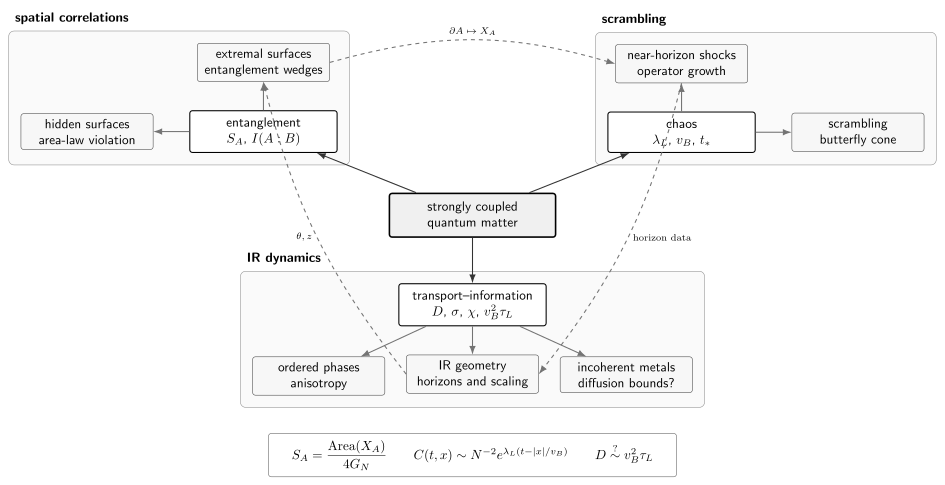
Information diagnostics organize holographic quantum matter along three complementary axes. Entanglement probes spatial organization through extremal surfaces. Chaos probes scrambling through near-horizon shock waves. Transport-information relations compare diffusion, butterfly velocity, and relaxation times, but only under controlled assumptions.
1. What is being diagnosed?
Section titled “1. What is being diagnosed?”A many-body state can look simple in one set of observables and complicated in another. A thermal state of a CFT, for example, has simple thermodynamics:
in spatial dimensions. But that scaling alone does not tell us how the quantum degrees of freedom are entangled, how fast perturbations spread, or whether the state has a hidden low-energy surface of gapless modes.
The diagnostics in this page answer questions such as:
- Does the state obey an area law for entanglement, or does it violate it?
- Does the entropy of a large region contain a volume-law thermal contribution?
- Do disconnected regions share mutual information?
- How quickly does a local perturbation scramble into the many-body state?
- Is there a butterfly velocity controlling the spatial spread of chaos?
- Is a transport coefficient controlled by the same scale as scrambling?
- Is an apparent scaling law universal, or merely a model-dependent feature of a chosen bulk geometry?
The answers are most powerful when combined with the previous diagnostics from this sequence:
No single diagnostic should be treated as a complete definition of a phase.
2. Entanglement entropy in quantum matter
Section titled “2. Entanglement entropy in quantum matter”For a quantum state and a spatial region , the reduced density matrix is
where is the complement of . The von Neumann entropy of is
In a pure state, . Entanglement entropy therefore measures correlations across the boundary between and . In a mixed state, also includes ordinary thermal entropy inside .
For a local ground state in spatial dimensions, the leading ultraviolet divergence usually obeys an area law:
where is a short-distance cutoff. The coefficient is not universal. The subleading terms are often more informative. Depending on the state, they may contain universal constants, logarithms, finite functions of shape, or thermal volume-law pieces.
Several patterns are especially important for quantum matter:
| State or regime | Entanglement pattern | Interpretation |
|---|---|---|
| Gapped ground state | area law plus exponentially small long-distance corrections | short-range entanglement unless topological order is present |
| Relativistic CFT vacuum | area law plus universal shape-dependent data | scale-invariant correlations |
| Thermal state | area law plus for large regions | ordinary thermal entropy dominates large regions |
| Fermi liquid | logarithmic violation of area law | extended surface of gapless modes |
| Hyperscaling-violating holographic phase | power-law or logarithmic modification | effective spatial dimensionality |
| Topologically ordered state | universal constant correction in dimensions | long-range entanglement |
Holography makes this table geometrical. The entanglement entropy is computed by an extremal surface in the bulk, so changes in entanglement are tied to changes in geometry.
3. The holographic formula
Section titled “3. The holographic formula”For a static state governed by two-derivative Einstein gravity, the leading large- holographic entanglement entropy of a boundary region is
where is a codimension-two bulk surface anchored on and homologous to . In time-dependent situations, one replaces the minimal surface by an extremal surface :
Quantum corrections replace the area-only expression by a generalized entropy:
For most of the quantum-matter applications in this page, the leading classical area term is the workhorse. The term is conceptually important, but the typical finite-density and transport applications use the classical saddle first.
The geometric formula has three immediate consequences.
First, entanglement is sensitive to the radial geometry. If a region has size , the extremal surface typically reaches a bulk depth set by . Long-distance entanglement therefore probes the infrared region of the geometry.
Second, entanglement can diagnose horizons. If is very large in a thermal state, the extremal surface contains a segment that runs close to the horizon. This produces the thermal volume-law contribution
where is the black-brane entropy density.
Third, entanglement can undergo phase transitions even when thermodynamic quantities are smooth. Competing extremal surfaces can exchange dominance. This is the geometric origin of many mutual-information transitions.
4. Mutual information and connected surfaces
Section titled “4. Mutual information and connected surfaces”For two disjoint regions and , the mutual information is
It is nonnegative and UV finite. This makes it especially useful in continuum QFT and holography. The leading area divergences near and cancel.
In holography, the key effect is a competition between disconnected and connected surfaces. Schematically,
When the disconnected surface dominates,
at leading order in large . This does not mean the exact mutual information is zero. It means the leading classical contribution is zero; subleading quantum bulk effects can still contribute.
When the connected surface dominates,
This sharp transition is a large- phenomenon. In ordinary finite- systems, mutual information changes smoothly. Holographically, the transition is useful because it gives a clean geometric diagnostic of whether two regions are connected by an entanglement wedge.
For quantum matter, mutual information is often more useful than raw entanglement entropy. It can diagnose screening, thermalization, phase transitions, and the range of correlations without being dominated by UV cutoff terms.
5. Entanglement and hidden Fermi surfaces
Section titled “5. Entanglement and hidden Fermi surfaces”A Fermi liquid in spatial dimensions has a famous logarithmic violation of the ground-state entanglement area law:
where is the size of the region and is the Fermi momentum scale. The rough reason is that a Fermi surface behaves like a continuum of gapless one-dimensional modes normal to the surface.
Holographic compressible phases are often mysterious because the charge may be carried partly or entirely behind a horizon. The boundary theory may have finite charge density, but no visible weakly coupled Fermi-liquid quasiparticles. Entanglement provides one way to ask whether there is nevertheless a hidden surface of low-energy modes.
In hyperscaling-violating geometries, the entropy density scales as
where is the number of boundary spatial dimensions, is the dynamical exponent, and is the hyperscaling-violation exponent. The effective spatial dimensionality is often described as
For a strip of width and transverse size , the finite part of the holographic entanglement entropy typically scales as
while the special value
produces a logarithmic violation of the area law:
This logarithm resembles the Fermi-surface entanglement pattern. It is therefore often interpreted as evidence that the holographic phase has a hidden Fermi-surface-like set of gapless modes.
The cautious statement is important: the logarithm is a diagnostic, not a proof of ordinary quasiparticles. It indicates an extended set of low-energy degrees of freedom. It does not by itself imply a Landau Fermi liquid.
6. Entanglement across ordered phases
Section titled “6. Entanglement across ordered phases”The ordered phases discussed earlier in this sequence also have information diagnostics.
In a holographic superfluid, the condensed branch changes the bulk geometry and matter profile. Entanglement entropy can detect the transition through a change in the extremal surface area. Near the transition, this change is often smooth in the entropy but nonanalytic in derivatives controlled by the order parameter.
In striped or helical phases, entanglement can become direction-dependent. A strip region parallel to the modulation and a strip region perpendicular to the modulation need not have the same finite part. Thus entanglement can diagnose anisotropy even when local thermodynamic quantities are not enough.
In phases with spontaneous translation breaking, the entanglement structure also reflects Goldstone physics. Long-wavelength phonons contribute low-energy correlations. Holographically, the bulk extremal surface samples the inhomogeneous geometry, so the entanglement functional becomes a spatially dependent probe.
There is a useful hierarchy:
The first detects symmetry breaking. The second detects excitation spectra. The third detects spatial organization of correlations at the level of regions rather than points.
7. Chaos and scrambling
Section titled “7. Chaos and scrambling”Entanglement asks how correlations are distributed in a state. Chaos asks how perturbations grow and spread.
A standard diagnostic is the squared commutator
where and are simple operators. At early times in a chaotic large- thermal system, one often finds
Here is the Lyapunov exponent and is the butterfly velocity. The scrambling time is roughly
The Lyapunov exponent measures how fast the perturbation grows. The butterfly velocity measures how fast the region influenced by the perturbation expands in space.
For thermal quantum systems obeying standard assumptions, the Lyapunov exponent satisfies the chaos bound
Einstein gravity black holes saturate this bound:
This is one of the cleanest statements connecting black-hole horizons to maximally chaotic many-body dynamics.
8. Holographic chaos from shock waves
Section titled “8. Holographic chaos from shock waves”In holography, chaos is computed by studying high-energy near-horizon scattering. The physical picture is simple. A small perturbation inserted at an early time falls toward the horizon. Because of the exponential blueshift near the horizon, the perturbation becomes a gravitational shock wave. A later probe crossing the shock experiences a shift. That shift is the bulk imprint of operator growth in the boundary theory.
The near-horizon origin of the effect explains why is universal in simple Einstein gravity. The local geometry near a smooth nonextremal horizon is Rindler-like, and the Rindler boost gives the exponential factor
Spatial spreading is more model-dependent. It depends on how the shock wave profile decays along the horizon. The butterfly velocity is therefore sensitive to the spatial metric at the horizon and to infrared scaling data.
For an AdS black brane dual to a relativistic CFT in spatial dimensions, the simple Einstein-gravity result is
For more general EMD, hyperscaling-violating, anisotropic, lattice, or inhomogeneous backgrounds, can change. It may become direction-dependent:
This is why chaos is useful in quantum matter. It is not merely a statement that black holes are chaotic. It gives an infrared diagnostic of geometry, anisotropy, and scaling.
9. Diffusion, butterfly velocity, and what is actually universal
Section titled “9. Diffusion, butterfly velocity, and what is actually universal”There is a tempting relation between diffusion and chaos:
This relation captures a real pattern in many holographic models, especially in incoherent regimes where momentum is not the slow bottleneck. But it is not a theorem for all quantum matter.
The reason is simple. Diffusion is a hydrodynamic property. It is controlled by conserved densities and susceptibilities:
for charge diffusion in a simple neutral system. Chaos is a property of operator growth and scrambling. There is no general principle requiring the same microscopic processes to control both.
The relation becomes plausible when:
- the system has no long-lived quasiparticles,
- momentum does not dominate transport,
- the relevant diffusion mode is controlled by the same infrared horizon data as the shock wave,
- no additional dangerously irrelevant couplings introduce a separate scale.
It becomes suspect when:
- translations are nearly conserved and momentum creates a Drude bottleneck,
- there are multiple diffusion constants,
- charge and heat diffusion mix strongly,
- disorder or lattice effects introduce new scales,
- the IR geometry is singular or controlled by irrelevant deformations.
A trustworthy use of chaos diagnostics therefore avoids slogans like “transport is always Planckian” or “diffusion is always butterfly-limited.” The safer statement is:
but the connection to transport must be checked in each model.
10. Complexity-like diagnostics
Section titled “10. Complexity-like diagnostics”A more speculative set of diagnostics involves circuit complexity and related geometric quantities. The basic question is: how hard is it to build the many-body state from a simple reference state?
In holography, several proposals relate complexity to bulk geometry, such as volumes of special slices or gravitational actions of special spacetime regions. For quantum matter, these ideas are less settled than entanglement or chaos, but they can still be suggestive.
Complexity-like probes may be useful for:
- distinguishing states with similar entropy but different interior geometry,
- characterizing late-time growth after thermalization,
- diagnosing long-lived ordered or glassy structures,
- comparing coherent and incoherent phases beyond linear response.
However, the caveats are severe. Complexity is not yet as sharply defined in continuum QFT as entanglement entropy or retarded correlators. Its normalization, reference state, gate set, and continuum limit can be ambiguous. For this reason, complexity should be treated as an exploratory diagnostic in this sequence, not as a primary observable.
The hierarchy of reliability is roughly
This is not because complexity is uninteresting. It is because its field-theory definition is less canonical.
11. Worked example: logarithmic entanglement from hyperscaling violation
Section titled “11. Worked example: logarithmic entanglement from hyperscaling violation”Consider a hyperscaling-violating geometry whose entropy density scales as
The exponent behaves like an effective number of spatial dimensions. For a strip region of width and transverse size , the finite entanglement contribution scales as
Now ask when this expression becomes logarithmic. A power law turns into a logarithm when the exponent of vanishes:
Therefore
At this value,
This is the holographic analogue of the logarithmic area-law violation associated with a Fermi surface. The interpretation is that the IR fixed point contains an extended set of low-energy degrees of freedom, even if those degrees of freedom are not weakly coupled quasiparticles.
The diagnostic is powerful because it links three things:
But it is not a complete phase identification. To determine whether the state is cohesive or fractionalized, stable or unstable, metallic or insulating, one must combine entanglement with charge accounting, transport, and spectral response.
12. Information diagnostics across this sequence
Section titled “12. Information diagnostics across this sequence”It is useful to summarize how the diagnostics of this page apply to the main phases studied in the previous pages.
| Holographic matter regime | Entanglement diagnostic | Chaos diagnostic | Main caution |
|---|---|---|---|
| Neutral quantum critical state | scale-invariant finite part; thermal volume term at | in simple Einstein duals | CFT data are not determined by entropy alone |
| Charged black brane | horizon entropy contributes to large-region entanglement | shock waves near charged horizons determine | extremal entropy may be unstable or lifted |
| EMD scaling phase | controls area-law violation | , , and irrelevant couplings affect | IR scaling region is not a complete state |
| Strange metal | possible incoherent relation between and | fast scrambling suggests no quasiparticle bottleneck | linear- resistivity is not uniquely explained by chaos |
| Holographic Fermi surface | spectral and entanglement logarithms are complementary | chaos usually controlled by the large- bath | a probe Fermi surface need not carry all charge |
| Electron star | many bulk fermion shells can give cohesive charge | star geometry modifies IR spreading | Thomas—Fermi limit is a special large-charge regime |
| Probe flavor | DBI open-string metric controls some fluctuations | probe-sector chaos may differ from adjoint-sector chaos | probe conductivity is not the full system conductivity |
| Superfluid phase | condensate changes extremal surfaces and mutual information | Goldstone physics adds long-distance structure | superfluid pole is not the same as momentum pole |
| Striped/helical phase | direction-dependent entanglement | anisotropic butterfly velocities | explicit and spontaneous modulation must be separated |
| Magnetic/anomalous phase | topological response may not strongly affect | anomaly-induced transport and chaos are distinct | Chern—Simons terms create contact-term subtleties |
This table is not a set of definitions. It is a diagnostic menu. A phase should be identified by combining all available data:
The virtue of holography is that these observables are not unrelated computations. They are different projections of the same bulk solution. The danger is that one may overinterpret a single projection.
13. Entanglement after a quench
Section titled “13. Entanglement after a quench”Although the next page treats nonequilibrium physics more systematically, one important information diagnostic already belongs here: the growth of entanglement after a quench.
Suppose a system is prepared in a low-entropy state and then driven into a state with final entropy density . In holography, simple homogeneous quenches are often modeled by a shell of matter collapsing into a black brane. Extremal surfaces anchored on a boundary region must probe the time-dependent geometry. Their areas grow as the surface crosses the infalling shell.
For large regions, the growth often has an intermediate linear regime:
where is an entanglement velocity. This is not the same as the butterfly velocity. The butterfly velocity measures the spread of operator growth. The entanglement velocity measures the rate at which entanglement entropy of a region grows after a quench.
The distinction is important:
Both are constrained by causality and both can be computed from bulk geometry in favorable cases, but they probe different aspects of dynamics. A system can scramble locally before a large region has reached its final entanglement entropy.
This separation is especially relevant in strongly coupled quantum matter. Transport, scrambling, and entanglement growth are all fast, but they are not identical processes.
14. Entanglement first law and linear response
Section titled “14. Entanglement first law and linear response”There is one bridge between entanglement and ordinary response theory that is rigorous and useful. For a small perturbation of a density matrix, the first-order variation of entanglement entropy obeys
where is the modular Hamiltonian defined by
For a general region in an interacting QFT, is highly nonlocal. But for special regions, such as a ball-shaped region in the vacuum of a CFT, it is known explicitly in terms of the stress tensor. Then the entanglement first law relates small changes in entanglement to small changes in energy density.
Holographically, this relation is one of the cleanest ways to see that extremal-surface dynamics knows about the gravitational equations. In quantum matter language, it means that entanglement is not merely a decorative diagnostic. In controlled settings, it is tied directly to linearized energy response.
However, the first law is a linearized statement. It does not say that finite entanglement differences are always equal to energy differences, and it does not replace the full extremal-surface calculation for large perturbations.
15. Butterfly velocity in scaling phases
Section titled “15. Butterfly velocity in scaling phases”In scaling geometries, the butterfly velocity often has a characteristic temperature dependence. The rough dimensional expectation is that a length scale grows as
so a velocity scale behaves as
Thus in a Lifshitz-like IR phase one expects
up to model-dependent constants and hyperscaling-violation effects. For , the velocity can approach a constant. For , it tends to vanish as . For semi-local criticality, formally , spatial propagation becomes especially subtle because time scales but space almost does not.
This scaling argument is only a guide. In full holographic models, dangerously irrelevant couplings can control the spatial metric near the horizon and change the prefactor or even the naive scaling. Still, is often one of the cleanest probes of the spatial structure of an IR geometry.
This is why chaos diagnostics belong in a quantum-matter section rather than only in a black-hole section: translates geometric IR scaling into a boundary notion of information spreading.
16. Common pitfalls
Section titled “16. Common pitfalls”Pitfall 1: treating entanglement entropy as automatically universal
Section titled “Pitfall 1: treating entanglement entropy as automatically universal”The leading area-law coefficient is cutoff-dependent. Universal data usually lives in finite constants, logarithmic terms, shape dependence, mutual information, or scaling exponents.
Pitfall 2: confusing thermal entropy with entanglement entropy
Section titled “Pitfall 2: confusing thermal entropy with entanglement entropy”For a large region in a thermal state, contains a volume-law term . This is ordinary thermal entropy, not purely boundary entanglement across .
Pitfall 3: interpreting too literally at large
Section titled “Pitfall 3: interpreting I(A:B)=0I(A:B)=0I(A:B)=0 too literally at large NNN”A classical holographic mutual-information transition gives at leading order. Subleading bulk quantum corrections can still produce nonzero mutual information.
Pitfall 4: treating logarithmic entanglement as proof of Landau quasiparticles
Section titled “Pitfall 4: treating logarithmic entanglement as proof of Landau quasiparticles”A logarithmic violation suggests a hidden extended set of gapless degrees of freedom. It does not prove the presence of weakly interacting quasiparticles.
Pitfall 5: using as a universal law
Section titled “Pitfall 5: using D∼vB2/TD\sim v_B^2/TD∼vB2/T as a universal law”This relation is useful in some incoherent holographic regimes. It fails or becomes ambiguous when momentum, multiple diffusion modes, irrelevant deformations, or model-specific scales dominate.
Pitfall 6: forgetting that chaos is a thermal diagnostic
Section titled “Pitfall 6: forgetting that chaos is a thermal diagnostic”The standard Lyapunov exponent and butterfly velocity are usually defined in thermal states. Zero-temperature limits require care and may depend sensitively on the IR geometry.
Pitfall 7: treating complexity as equally canonical as entropy
Section titled “Pitfall 7: treating complexity as equally canonical as entropy”Complexity-like observables are interesting, but their field-theory definition is less universal. They should not be used as primary evidence for a phase unless supported by more robust observables.
17. Exercises
Section titled “17. Exercises”Exercise 1. Mutual information and UV cancellation
Section titled “Exercise 1. Mutual information and UV cancellation”Suppose the entanglement entropy of a single connected region has the form
Assume and are disjoint regions with non-overlapping boundaries. Show that the leading area-law divergences cancel in
Solution
Because and are disjoint and their boundaries do not overlap, the boundary of the disconnected union is
Therefore the leading divergent part of is
The divergent part of is exactly the same. Hence
up to possible subtleties when the regions touch. Thus mutual information is UV finite for separated regions.
Exercise 2. Logarithmic entanglement from hyperscaling violation
Section titled “Exercise 2. Logarithmic entanglement from hyperscaling violation”For a strip region in a hyperscaling-violating holographic phase, assume
Find the value of for which the finite part becomes logarithmic in .
Solution
A logarithm appears when the power of degenerates to zero. The exponent is
Setting it equal to zero gives
At this value, the power-law expression is replaced by
This is the holographic signal often associated with hidden Fermi-surface-like low-energy structure.
Exercise 3. Scrambling time at large
Section titled “Exercise 3. Scrambling time at large NNN”Suppose the squared commutator grows as
Estimate the scrambling time at which becomes order one.
Solution
Set
Taking the logarithm gives
Therefore
For an Einstein-gravity black brane, , so
Exercise 4. Why diffusion is not automatically chaos
Section titled “Exercise 4. Why diffusion is not automatically chaos”A model has a Lyapunov exponent and butterfly velocity . A charge diffusion constant is measured to be
Explain why the equality with constant is not guaranteed.
Solution
The Lyapunov exponent and butterfly velocity measure operator growth and spatial scrambling. The diffusion constant measures hydrodynamic relaxation of a conserved density. Although both can be controlled by the same horizon region in simple holographic models, they are logically different observables.
The diffusion constant depends on conductivity and susceptibility:
The conductivity may be affected by momentum conservation, momentum relaxation, irrelevant deformations, disorder, multiple conserved quantities, or mixing between charge and heat. The butterfly velocity is extracted from shock-wave spreading near the horizon. These ingredients need not combine into a universal constant.
Thus a relation of the form
can be a useful diagnostic in incoherent regimes, but it must be derived or checked in each model. It is not a general theorem.
Exercise 5. Scaling estimate for the butterfly velocity
Section titled “Exercise 5. Scaling estimate for the butterfly velocity”Assume an IR fixed point has dynamical exponent , so the thermal length and thermal time scale as
Use dimensional analysis to estimate the temperature dependence of a characteristic velocity. What happens for , , and ?
Solution
A velocity is a length divided by a time. Therefore
For , this is temperature independent, as expected for a relativistic critical point with a fixed speed scale. For , the velocity tends to zero as . In the formal semi-local limit , the estimate gives
The last result should be treated cautiously: semi-local critical geometries often involve dangerously irrelevant couplings that control spatial propagation, so a full bulk calculation is needed.
18. Further reading
Section titled “18. Further reading”For holographic entanglement entropy and its generalizations, see the original work of Ryu and Takayanagi, Hubeny—Rangamani—Takayanagi, Faulkner—Lewkowycz—Maldacena, and the monograph by Rangamani and Takayanagi.
For holographic quantum matter, entanglement in compressible phases, hyperscaling violation, chaos, diffusion, and transport, see the review by Hartnoll, Lucas, and Sachdev.
For holographic condensed matter applications, including quantum criticality, finite density, fermions, superconductors, translation breaking, and entanglement, see the book by Zaanen, Liu, Sun, and Schalm.
For general gauge/gravity applications to finite temperature, hydrodynamics, condensed matter, and entanglement, see the textbook by Ammon and Erdmenger.