
Bosonization, Spin Fields, and Spacetime Supersymmetry
The previous page explained why the Ramond ground state is a spacetime spinor: the Ramond zero modes satisfy a Clifford algebra. That statement is already deep, but it is still phrased in terms of modes. To compute operator products, write vertex operators, and construct spacetime supersymmetry charges, we need local worldsheet fields that create those spinor ground states.
These local fields are spin fields. Their defining property is that a worldsheet fermion has a square-root branch cut around them. In radial quantization, that branch cut changes the fermion boundary condition from Neveu—Schwarz to Ramond. Thus a spin field is precisely the operator that creates a Ramond-sector state from the NS vacuum.
The cleanest way to construct spin fields is bosonization. In two dimensions, two real chiral fermions are equivalent, as a conformal field theory, to one compact chiral boson. Ramond ground states then become exponential operators with half-integral bosonic charge. This turns spacetime spinors into the elementary weight lattice of free bosons.
We work mostly with the holomorphic sector. For open strings this is enough after the doubling trick. For closed strings one repeats the construction independently for the antiholomorphic sector.
One complex fermion and one compact boson
Section titled “One complex fermion and one compact boson”Take two real holomorphic Majorana fermions normalized by
Package them into one complex fermion,
Then
Bosonization replaces this complex fermion system by a chiral scalar with
and compact identification
The basic dictionary is
The factors are cocycles, also called Klein factors. They are often suppressed because they do not change conformal weights or local powers of , but they are essential for the correct anticommutation signs when several complex fermions are bosonized. Below we suppress them unless signs between different fermion species matter.
The exponential OPE is
The corresponding conformal weight is
Thus has , exactly the weight of a chiral fermion. The charge under is simply the momentum along the bosonized circle:
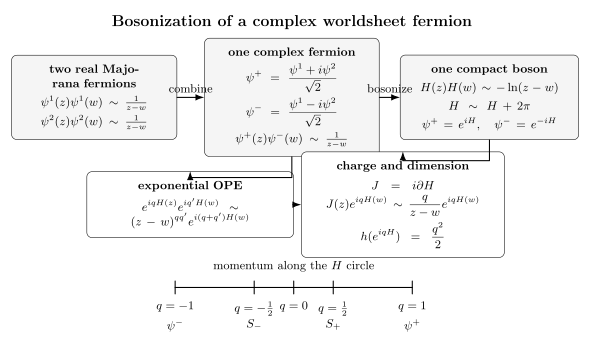
Two real chiral fermions form one complex fermion, which can be represented by a compact chiral boson . Integer charges give ordinary fermionic operators; half-integer charges create Ramond spin fields.
The field is not a new spacetime coordinate. It is a very efficient representation of the original fermionic CFT. Its momentum lattice remembers fermion number, spin structure, and, in higher dimensions, spacetime spinor weights.
Ramond vacua as spin fields
Section titled “Ramond vacua as spin fields”For one complex fermion, define
These are the two spin fields of the two-real-fermion system. Their conformal weights are
This is also consistent with the Ising-model viewpoint: one real Majorana fermion has a spin field of weight , so two real fermions give .
The essential property is the square-root OPE with the fermion. From the exponential rule,
and
Since , the OPE contains half-integer powers of . A fermion transported once around the spin-field insertion changes sign. In radial quantization, the spin field changes the boundary condition of the fermion around the origin. This is the local operator statement that creates a Ramond-sector state.
Let us see the Ramond zero modes explicitly. In the Ramond sector,
so the zero-mode algebra is
The two Ramond ground states are created by the two spin fields:
where
The singular OPEs are
Therefore the zero modes act as
while
Thus one complex fermion gives the two-dimensional representation of the Clifford algebra generated by .
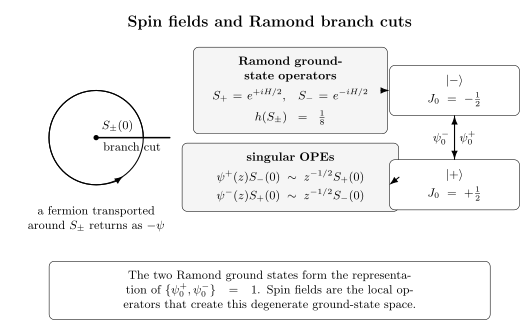
A spin field creates a square-root branch cut for the fermion. Around the insertion the fermion picks up a sign, and the Ramond zero modes act on the two spin-field vacua as a Clifford doublet.
Ten-dimensional spin fields
Section titled “Ten-dimensional spin fields”For the ten-dimensional RNS matter fermions , with , it is convenient to Wick rotate the tangent-space group to while doing the bosonization. Pair the ten real fermions into five complex fermions,
where . Introduce five bosons with
so that
A covariant Ramond ground-state spin field is
The conformal weight is
There are
choices of signs . These are the weights of a ten-dimensional Dirac spinor. The chirality operator acts, up to an overall convention, as
Equivalently, the two chiral spinor representations are distinguished by whether the number of minus signs in is even or odd:
The labels and depend on the convention for ; the invariant statement is
After continuation back to Lorentzian signature, this is the decomposition of a ten-dimensional Majorana spinor into the two Majorana—Weyl chiralities. The Ramond GSO projection keeps one of these two chiralities.
In light-cone gauge only the eight transverse fermions remain. They can be bosonized using four bosons. The transverse spin fields then have
and the transverse spin fields split as
under the little group . This is the light-cone form of the same Ramond ground-state degeneracy.
Fermion-spin-field OPEs and gamma matrices
Section titled “Fermion-spin-field OPEs and gamma matrices”The bosonized form makes it obvious how gamma matrices arise. Acting with a fermion changes one of the spinor weights. For example,
When , the leading term is singular and flips to . Similarly has a singular action when and flips it to . Flipping one sign changes the chirality. In a covariant notation, the leading Ramond-ground-state part of the OPE is
Here and denote opposite ten-dimensional chiralities. This OPE is the local CFT version of
The gamma matrices are therefore not inserted by hand; they are the coefficients in the OPE of an elementary worldsheet fermion with a spin field.
Spin fields also have OPEs among themselves. Schematically,
with the terms allowed depending on the chiralities of and . The power counting follows from and . These OPEs are the worldsheet origin of familiar spacetime spinor bilinears.
Mutual locality and the GSO projection
Section titled “Mutual locality and the GSO projection”Bosonization gives a sharp operator interpretation of the GSO projection. Suppose two bosonized matter operators carry charge vectors and . Their OPE contains
If is not an integer, one operator has a branch cut around the other. Some branch cuts are physical: spin fields are designed to have branch cuts with fermions. But the set of physical vertex operators in a given string theory must be mutually local with the spacetime supercharges, after including matter, ghost, superghost, and cocycle factors.
Thus the GSO projection can be viewed as the selection of a maximal mutually local operator algebra containing the spin-field currents that generate spacetime supersymmetry. In the NS sector, this removes the tachyon and keeps the massless vector. In the R sector, it selects a definite chirality of the Ramond ground state.
This is one reason the GSO projection is not merely a convenient deletion of bad states. It is the condition that the worldsheet CFT contain well-defined spacetime supercharges.
Spacetime supercharges as contour integrals
Section titled “Spacetime supercharges as contour integrals”The matter spin field in ten dimensions has dimension . By itself it cannot be integrated to give a conserved charge, because a holomorphic contour current must have dimension . The missing factor comes from the superconformal ghosts. In the standard bosonization of the superghost system, one introduces a scalar such that
For ,
Therefore
has
The holomorphic spacetime supercharge is
The factor means that this is the supercharge in the picture. The ghost and picture-number machinery will be developed next; for now, the important point is the dimension count and the spinor index supplied by .
For closed strings there is also an antiholomorphic charge,
Type IIA has opposite left- and right-moving Ramond chiralities, while type IIB has the same chirality. This is the spin-field version of the type IIA/type IIB distinction.
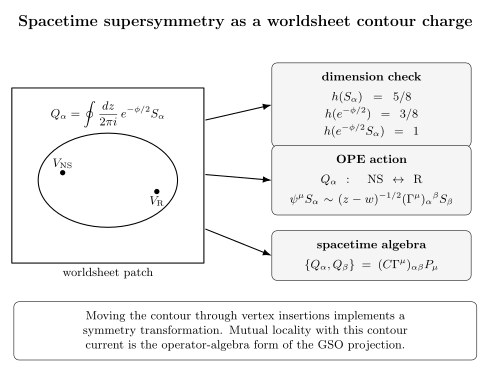
The RNS spacetime supercharge is a contour integral of the spin-field current . Its OPE maps NS vertex operators to R vertex operators and conversely.
How acts on the massless open-string multiplet
Section titled “How QQQ acts on the massless open-string multiplet”The massless open-string gauge boson is represented in the picture by
with
The massless gaugino is represented in the picture by
where the spinor polarization obeys
Now take the OPE of the supercharge current with the gauge-boson vertex. The matter part contains
The superghost factor supplies the remaining half-power needed for a simple pole in the full physical OPE. The contour integral extracts that pole and produces a Ramond vertex. Schematically,
Conversely, the OPE of with the gaugino vertex contains the spin-field product and produces an NS vector vertex. Thus the supercharge exchanges the massless NS and R states,
At low energy this becomes the supersymmetry of ten-dimensional super Yang—Mills theory,
The supersymmetry algebra
Section titled “The supersymmetry algebra”The OPE of two spacetime-supercharge currents contains the vector operator that represents translations. In a convenient picture, the simple-pole term has the schematic form
After picture-changing, this becomes the usual spacetime momentum generator. The contour algebra is
up to normalization conventions. The RNS action did not make this spacetime supersymmetry manifest, but the operator algebra contains it exactly once the GSO projection has selected the mutually local spectrum.
Summary
Section titled “Summary”Bosonization turns a pair of real RNS fermions into a compact chiral boson:
The exponential has conformal weight . Integer charges describe ordinary fermion operators, while half-integer charges create Ramond spin fields. For one complex fermion,
For ten real fermions, five bosons produce spin fields
The spin fields form a ten-dimensional Dirac spinor, and the GSO projection selects one Majorana—Weyl chirality. The OPE contains the gamma matrices and realizes the Ramond zero-mode Clifford algebra locally on the worldsheet.
Including the superghost factor gives the spacetime supercharge
Its OPEs exchange NS and R vertex operators, and the anticommutator of two such charges closes on spacetime momentum. In bosonized language, the GSO projection is the mutual-locality condition that allows these supercharges to be part of the physical operator algebra.
Exercises
Section titled “Exercises”Exercise 1: conformal weight of a bosonized exponential
Section titled “Exercise 1: conformal weight of a bosonized exponential”For a chiral boson with
show that has conformal weight . Check that has the weight of a chiral fermion.
Solution
Using
the double contraction in gives
The single contraction gives the derivative term,
Therefore
so . For , this gives , the conformal weight of a chiral fermion.
Exercise 2: the square-root OPE
Section titled “Exercise 2: the square-root OPE”Let and . Compute the leading OPEs of and with . Which OPEs contain square-root singularities?
Solution
The exponential OPE gives
and
The other two OPEs are
and
All four OPEs have half-integer powers and hence branch cuts. The singular two show directly how the Ramond zero modes move between the two ground states.
Exercise 3: dimension and counting of ten-dimensional spin fields
Section titled “Exercise 3: dimension and counting of ten-dimensional spin fields”Pair ten real fermions into five complex fermions and define
Show that and that the spin fields form a -dimensional Dirac spinor. Explain how chirality divides the states into .
Solution
The five bosons are independent, so conformal weights add:
Each has two possible values. Hence the number of spin fields is
These are the weights of a ten-dimensional Dirac spinor. The chirality operator acts, up to convention, by
The product is for an even number of minus signs and for an odd number. The number of even sign choices is
and the number of odd sign choices is
Thus
The Ramond GSO projection keeps one of these two chiralities.
Exercise 4: gamma matrices from the OPE
Section titled “Exercise 4: gamma matrices from the OPE”Using bosonization, explain why the leading singular part of maps a spin field of one chirality to a spin field of the opposite chirality. Why is this the local CFT version of ?
Solution
In a complex basis, raises the th spin weight, while lowers it. Acting on a Ramond ground-state weight , the singular part flips one sign:
Flipping one sign changes the parity of the number of minus signs, and therefore changes chirality. Hence the leading ground-state term has the form
In radial quantization, the coefficient of the term is the action of the fermion zero mode. Since
the matrices representing obey
Thus the gamma matrices are precisely the Ramond zero-mode action encoded in the OPE.
Exercise 5: the dimension-one supercharge current
Section titled “Exercise 5: the dimension-one supercharge current”The bosonized superghost field satisfies
Compute and show that has dimension one in ten dimensions.
Solution
For ,
The ten-dimensional matter spin field has
Therefore
A dimension-one holomorphic current can be integrated around a contour, so
defines a spacetime charge.
Exercise 6: mutual locality and the GSO projection
Section titled “Exercise 6: mutual locality and the GSO projection”Consider a bosonized matter operator
and a spin field
Compute the branch-cut factor in their OPE. Explain why demanding mutual locality with the spacetime supercharge imposes a projection on the spectrum.
Solution
The OPE is
Taking once around gives the monodromy
before including ghost and cocycle factors. The full physical vertex operator must be mutually local with the supercharge current
This requirement selects only those states whose full monodromy is allowed. In the NS sector it keeps the correct worldsheet fermion parity, removing the tachyon and keeping the vector. In the R sector it keeps one chirality. This is the bosonized operator-algebra interpretation of the GSO projection.