
11. Probe Flavor at Finite Density and DBI Transport
Finite density in holography does not always mean that the entire large- state is charged.
The charged black branes of page 04 describe charge carried by the leading large- sector. Electron stars and Dirac hair, discussed in page 10, describe charged bulk matter that backreacts on the geometry. Probe flavor is different. It describes a comparatively small sector of fundamental matter, of order , moving through an order- adjoint bath. The bulk description is a flavor D-brane with a worldvolume gauge field. The finite density is radial electric flux on that brane.
This distinction is not cosmetic. It decides which thermodynamic quantity is leading, where electric flux can end, why some finite-density embeddings are forbidden, when a meson is stable or melted, and why the probe current can have finite leading-order DC conductivity even in a translationally invariant background.
The main slogan of this page is:
Probe flavor at finite density is the holographic theory of a charged fundamental sector in a much larger neutral or adjoint bath. Its charge is worldvolume electric displacement, and its transport is governed by the nonlinear DBI action.
This page assumes familiarity with the standard source/operator dictionary and the earlier pages. In particular, it uses the source/response dictionary, finite-temperature horizons, finite-density gauge fields, and basic hydrodynamic transport. Everything specific to flavor branes and DBI transport is explained here.
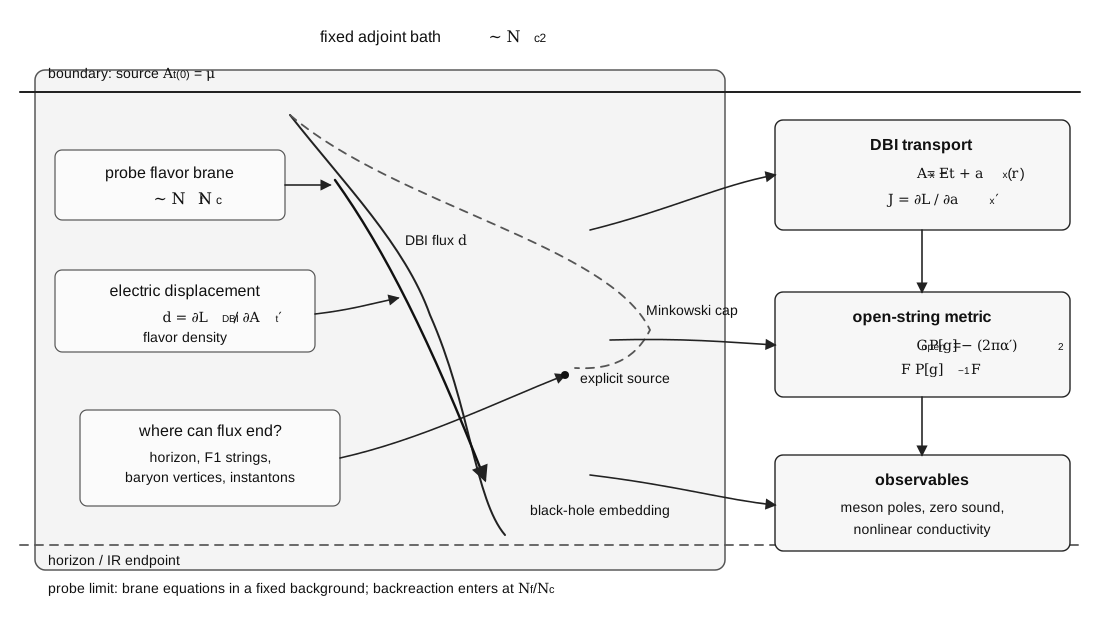
Probe flavor separates the order- adjoint bath from an order- charged flavor sector. Finite density is radial DBI electric flux . The flux can run into a horizon, end on explicit charged sources such as strings or baryon vertices, or vanish. This one question—where does the flux end?—organizes embeddings, meson melting, zero sound, and probe-sector transport.
1. What probe flavor adds to holographic quantum matter
Section titled “1. What probe flavor adds to holographic quantum matter”1.1. Fundamental matter from open strings
Section titled “1.1. Fundamental matter from open strings”In the canonical large- gauge theories behind holography, the degrees of freedom are often adjoint fields. Their thermodynamics scales like
Condensed-matter and QCD-like applications often ask for fields in the fundamental representation: quarks, impurities, defect matter, charge carriers, or flavor multiplets. In a top-down string construction, these arise from open strings stretched between color branes and flavor branes.
A useful mental model is:
If there are flavor branes, the boundary theory usually has a flavor symmetry , at least in an appropriate limit. The diagonal current is the simplest object to use at finite density. We denote it by , because in many QCD-like contexts it is baryon-number-like. Its source is the boundary value of a worldvolume gauge field,
and the associated density is
Here is a chemical potential for the flavor sector, not necessarily for the whole order- state.
1.2. The probe limit
Section titled “1.2. The probe limit”The simplest and most controlled limit is
with held fixed or at least parametrically smaller than . The color sector contributes
whereas the flavor sector contributes
Thus
This is the probe approximation. One first solves for the background geometry generated by the adjoint degrees of freedom, then solves the flavor-brane equations inside that fixed geometry. The background geometry is not corrected at leading order by the flavor density.
This is why probe flavor is simultaneously powerful and limited. It is powerful because the calculation is controlled and often top-down. It is limited because it does not describe a state whose entire large- charge sector backreacts on the geometry.
1.3. Three finite-density holographic mechanisms
Section titled “1.3. Three finite-density holographic mechanisms”It is useful to keep three finite-density mechanisms separate.
| Mechanism | Bulk charge carrier | Large- scaling | Typical use |
|---|---|---|---|
| Charged black brane | electric flux through the horizon | leading compressible state | |
| Electron star / Dirac hair | charged matter outside the horizon | in the backreacted limit | cohesive or partially fractionalized charge |
| Probe flavor brane | DBI electric flux on a flavor brane | finite-density fundamental sector |
The third case is the subject of this page. Its basic question is not “what is the charged geometry of the whole theory?” but rather “what does a charged flavor sector do inside a much larger holographic bath?”
2. The DBI action and the finite-density variable
Section titled “2. The DBI action and the finite-density variable”2.1. The DBI plus Wess—Zumino action
Section titled “2.1. The DBI plus Wess—Zumino action”At leading order in derivatives and in the probe limit, a stack of coincident flavor branes is governed by the Dirac—Born—Infeld plus Wess—Zumino action. For the diagonal sector, ignoring non-Abelian complications, this is
Here:
| Symbol | Meaning |
|---|---|
| worldvolume coordinates on the flavor brane | |
| D-brane tension | |
| pullback of the spacetime metric to the brane | |
| background dilaton | |
| worldvolume field strength | |
| coupling to background Ramond—Ramond potentials |
The DBI square root is not a decorative stringy correction. It is central to finite-density flavor physics. It makes the electric displacement nonlinear, controls pair-creation physics, determines the effective open-string metric for fluctuations, and produces nonlinear current-voltage relations.
For small worldvolume fields, the DBI action expands as
Thus the worldvolume gauge field reduces to an ordinary Maxwell field only in the weak-field regime. At finite density or strong applied electric field, the full square root is often essential.
2.2. Homogeneous density and radial electric flux
Section titled “2.2. Homogeneous density and radial electric flux”For a homogeneous finite-density state, we turn on a radial profile
so that
The boundary value of is the chemical potential,
up to a gauge choice that fixes the value at the infrared endpoint. The density is not simply . The natural conserved quantity is the radial electric displacement
Because appears only through , the equation of motion is
so
The displacement is independent of . Up to conventional normalization factors, it is the boundary flavor density .
This is the finite-density dictionary for probe flavor:
2.3. A toy DBI calculation
Section titled “2.3. A toy DBI calculation”To see what changes relative to Maxwell theory, consider a simplified one-dimensional radial Lagrangian
where and are metric-dependent functions. The displacement is
Solving for gives
This expression already shows the nonlinear nature of DBI density. The electric field is bounded by the square-root structure, and the density enters through the conserved displacement rather than through a linear Maxwell equation.
The chemical potential is obtained by integrating the radial electric field,
where is the infrared endpoint of the flux. The term is absent for a regular horizon endpoint in the usual gauge, but it can appear when strings, baryon vertices, or other charged objects absorb the flux.
2.4. Legendre transform and fixed-density ensemble
Section titled “2.4. Legendre transform and fixed-density ensemble”If one fixes , the grand potential is obtained directly from the on-shell action. If one fixes , it is often cleaner to Legendre transform:
For the toy DBI action above,
This form makes the canonical ensemble transparent. The brane embedding and thermodynamics can be solved at fixed density without repeatedly inverting for .
The important conceptual point is that and are not interchangeable. They are conjugate variables, and changing ensemble changes the boundary term in the variational principle.
3. Embeddings and the endpoint of electric flux
Section titled “3. Embeddings and the endpoint of electric flux”3.1. Brane embeddings and quark mass
Section titled “3.1. Brane embeddings and quark mass”A flavor brane is not only a worldvolume gauge field. It also has embedding scalars. Schematically, one writes an embedding profile
or an equivalent transverse separation function. Near the boundary, this profile typically has an expansion of the form
The leading coefficient is interpreted as a mass or source for the fundamental matter, while the subleading coefficient is related to a condensate. The precise powers depend on the brane intersection and the dimension of the defect.
At finite temperature, the same flavor brane may have multiple possible embeddings. Two broad classes are especially important.
| Embedding | Geometry | Boundary interpretation |
|---|---|---|
| Minkowski embedding | brane caps off smoothly above the horizon | stable or narrow mesons |
| Black-hole embedding | brane reaches the horizon | melted mesons and dissipative flavor modes |
This geometric transition is one of the cleanest holographic descriptions of meson melting.
3.2. Why finite density often forces horizon-reaching embeddings
Section titled “3.2. Why finite density often forces horizon-reaching embeddings”Now switch on nonzero displacement . Gauss law says is radially conserved. If the brane caps off smoothly above the horizon and there is no explicit charged object at the tip, regularity requires that the radial electric flux vanish at the cap. But if is conserved, vanishing at the cap means vanishing everywhere:
Therefore:
A smooth source-free capped flavor brane cannot carry nonzero radial electric displacement.
Equivalently, in the simplest source-free deconfined setup, finite density forces the flavor brane to reach the horizon. The horizon is where the electric flux can end.
This is the geometric origin of the common statement that finite baryon density destroys Minkowski embeddings. The statement is correct in the source-free setup, but it is not a universal theorem. It is a Gauss-law statement about flux endpoints.
3.3. Strings, baryon vertices, and instanton density
Section titled “3.3. Strings, baryon vertices, and instanton density”Flux does not have to end on a horizon. It can also end on explicit charged sources.
The main possibilities are:
| Flux endpoint | Bulk object | Boundary interpretation |
|---|---|---|
| horizon | black-hole endpoint | deconfined charged flavor matter |
| fundamental strings | F1 strings attached to brane | explicit quark density |
| wrapped branes | baryon vertices | baryonic matter |
| instanton density | worldvolume gauge instantons | baryon density in some flavor-brane models |
The most important lesson is that finite density is not specified completely by saying “turn on .” One must also say where the flux ends.
A confining model with no horizon cannot support pure radial flux without sources. It needs strings, baryon vertices, instanton density, or some other charged object. This is why baryonic matter in top-down models is richer than simply adding a chemical potential to a probe brane.
3.4. Meson melting as a spectral transition
Section titled “3.4. Meson melting as a spectral transition”Embedding geometry controls the fluctuation spectrum.
For a Minkowski embedding, worldvolume fluctuations obey a normal-mode problem on an interval with a smooth cap. The spectrum is often discrete and real. These modes are interpreted as stable mesons at large .
For a black-hole embedding, the fluctuations see a horizon. Retarded correlators require infalling boundary conditions, and the modes become quasinormal modes,
The imaginary part is the meson width. Thus meson melting is not just a cartoon; it is the statement that poles in the flavor-sector Green’s functions move away from the real axis when the brane reaches a horizon.
4. Flavor thermodynamics and compressibility
Section titled “4. Flavor thermodynamics and compressibility”4.1. Free energy from the on-shell probe action
Section titled “4.1. Free energy from the on-shell probe action”The probe contribution to the thermodynamic potential is computed from the Euclidean on-shell brane action,
In the grand-canonical ensemble one fixes . In the canonical ensemble one Legendre transforms and fixes . The total large- thermodynamics is schematically
with
The ellipsis includes backreaction and higher-order effects in .
4.2. Compressibility
Section titled “4.2. Compressibility”The flavor compressibility is
A probe-brane system can be compressible even if the adjoint bath itself is neutral. This is an important conceptual advantage: one can study finite-density flavor matter without simultaneously changing the entire background geometry.
However, the compressibility is a property of the probe sector. If the flavor density becomes large enough that effects are no longer small, the probe approximation must be abandoned.
4.3. The mass-density phase diagram
Section titled “4.3. The mass-density phase diagram”Probe flavor models often have a phase diagram in the plane of temperature, chemical potential, and flavor mass. The typical qualitative features are:
- at low density and sufficiently heavy mass, mesonic Minkowski embeddings may dominate,
- at nonzero source-free density in deconfined phases, horizon-reaching embeddings dominate or are forced by regularity,
- with explicit baryonic or stringy sources, additional finite-density phases can appear,
- first-order transitions are common because different embeddings compete in free energy.
The precise phase diagram is model dependent. The universal part is the logic of the variational problem: specify the ensemble, solve the embedding and gauge-field equations, renormalize the on-shell action, and compare free energies.
5. Linear response: zero sound, diffusion, and meson poles
Section titled “5. Linear response: zero sound, diffusion, and meson poles”5.1. Fluctuations on a finite-density brane
Section titled “5.1. Fluctuations on a finite-density brane”To compute density response, perturb the worldvolume gauge field,
The longitudinal electric fluctuation is often organized into a gauge-invariant combination,
Solving the linearized DBI equations with normalizability at the boundary and infalling conditions at any worldvolume horizon gives the retarded flavor-current correlators.
5.2. Holographic zero sound
Section titled “5.2. Holographic zero sound”At low temperature and finite density, many probe-brane systems support a collective mode with dispersion
This is called holographic zero sound because it is a propagating density wave at low temperature. It resembles Landau zero sound in form, but the interpretation is different.
It is safest to say:
Holographic zero sound is a collective mode of a compressible large- flavor sector. It is not by itself proof of a Landau quasiparticle Fermi surface.
At higher temperature, the same longitudinal response often crosses over to ordinary diffusion,
The crossover from collisionless sound-like behavior to hydrodynamic diffusion is one of the useful diagnostics of finite-density probe matter.
5.3. Meson poles and quasinormal modes
Section titled “5.3. Meson poles and quasinormal modes”The same fluctuation problem also computes meson spectra and widths. A pole of a flavor-current or scalar correlator corresponds to a normal mode or quasinormal mode of the brane. In a horizon-reaching embedding, the imaginary parts encode damping into the adjoint bath.
The physics is nicely unified:
All are poles of retarded probe-sector Green’s functions.
6. DBI transport and the open-string metric
Section titled “6. DBI transport and the open-string metric”6.1. Nonlinear current from conserved radial quantities
Section titled “6.1. Nonlinear current from conserved radial quantities”Now apply an electric field in the boundary direction ,
The DBI action depends on but not on , so the radial conjugate momentum
is conserved. This conserved quantity is the boundary current.
The nonlinear current-voltage relation is obtained by solving the algebraic constraints from the DBI square root. In many cases the square root develops a special radial point where numerator and denominator must vanish together for the on-shell action to remain real. This condition fixes as a function of , density, temperature, and embedding data.
This is a distinctive advantage of probe-brane transport: the nonlinear response can often be reduced to radial conservation laws and a regularity condition.
6.2. The open-string metric
Section titled “6.2. The open-string metric”Fluctuations of open strings on a brane with background field strength do not propagate in the closed-string metric alone. They see the symmetric open-string metric
This metric can have its own effective horizon even when the induced metric horizon structure is less direct. The open-string metric horizon controls dissipation, effective temperature, and fluctuation regularity for the probe sector.
This is one of the most elegant pieces of DBI physics: the nonlinear electromagnetic field on the brane reshapes the causal structure experienced by flavor-sector fluctuations.
6.3. Pair creation and density drag
Section titled “6.3. Pair creation and density drag”Probe-brane conductivity often contains two qualitatively different contributions.
- A density contribution from existing charge carriers.
- A pair-creation contribution from thermally or field-induced flavor pairs.
Schematically, one often finds a result of the form
though the precise powers and prefactors depend on the brane system and dimension.
The square-root structure is DBI-like: the current is not simply a linear Maxwell response. It is a nonlinear combination of density, background geometry, and worldvolume fields.
6.4. Why probe DC conductivity can be finite without explicit translation breaking
Section titled “6.4. Why probe DC conductivity can be finite without explicit translation breaking”A clean finite-density system with exact translations usually has a divergent DC conductivity because current overlaps with conserved momentum. In hydrodynamic notation,
If translations are exact, , and the DC conductivity contains a delta function.
Probe flavor seems to violate this rule, but it does not. The resolution is the large- hierarchy. The flavor sector is small and can lose momentum into the adjoint bath. The bath momentum changes only at subleading order in , so at leading probe order it behaves as an infinite reservoir.
Thus finite probe-sector DC conductivity means:
not
Once flavor backreaction is included strongly enough, the full momentum-conservation argument returns.
7. Canonical examples
Section titled “7. Canonical examples”7.1. D3/D7 flavor
Section titled “7.1. D3/D7 flavor”The D3/D7 system is the classic example of adding fundamental matter to the -dimensional adjoint theory. It teaches:
- the relation between brane separation and flavor mass,
- the emergence of a meson spectrum from worldvolume fluctuations,
- meson melting through black-hole embeddings,
- finite baryon density through DBI electric displacement,
- holographic zero sound,
- and nonlinear flavor conductivity.
It is top-down and explicit, which makes it one of the most valuable examples even when the eventual goal is more phenomenological.
7.2. D3/D5 and defect matter
Section titled “7.2. D3/D5 and defect matter”The D3/D5 system gives flavor or defect matter localized on a lower-dimensional subspace of the boundary theory. It is useful for quantum Hall-like setups, defect CFTs, magnetic response, and reduced-dimensional transport.
Here the distinction between the ambient bath and the charged defect sector is especially transparent: the probe sector can be lower-dimensional while still exchanging energy and momentum with the higher-dimensional adjoint plasma.
7.3. Sakai—Sugimoto and baryonic matter
Section titled “7.3. Sakai—Sugimoto and baryonic matter”In Sakai—Sugimoto-type constructions, flavor branes join geometrically in the infrared, realizing chiral symmetry breaking. Baryon number can be represented by instanton number on the flavor brane or by wrapped baryon vertices. This gives a more QCD-like route to finite-density flavor physics than pure horizon flux.
The main lesson is not that all models agree. They do not. The lesson is that top-down probe flavor gives several controlled ways to ask what carries density: strings, brane flux, instantons, baryon vertices, or horizons.
8. What this framework does and does not establish
Section titled “8. What this framework does and does not establish”Probe flavor establishes a controlled large- approximation to finite-density fundamental matter. It is excellent for:
- meson spectra and meson melting,
- flavor thermodynamics,
- baryon-number susceptibility,
- zero-sound-like collective modes,
- defect and flavor transport,
- nonlinear DBI response,
- magnetic-field and Hall response in probe sectors,
- and top-down checks on bottom-up finite-density intuition.
It does not automatically establish:
- a conventional Landau Fermi liquid,
- a fully backreacted metallic state of the whole theory,
- finite DC conductivity for a leading-order charged translationally invariant system,
- or a direct model of a specific material.
This is the right level of epistemic discipline. Probe flavor is not a universal theory of metals. It is a precise holographic laboratory for a charged fundamental sector.
9. Common pitfalls
Section titled “9. Common pitfalls”| Pitfall | Correction |
|---|---|
| Treating as bulk charge density | is a source; density is the electric displacement or . |
| Confusing probe charge with leading large- charge | Probe charge scales as , not . |
| Assuming finite density always implies a charged black brane | Probe density can live on flavor branes in a fixed background. |
| Forgetting flux endpoints | Nonzero radial flux must end on a horizon or explicit charged sources. |
| Calling every propagating density mode a Fermi-liquid zero sound | Holographic zero sound is a collective mode; quasiparticles require more evidence. |
| Treating finite probe conductivity as momentum relaxation of the full system | It is leading-order relaxation into a large bath. |
| Ignoring ensemble choice | Fixed and fixed require different variational problems. |
| Using Maxwell intuition outside its regime | DBI square roots matter at finite density and strong electric field. |
| Forgetting the open-string metric | Probe-sector fluctuations propagate in the open-string metric, not just the closed-string metric. |
10. Takeaways
Section titled “10. Takeaways”- Probe flavor describes fundamental matter of order in an order- adjoint bath.
- The finite-density variable is the conserved DBI electric displacement
- The chemical potential is the boundary value of the worldvolume gauge potential, with infrared regularity or source contributions fixing the gauge-invariant potential difference.
- Source-free capped embeddings cannot carry nonzero radial electric flux; in deconfined setups, finite density therefore often forces horizon-reaching embeddings.
- Strings, baryon vertices, and instanton density can absorb flux and modify the finite-density phase structure.
- Minkowski embeddings typically give stable mesons; horizon-reaching embeddings give quasinormal resonances and meson melting.
- DBI transport is nonlinear and is controlled by conserved radial currents, regularity, and the open-string metric.
- A finite probe-sector DC conductivity in a translationally invariant background is compatible with momentum conservation because the charged probe sector relaxes into a much larger bath.
- Probe flavor is one of the most controlled top-down laboratories for finite-density fundamental matter, but it is not a complete model of every metallic state.
Exercises
Section titled “Exercises”Exercise 1. Large- scaling of probe flavor
Section titled “Exercise 1. Large-NNN scaling of probe flavor”Explain why the adjoint-sector free energy scales as , while the probe flavor free energy scales as . Why does this justify ignoring flavor backreaction when ?
Solution
Adjoint fields are matrices, so the number of adjoint degrees of freedom scales like . Their contribution to thermodynamic quantities such as the free energy is therefore order .
Fundamental matter carries one color index and one flavor index. With flavors, the number of color-flavor degrees of freedom scales as . In the dual string description this is the scaling of the probe-brane action.
Thus
When , the flavor stress tensor and charge density are parametrically small compared with the adjoint sector. The leading geometry can therefore be solved without the flavor brane. The flavor brane is then placed in that fixed background as a probe.
Exercise 2. Radial conservation of electric displacement
Section titled “Exercise 2. Radial conservation of electric displacement”Let the DBI Lagrangian density depend on only through . Show that
is conserved along the radial direction. Explain why it is identified with flavor density.
Solution
The Euler—Lagrange equation for is
If depends on but not on itself, the first term vanishes. Therefore
So
The radial conservation law is Gauss law on the brane. In holography, the canonical momentum conjugate to the boundary value of a gauge field is the expectation value of the dual current. Therefore the conserved electric displacement is proportional to
The exact proportionality depends on the normalization of , the brane tension, powers of , and the volume of internal directions wrapped by the brane.
Exercise 3. Solving a toy DBI equation
Section titled “Exercise 3. Solving a toy DBI equation”For
derive
Solution
The displacement is
Square both sides:
Rearrange:
Thus
Taking the branch with positive gives
The other sign corresponds to reversing the sign convention for the charge density.
Exercise 4. Why a source-free capped brane cannot carry density
Section titled “Exercise 4. Why a source-free capped brane cannot carry density”A flavor brane caps off smoothly above the horizon. There is no string, baryon vertex, or instanton charge at the cap. Explain why regularity requires .
Solution
The displacement is the radial electric flux on the brane. Because it is conserved, the same amount of flux passes through every radial slice.
At a smooth cap, the radial cycle on which the flux would pass shrinks to zero. If there is no explicit charged source at the cap, Gauss law says that no electric flux can terminate there. A nonzero flux through a shrinking surface would correspond to a singular charge source or a singular gauge field configuration.
Therefore regularity and absence of sources require the flux at the cap to vanish. Since is radially conserved, it must vanish everywhere:
This is why nonzero density in a source-free deconfined setup usually requires the brane to reach a horizon. The horizon provides an infrared endpoint for the flux.
Exercise 5. Chemical potential and the horizon gauge choice
Section titled “Exercise 5. Chemical potential and the horizon gauge choice”For a horizon-reaching embedding, explain why regularity suggests choosing and why the chemical potential is then
How can this formula change if the flux ends on explicit charged sources instead of a horizon?
Solution
In Euclidean signature, the thermal circle shrinks at the horizon. A one-form component along a shrinking circle must be regular. The usual regular gauge sets
The boundary source is the asymptotic value
With the regular gauge this becomes
If the flux ends on strings, baryon vertices, or instanton density, the infrared endpoint is not simply a regular horizon with . The chemical potential must include the energy or boundary term associated with those charged sources. Schematically,
The precise source contribution depends on the charged object that absorbs the flux.
Exercise 6. Probe conductivity and momentum conservation
Section titled “Exercise 6. Probe conductivity and momentum conservation”Why can a probe flavor current have finite DC conductivity in a translationally invariant background, even though a fully charged translationally invariant finite-density system has divergent DC conductivity?
Solution
A fully charged finite-density system has current overlap with conserved momentum. If translations are exact, momentum cannot decay, and the DC conductivity contains a delta function. Hydrodynamically this appears as
with .
In the probe limit, the charged flavor sector is only order , while the adjoint bath is order . At leading order in , the flavor current can lose momentum into the huge bath, but the resulting motion of the bath is subleading. The bath acts like an effectively infinite reservoir.
Thus finite probe conductivity is not a violation of momentum conservation. It is a leading-order statement about a small charged sector coupled to a much larger neutral or adjoint sector. If the flavor sector is backreacted so that its charge contributes at leading order, the full momentum-conservation argument must be restored.
Exercise 7. Zero sound versus Fermi liquid
Section titled “Exercise 7. Zero sound versus Fermi liquid”A probe-brane system has a mode
Why is this called zero sound, and why is it not enough to prove that the system is a Landau Fermi liquid?
Solution
The mode is called zero sound because it is a propagating density oscillation at low temperature and finite density. The dispersion relation resembles collisionless zero sound in a Fermi liquid.
However, Landau zero sound is tied to long-lived quasiparticles near a Fermi surface. A holographic probe-brane zero-sound-like mode is a pole of a large- current correlator. It shows that the compressible flavor sector supports a collective density wave, but it does not by itself identify quasiparticles, a Fermi surface volume, or Landau parameters.
To establish a Landau Fermi liquid one would need additional evidence, such as quasiparticle poles in fermionic spectral functions, a controlled Luttinger count, and appropriate thermodynamic and transport behavior.
Exercise 8. Open-string metric horizon
Section titled “Exercise 8. Open-string metric horizon”Explain in words why a strong worldvolume electric field can create an effective horizon for probe fluctuations even when the background geometry is fixed.
Solution
Open-string fluctuations on a brane with background field strength propagate in the open-string metric
This metric depends on both the induced closed-string metric and the worldvolume electric field. When the electric field is strong enough, the effective causal structure seen by open-string fluctuations can develop a horizon. This horizon controls infalling boundary conditions, dissipation, and effective temperature for the probe sector.
The background geometry is still fixed in the probe approximation. The new horizon is not a leading-order spacetime horizon of the full bulk geometry; it is an effective horizon for flavor-sector fluctuations.
References and further reading
Section titled “References and further reading”The standard starting points for this page are the original flavor-brane constructions of Karch and Katz; finite-density D3/D7 analyses by Kobayashi, Mateos, Matsuura, Myers, and Thomson; DBI transport work by Karch and O’Bannon; holographic zero-sound work by Karch, Son, and Starinets; and the Sakai—Sugimoto model for flavor, chiral symmetry breaking, and baryonic matter. For broader context, see the discussions of probe branes, finite-density flavor, zero sound, nonlinear conductivity, and top-down AdS/CMT in Hartnoll—Lucas—Sachdev, Zaanen—Liu—Sun—Schalm, and Ammon—Erdmenger.