
CFT Data, Large N, and Single-Trace Operators
The main idea
Section titled “The main idea”AdS/CFT is often introduced from the bulk side: start with a field in AdS, solve a wave equation, and read off a boundary correlator. That is useful, but it hides the deeper logic. The boundary theory is a complete quantum system. It does not need the bulk in order to be well-defined.
From the CFT point of view, the essential data are:
In a unitary CFT, the operator spectrum consists of primary operators and their descendants. The OPE coefficients tell us how products of local operators decompose into this spectrum. Schematically,
The crucial holographic lesson is that bulk locality is a special organization of CFT data. In a holographic CFT, the data are not generic. They have a large parameter, conventionally called , or more invariantly a large stress-tensor coefficient . Connected correlators of properly normalized low-dimension single-trace operators are suppressed by powers of . This makes the theory behave, at leading order, like a generalized free theory. The generalized free fields are the boundary shadows of free bulk particles.
At the next order in , the CFT remembers bulk interactions. Single-trace three-point coefficients become cubic bulk couplings, connected four-point functions become tree-level Witten diagrams, anomalous dimensions of double-trace operators become binding energies, and higher orders become bulk loops.
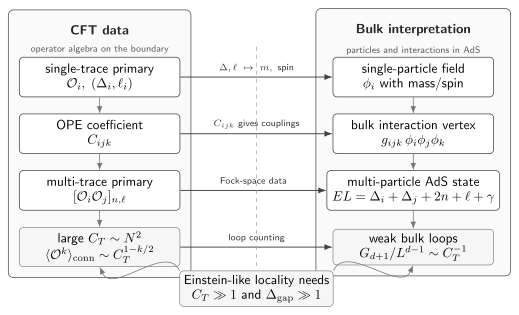
At large , single-trace primaries behave like single-particle bulk fields. Multi-trace primaries behave like multi-particle states. Operator dimensions give particle masses and spins; OPE coefficients give bulk couplings; connected correlators are suppressed by powers of .
This page is the conceptual bridge between the previous geometric module and the next dictionary pages. The next pages will discuss sources, near-boundary fields, the mass-dimension relation, currents, the stress tensor, and the GKP/Witten prescription. Here we first ask: what must the CFT data look like for a weakly coupled bulk description to exist at all?
CFT data: what has to be specified?
Section titled “CFT data: what has to be specified?”In a CFT on flat Euclidean space , local primary operators are labeled by their scaling dimension , their spin representation under , and their quantum numbers under any global symmetries. Descendants are obtained by applying translations,
to primaries. A conformal family is a primary together with all of its descendants.
For scalar primaries normalized as
conformal symmetry fixes the position dependence of two- and three-point functions:
and
where . For spinning operators, there are several allowed tensor structures, each with its own coefficient. The basic idea is the same: conformal symmetry fixes the shape; the theory supplies the numbers.
Four-point functions contain the first genuinely dynamical functions. For four scalar primaries,
with
The variables and are conformally invariant cross-ratios; all dynamical dependence of the scalar four-point function sits in .
The same four-point function can be decomposed into conformal blocks:
where is fixed by conformal symmetry and the sum runs over primary operators appearing in the OPE. Crossing symmetry says that this decomposition must agree with decompositions in other OPE channels. In this sense, a CFT is a highly constrained algebra of local operators.
A concise way to write the CFT data is
subject to unitarity, associativity of the OPE, Ward identities, and crossing symmetry.
For AdS/CFT, this data set is not just formal bookkeeping. It is the boundary encoding of bulk physics.
Radial quantization and why dimensions look like energies
Section titled “Radial quantization and why dimensions look like energies”The state-operator correspondence turns local operators into states. Insert a primary operator at the origin of Euclidean . Under the conformal map
dilatations on become time translations on the cylinder. If is the dilatation generator, then
becomes
where is the radius of the spatial sphere.
This is the first hint of the bulk particle dictionary. In global AdS, the boundary is the cylinder
A normal mode of a bulk field has a discrete global energy. The corresponding CFT state has a discrete cylinder energy. Thus the operator dimension is not merely a critical exponent: in radial quantization it is an energy quantum number.
For a scalar field in AdS, the next page will derive
For now, the important point is qualitative:
and
Descendants do not represent new particle species. They are the same conformal family acted on by translations. In the bulk, they are related to the spacetime dependence and global descendants of the same field. New bulk fields correspond to new primary families.
The stress-tensor coefficient as the invariant large- parameter
Section titled “The stress-tensor coefficient as the invariant large-NNN parameter”In matrix gauge theories, the large parameter is often called , the rank of the gauge group. But not every holographic CFT is handed to us as an explicit matrix gauge theory. A more invariant measure of the number of degrees of freedom is the coefficient in the stress-tensor two-point function:
where is the conformally fixed tensor structure. The normalization of is convention-dependent, but its scaling is not. In large- matrix theories,
In a classical Einstein gravity dual,
again up to a convention-dependent numerical factor. Thus
is the bulk loop-counting parameter. Classical gravity is the limit
This is the cleanest way to state large in a general holographic CFT. When the course writes , it often means .
Normalization conventions: raw operators versus unit-normalized operators
Section titled “Normalization conventions: raw operators versus unit-normalized operators”A surprisingly common source of confusion is operator normalization. There are two useful conventions.
| Convention | Two-point function | Connected -point scaling | Typical use |
|---|---|---|---|
| Bulk-natural operator | at tree level | Directly conjugate to a bulk source | |
| Unit-normalized operator | Clean large- counting |
The two are related by
In gauge theory language, a raw single trace such as
often has a two-point function of order . A unit-normalized version is schematically
This course will usually use unit-normalized single-trace operators when discussing large- factorization, because then the hierarchy is especially transparent:
Thus
This is not a statement about free fields in the Lagrangian. It is a statement about gauge-invariant observables in the large- limit.
Large- factorization
Section titled “Large-NNN factorization”Large- factorization means that products of separated gauge-invariant single-trace operators factorize at leading order. For a single operator with vanishing one-point function,
More generally,
for unit-normalized single-trace operators.
This leading answer looks like Wick’s theorem. But the operator need not be a free elementary field. Its dimension may be strongly coupled and far from any engineering dimension. The correct name is generalized free field.
A generalized free field is defined by two facts:
- its two-point function has the conformal form fixed by its dimension;
- its higher-point functions factorize into sums of products of two-point functions.
In AdS language, generalized free fields are what one gets from free particles propagating in a fixed AdS background. The particles are free because suppresses interactions. They live in AdS because the conformal group acts as the AdS isometry group.
This is the boundary signature of a classical bulk limit.
Single-trace operators
Section titled “Single-trace operators”In a gauge theory with adjoint matrix fields, a single-trace operator is schematically
with gauge indices contracted in one trace. Examples in SYM include scalar chiral primaries of the form
as well as the stress tensor, conserved currents, and many unprotected long operators.
The word “single-trace” has two related meanings:
| Meaning | Description | Best used when |
|---|---|---|
| Literal trace | A gauge-invariant operator built from one matrix trace | The CFT has an explicit gauge-theory Lagrangian |
| Large- elementary operator | A primary whose correlators scale like one-particle observables and which is not a product of lower operators | The CFT is abstract, strongly coupled, or defined non-Lagrangianly |
The second meaning is more robust for holography. We often call these operators single-particle operators or single-trace-like operators.
The basic dictionary is:
A scalar single-trace primary gives a scalar field. A conserved current gives a bulk gauge field. The stress tensor gives the graviton. Spin- single-trace primaries give bulk fields of spin , though a weakly curved Einstein-like bulk requires most higher-spin single-trace fields to be heavy.
Multi-trace operators and bulk multi-particle states
Section titled “Multi-trace operators and bulk multi-particle states”Multi-trace operators are products of single-trace operators, with descendant pieces subtracted so that the result is a conformal primary. Schematic double-trace operators are
At , their dimensions are additive:
At large but finite ,
where
for ordinary two-particle binding effects in a theory with only adjoint degrees of freedom.
The bulk interpretation is immediate:
and similarly
at leading order in .
The integers and have a simple physical meaning. The spin is orbital angular momentum on the boundary sphere, and counts radial excitation. The additive formula for is just the energy formula for two noninteracting particles in the AdS box.
This is one of the most useful ideas in practical AdS/CFT: anomalous dimensions of multi-trace operators measure bulk interactions.
For example, if a four-point function receives a tree-level exchange contribution from a single-trace field, then the OPE expansion of that same four-point function contains corrections to the dimensions and OPE coefficients of double-trace operators. The same physical process is being described in two languages:
OPE coefficients as bulk couplings
Section titled “OPE coefficients as bulk couplings”Consider three unit-normalized single-trace primaries. Their three-point coefficient scales as
In the bulk, after canonically normalizing fields, a cubic interaction has the schematic form
The precise numerical map between and depends on field normalizations and on the AdS integral that produces the three-point Witten diagram. But the scaling is universal:
Similarly, a connected four-point function of unit-normalized single-trace operators scales as
In the bulk, this is the scaling of a tree-level four-point process: an exchange Witten diagram or a quartic contact Witten diagram. Bulk loops are further suppressed by powers of .
The large- dictionary can therefore be summarized as:
| CFT quantity | Scaling for unit-normalized single traces | Bulk interpretation |
|---|---|---|
| , | for light fields | Mass and spin of a bulk particle |
| Cubic coupling of canonically normalized fields | ||
| Connected four-point function | Tree-level scattering in AdS | |
| Double-trace anomalous dimension | Two-particle binding energy | |
| Higher connected correlators | powers of | Higher-point vertices and diagrams |
| corrections | loop expansion | Quantum gravity corrections |
This table is one of the conceptual cores of the course.
Large is not enough
Section titled “Large NNN is not enough”A large- expansion gives a weak coupling expansion in the bulk, but it does not guarantee a simple Einstein gravity dual.
There are two distinct requirements:
and
Here is the dimension of the lightest single-trace operator with spin greater than two, or more generally the gap to stringy/higher-spin single-particle states not included in the low-energy bulk effective theory.
Why does this matter? A theory can have factorization but still fail to look like Einstein gravity.
Vector models
Section titled “Vector models”Large- vector models have many degrees of freedom and factorization, but their natural single-trace-like operators include an infinite tower of approximately conserved higher-spin currents:
A dual description, when it exists, is not ordinary Einstein gravity with a small number of light fields. It is higher-spin gravity. The bulk is weakly coupled in a large- sense, but not local in the same way as a low-energy Einstein effective field theory.
Weakly coupled matrix theories
Section titled “Weakly coupled matrix theories”A weakly coupled matrix CFT can also have a large number of low-dimension single-trace operators with high spin. In string language, the string scale is comparable to the AdS scale:
Then the bulk may still be stringy, but there is no large separation between the AdS radius and the string length. Local supergravity is not a good approximation.
Strongly coupled holographic CFTs
Section titled “Strongly coupled holographic CFTs”For a weakly curved Einstein-like bulk, we need both
and
The first condition suppresses quantum loops:
The second suppresses higher-derivative/stringy corrections:
In the canonical AdS example, this second condition is related to large ‘t Hooft coupling . In general CFT language, it is a statement about a sparse spectrum of low-dimension single-trace operators.
How a four-point function knows about the bulk
Section titled “How a four-point function knows about the bulk”The best place to see the dictionary in action is a four-point function of identical scalar single-trace primaries:
At , factorization gives
This is the generalized-free answer. In the OPE channel , this answer contains the identity operator and an infinite tower of double-trace primaries:
At order , the four-point function becomes
The correction has two simultaneous interpretations:
- Bulk perturbation theory: it is computed by tree-level Witten diagrams.
- CFT OPE data: it shifts double-trace dimensions and OPE coefficients:
The equality of these descriptions is not a poetic analogy. It is how perturbative bulk dynamics is encoded in the CFT bootstrap. A tree-level contact interaction in AdS is a particular crossing-symmetric correction to CFT data. A bulk exchange diagram is another such correction. Bulk locality becomes a statement about the analytic and asymptotic behavior of this CFT data.
This is why modern AdS/CFT often studies holography directly from CFT data, without first invoking a specific string compactification.
A compact dictionary for this page
Section titled “A compact dictionary for this page”| Boundary CFT concept | Bulk AdS concept | Comment |
|---|---|---|
| Primary operator | Particle species / field | One conformal family per bulk field |
| Dimension | Energy on global AdS; mass in AdS units | For scalars, |
| Spin | Bulk spin | Conserved spin-one current gives a gauge field; stress tensor gives the graviton |
| Descendants | Excitations within the same field representation | Not new particle species |
| Single-trace primary | Single-particle state | Precise as a large- notion |
| Multi-trace primary | Multi-particle state | Dimensions additive at |
| OPE coefficient | Cubic coupling | With normalization-dependent proportionality |
| Double-trace anomalous dimension | Binding energy / scattering data | Appears at order |
| Stress-tensor coefficient | Controls bulk loops | |
| Sparse single-trace spectrum | Low-energy bulk effective field theory | Needed for Einstein-like locality |
Common mistakes
Section titled “Common mistakes”Mistake 1: “Every large- CFT has an Einstein gravity dual.”
Section titled “Mistake 1: “Every large-NNN CFT has an Einstein gravity dual.””No. Large gives factorization and a candidate weak-coupling expansion. An Einstein-like bulk also requires a sparse low-dimension single-trace spectrum and a large gap to higher-spin/stringy states.
Mistake 2: “Single-trace means literally one trace in every CFT.”
Section titled “Mistake 2: “Single-trace means literally one trace in every CFT.””No. Literal traces exist only when the CFT has a matrix gauge-theory description. In abstract holographic CFTs, “single-trace” means large- elementary: an operator that behaves like a single-particle state rather than a multi-particle composite.
Mistake 3: “Generalized free means free Lagrangian.”
Section titled “Mistake 3: “Generalized free means free Lagrangian.””No. A generalized free field is free in its correlator factorization, not necessarily in its microscopic construction. A strongly coupled single-trace operator can be generalized free at .
Mistake 4: “The multi-trace spectrum is optional.”
Section titled “Mistake 4: “The multi-trace spectrum is optional.””No. Multi-trace operators are forced by the OPE. In the bulk they are forced by the existence of multi-particle states. A single-particle field in AdS automatically generates a tower of multi-particle states in the Hilbert space.
Mistake 5: “The coefficient is exactly .”
Section titled “Mistake 5: “The coefficient CTC_TCT is exactly N2N^2N2.””Only in special conventions and examples. The invariant statement is that measures the number of degrees of freedom and scales like in a gravity dual. For gauge theories, it usually scales as at large .
What this prepares for
Section titled “What this prepares for”The next pages will use this organization of CFT data to build the practical AdS/CFT dictionary:
- sources couple to operators;
- boundary values of bulk fields are sources;
- normalizable modes encode states and expectation values;
- masses determine dimensions;
- gauge fields encode currents;
- the graviton encodes the stress tensor;
- differentiating the renormalized on-shell action produces CFT correlators.
The slogan is:
The rest of the course is largely the art of making this arrow calculable.
Exercises
Section titled “Exercises”Exercise 1: OPE data and the scalar three-point function
Section titled “Exercise 1: OPE data and the scalar three-point function”Assume three scalar primaries have unit-normalized two-point functions. Use scale invariance and translation invariance to show that their three-point function must have the form
with
Solution
Translation and rotation invariance imply that the correlator can depend only on distances , , and . Write
Under a scale transformation , the correlator must scale as
This gives
More strongly, the correlator must have the correct scaling when one uses the OPE in each pair. The OPE of contains with singularity
so
Applying the same reasoning to the other two pairs gives
These exponents also obey .
Exercise 2: Large- scaling of normalized correlators
Section titled “Exercise 2: Large-NNN scaling of normalized correlators”Let be a unit-normalized single-trace operator in a matrix large- CFT with . Suppose connected correlators scale as
Find the scaling of the connected two-, three-, four-, and five-point functions in powers of .
Solution
Since ,
Therefore
and
This is the same hierarchy as tree-level bulk perturbation theory with canonically normalized fields and cubic couplings of order .
Exercise 3: Double-trace dimensions as two-particle energies
Section titled “Exercise 3: Double-trace dimensions as two-particle energies”Consider two scalar single-trace primaries and with dimensions and . At , construct the schematic double-trace primary
Explain why its leading dimension is
Solution
At , connected interactions between single-trace operators vanish. Thus a double-trace operator behaves like a two-particle state in global AdS or, equivalently, like a product state in radial quantization.
The two particles contribute additive energies
To form a spin- primary, we insert symmetrized traceless derivatives, contributing units of dimension. Radial excitations are labeled by a nonnegative integer and contribute units. Thus
At finite , interactions shift this by an anomalous dimension:
For adjoint large- theories with unit-normalized single traces, ordinary binding effects begin at order .
Exercise 4: Diagnose the bulk dual
Section titled “Exercise 4: Diagnose the bulk dual”For each theory below, decide whether the stated information is enough to expect a weakly curved Einstein gravity dual.
- A CFT has , but also an infinite tower of conserved higher-spin currents with dimensions .
- A matrix CFT has and a large gap to all single-trace operators with spin greater than two.
- A CFT has a large number of degrees of freedom, but no factorization of connected correlators.
- A large- CFT has factorization, but .
Solution
-
No ordinary Einstein gravity dual is expected. Conserved higher-spin currents imply massless higher-spin fields in the bulk. A higher-spin dual may exist, but the low-energy bulk is not just Einstein gravity plus a small number of matter fields.
-
Yes, this is the standard structural expectation for a weakly coupled local bulk effective theory: suppresses bulk loops, and suppresses stringy or higher-spin corrections.
-
No. A large number of degrees of freedom by itself is not enough. Without factorization, there is no obvious weakly coupled bulk perturbation theory.
-
Not a weakly curved Einstein dual. The theory may still have a stringy or higher-spin bulk interpretation, but if the gap is order one, many extra single-particle states remain light in AdS units and the simple local gravity approximation fails.
Exercise 5: Generalized free four-point function
Section titled “Exercise 5: Generalized free four-point function”Let be a scalar generalized free field of dimension with
Show that
can be written as
Solution
The first Wick-like contraction gives
The second gives
The third gives
Using
we have
Therefore
This is the four-point function of a unit-normalized single-trace operator in a holographic CFT.
Further reading
Section titled “Further reading”- O. Aharony, S. S. Gubser, J. Maldacena, H. Ooguri, and Y. Oz, Large N Field Theories, String Theory and Gravity. The classic review; useful for the large-/bulk-gravity relation and the canonical examples.
- D. Simmons-Duffin, TASI Lectures on the Conformal Bootstrap. Excellent for CFT data, radial quantization, OPEs, conformal blocks, and crossing.
- I. Heemskerk, J. Penedones, J. Polchinski, and J. Sully, Holography from Conformal Field Theory. A foundational modern reference on how large and a sparse spectrum encode local bulk interactions.
- J. Penedones, TASI lectures on AdS/CFT. A CFT-first introduction to AdS/CFT, including boundary operators, AdS intuition, and Mellin-space correlators.
- J. M. Maldacena, The Large N Limit of Superconformal Field Theories and Supergravity. The original proposal; especially important for understanding why the large- limit contains a supergravity sector in explicit string/M-theory examples.