
Three-Point Functions and Cubic Couplings
The main idea
Section titled “The main idea”The previous two pages developed the two ingredients needed for the first interacting calculation in AdS/CFT:
- A boundary source determines a classical bulk solution through a bulk-to-boundary propagator.
- The renormalized on-shell action generates CFT correlation functions.
Two-point functions are mostly kinematics plus normalization. For a scalar primary, conformal symmetry fixes
The first genuinely dynamical CFT data appear in three-point functions. For scalar primaries,
at separated points. Conformal symmetry fixes the entire position dependence. The number is dynamical. Equivalently, after normalizing two-point functions, it is the OPE coefficient.
In holography, the leading large- contribution to is computed by a cubic interaction in the bulk:
The corresponding diagram is the simplest contact Witten diagram: three bulk-to-boundary propagators meet at one integrated bulk point.
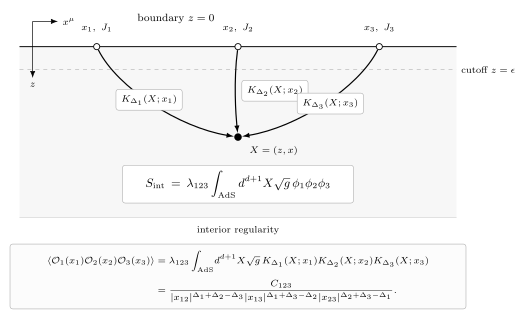
A cubic bulk vertex computes a scalar CFT three-point function. Each boundary source creates a classical bulk field through ; the interaction point is integrated over AdS. The result has the unique scalar conformal structure, while the overall coefficient is determined by the renormalized cubic coupling.
This page is conceptually important because it explains how the dynamical bulk Lagrangian becomes the CFT operator algebra. Masses determine dimensions. Kinetic terms determine two-point normalizations. Cubic couplings determine three-point coefficients.
What the CFT side is asking for
Section titled “What the CFT side is asking for”A CFT is not defined only by its list of scaling dimensions. For local scalar primaries, the basic data include
where
in a diagonal basis. The operator product expansion then has the schematic form
If we define normalized operators
then
and the normalized OPE coefficient is
This distinction is not pedantic. Holographic computations naturally produce numbers in a chosen bulk-field normalization. To compare with bootstrap conventions, one must divide by the square roots of the two-point coefficients.
For scalar primaries, the three-point position dependence is fixed by translations, rotations, dilatations, and special conformal transformations. It is useful to define
Then the scalar three-point function is
The goal of the bulk calculation is to compute .
The bulk setup
Section titled “The bulk setup”Work in Euclidean Poincare AdS,
Consider three scalar fields with masses
A convenient schematic Euclidean action is
Here fixes the two-point normalization of . The coupling is written in the same field normalization. In a top-down compactification, and are not arbitrary: they come from reducing the ten- or eleven-dimensional supergravity or string action. In a bottom-up model, they are phenomenological parameters specifying the CFT data one wants to model.
For three distinct fields the cubic term has no symmetry factor. If the interaction is instead
the three functional derivatives with respect to the same source produce a factor , so the final answer again contains rather than .
At leading order in , the classical solution sourced by is just the free solution:
The normalized Euclidean bulk-to-boundary propagator is
The normalization is chosen so that
Substituting the free solutions into the cubic term gives the cubic part of the renormalized generating functional at separated points:
Using the convention of the previous pages, where functional derivatives of generate correlators, the separated-point three-point function is
Different Euclidean sign conventions move an overall sign between the action and the generating functional. That sign is not the interesting physics here. The physical data are the separated-point coefficient, the normalization of the operators, and the tensor structure.
The scalar contact integral
Section titled “The scalar contact integral”Set for the moment and strip off the normalization constants . Define
Let
For non-extremal dimensions in the domain where the integral converges, and elsewhere by analytic continuation plus holographic renormalization, the result is
Restoring the propagator normalizations and the AdS radius gives
with
up to the field-normalization and sign conventions already stated.
This formula is one of the cleanest examples of the AdS/CFT dictionary. The bulk integral knows about the boundary conformal group because AdS isometries act as boundary conformal transformations. The bulk-to-boundary propagator transforms like a primary of dimension , and the invariant AdS measure does the rest.
Why the answer had to have this form
Section titled “Why the answer had to have this form”There is a quick conceptual derivation of the position dependence. Under an AdS isometry corresponding to a boundary conformal transformation , the bulk point transforms as , the measure is invariant,
and the bulk-to-boundary propagator transforms as
Therefore the integral transforms as a product of three scalar primaries. There is no conformal cross-ratio for three points, so the answer must be the unique scalar three-point structure. The only nontrivial information left is the coefficient.
This is a good diagnostic principle:
If a tree-level scalar contact diagram in pure AdS gives a separated-point answer that is not the scalar CFT three-point structure, the calculation has violated the boundary condition, the normalization, or conformal covariance.
A worked special case: three equal dimensions
Section titled “A worked special case: three equal dimensions”For , one has
The stripped contact integral becomes
Including the propagator normalization gives
For example, for three marginal scalar operators in , so , the normalized integral part is proportional to
as conformal invariance demands. The number multiplying this structure depends on the normalization of the bulk fields and on the cubic coupling.
Derivative cubic couplings
Section titled “Derivative cubic couplings”Real supergravity actions rarely contain only . They contain derivative interactions, mixing terms, gauge couplings, and terms produced by dimensional reduction. A simple example is
For separated scalar three-point functions, many derivative interactions reduce to the same conformal structure with a modified coefficient. Using the free equations of motion
and integrating by parts, one obtains
Thus this derivative coupling shifts the effective scalar cubic coefficient by
where the dots denote other derivative structures and possible boundary contributions.
The phrase “boundary terms” should not be skipped over. At separated, non-extremal points, many such terms are contact terms or vanish after renormalization. In extremal and near-extremal correlators, however, boundary terms can carry finite physical information. This is one reason why top-down three-point computations require the properly reduced and renormalized action, not only the bulk equations of motion.
For spinning operators the situation is richer. Derivative couplings are no longer merely coefficient shifts. They produce different conformal tensor structures. A cubic vertex such as
computes a current-scalar-scalar three-point function, while graviton couplings compute stress-tensor correlators. Ward identities then relate some three-point coefficients to two-point normalizations.
From cubic couplings to OPE coefficients
Section titled “From cubic couplings to OPE coefficients”Suppose the holographic two-point functions are
and the cubic computation gives
Then the normalized OPE coefficient is
This is often the number that should be compared with conformal-bootstrap conventions.
In a top-down compactification, the cubic coupling itself often has the schematic form
where and are internal harmonics or wavefunctions on the compact space . This immediately explains many selection rules. For , the internal harmonics transform under , so a three-point function is allowed only when the tensor product of the corresponding representations contains a singlet.
The internal-space overlap is the bulk version of a CFT statement: global symmetry representations constrain which OPE coefficients can be nonzero.
Large- scaling
Section titled “Large-NNN scaling”The overall size of cubic Witten diagrams is controlled by the gravitational coupling. For a classical Einstein-like bulk dual, the effective action has the schematic form
where
is proportional to the stress-tensor two-point coefficient of the CFT. In the canonical AdS/CFT example, .
With the source-normalized fields above, connected -point functions of unnormalized single-trace operators scale as
at tree level, because the whole classical action is multiplied by . After normalizing each operator to have a unit two-point function,
the connected tree-level scaling becomes
Thus normalized scalar three-point coefficients scale as
for matrix large- theories with . This is the same large- factorization seen from the boundary. In canonically normalized bulk fields,
the cubic coupling is explicitly suppressed by . Bulk perturbation theory is therefore the same expansion as large- factorization.
Extremal and near-extremal subtleties
Section titled “Extremal and near-extremal subtleties”The contact integral contains gamma functions
If one dimension equals the sum of the other two, for example
then
and the naive bulk integral diverges. This is the extremal case. Geometrically, the divergence comes from a near-boundary region of the bulk integral. In many protected supergravity examples, the corresponding cubic coupling vanishes at the same rate as the integral diverges, so the product is finite after analytic continuation. In other cases, boundary terms are essential.
The lesson is simple but important:
Extremal three-point functions cannot be computed by blindly inserting dimensions into the non-extremal contact integral.
One must use the renormalized action, including boundary terms and the correct limiting procedure. These subtleties are especially common for protected chiral-primary correlators in supersymmetric examples.
There are also logarithmic cases. When dimensions make powers in the near-boundary expansion collide, holographic renormalization produces logarithmic counterterms. These affect contact terms and anomaly-related terms. At separated points the nonlocal conformal structure remains fixed, but the precise local terms are scheme-dependent.
Contact terms and scheme dependence
Section titled “Contact terms and scheme dependence”The formula above is a separated-point result. Local counterterms can add terms such as
and similar descendants. These are contact terms. They matter for Ward identities, anomalies, integrated correlators, and source-dependent one-point functions. They do not change the separated-point OPE coefficient .
Bulk field redefinitions can also move terms between different cubic vertices and boundary terms. For example, redefining
changes the apparent cubic Lagrangian. A physical separated-point CFT three-point coefficient cannot depend on such a choice. The invariant object is the properly renormalized on-shell action as a functional of the boundary sources.
Practical recipe
Section titled “Practical recipe”To compute a scalar three-point coefficient holographically:
- Identify the operators and fields. Determine and the correct standard or alternate quantization.
- Normalize the quadratic action. Compute the two-point coefficients in the same conventions.
- Find the cubic action. Include derivative terms, mixing terms, boundary terms, and compactification overlap factors.
- Evaluate the contact integral. Reduce derivative vertices when possible, or compute the appropriate tensor integral.
- Renormalize. Separate the physical separated-point coefficient from contact terms and scheme-dependent local terms.
- Normalize the OPE coefficient. Divide by if comparing to unit-normalized CFT operators.
- Check symmetries. Global charges, spins, parity, supersymmetry, and Ward identities should match the CFT expectations.
This recipe generalizes. Four-point contact diagrams use the same logic but are no longer fixed by conformal symmetry because four points have cross-ratios. Exchange diagrams require bulk-to-bulk propagators. Loops require the quantum bulk theory. Those are the subject of the next Witten-diagram page.
Common mistakes
Section titled “Common mistakes”| Mistake | Why it is wrong | Safer statement |
|---|---|---|
| “The cubic coupling is the OPE coefficient.” | It is only true after propagator normalizations, AdS integrals, two-point normalizations, and renormalization are accounted for. | Cubic couplings determine OPE coefficients. |
| Forgetting two-point normalization | Bootstrap OPE coefficients usually use unit-normalized operators. | Always compute . |
| Ignoring derivative terms | Supergravity cubic actions often contain derivatives and field mixing. | Reduce derivative vertices on shell only after checking boundary terms. |
| Treating extremal limits as ordinary integrals | Gamma functions can diverge and cubic couplings may vanish simultaneously. | Use analytic continuation and the full renormalized action. |
| Confusing contact terms with separated OPE data | Counterterms change local distributions but not separated-point scalar structures. | Specify whether the result is at separated points or as a distribution. |
| Assuming large means classical Einstein gravity | Large suppresses loops, but locality also requires a large gap to stringy or higher-spin states. | Classical supergravity requires both large and a sparse low-dimension single-trace spectrum. |
Exercises
Section titled “Exercises”Exercise 1: Fix the scalar three-point exponents
Section titled “Exercise 1: Fix the scalar three-point exponents”Assume the scalar three-point function has the form
Use scaling at each insertion to show that
Solution
Under a global scale transformation , the whole correlator must scale as
so
A sharper way is to apply inversion or, equivalently, demand the correct conformal weight at each point. The factors containing are and , so insertion has weight
Similarly,
Solving these three equations gives
Exercise 2: Evaluate the contact integral by Schwinger parameters
Section titled “Exercise 2: Evaluate the contact integral by Schwinger parameters”Use
to derive the position dependence of
You do not need to reproduce every gamma-function coefficient, but you should obtain the powers of .
Solution
Write each denominator with a Schwinger parameter:
The exponent involving is
where
The integral gives a Gaussian factor . The integral is also elementary after combining with the numerator :
Now change variables to with . The remaining integral over the simplex has exponential
The final integral and simplex integral produce the unique homogeneous conformal structure. Dimensional covariance and symmetry among the three points then fix the powers to be
with
Keeping track of the beta-function integrals gives the gamma-function coefficient displayed in the main text.
Exercise 3: Reduce a derivative vertex
Section titled “Exercise 3: Reduce a derivative vertex”Show that, for free external scalar solutions satisfying ,
Solution
Use the identity
Multiplying by and integrating gives
Integrate the first term by parts twice:
Using yields
Exercise 4: Large- normalization of a three-point coefficient
Section titled “Exercise 4: Large-NNN normalization of a three-point coefficient”Assume a matrix large- CFT has . A single-trace operator is normalized so that
and the connected three-point function scales as
Define . How does
scale with ?
Solution
Each normalized operator contributes a factor . Therefore
This agrees with the bulk statement that canonically normalized cubic couplings are suppressed by in theories with .
Exercise 5: Detect an extremal divergence
Section titled “Exercise 5: Detect an extremal divergence”Let . Which gamma function in the contact integral diverges? What is the expected position dependence of the separated three-point function after a proper limiting procedure?
Solution
If
then
The contact integral contains , so the naive non-extremal formula diverges. This is the extremal divergence.
The separated-point conformal structure is still fixed by conformal symmetry. Substituting gives
with no power of . The coefficient must be computed by the correct renormalized limiting procedure, including possible vanishing cubic couplings and boundary terms.
Further reading
Section titled “Further reading”- D. Z. Freedman, S. D. Mathur, A. Matusis, and L. Rastelli, Correlation functions in the CFT/AdS correspondence. The classic early computation of scalar and current three-point functions from AdS integrals.
- E. D’Hoker and D. Z. Freedman, Supersymmetric gauge theories and the AdS/CFT correspondence. A detailed lecture-note treatment of Witten diagrams, supergravity fields, and correlators.
- K. Skenderis, Lecture notes on holographic renormalization. The systematic framework for counterterms, one-point functions, Ward identities, and contact terms.
- J. Penedones, TASI lectures on AdS/CFT. A modern CFT-first approach emphasizing boundary operators, AdS perturbation theory, and correlators.
- D. Z. Freedman, K. Pilch, S. S. Pufu, and N. P. Warner, Boundary terms and three-point functions. A useful warning about boundary terms and extremal three-point subtleties.