
Entanglement First Law and Einstein Equations
The main idea
Section titled “The main idea”The Ryu—Takayanagi formula already suggests that spacetime geometry knows about quantum entanglement. The sharper claim discussed in this lecture is more dynamical:
For small perturbations around the CFT vacuum, the entanglement first law for every ball-shaped boundary region is equivalent to the linearized Einstein equation in the AdS bulk.
The statement is not a metaphor. It is a precise bridge between three facts:
- in any quantum theory, nearby density matrices obey
where is the modular Hamiltonian of the reference state;
-
in the CFT vacuum, the modular Hamiltonian of a ball-shaped region is an integral of the stress tensor with a known conformal weight;
-
in holography, the entropy variation is an area variation, while the stress-tensor variation is encoded in the asymptotic metric.
Putting these ingredients together gives an integral constraint on the bulk metric perturbation. The Iyer—Wald formalism rewrites that integral constraint as
where is a boundary ball, is the corresponding AdS-Rindler bulk region, is its Killing vector, and is the linearized gravitational equation of motion. The entanglement first law sets the left-hand side to zero. Requiring this for all balls forces
For Einstein gravity this is the linearized Einstein equation about pure AdS.
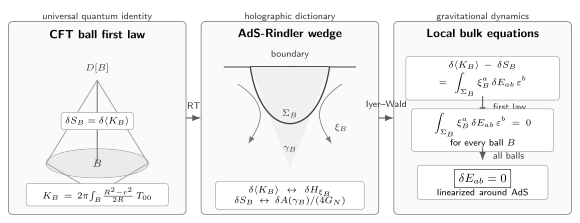
For a vacuum CFT ball , the modular Hamiltonian is local and generated by a conformal Killing vector. In the bulk this vector becomes the AdS-Rindler Killing field , which vanishes on the RT surface . The difference is an integral of the gravitational equations over the bulk slice .
This page explains the derivation slowly. The punchline is not that “entanglement magically creates gravity.” The punchline is more precise and more useful: the consistency of the RT formula with the universal first law of density matrices forces the bulk metric to obey gravitational dynamics.
The entanglement first law in any quantum theory
Section titled “The entanglement first law in any quantum theory”Let be a reference density matrix for a spatial region . Define its modular Hamiltonian by
The additive constant in is usually irrelevant. If is normalized, then , and the definition fixes the constant automatically.
For another state , the relative entropy is
Using and , this becomes
where
and
Relative entropy is nonnegative:
It vanishes if . Therefore, for a one-parameter family of states
the first derivative of relative entropy at must vanish. This gives the entanglement first law:
This is an exact quantum-mechanical identity. It does not assume conformal symmetry, holography, gravity, large , or semiclassical physics. It is as basic as the first law of thermodynamics, but it applies to reduced density matrices.
The difficulty is that is usually highly nonlocal. For a generic region in a generic QFT state, writing explicitly is hopeless. The reason ball-shaped regions in the CFT vacuum are so powerful is that their modular Hamiltonians are known exactly.
The modular Hamiltonian for a vacuum CFT ball
Section titled “The modular Hamiltonian for a vacuum CFT ball”Consider a CFT on flat Minkowski space in the vacuum state. Let be the ball at defined by
The domain of dependence is a causal diamond. Because the CFT vacuum and the ball have a large conformal symmetry, the reduced density matrix on is conformally related to a thermal density matrix on hyperbolic space. As a result, the modular Hamiltonian is local:
For the rest of this page, unless stated otherwise, means the modular Hamiltonian of the vacuum reduced to the ball .
The weight
is positive inside the ball and vanishes on . This vanishing is important: modular flow leaves the boundary of the causal diamond fixed.
For a small perturbation of the CFT state around the vacuum, the entanglement first law gives
This equation is already striking. The left side is a variation of entanglement entropy, which is nonlocal in the microscopic fields. The right side is a weighted integral of the local stress tensor. For a general region this simplification would not occur.
In two-dimensional CFT language, this formula is the higher-dimensional cousin of the fact that interval modular flow in the vacuum is generated by a conformal transformation preserving the interval. In higher dimensions, the special regions are balls.
The holographic translation
Section titled “The holographic translation”Now assume the CFT has a semiclassical holographic dual and consider perturbations around the vacuum state. The vacuum is dual to pure AdS:
The boundary ball has a simple RT surface in the slice:
It is a hemisphere ending on . The leading large- holographic entropy is
Therefore the entropy variation is
Here we can evaluate the area variation on the unperturbed RT surface. The reason is standard variational calculus: since is extremal in the background, the first-order change from shifting the surface vanishes. Only the first-order change in the metric contributes.
The right-hand side of the CFT first law is also holographic. The one-point function is read from the asymptotic metric perturbation. In Fefferman—Graham gauge,
with flat boundary metric and normalizable perturbations,
up to possible logarithmic terms in even boundary dimension. Schematically,
with the precise proportionality depending on the standard holographic-renormalization convention.
So the first law becomes a purely gravitational statement:
At this point the equation is still an equality of two boundary-accessible quantities: an area variation and an asymptotic metric coefficient. The beautiful step is that this equality can be rewritten as a bulk integral of the linearized gravitational equations.
The AdS-Rindler Killing vector
Section titled “The AdS-Rindler Killing vector”The causal development of a ball in the boundary vacuum corresponds to an AdS-Rindler wedge in the bulk. There is a Killing vector that generates the associated modular flow. For a ball centered at the origin, it is
Near the boundary, , this reduces to the conformal Killing vector that generates modular flow of the boundary causal diamond. On the boundary slice,
This is exactly the weight appearing in the modular Hamiltonian.
The same vector vanishes on the RT surface:
Thus is the bifurcation surface of the AdS-Rindler horizon. This is why the entanglement first law for a ball looks like a gravitational first law: the ball modular Hamiltonian is the energy associated with , and the RT surface plays the role of a horizon cross-section.
This analogy is not just suggestive. It is made precise by the covariant phase-space formalism.
The Iyer—Wald bridge
Section titled “The Iyer—Wald bridge”Let the bulk gravitational theory be Einstein gravity with negative cosmological constant. Write the equation of motion as
where
for vacuum Einstein gravity. In the presence of classical bulk matter one would instead write
For the moment, focus on source-free linearized perturbations around pure AdS.
The Iyer—Wald formalism associates to a diffeomorphism generator a Noether charge form and a symplectic potential form . For a metric perturbation , define the -form
For , this form has two crucial boundary integrals:
and
The first equality uses the holographic stress-tensor dictionary. The second equality is the gravitational first-law statement: since vanishes on the bifurcation surface , the Noether charge variation reduces to the area variation divided by .
Now let be a bulk codimension-one surface bounded by and :
Stokes’ theorem gives
The covariant phase-space identity says that, on a background solution and for a background Killing vector ,
where is the natural volume form with one index raised. Therefore
This is the core formula. It turns a statement about entanglement into a statement about the bulk equations of motion.
From the first law to the linearized Einstein equation
Section titled “From the first law to the linearized Einstein equation”The CFT entanglement first law says
for every ball . Hence
for every boundary ball.
Why does this imply the local equation ?
The rough reason is that the set of all balls is extremely overcomplete. By varying the center, radius, and Lorentz frame of , one obtains integral constraints over all AdS-Rindler wedges. These constraints are equivalent to a tensor Radon transform of . If those integrals vanish for all balls, then the local tensor must vanish:
More physically, a nonzero local violation of the linearized Einstein equation would be detected by choosing an AdS-Rindler wedge whose Killing vector and integration region have support near that violation. Since the first law holds for all balls, no such violation is allowed.
Thus, for holographic CFTs with RT entropy governed by Einstein gravity,
This statement is one of the cleanest examples of how bulk dynamics emerges from boundary quantum information.
A useful worked example: constant energy density
Section titled “A useful worked example: constant energy density”Suppose a small homogeneous perturbation of the CFT vacuum has
constant over a ball of radius at . The entanglement first law gives
Let be the number of spatial dimensions and let be the volume of the unit -sphere. Then
The radial integral is
Therefore
This scaling is useful. A small ball probes the local energy density, and the entanglement variation scales like the volume of the causal diamond, , not like the area divergence. The UV-divergent vacuum area-law part cancels in the first variation around the same reference state.
Holographically, this same quantity is the area variation of the hemispherical RT surface caused by the normalizable metric perturbation dual to . The equality is not an additional assumption; it is the first law translated through the dictionary.
Relative entropy beyond first order
Section titled “Relative entropy beyond first order”The first law is the linearized statement. Relative entropy contains more information. For finite differences,
At first order this vanishes. At second order it becomes a positive quadratic quantity. In holography, the second-order relative entropy of ball regions is related to canonical energy in the corresponding AdS-Rindler wedge.
Schematically,
where is the bulk metric perturbation. With bulk quantum fields included, the more precise structure contains bulk relative entropy in the entanglement wedge:
This is the dynamical side of the JLMS relation. Relative entropy is not just nonnegative; it measures distinguishability. Boundary distinguishability of states in becomes bulk distinguishability inside the entanglement wedge, plus the gravitational energy required to change the geometry.
The positivity
therefore becomes a nontrivial positivity constraint on gravitational perturbations. In suitable settings it is related to positive energy theorems, linear stability, and constraints on higher-derivative couplings.
Adding bulk matter and quantum corrections
Section titled “Adding bulk matter and quantum corrections”So far we used the leading RT formula
At the next order in the expansion, the entropy is the generalized entropy
where is the quantum extremal surface and is the bulk region between and .
The CFT first law then becomes
The bulk fields also obey their own entanglement first law:
Combining the boundary and bulk first laws yields the linearized semiclassical Einstein equation,
rather than the source-free classical equation. This is the right result: once bulk quantum fields carry energy, the geometry should respond to their stress tensor.
This is also why the JLMS relation is conceptually important. In one useful schematic form,
inside the code subspace, where the dots include subtleties associated with gauge constraints, edge modes, higher-order corrections, and operator-algebra choices. Taking differences between states gives a relation between boundary and bulk relative entropies.
The quantum lesson is not that the first-law derivation fails. It is that the object called “entropy” must be upgraded from area to generalized entropy, and the object called “Einstein equation” must be upgraded from classical to semiclassical.
Higher-derivative gravity
Section titled “Higher-derivative gravity”If the bulk theory is not two-derivative Einstein gravity, the entropy functional is not simply area. For stationary black holes the appropriate entropy is Wald entropy, and for general holographic entanglement surfaces the functional includes additional extrinsic-curvature terms.
The same logic still works, but with replacements:
and
So the first-law argument does not uniquely pick Einstein gravity from entanglement alone. It picks the bulk equations compatible with the entropy functional assigned to extremal surfaces. To obtain Einstein gravity specifically, one needs the leading RT area functional, which is itself tied to a large- CFT with a sparse spectrum and a two-derivative bulk limit.
This is a recurring theme of the course: entanglement is powerful, but it does not remove the need to specify the dynamical universality class of the bulk effective theory.
What exactly has been derived?
Section titled “What exactly has been derived?”It is worth being precise about the assumptions.
The cleanest theorem-like statement is:
In a holographic CFT whose leading entanglement entropy for ball regions is given by the RT area functional, small perturbations around the vacuum obey the entanglement first law for all balls if and only if the dual metric perturbation obeys the linearized Einstein equation about pure AdS.
This statement assumes:
- the CFT vacuum is dual to pure AdS;
- the perturbation has a semiclassical bulk metric description;
- the leading entropy is the RT area;
- the stress tensor is read from the asymptotic metric in the usual way;
- the perturbation is sufficiently regular in the relevant AdS-Rindler wedges;
- the first law is imposed for all ball-shaped boundary regions and all Lorentz frames.
It does not say that every QFT has a geometric dual. It does not by itself prove full nonlinear Einstein gravity. It does not imply that entanglement entropy alone contains every local observable. And it does not mean that spacetime is literally made of pairwise entanglement links.
What it does say is already remarkable: once a CFT has a semiclassical holographic dual and RT computes its entanglement, the universal first law of density matrices forces the bulk metric to satisfy the correct local gravitational equation at linear order.
Why ball regions are special
Section titled “Why ball regions are special”The derivation uses ball regions for two independent reasons.
First, the vacuum modular Hamiltonian is local only for special regions. For a generic shape, the modular Hamiltonian is nonlocal and complicated. Without a local expression for , the right-hand side is not simply a stress-tensor integral.
Second, the bulk dual of a ball in the vacuum is an AdS-Rindler wedge with an exact Killing vector. The Iyer—Wald identity uses that is a Killing vector of the background and that it vanishes on the RT surface. Generic regions do not have this symmetry.
This does not make generic regions unimportant. They contain more detailed information about bulk geometry and reconstruction. But for deriving local gravitational equations in the cleanest possible way, balls are the right probes.
A useful slogan is:
That equality of flows is the engine behind the derivation.
Relation to the older thermodynamic derivation of Einstein gravity
Section titled “Relation to the older thermodynamic derivation of Einstein gravity”There is an older and famous idea that Einstein’s equation can be understood as an equation of state. In Jacobson’s local-horizon derivation, the Clausius relation
applied to local Rindler horizons leads to the Einstein equation, assuming the entropy is proportional to horizon area.
The holographic entanglement-first-law derivation is spiritually close but technically different. Here the starting point is not heat flow across arbitrary local horizons. It is the exact quantum identity
for reduced density matrices in a CFT, together with the RT formula. The “Rindler horizon” is the AdS-Rindler horizon associated with a boundary ball, and the energy is the modular energy of the CFT region.
Both approaches teach the same deep lesson: when horizon or entanglement entropy is geometric, thermodynamic consistency strongly constrains spacetime dynamics.
Common mistakes
Section titled “Common mistakes”Mistake 1: Treating the entanglement first law as an approximation.
The first law
is exact at first order in the state variation. The approximations enter when we use a semiclassical bulk dual, the RT formula, and the large- expansion.
Mistake 2: Forgetting that is the vacuum modular Hamiltonian.
The local formula for applies to the vacuum reduced to a ball. For a finite-temperature state, a generic excited state, or a generic region, the modular Hamiltonian is usually nonlocal.
Mistake 3: Varying the RT surface incorrectly at first order.
At first order around an extremal surface, the embedding variation does not contribute to the area variation. One evaluates the metric perturbation on the original surface. Surface shifts matter at higher order.
Mistake 4: Saying the first law derives full nonlinear gravity in one step.
The direct derivation gives the linearized equations around AdS. Nonlinear equations can be built perturbatively with additional input from higher-order relative entropy and consistency, but the simple first-law equality is a linear statement.
Mistake 5: Ignoring quantum bulk entropy.
At subleading order, is not optional. Without it, the first-law argument would miss the bulk matter stress tensor and would produce the wrong semiclassical equation.
Exercises
Section titled “Exercises”Exercise 1: Derive the entanglement first law
Section titled “Exercise 1: Derive the entanglement first law”Let with . Define . Show that
Solution
The entropy is
The first variation is
The second term is
because the density matrix remains normalized. Therefore
Exercise 2: Modular energy of a homogeneous perturbation
Section titled “Exercise 2: Modular energy of a homogeneous perturbation”For a -dimensional CFT in flat space, consider a small perturbation with constant energy density
over a ball of radius at . Use the vacuum ball modular Hamiltonian to show that
Solution
The ball modular Hamiltonian gives
Using spherical coordinates in spatial dimensions,
The integral is
Multiplying by gives
Exercise 3: The RT surface as a fixed surface of modular flow
Section titled “Exercise 3: The RT surface as a fixed surface of modular flow”For a ball of radius centered at the origin, the AdS-Rindler Killing vector is
Show that vanishes on the RT surface
Solution
On the surface , the second term in is proportional to and therefore vanishes. The remaining coefficient is
On the RT surface , this coefficient also vanishes. Hence
on . This is why behaves like a bifurcation surface of an AdS-Rindler horizon.
Exercise 4: The Iyer—Wald identity and the first law
Section titled “Exercise 4: The Iyer—Wald identity and the first law”Assume that for a ball one has a form satisfying
and
Use Stokes’ theorem to show that the entanglement first law implies
Solution
Since with opposite orientations for the two boundary components,
Using the two boundary identities,
The bulk identity gives
The entanglement first law sets the left-hand side to zero. Therefore
Exercise 5: Why all balls are needed
Section titled “Exercise 5: Why all balls are needed”Explain why imposing the first-law constraint for one fixed ball does not imply the local equation , while imposing it for all balls does.
Solution
For one fixed ball, the first-law constraint gives only one integrated equation:
A nonzero local function can have a vanishing weighted integral over one region. Therefore one ball cannot determine the local tensor .
When the condition holds for all balls, the center, radius, and Lorentz frame of the corresponding AdS-Rindler wedges can be varied. The resulting family of integral constraints is overcomplete. It is essentially a tensor Radon transform of . If all such integrals vanish, then the local tensor must vanish:
Exercise 6: Quantum correction and bulk matter
Section titled “Exercise 6: Quantum correction and bulk matter”At leading order, the first-law argument gives the source-free equation
Explain why including bulk entropy leads instead to
Solution
At leading order, the CFT entropy is computed only by the area term,
Then the entanglement first law relates the boundary modular energy entirely to an area variation, and the Iyer—Wald identity gives the vacuum linearized Einstein equation.
At the next order, the entropy includes bulk entanglement:
The bulk entropy variation obeys its own first law,
The bulk modular-energy term is the energy of quantum fields in the entanglement wedge. In the gravitational constraint equation, this appears as the bulk stress tensor source. Thus the linearized equation becomes the semiclassical equation
Further reading
Section titled “Further reading”- D. D. Blanco, H. Casini, L.-Y. Hung, and R. C. Myers, Relative Entropy and Holography.
- N. Lashkari, M. B. McDermott, and M. Van Raamsdonk, Gravitational Dynamics From Entanglement Thermodynamics.
- T. Faulkner, M. Guica, T. Hartman, R. C. Myers, and M. Van Raamsdonk, Gravitation from Entanglement in Holographic CFTs.
- V. Iyer and R. M. Wald, Some Properties of Noether Charge and a Proposal for Dynamical Black Hole Entropy.
- D. L. Jafferis, A. Lewkowycz, J. Maldacena, and S. J. Suh, Relative Entropy Equals Bulk Relative Entropy.
- B. Swingle and M. Van Raamsdonk, Universality of Gravity from Entanglement.
- T. Jacobson, Entanglement Equilibrium and the Einstein Equation.