
The Polyakov Action, Gauge Symmetry, and Virasoro Constraints
The Nambu—Goto action is the most geometric way to write the dynamics of a string, but it hides the most important simplifying structure. Its square root makes the embedding fields interact nonlinearly, even in flat spacetime. The Polyakov formulation replaces this square root by an auxiliary worldsheet metric. The reward is enormous: after gauge fixing, the classical string becomes a two-dimensional conformal field theory of free scalar fields, supplemented by constraints.
This page introduces that formulation carefully. The key lesson is that the equations of motion and the constraints are conceptually different:
The second statement is what later becomes the Virasoro constraint. It is not a decoration; it removes the unphysical longitudinal and timelike oscillations.
From effective strings to the fundamental worldsheet theory
Section titled “From effective strings to the fundamental worldsheet theory”The long-string analysis already tells us why a two-dimensional field theory should appear. A stretched string of length has transverse fluctuations. At long distance these are massless fields on the worldsheet. Their normal modes behave as
Their zero-point energy gives the universal Lüscher correction
With zeta-function regularization,
so
Thus a long confining string has the schematic potential
The leading term is classical area; the term is the Casimir energy of worldsheet fields. This is the first hint that the right language is not just minimal surfaces, but quantum field theory on a surface. The Polyakov action is the formulation that makes this language manifest.
Notation: induced metric versus auxiliary metric
Section titled “Notation: induced metric versus auxiliary metric”Let the worldsheet coordinates be
The string embedding into target spacetime is
We use mostly-plus target-space signature,
and write target-space scalar products as
in flat spacetime. In a curved target-space metric one replaces by .
The induced worldsheet metric is
The Nambu—Goto action is
In the Polyakov formulation we introduce a second metric,
which is not initially equal to . It is an independent worldsheet field. The equations of motion for will force it to be conformally equivalent to .
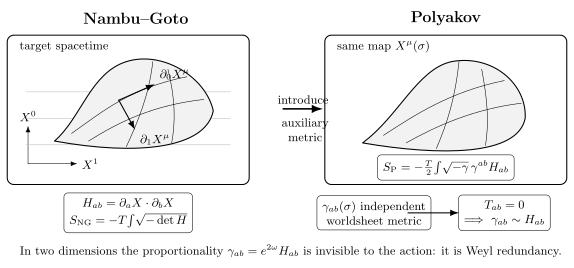
The Nambu—Goto action computes the area using the induced metric . The Polyakov action introduces an auxiliary metric ; its equation of motion imposes , where the proportionality is a Weyl redundancy.
The Polyakov action
Section titled “The Polyakov action”The Polyakov action is
where
In flat spacetime this becomes
At first glance this action looks less geometric than Nambu—Goto: we have introduced a metric by hand. But it has three crucial virtues.
First, it is quadratic in when . The complicated square root has been moved into the metric sector.
Second, it is the natural action of scalar fields coupled to two-dimensional gravity. The string path integral is therefore schematically
with the appropriate sum over worldsheet topologies when interactions are included.
Third, two-dimensional gravity is special. Locally, the metric has no propagating graviton. After gauge fixing, the metric leaves behind moduli, ghosts, and constraints, but not local gravitational waves. This is why string perturbation theory is so rigid.
Gauge symmetries
Section titled “Gauge symmetries”The Polyakov action has several symmetries. In flat target space it has the target-space Poincaré symmetry
More importantly, it has local worldsheet symmetries.
Worldsheet diffeomorphisms
Section titled “Worldsheet diffeomorphisms”For an arbitrary change of worldsheet coordinates
the fields transform as a scalar and a tensor:
This is the string analogue of reparametrization invariance for the relativistic particle. The coordinates and label points on the worldsheet; they are not physical observables.
Weyl transformations
Section titled “Weyl transformations”The action is also invariant under local rescalings of the worldsheet metric,
Indeed, in two dimensions
so the product is invariant. This cancellation is special to two worldsheet dimensions. For a -dimensional worldvolume one would instead get
which is invariant only for . This is one of the deep reasons strings are much easier to quantize than generic membranes or higher branes.
A useful way to count the local gauge freedom is this: a two-dimensional Lorentzian metric has three independent components,
Two functions come from diffeomorphisms and one more comes from Weyl rescaling. Locally, all three components can be gauge-fixed.
Equivalence to the Nambu—Goto action
Section titled “Equivalence to the Nambu—Goto action”The worldsheet stress tensor is defined by varying the action with respect to the auxiliary metric. With the normalization convenient for string theory,
Using
we find
In terms of the induced metric ,
The equation of motion for is therefore
This equation says
If the induced metric is nondegenerate, this means that is proportional to :
So the auxiliary metric is not equal to the induced metric uniquely; it is equal up to a local scale factor. That scale factor is precisely Weyl gauge redundancy.
Now substitute the metric equation back into the Polyakov action. Since in two dimensions,
For a Lorentzian worldsheet with the appropriate orientation,
Therefore
Thus the Polyakov and Nambu—Goto formulations are classically equivalent. The Polyakov form is not changing the classical string; it is giving us a better set of variables for quantization.
Why the same trick does not solve higher branes
Section titled “Why the same trick does not solve higher branes”For a -brane with worldvolume dimension , one can write a Polyakov-like action
The constant term is chosen so that eliminating reproduces the Nambu—Goto action
For this constant term vanishes. That is the string. For it is required, and it breaks Weyl invariance. So higher branes do not have the same local simplification: after using diffeomorphisms, the worldvolume metric still contains local degrees of freedom. This is the practical reason the fundamental string admits a controlled perturbative quantization, while fundamental membranes are far harder.
Equations of motion for the embedding fields
Section titled “Equations of motion for the embedding fields”Now vary . In a general target-space metric, the variation gives the harmonic-map equation
Here is the target-space Christoffel symbol. In flat spacetime this reduces to
The variation also gives a boundary term. For flat target space,
where is normal to the boundary inside the worldsheet. A consistent variational principle therefore requires boundary conditions.
For a closed string there is no boundary; instead is periodic in .
For an open string on a strip , the boundary term in conformal gauge becomes
There are two basic ways to make it vanish:
or
For a fundamental open string in empty flat space one usually imposes Neumann boundary conditions in all target-space directions. Dirichlet conditions will become central later: they say that the endpoint of the open string is confined to a hypersurface, namely a D-brane.
Conformal gauge
Section titled “Conformal gauge”Because the two-dimensional metric has no local gauge-invariant components, we can locally choose conformal gauge,
The Weyl factor drops out of the action:
Therefore in flat target space,
where
The equation of motion is the two-dimensional wave equation,
This is the first big simplification. In conformal gauge the string looks like free massless scalar fields on a two-dimensional worldsheet.
But this is not the full story. We used the metric equations to choose a gauge; we must still impose the metric equations of motion,
Gauge fixing makes the equations of motion simple, but it does not erase the constraints.
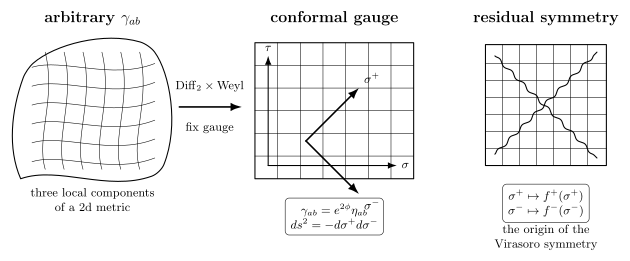
Diffeomorphisms and Weyl transformations bring any two-dimensional metric locally to conformal gauge. The remaining transformations independently reparametrize the two light-cone coordinates.
Light-cone coordinates on the worldsheet
Section titled “Light-cone coordinates on the worldsheet”Define
Then
and
The flat worldsheet line element is
The wave equation becomes
Locally its general solution is a sum of left-moving and right-moving pieces,
The names left-moving and right-moving depend on conventions, but the invariant statement is clear: the two chiral halves move along the two null directions on the worldsheet.
Residual conformal symmetry
Section titled “Residual conformal symmetry”Conformal gauge does not completely fix the gauge. The transformations
preserve the metric up to a Weyl rescaling:
The factor is removed by a Weyl transformation. Therefore these transformations remain as residual gauge symmetries after conformal gauge fixing.
Infinitesimally,
Since is a worldsheet scalar,
The conserved currents associated with these residual transformations are the chiral components of the stress tensor. Their Fourier modes are the classical Virasoro generators. Later, after quantization, they become operators and with a central extension.
Stress tensor in conformal gauge
Section titled “Stress tensor in conformal gauge”In conformal gauge the stress tensor becomes
Using , its components are
and
The constraints are therefore
Equivalently,
In light-cone coordinates the same constraints take the beautifully simple form
The mixed component vanishes identically in a classical conformal theory:
This is the classical tracelessness condition. It follows from Weyl invariance.
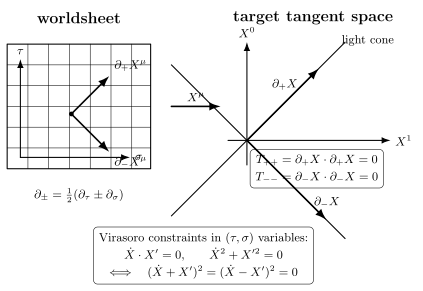
The conformal-gauge constraints say that the two tangent vectors and are null vectors in target spacetime. In variables this is equivalent to and .
Physical meaning of the constraints
Section titled “Physical meaning of the constraints”The wave equation alone would describe independent massless scalar fields on the worldsheet. That cannot be the physical string spectrum, because one of those scalar fields is , a timelike field with negative norm. The constraints remove precisely the unphysical degrees of freedom.
Classically, the constraints say that the curves of constant and constant map into null curves in target spacetime:
Geometrically, a conformal parametrization of the worldsheet makes the coordinate directions null with respect to the induced metric. The worldsheet is still a timelike surface in spacetime, but its two light-cone tangent directions are target-space null.
Counting degrees of freedom also becomes transparent. The embedding has functions . Diffeomorphism invariance removes two functional degrees of freedom. Weyl invariance acts on the metric rather than on , but after conformal gauge fixing the remaining metric equations impose two constraints. The net result is that a string has local transverse oscillations, matching the static-gauge analysis.
This agreement is a crucial consistency check:
Static gauge makes the physical fields obvious but hides conformal symmetry. Conformal gauge makes conformal symmetry obvious but requires constraints. String theory uses both viewpoints constantly.
Noether currents: spacetime momentum and angular momentum
Section titled “Noether currents: spacetime momentum and angular momentum”In flat target spacetime, translations and Lorentz transformations of give conserved worldsheet currents. In conformal gauge the canonical momentum density is
The total target-space momentum is
Similarly, Lorentz invariance gives the conserved angular momentum
These formulae will be useful immediately. Classical rotating string solutions obey the Virasoro constraints, and their energy and angular momentum lie on Regge trajectories. That calculation is one of the cleanest bridges from the classical string to the quantum spectrum.
Summary
Section titled “Summary”The Polyakov action rewrites the Nambu—Goto string as scalar fields coupled to a two-dimensional metric:
The auxiliary metric equation gives
which makes the Polyakov and Nambu—Goto actions classically equivalent.
Using diffeomorphism and Weyl invariance, one can choose conformal gauge:
Then the equations of motion are free wave equations,
but the metric equations remain as the Virasoro constraints,
This is the basic classical structure behind perturbative string theory: a free two-dimensional conformal field theory, projected onto the gauge-invariant subspace by the constraints.
Exercises
Section titled “Exercises”Exercise 1: deriving the stress tensor
Section titled “Exercise 1: deriving the stress tensor”Starting from
vary with respect to and show that
Solution
Use
Then
Substituting the variation of gives
With
we obtain
Exercise 2: Weyl invariance is special to the string
Section titled “Exercise 2: Weyl invariance is special to the string”Let the worldvolume dimension be . Show that
is invariant under only for .
Solution
In dimensions,
so
Also,
Therefore
The kinetic term is invariant for arbitrary local only if
hence . Since , this means : the object is a string.
Exercise 3: open-string boundary conditions
Section titled “Exercise 3: open-string boundary conditions”In conformal gauge, the flat-space Polyakov action is
on the strip . Derive the boundary term in and show how Neumann and Dirichlet boundary conditions make it vanish.
Solution
Varying the action gives
Integrating by parts,
The bulk equation is
The spatial boundary term vanishes if, for each target-space direction, either
at , which is a Neumann condition, or
at , which is a Dirichlet condition. Neumann means the endpoint is free to move in that target-space direction. Dirichlet means the endpoint position in that direction is fixed.
Exercise 4: constraints in light-cone coordinates
Section titled “Exercise 4: constraints in light-cone coordinates”Show that
are equivalent to
Solution
Using
we have
and
Thus means
Adding the two equations gives
so
Subtracting them gives
so
The converse follows by reversing these steps.
Exercise 5: residual conformal transformations
Section titled “Exercise 5: residual conformal transformations”Show that the coordinate transformation
preserves conformal gauge up to a Weyl transformation.
Solution
In conformal gauge the Lorentzian line element is
Under
we have
Therefore
This is the original metric multiplied by the local factor
A Weyl transformation removes this factor. Hence these transformations preserve the conformal-gauge form of the metric and remain as residual gauge symmetries.