
Relevant Deformations and Domain Walls
The main idea
Section titled “The main idea”A conformal field theory is a fixed point of the renormalization group. To make it flow, we perturb it. The simplest and most controlled deformation is a relevant scalar operator,
The coupling has mass dimension
so the deformation becomes more important at long distances. In ordinary field-theory language, it changes the theory away from the UV CFT and asks what the infrared physics becomes: another CFT, a mass gap, confinement, spontaneous symmetry breaking, or something more exotic.
In holography, the same operation has a beautifully geometric avatar. The operator is dual to a bulk scalar field . Turning on the coupling means imposing a non-normalizable boundary condition for . The scalar profile backreacts on the metric. If the deformation preserves -dimensional Poincaré invariance, the bulk solution takes the form of a domain wall,
Near the boundary, the metric approaches AdS and the dual theory approaches the UV CFT. Deeper in the bulk, the changing scalar and warp factor describe the RG evolution of the deformed theory.
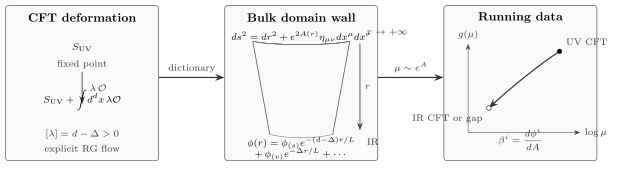
A relevant deformation of the UV CFT is implemented holographically by a scalar boundary condition. The bulk solution is a domain wall whose warp factor sets the approximate energy scale , while the scalar profile encodes running couplings and expectation values. The IR may be another AdS region, a smooth cap, a horizon, or a physically acceptable singular endpoint.
This page introduces the basic technology. Later pages will use the same setup to derive holographic -theorems, model confinement, diagnose mass gaps, and add flavor degrees of freedom.
CFT deformations and dimensionless couplings
Section titled “CFT deformations and dimensionless couplings”Start with a UV CFT in dimensions. A scalar primary operator has scaling dimension , so under a scale transformation ,
The deformation
is dimensionless only if . Therefore:
| Type of operator | Condition | Coupling dimension | UV behavior |
|---|---|---|---|
| relevant | positive | grows toward the IR | |
| marginal | zero | requires higher-order beta function | |
| irrelevant | negative | suppressed in the IR but dangerous in the UV |
For a relevant deformation, a convenient dimensionless coupling at energy scale is
At leading order near the UV fixed point,
Because , grows as is lowered. This is the field-theory origin of the bulk intuition that a small UV scalar boundary condition can become large in the interior.
A source deformation is not the same thing as choosing a different state. The deformation changes the Lagrangian or Hamiltonian. A state changes expectation values while leaving the theory fixed. In holography this distinction becomes the difference between the two leading near-boundary modes of the bulk scalar.
The bulk model
Section titled “The bulk model”The minimal bulk system for a holographic RG flow is Einstein gravity coupled to scalar fields. For one scalar, use
Here is the Gibbons-Hawking term and contains local counterterms needed to define finite one-point functions. For several scalars,
A CFT fixed point corresponds to an AdS critical point of the scalar potential:
The AdS radius determines the scale of CFT data such as the stress-tensor two-point coefficient,
up to a dimension-dependent normalization. If the same potential has two AdS critical points, a domain wall may interpolate between a UV CFT and an IR CFT. If the flow instead ends at a cap or a singularity, the field theory may have a mass gap, confinement, or another nonconformal infrared behavior.
Near a UV critical point, expand
The mass of is related to the dimension of the dual operator by
Thus a relevant deformation corresponds to a scalar whose mass lies in the range associated with . The mass may be negative without indicating an instability, as long as it obeys the Breitenlohner-Freedman bound,
Domain-wall equations
Section titled “Domain-wall equations”For a Poincaré-invariant RG flow, take
The coordinate is chosen so that the UV boundary lies at . Pure AdS is recovered when
For one scalar with canonical kinetic term, the equations of motion reduce to
and the Hamiltonian constraint
The second equation is crucial:
It says that, in this simple two-derivative model with positive scalar kinetic energy, the warp factor is concave as a function of the radial coordinate. This is the geometric seed of holographic monotonicity. The next page will turn it into a -theorem.
The scalar equation has an intuitive interpretation. The term acts like friction in the radial evolution. Close to the UV boundary, , so the linearized equation is a damped equation whose two independent solutions are precisely the source and response modes.
The near-boundary dictionary
Section titled “The near-boundary dictionary”It is often clearer to use Fefferman-Graham coordinate , related near the UV boundary to by
The metric then has the asymptotic form
The scalar behaves as
when and no logarithmic degeneracy is present. In terms of ,
In standard quantization:
The precise relation between and is not simply a universal numerical constant. It can receive local contributions from counterterms, nonlinear terms in the asymptotic expansion, and conformal anomaly terms. Schematically,
For separated-point correlators the local terms often do not matter. For one-point functions, Ward identities, and thermodynamics, they matter enormously.
Source flows versus vev flows
Section titled “Source flows versus vev flows”A common trap is to call every scalar domain wall an RG flow triggered by a relevant operator. This is too quick.
There are two qualitatively different possibilities:
| Boundary data | Field-theory interpretation | Typical name |
|---|---|---|
| explicit deformation of the UV CFT | source flow | |
| , | nonzero expectation value in a state or vacuum | vev flow |
A source flow changes the theory. A vev flow changes the vacuum of the same theory. This distinction is familiar in QFT: adding a mass term is not the same as choosing a vacuum with .
The distinction is also visible in the trace Ward identity. For a deformed flat-space CFT, one expects schematically
where denotes possible anomaly terms. Near a fixed point with dimensionful sources, this is often written, up to sign conventions, as
If the source vanishes but the expectation value is nonzero, conformal invariance may be spontaneously rather than explicitly broken. Then the Ward identity and the spectrum can look very different. Coulomb-branch flows of SYM are standard examples: the bulk is not simply dual to adding a relevant term to the Lagrangian.
How the radial direction becomes an RG scale
Section titled “How the radial direction becomes an RG scale”For the domain-wall metric,
a natural local energy scale is
This is not a literal equality with a unique scheme-independent RG scale. A radial redefinition changes how one labels slices. What is robust is the asymptotic statement: near AdS,
Given scalar profiles , one can define holographic beta functions by differentiating with respect to :
This formula is useful, but it should be read with care. The bulk scalar value is not always identical to a renormalized field-theory coupling in a canonical scheme. Field redefinitions in the bulk correspond to coupling redefinitions in the boundary theory. The invariant content is not the coordinate value of at a particular radial position, but the complete renormalized generating functional and its Ward identities.
Still, the formula captures the central intuition. A holographic RG flow is a radial evolution problem in which the boundary conditions at large specify UV data and the regularity or admissibility condition in the interior selects physical IR data.
First-order flow and superpotentials
Section titled “First-order flow and superpotentials”Many important domain walls can be written in first-order form. Suppose there is a function such that
Then the second-order equations are solved by
with the sign convention chosen so that for an AdS solution with .
For several scalars,
Then the holographic beta functions become
In supersymmetric flows, is usually a genuine superpotential determined by the supersymmetry variations of the gauged supergravity. In non-supersymmetric flows, a function may still exist locally; then it is often called a fake superpotential. The first-order form is powerful because it turns a boundary-value problem into a gradient-flow-like system, but it does not eliminate the need for UV holographic renormalization or IR regularity conditions.
What happens in the infrared?
Section titled “What happens in the infrared?”The IR endpoint determines the physical character of the deformed theory. Common possibilities include:
| Bulk endpoint | Boundary interpretation |
|---|---|
| another AdS region | flow to an IR CFT |
| smooth cap | mass gap; often confinement-like behavior |
| black-brane horizon | finite-temperature plasma state |
| acceptable singularity | possible zero-temperature IR phase, often requiring uplift or extra criteria |
| unacceptable singularity | likely unphysical solution or incomplete truncation |
If the flow reaches another AdS critical point , then
The IR CFT has operator dimensions determined by the Hessian of at ,
Notice the subtlety: the same bulk scalar can correspond to one operator dimension near the UV fixed point and another near the IR fixed point. Operator identities along an RG flow are not usually as simple as tracking one scalar label. The scalar labels fields in a bulk effective theory; the CFT interpretation depends on the fixed point around which one linearizes.
If the flow ends at a singularity, one must be cautious. Some singularities are artifacts of a lower-dimensional truncation and become smooth after uplifting to ten or eleven dimensions. Some are physically meaningful endpoints of brane distributions. Others are pathological. A widely used practical criterion is that a physically acceptable singularity should admit a sensible finite-temperature deformation, or equivalently should satisfy appropriate boundedness conditions on the scalar potential along the solution. This is a useful diagnostic, not a magic theorem.
Holographic renormalization along flows
Section titled “Holographic renormalization along flows”A domain wall dual to a relevant deformation is usually asymptotically AdS in the UV. Therefore the divergences of the on-shell action are still controlled by the near-boundary expansion. One introduces a cutoff surface or , evaluates the regulated action, adds local covariant counterterms, and removes the cutoff.
The renormalized one-point functions are obtained by variation with respect to the boundary sources:
For the stress tensor,
The Ward identities express the remaining bulk gauge redundancies. For scalar sources on a curved boundary, they take the schematic form
and
For constant sources in flat space, the diffeomorphism Ward identity reduces to stress-tensor conservation. The trace Ward identity is the interesting one: it says the stress tensor is no longer traceless because the theory is no longer conformal.
This is one of the cleanest ways to see the difference between a conformal state and a deformed theory. A thermal state of a CFT on flat space still has a traceless stress tensor when the theory is exactly conformal, up to anomalies on curved backgrounds. A relevant deformation changes the operator identity for the trace.
A minimal computational workflow
Section titled “A minimal computational workflow”Given a proposed holographic RG flow, the disciplined calculation goes as follows.
| Step | Bulk task | Boundary interpretation |
|---|---|---|
| 1 | Specify and the scalar kinetic metric | choose operator content and possible fixed points |
| 2 | Find UV AdS asymptotics | identify the UV CFT and operator dimensions |
| 3 | Choose source data | specify the deformation |
| 4 | Impose IR regularity or admissibility | select the physical vacuum or phase |
| 5 | Add counterterms and vary | compute and |
| 6 | Study fluctuations around the background | compute spectra, correlators, transport, or stability |
The most important practical point is that a domain-wall background alone is not the full answer. The background gives one-point functions and thermodynamics. Two-point functions require linearized fluctuations around the background. Spectra require normalizability and IR boundary conditions. Wilson loops require string worldsheets in the background. Entanglement requires extremal surfaces. The domain wall is the geometry on which many other observables are computed.
Example: a flow between two fixed points
Section titled “Example: a flow between two fixed points”Suppose has two extrema:
with
A domain wall interpolating between them has
and
after choosing the IR coordinate orientation appropriately. Near each endpoint the geometry is approximately AdS, but the radius can differ. Since the number of degrees of freedom scales like , the ratio
measures how many degrees of freedom remain at the IR fixed point. Under suitable energy conditions, holographic monotonicity implies the IR value should not exceed the UV value. This is the geometric version of the intuition that RG flow integrates out degrees of freedom.
Real top-down examples are richer. Supersymmetric mass deformations of SYM lead to scalar profiles in five-dimensional gauged supergravity. Some flows approach nontrivial IR fixed points. Others describe confining or singular endpoints. The important lesson for this course is not the details of a particular potential, but the method: relevant deformations are boundary conditions; RG evolution is encoded in radial profiles; IR physics is encoded in the interior endpoint.
What is universal, and what is model-dependent?
Section titled “What is universal, and what is model-dependent?”The following statements are robust in standard two-derivative Einstein-scalar holography:
- a relevant scalar source changes the UV CFT action;
- the scalar near-boundary expansion separates source and response data;
- Poincaré-invariant deformations are described by domain-wall geometries;
- the radial scale is approximately an RG scale near AdS regions;
- positive scalar kinetic energy gives ;
- holographic renormalization gives finite one-point functions and Ward identities.
The following statements are model-dependent:
- whether the IR endpoint is a CFT, a gap, confinement, or a singularity;
- whether a singularity is acceptable;
- the detailed beta functions away from fixed points;
- the precise spectrum of glueball-like modes;
- whether a bottom-up potential has a controlled string-theory embedding;
- how closely a phenomenological model resembles QCD.
The difference matters. Holographic RG flows are powerful because they organize strongly coupled dynamics geometrically. They are dangerous when the geometry is treated as if every feature automatically had a known UV-complete field-theory interpretation.
Common mistakes
Section titled “Common mistakes”Mistake 1: equating the radial coordinate with a unique RG scale. The relation is useful, especially near AdS regions, but it is not a scheme-independent local identity.
Mistake 2: calling every scalar profile a source deformation. The source mode and vev mode have different field-theory meanings. Many famous domain walls are vacuum or Coulomb-branch flows rather than explicit relevant deformations.
Mistake 3: forgetting backreaction. A scalar profile generically changes the metric. Treating it as a probe is a separate approximation and usually misses stress-tensor one-point functions and central-charge flow.
Mistake 4: trusting singular interiors automatically. A singular domain wall is not automatically wrong, but it is not automatically right either. One must check regularity, uplift, finite-temperature deformations, fluctuation spectra, and physical observables.
Mistake 5: reading the potential too literally. A bottom-up scalar potential is a model for a sector of RG physics. Without a top-down construction or a sharply defined boundary QFT, it is not a first-principles Lagrangian derivation.
Exercises
Section titled “Exercises”Exercise 1: Relevant coupling and RG growth
Section titled “Exercise 1: Relevant coupling and RG growth”Let be a scalar operator of dimension , and define the dimensionless coupling
Show that the leading UV beta function is
Explain why this means the deformation grows toward the IR.
Solution
Since is a fixed dimensionful parameter at leading order,
For a relevant operator, . Therefore decreases as is increased toward the UV and increases as is lowered toward the IR. Equivalently, if is a length scale, then grows at large distances.
Exercise 2: Deriving the domain-wall equations
Section titled “Exercise 2: Deriving the domain-wall equations”For the action
use the ansatz
to show that
Solution
The Einstein equations can be written as
For the domain-wall metric,
and
The equation gives
The equation gives
Substituting the first relation into the second eliminates and yields
so
Exercise 3: Source and vev in coordinates
Section titled “Exercise 3: Source and vev in rrr coordinates”In Fefferman-Graham coordinate , a scalar behaves as
Using near the boundary, rewrite this in terms of and identify which term is the source in standard quantization.
Solution
Substituting gives
Therefore
In standard quantization, is the source for the operator , while is related to after holographic renormalization.
Exercise 4: First-order flow implies the constraint
Section titled “Exercise 4: First-order flow implies the constraint”Assume
and
Show that the Hamiltonian constraint
is automatically satisfied.
Solution
Using the first-order equations,
The right-hand side of the Hamiltonian constraint is
The terms cancel, leaving
Thus the constraint is automatically satisfied.
Exercise 5: The trace Ward identity for a constant source
Section titled “Exercise 5: The trace Ward identity for a constant source”Consider a flat-space CFT deformed by a constant source for an operator of dimension . Ignoring anomalies and scheme-dependent contact terms, explain why dimensional analysis suggests
Solution
Under a Weyl rescaling, the source must transform with weight so that
remains dimensionless. The trace of the stress tensor measures the response of the renormalized generating functional to a Weyl rescaling. Therefore the explicit breaking caused by the source is proportional to the Weyl weight of the source, namely , times the source and the conjugate operator expectation value.
The precise sign depends on whether the deformation is written with or in the action and on Euclidean versus Lorentzian conventions. The invariant lesson is that the trace is controlled by beta functions or dimensionful sources times their conjugate operators.
Further reading
Section titled “Further reading”- D. Z. Freedman, S. S. Gubser, K. Pilch, and N. P. Warner, Renormalization Group Flows from Holography—Supersymmetry and a c-Theorem.
- J. de Boer, E. Verlinde, and H. Verlinde, On the Holographic Renormalization Group.
- M. Bianchi, D. Z. Freedman, and K. Skenderis, Holographic Renormalization.
- M. Bianchi, O. DeWolfe, D. Z. Freedman, and K. Pilch, Anatomy of Two Holographic Renormalization Group Flows.
- K. Skenderis, Lecture Notes on Holographic Renormalization.
- S. S. Gubser, Curvature Singularities: The Good, the Bad, and the Naked.