
Wilson Loops, Defects, and Spin Chains
So far, the course has treated a CFT mainly as a theory of local operators: primaries, descendants, OPE coefficients, conformal blocks, chiral primaries, and large- single-trace states. That is the right foundation, but it is not the whole story. A gauge CFT also contains extended operators. In super Yang—Mills, the most important extended operators are Wilson loops.
This page explains three related structures:
- Wilson loops, which are gauge-invariant observables supported on curves.
- Defect CFT data, which arise when a Wilson line creates a lower-dimensional conformal defect.
- Planar spin chains, which reorganize the anomalous-dimension problem for long single-trace operators.
They are deeply tied to AdS/CFT. Wilson loops become string worldsheets, defect operators become open-string fluctuations, and planar spin chains become the weak-coupling face of closed-string dynamics on .
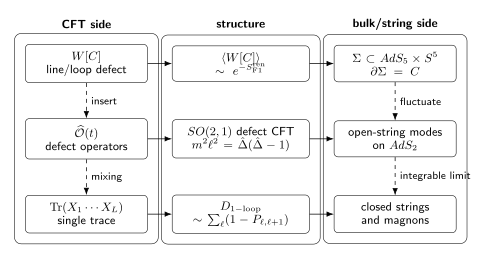
Wilson loops, defect operators, and planar spin chains are three structured observables in SYM. At large and strong , they map respectively to string worldsheets, open-string or brane-localized modes, and closed-string states in .
Wilson loops in gauge theory
Section titled “Wilson loops in gauge theory”In a gauge theory, the gauge potential is not gauge invariant. Local gauge-invariant operators are built from traces such as or . But gauge theory also has natural nonlocal observables.
Given a path from to , the Wilson line in a representation is
where and denotes path ordering. Under a gauge transformation,
the Wilson line transforms as
Thus an open Wilson line is not gauge invariant by itself. For a closed curve , the traced Wilson loop
is gauge invariant by cyclicity of the trace.
In SYM, the canonical supersymmetric loop couples also to the six adjoint scalar fields . It is usually called the Maldacena—Wilson loop:
with
The scalar coupling is essential. It is what makes the straight line and the circle compatible with supersymmetry. Different sign conventions appear in the literature, especially between Euclidean and Lorentzian signature; the invariant point is that the loop couples to a ten-dimensional-looking connection built from and the six scalars.
The half-BPS straight line and circle
Section titled “The half-BPS straight line and circle”The most important example is the half-BPS straight Wilson line. Place the line along a coordinate and choose a fixed scalar direction, say :
The line preserves the one-dimensional conformal group acting along :
It also preserves rotations transverse to the line,
and the scalar coupling breaks the original symmetry to
Together with preserved supercharges, the full symmetry of the half-BPS line is often denoted , whose bosonic subgroup contains
A circle is conformally related to a straight line. Quantum mechanically, the half-BPS circular Wilson loop has a nontrivial expectation value, while the line has expectation value in the usual supersymmetric normalization. The difference is not a contradiction: the conformal map between the line and the circle involves the point at infinity and changes the infrared/ultraviolet treatment of the operator.
Wilson line as a defect CFT
Section titled “Wilson line as a defect CFT”The insertion of a straight Wilson line breaks the ambient four-dimensional conformal symmetry, but preserves a lower-dimensional conformal subgroup. Therefore the theory in the presence of the line is a defect CFT.
There are two kinds of operators:
- ambient operators , inserted away from the line;
- defect operators , inserted on the line.
A normalized ambient one-point function in the presence of the line is
For a scalar primary of dimension , transverse rotations and one-dimensional conformal symmetry fix
if the preserved quantum numbers allow the one-point function. The coefficient is part of the defect CFT data.
A defect operator is an insertion inside the path-ordered exponential. Schematically,
The normalized defect correlator is
One-dimensional conformal kinematics
Section titled “One-dimensional conformal kinematics”The group acts on the line by fractional linear transformations:
A defect primary of dimension transforms as
Consequently, in an orthonormal basis of defect primaries,
The three-point function is
Four-point functions depend on one cross-ratio,
Thus a Wilson line gives a lower-dimensional CFT problem with data
Here are bulk-to-defect OPE coefficients. As an ambient operator approaches the line,
This is the defect analogue of the ordinary OPE.
The displacement operator
Section titled “The displacement operator”The most universal defect operator is the displacement operator , where labels transverse directions. A line defect breaks translations transverse to the line. The corresponding Ward identity has the schematic form
Away from the defect, the stress tensor is conserved. At the defect, transverse momentum can be absorbed by the line. The operator measures the response of the defect to small shape deformations.
For a line defect, the displacement operator has protected dimension
Its two-point function is fixed up to one coefficient:
In the half-BPS Wilson line of SYM, this coefficient is related to the Bremsstrahlung function , which also controls the small-angle expansion of the cusp anomalous dimension.
Cusps and anomalous dimensions
Section titled “Cusps and anomalous dimensions”A smooth Wilson loop has local UV divergences associated with its length. A Wilson loop with a cusp has an additional logarithmic divergence. For a cusp with spacetime angle and scalar internal angle , one writes schematically
The function is the cusp anomalous dimension. It is important far beyond Wilson loops: it appears in the infrared structure of gauge-theory scattering amplitudes, in anomalous dimensions of large-spin operators, and in integrability.
Near a BPS cusp in SYM,
up to sign conventions associated with Euclidean versus Lorentzian continuation. The key lesson is structural: deforming a conformal line defect produces universal defect observables.
Wilson loops in AdS/CFT
Section titled “Wilson loops in AdS/CFT”At large and large ‘t Hooft coupling,
a Wilson loop in the fundamental representation is dual to a fundamental string worldsheet ending on the contour at the AdS boundary:
More explicitly,
so the semiclassical answer is
The scalar coupling specifies boundary conditions on . Thus a supersymmetric Wilson loop is not only a contour in spacetime; it is also a choice of internal path on the sphere.
For a rectangular Wilson loop of spatial size and time extent ,
Conformal invariance requires
The strong-coupling classical string computation gives
For the half-BPS circle, supersymmetric localization gives, in the planar limit,
so at strong coupling
matching the classical string area.
Defect operators as open-string fluctuations
Section titled “Defect operators as open-string fluctuations”The straight half-BPS Wilson line is dual to a fundamental string whose induced worldsheet geometry is . Defect operators inserted on the line correspond to fluctuations of this open string.
The schematic dictionary is
For a scalar fluctuation of mass on with radius , the defect dimension obeys
This is the version of the ordinary scalar mass-dimension relation, specialized to .
Thus the Wilson line is not merely a number whose expectation value one computes. It is a lower-dimensional holographic system embedded inside the original four-dimensional CFT.
From single traces to spin chains
Section titled “From single traces to spin chains”Now return to local single-trace operators. A long single-trace operator is a cyclic word:
where each is an adjoint field, covariant derivative, or composite letter. In the planar limit, the ordering of letters inside the trace is meaningful. The trace behaves like a closed chain.
The dilatation operator acts on these words:
Perturbatively,
At planar one loop, interactions are nearest-neighbor along the trace. Therefore is a spin-chain Hamiltonian.
The cleanest example is the scalar sector. Define
and consider operators made only from and :
Each site has two states,
The planar one-loop anomalous dimension in this sector is governed by
where swaps neighboring spin-chain sites and periodicity means . This is the ferromagnetic Heisenberg spin chain, up to normalization.
The state
is the ferromagnetic vacuum. It is half-BPS, so its anomalous dimension vanishes. In spin-chain language, annihilates every neighboring pair.
Magnons and Bethe equations
Section titled “Magnons and Bethe equations”Replacing one by an creates a magnon. On a long chain,
The one-loop energy is
For a closed single trace, cyclicity imposes the zero-total-momentum condition
A single magnon with nonzero momentum is therefore not a physical closed-chain state by itself, but it is a useful building block of multi-magnon states.
The one-loop Bethe ansatz introduces rapidities related to magnon momenta by
The Bethe equations are
Cyclicity gives
and the anomalous dimension is
The key point is conceptual: in planar SYM, computing anomalous dimensions becomes a quantum many-body spectral problem.
Spin chains and strings
Section titled “Spin chains and strings”The AdS interpretation is
The scaling dimension is the string energy:
The half-BPS vacuum is dual to a pointlike string moving along a great circle of . Magnons are string excitations. In the all-loop integrability description, the elementary magnon dispersion relation is
Equivalently,
At weak coupling,
which matches the one-loop spin-chain magnon energy after subtracting the classical impurity contribution. At strong coupling, related excitations are semiclassical string solitons such as giant magnons.
Open spin chains from Wilson-line insertions
Section titled “Open spin chains from Wilson-line insertions”Wilson loops and spin chains meet when one inserts many fields along a Wilson line. Schematically,
The ordered sequence of insertions can mix under renormalization. In planar perturbation theory this mixing often resembles an open spin chain, because the Wilson line supplies boundary conditions rather than cyclic trace identification.
Thus we have two parallel spectral problems:
This is one reason defect CFT is so useful in AdS/CFT: it exposes the open-string sector directly inside the gauge theory.
AdS/CFT checkpoint
Section titled “AdS/CFT checkpoint”The three dictionaries to remember are
Local single-trace operators teach us about bulk fields and closed strings. Wilson loops teach us about open strings and branes. Spin chains teach us that the string spectrum is already encoded in the CFT dilatation operator.
Common pitfalls
Section titled “Common pitfalls”A Wilson loop is not just a complicated local operator. It is an extended operator. A straight Wilson line changes the problem into a defect CFT.
The scalar coupling in the Maldacena—Wilson loop is essential. Without it, the line generally preserves less supersymmetry and is not the canonical half-BPS defect.
A spin chain is not a separate microscopic theory replacing the gauge theory. It is the planar organization of the dilatation operator acting on single-trace operators.
Large and large are logically different. Spin chains appear already at weak coupling in the planar limit. Classical strings require strong ‘t Hooft coupling.
Exercises
Section titled “Exercises”Exercise 1: Gauge covariance of an open Wilson line
Section titled “Exercise 1: Gauge covariance of an open Wilson line”Show that
transforms as
Then explain why is gauge invariant for a closed curve.
Solution
Parametrize the path by . The Wilson line satisfies
Define
Using
one verifies directly that
The initial condition is also correct. Therefore
If , then
by cyclicity.
Exercise 2: Defect two-point function
Section titled “Exercise 2: Defect two-point function”Use one-dimensional conformal invariance to show that the two-point function of scalar defect primaries is
and that can be nonzero only when .
Solution
Translation invariance gives a function of only. Scale invariance gives
hence
Now impose inversion . A primary transforms as
Since
the transformed answer agrees with the same functional form only when , unless .
Exercise 3: One-magnon energy
Section titled “Exercise 3: One-magnon energy”For
show that the one-magnon plane wave
has energy
Deduce the one-loop anomalous dimension.
Solution
Only the two links adjacent to the impurity act nontrivially, so
Therefore
Relabeling sums gives
Thus
Exercise 4: Dimension of the displacement operator
Section titled “Exercise 4: Dimension of the displacement operator”For a flat -dimensional defect in a -dimensional CFT, use
to determine .
Solution
The stress tensor has dimension , so has dimension . The transverse delta function has dimension . Therefore the defect operator must have dimension
For a line defect, , so
Further reading
Section titled “Further reading”For Wilson loops in SYM and their string duals, start with the Maldacena—Wilson loop construction, the classical string computation of rectangular and circular loops, and the localization result for the half-BPS circle.
For defect CFT, focus on the half-BPS Wilson line, the displacement operator, the bulk-to-defect OPE, and the open-string fluctuation spectrum.
For spin chains, start with the one-loop sector, then study the planar dilatation operator in larger sectors, Bethe equations, magnon dispersion, and semiclassical strings on .