Skip to content

Stress Tensor and the Virasoro Algebra

The previous page explained why two-dimensional conformal transformations split into holomorphic and antiholomorphic maps,

zf(z),zˉfˉ(zˉ).z\mapsto f(z), \qquad \bar z\mapsto \bar f(\bar z).

This page explains how this local symmetry is represented in a quantum CFT. The central object is the stress tensor. In two dimensions, its holomorphic component is not just one conserved current. It packages infinitely many conserved charges:

Ln=12πidzzn+1T(z),Lˉn=12πidzˉzˉn+1Tˉ(zˉ).L_n=\frac{1}{2\pi i}\oint dz\,z^{n+1}T(z), \qquad \bar L_n=\frac{1}{2\pi i}\oint d\bar z\,\bar z^{n+1}\bar T(\bar z).

These charges satisfy the Virasoro algebra,

[Ln,Lm]=(nm)Ln+m+c12n(n21)δn+m,0,[L_n,L_m] = (n-m)L_{n+m} + \frac{c}{12}n(n^2-1)\delta_{n+m,0},

and similarly for the barred sector. The number cc is the central charge. It measures the quantum central extension of the classical local conformal algebra.

For AdS/CFT, this page is especially important in two places. In AdS3_3/CFT2_2, the Virasoro algebra is the asymptotic symmetry algebra of gravity in AdS3_3. In string theory, the worldsheet theory is a two-dimensional CFT, and the Virasoro constraints are the local conformal constraints of the string.

Let the Euclidean plane have complex coordinates

z=x1+ix2,zˉ=x1ix2,z=x^1+i x^2, \qquad \bar z=x^1-i x^2,

with derivatives

=z,ˉ=zˉ.\partial=\partial_z, \qquad \bar\partial=\partial_{\bar z}.

In a two-dimensional conformal field theory, the stress tensor is conserved and, after possible improvement, traceless. In complex coordinates this means, away from operator insertions,

Tzzˉ=0,T_{z\bar z}=0,

and conservation becomes

ˉTzz=0,Tzˉzˉ=0.\bar\partial T_{zz}=0, \qquad \partial T_{\bar z\bar z}=0.

Thus the two nonzero components split into a holomorphic and an antiholomorphic part. We choose the standard CFT normalization

T(z)=2πTzz(z),Tˉ(zˉ)=2πTzˉzˉ(zˉ).T(z)=-2\pi T_{zz}(z), \qquad \bar T(\bar z)=-2\pi T_{\bar z\bar z}(\bar z).

With this convention,

ˉT(z)=0,Tˉ(zˉ)=0,\bar\partial T(z)=0, \qquad \partial \bar T(\bar z)=0,

away from insertions. The phrase “away from insertions” matters. In correlation functions, T(z)T(z) has poles when zz approaches other operator insertions. Those poles encode the conformal transformation laws of the inserted operators.

A useful way to remember the logic is

conservation+tracelessnessT(z) holomorphic,Tˉ(zˉ) antiholomorphic.\boxed{ \text{conservation} + \text{tracelessness} \quad\Longrightarrow\quad T(z)\text{ holomorphic},\quad \bar T(\bar z)\text{ antiholomorphic}. }

This is the two-dimensional enhancement. In higher dimensions the stress tensor generates finitely many conformal charges. In two dimensions, a holomorphic current has infinitely many Laurent modes.

Let

X=i=1Nϕi(zi,zˉi)X=\prod_{i=1}^N \phi_i(z_i,\bar z_i)

be a product of primary fields with weights (hi,hˉi)(h_i,\bar h_i). The holomorphic conformal Ward identity is

T(z)i=1Nϕi(zi,zˉi)=i=1N[hi(zzi)2+1zzizi]i=1Nϕi(zi,zˉi).\boxed{ \left\langle T(z)\prod_{i=1}^N \phi_i(z_i,\bar z_i)\right\rangle = \sum_{i=1}^N \left[ \frac{h_i}{(z-z_i)^2} + \frac{1}{z-z_i}\partial_{z_i} \right] \left\langle \prod_{i=1}^N \phi_i(z_i,\bar z_i)\right\rangle. }

Similarly,

Tˉ(zˉ)i=1Nϕi(zi,zˉi)=i=1N[hˉi(zˉzˉi)2+1zˉzˉizˉi]i=1Nϕi(zi,zˉi).\boxed{ \left\langle \bar T(\bar z)\prod_{i=1}^N \phi_i(z_i,\bar z_i)\right\rangle = \sum_{i=1}^N \left[ \frac{\bar h_i}{(\bar z-\bar z_i)^2} + \frac{1}{\bar z-\bar z_i}\partial_{\bar z_i} \right] \left\langle \prod_{i=1}^N \phi_i(z_i,\bar z_i)\right\rangle. }

These identities are among the most important formulas in two-dimensional CFT. They say that inserting T(z)T(z) into a correlator is equivalent to making an infinitesimal holomorphic conformal transformation of all other insertions.

To see the contour form, take a holomorphic vector field ϵ(z)\epsilon(z) and define

Qϵ=12πiCdzϵ(z)T(z).Q_\epsilon = \frac{1}{2\pi i}\oint_C dz\,\epsilon(z)T(z).

If the contour CC surrounds all insertions, then by contour deformation the charge is the sum of residues at the insertion points:

12πiCdzϵ(z)T(z)X=i[ϵ(zi)zi+hiϵ(zi)]X.\frac{1}{2\pi i}\oint_C dz\,\epsilon(z) \left\langle T(z)X\right\rangle = \sum_i \left[ \epsilon(z_i)\partial_{z_i} +h_i\partial\epsilon(z_i) \right] \langle X\rangle.

The local action on one primary field is therefore

12πizidzϵ(z)T(z)ϕi(zi,zˉi)=[ϵ(zi)zi+hiϵ(zi)]ϕi(zi,zˉi).\frac{1}{2\pi i}\oint_{z_i} dz\,\epsilon(z)T(z)\phi_i(z_i,\bar z_i) = \left[ \epsilon(z_i)\partial_{z_i}+h_i\partial\epsilon(z_i)\right] \phi_i(z_i,\bar z_i).

This is the same transformation law as on the previous page, up to the usual sign convention between an active variation of the operator and the generator acting on the insertion.

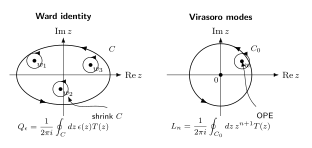
Stress-tensor contours and Virasoro modes.

The stress tensor generates conformal transformations by contour integrals. A contour enclosing several insertions can be deformed into small contours around each insertion, so the Ward identity is a residue theorem. Choosing ϵ(z)=zn+1\epsilon(z)=z^{n+1} gives the Virasoro mode LnL_n.

The Ward identity is equivalently encoded in the operator product expansion

T(z)ϕ(w,wˉ)hϕ(w,wˉ)(zw)2+ϕ(w,wˉ)zw.\boxed{ T(z)\phi(w,\bar w) \sim \frac{h\phi(w,\bar w)}{(z-w)^2} + \frac{\partial\phi(w,\bar w)}{z-w}. }

The symbol \sim means equality up to terms regular as zwz\to w. The antiholomorphic counterpart is

Tˉ(zˉ)ϕ(w,wˉ)hˉϕ(w,wˉ)(zˉwˉ)2+ˉϕ(w,wˉ)zˉwˉ.\boxed{ \bar T(\bar z)\phi(w,\bar w) \sim \frac{\bar h\phi(w,\bar w)}{(\bar z-\bar w)^2} + \frac{\bar\partial\phi(w,\bar w)}{\bar z-\bar w}. }

This OPE is often the most efficient definition of a primary field in two-dimensional CFT.

The double pole knows the conformal weight. The simple pole knows the derivative descendant. Said differently,

weight1(zw)2,translation1zw.\text{weight} \longleftrightarrow \frac{1}{(z-w)^2}, \qquad \text{translation} \longleftrightarrow \frac{1}{z-w}.

This simple local formula is the reason two-dimensional CFT computations are so contour-friendly. Once the singular part of an OPE is known, the corresponding charge action follows by residues.

Because T(z)T(z) is holomorphic away from insertions, it admits a Laurent expansion on a punctured plane:

T(z)=nZLnzn2.\boxed{ T(z)=\sum_{n\in\mathbb Z}L_n z^{-n-2}. }

The inverse formula is

Ln=12πi0dzzn+1T(z).\boxed{ L_n=\frac{1}{2\pi i}\oint_0 dz\,z^{n+1}T(z). }

Similarly,

Tˉ(zˉ)=nZLˉnzˉn2,\bar T(\bar z)=\sum_{n\in\mathbb Z}\bar L_n\bar z^{-n-2},

with

Lˉn=12πi0dzˉzˉn+1Tˉ(zˉ).\bar L_n=\frac{1}{2\pi i}\oint_0 d\bar z\,\bar z^{n+1}\bar T(\bar z).

The power zn2z^{-n-2} appears because TT has holomorphic weight 22. Equivalently, the vector-field mode ϵ(z)=zn+1\epsilon(z)=z^{n+1} pairs naturally with T(z)T(z) in the contour charge.

From the TϕT\phi OPE,

[Ln,ϕ(w,wˉ)]=12πiwdzzn+1T(z)ϕ(w,wˉ),[L_n,\phi(w,\bar w)] = \frac{1}{2\pi i}\oint_w dz\,z^{n+1}T(z)\phi(w,\bar w),

so

[Ln,ϕ(w,wˉ)]=(wn+1w+h(n+1)wn)ϕ(w,wˉ).\boxed{ [L_n,\phi(w,\bar w)] = \left(w^{n+1}\partial_w+h(n+1)w^n\right) \phi(w,\bar w). }

Likewise,

[Lˉn,ϕ(w,wˉ)]=(wˉn+1wˉ+hˉ(n+1)wˉn)ϕ(w,wˉ).\boxed{ [\bar L_n,\phi(w,\bar w)] = \left(\bar w^{n+1}\partial_{\bar w}+\bar h(n+1)\bar w^n\right) \phi(w,\bar w). }

For the first few holomorphic modes,

L1:w,L_{-1}:\quad \partial_w, L0:ww+h,L_0:\quad w\partial_w+h, L1:w2w+2hw.L_1:\quad w^2\partial_w+2hw.

Thus L1L_{-1} translates the insertion, L0L_0 measures holomorphic scaling weight, and L1L_1 generates the holomorphic special conformal transformation.

The T(z)T(w)T(z)T(w) OPE and the central charge

Section titled “The T(z)T(w)T(z)T(w)T(z)T(w) OPE and the central charge”

If TT were an ordinary primary field of weight (2,0)(2,0), its OPE with TT would be determined by the primary formula with h=2h=2:

T(z)T(w)2T(w)(zw)2+T(w)zw.T(z)T(w) \sim \frac{2T(w)}{(z-w)^2} + \frac{\partial T(w)}{z-w}.

Quantum mechanically there is one more allowed singular term proportional to the identity:

T(z)T(w)c/2(zw)4+2T(w)(zw)2+T(w)zw.\boxed{ T(z)T(w) \sim \frac{c/2}{(z-w)^4} + \frac{2T(w)}{(z-w)^2} + \frac{\partial T(w)}{z-w}. }

Similarly,

Tˉ(zˉ)Tˉ(wˉ)cˉ2(zˉwˉ)4+2Tˉ(wˉ)(zˉwˉ)2+ˉTˉ(wˉ)zˉwˉ.\boxed{ \bar T(\bar z)\bar T(\bar w) \sim \frac{\bar c}{2(\bar z-\bar w)^4} + \frac{2\bar T(\bar w)}{(\bar z-\bar w)^2} + \frac{\bar\partial \bar T(\bar w)}{\bar z-\bar w}. }

For a parity-invariant unitary CFT one usually has

c=cˉ.c=\bar c.

In a theory with a gravitational anomaly, one can have ccˉc\neq \bar c.

The coefficient cc is the central charge. It is not an operator-valued field. It is a number characterizing the CFT. Roughly speaking, it measures the strength of stress-tensor fluctuations and the response of the theory to Weyl transformations. In examples,

TheoryHolomorphic central charge
one free real bosonc=1c=1
one free Majorana fermionc=12c=\frac12
one free Dirac fermionc=1c=1
reparametrization ghosts of the bosonic stringc=26c=-26

The TTT T OPE is the local form of the Virasoro algebra. The term c/2(zw)4c/2(z-w)^{-4} is the local origin of the central extension.

Use

Ln=12πi0dzzn+1T(z).L_n=\frac{1}{2\pi i}\oint_0 dz\,z^{n+1}T(z).

The commutator [Ln,Lm][L_n,L_m] is computed by nesting contours and using the singular part of T(z)T(w)T(z)T(w). Schematically,

[Ln,Lm]=12πi0dwwm+1Resz=w[zn+1T(z)T(w)].[L_n,L_m] = \frac{1}{2\pi i}\oint_0 dw\,w^{m+1} \operatorname*{Res}_{z=w} \left[z^{n+1}T(z)T(w)\right].

Now use

T(z)T(w)c/2(zw)4+2T(w)(zw)2+T(w)zw.T(z)T(w) \sim \frac{c/2}{(z-w)^4} + \frac{2T(w)}{(z-w)^2} + \frac{\partial T(w)}{z-w}.

The 2T(w)/(zw)22T(w)/(z-w)^2 term gives

2(n+1)12πi0dwwn+m+1T(w).2(n+1)\frac{1}{2\pi i}\oint_0 dw\,w^{n+m+1}T(w).

The T(w)/(zw)\partial T(w)/(z-w) term gives

12πi0dwwn+m+2T(w)=(n+m+2)Ln+m,\frac{1}{2\pi i}\oint_0 dw\,w^{n+m+2}\partial T(w) = -(n+m+2)L_{n+m},

where we integrated by parts. Combining these two noncentral terms gives

[2(n+1)(n+m+2)]Ln+m=(nm)Ln+m.\left[2(n+1)-(n+m+2)\right]L_{n+m} =(n-m)L_{n+m}.

The central term comes from

c/2(zw)4.\frac{c/2}{(z-w)^4}.

The residue of zn+1/(zw)4z^{n+1}/(z-w)^4 at z=wz=w is

13!w3wn+1=(n+1)n(n1)6wn2.\frac{1}{3!}\partial_w^3 w^{n+1} = \frac{(n+1)n(n-1)}{6}w^{n-2}.

Therefore the central contribution is

c2n(n21)612πi0dwwn+m1=c12n(n21)δn+m,0.\frac{c}{2}\frac{n(n^2-1)}{6} \frac{1}{2\pi i}\oint_0 dw\,w^{n+m-1} = \frac{c}{12}n(n^2-1)\delta_{n+m,0}.

Thus

[Ln,Lm]=(nm)Ln+m+c12n(n21)δn+m,0.\boxed{ [L_n,L_m] = (n-m)L_{n+m} + \frac{c}{12}n(n^2-1)\delta_{n+m,0}. }

The barred sector gives

[Lˉn,Lˉm]=(nm)Lˉn+m+cˉ12n(n21)δn+m,0.\boxed{ [\bar L_n,\bar L_m] = (n-m)\bar L_{n+m} + \frac{\bar c}{12}n(n^2-1)\delta_{n+m,0}. }

The two sectors commute:

[Ln,Lˉm]=0.\boxed{ [L_n,\bar L_m]=0. }

The classical Witt algebra is recovered by setting c=0c=0 and replacing quantum commutators by classical vector-field commutators.

The modes

L1,L0,L1L_{-1},\quad L_0,\quad L_1

generate the global holomorphic conformal transformations. They close into sl(2)\mathfrak{sl}(2):

[L0,L1]=L1,[L_0,L_{-1}]=L_{-1}, [L0,L1]=L1,[L_0,L_1]=-L_1, [L1,L1]=2L0.[L_1,L_{-1}]=2L_0.

The central term vanishes for these modes because

n(n21)=0for n=1,0,1.n(n^2-1)=0 \qquad \text{for } n=-1,0,1.

Thus the central extension affects local conformal transformations but not the global SL(2)SL(2) subgroup.

On the plane, the conformal vacuum is invariant under global conformal transformations:

L10=L00=L10=0,L_{-1}|0\rangle=L_0|0\rangle=L_1|0\rangle=0,

and similarly

Lˉ10=Lˉ00=Lˉ10=0.\bar L_{-1}|0\rangle=\bar L_0|0\rangle=\bar L_1|0\rangle=0.

In fact, regularity of T(z)0T(z)|0\rangle at z=0z=0 gives the stronger condition

Ln0=0for n1,L_n|0\rangle=0 \qquad \text{for } n\ge -1,

with the analogous barred statement.

Let a primary operator ϕ(0,0)\phi(0,0) create a state by radial quantization:

h,hˉ=ϕ(0,0)0.|h,\bar h\rangle=\phi(0,0)|0\rangle.

The TϕT\phi OPE implies

L0h,hˉ=hh,hˉ,L_0|h,\bar h\rangle=h|h,\bar h\rangle, Lˉ0h,hˉ=hˉh,hˉ,\bar L_0|h,\bar h\rangle=\bar h|h,\bar h\rangle,

and

Lnh,hˉ=0,Lˉnh,hˉ=0,n>0.L_n|h,\bar h\rangle=0, \qquad \bar L_n|h,\bar h\rangle=0, \qquad n>0.

The negative modes create descendants:

Lnh,hˉ,Lˉnh,hˉ,n>0.L_{-n}|h,\bar h\rangle, \qquad \bar L_{-n}|h,\bar h\rangle, \qquad n>0.

For example,

L1h,hˉϕ(0,0),L_{-1}|h,\bar h\rangle \leftrightarrow \partial\phi(0,0),

and

Lˉ1h,hˉˉϕ(0,0).\bar L_{-1}|h,\bar h\rangle \leftrightarrow \bar\partial\phi(0,0).

This is the beginning of Virasoro representation theory. The next page develops highest-weight modules, Verma modules, null states, and the unitarity constraints that make two-dimensional CFT exactly solvable.

The Schwarzian derivative and why TT is not quite primary

Section titled “The Schwarzian derivative and why TTT is not quite primary”

A primary field of holomorphic weight 22 would transform under zwz\mapsto w as

ϕw(w)=(dzdw)2ϕz(z).\phi_w(w)=\left(\frac{dz}{dw}\right)^2\phi_z(z).

The stress tensor almost does this, but not quite. Its transformation law is

Tw(w)=(dzdw)2Tz(z)+c12{z,w}.\boxed{ T_w(w) = \left(\frac{dz}{dw}\right)^2T_z(z) + \frac{c}{12}\{z,w\}. }

Here

{z,w}=z(w)z(w)32(z(w)z(w))2\boxed{ \{z,w\} = \frac{z'''(w)}{z'(w)} - \frac{3}{2} \left(\frac{z''(w)}{z'(w)}\right)^2 }

is the Schwarzian derivative. The anomalous Schwarzian term is another expression of the central charge.

For Möbius transformations, the Schwarzian vanishes:

{az+bcz+d,z}=0.\left\{\frac{az+b}{cz+d},z\right\}=0.

Therefore TT transforms as a genuine weight-two field under global conformal transformations. It fails to be primary only under general local conformal transformations.

A famous example is the map from the plane to the cylinder:

z=ew,w=τ+iσ.z=e^w, \qquad w=\tau+i\sigma.

For this map,

{z,w}=12.\{z,w\}=-\frac12.

If the plane vacuum has

Tz(z)=0,\langle T_z(z)\rangle=0,

then on the cylinder

Tw(w)=c24.\langle T_w(w)\rangle=-\frac{c}{24}.

This is the Casimir energy of the two-dimensional CFT on the cylinder. It will reappear in modular invariance, the Cardy formula, and AdS3_3 black-hole physics.

The central charge cc has several equivalent interpretations.

First, it normalizes the stress-tensor two-point function. From the TTTT OPE,

T(z)T(0)=c/2z4\langle T(z)T(0)\rangle=\frac{c/2}{z^4}

on the plane, assuming T=0\langle T\rangle=0.

Second, it controls the Weyl anomaly. On a curved two-dimensional background,

Tμμ=c12R\langle T^\mu{}_\mu\rangle =-\frac{c}{12}R

up to conventions for the normalization of TμνT_{\mu\nu} and the curvature. Many references instead write this as Tμμ=c24πR\langle T^\mu{}_\mu\rangle=-\frac{c}{24\pi}R, depending on whether factors of 2π2\pi are absorbed into TT.

Third, it controls the universal cylinder Casimir energy:

E0=c12E_0=-\frac{c}{12}

for a unit-radius spatial circle when both holomorphic and antiholomorphic sectors contribute equally. In holomorphic language this is the shift

L0L0c24.L_0\mapsto L_0-\frac{c}{24}.

Fourth, in AdS3_3/CFT2_2, the Brown-Henneaux central charge is

c=3AdS2GN,c=\frac{3\ell_{\mathrm{AdS}}}{2G_N},

so a large central charge corresponds to weakly coupled semiclassical gravity.

The central charge is therefore not a decorative constant. It is one of the main bridges between symmetry, anomaly, density of states, and holographic gravity.

One common mistake is to say that TT is a primary field. It is better to say: TT is a quasi-primary field of weight (2,0)(2,0), but unless c=0c=0, it is not primary under arbitrary local conformal maps because of the Schwarzian derivative.

Another mistake is to forget that the Ward identity is a statement about singularities. The formula

ˉT(z)=0\bar\partial T(z)=0

is true away from insertions. In correlators, the singularities at insertion points become contact terms.

A third mistake is to treat the central charge as a property of only one field. The central charge is a property of the full CFT. It adds over decoupled sectors:

ctotal=c1+c2c_{\mathrm{total}}=c_1+c_2

for a tensor product of independent CFTs.

A fourth mistake is to ignore barred modes. Many chiral computations use only T(z)T(z) and LnL_n, but a full local two-dimensional CFT usually has both holomorphic and antiholomorphic sectors.

The holomorphic stress tensor generates local conformal transformations:

Qϵ=12πidzϵ(z)T(z).Q_\epsilon=\frac{1}{2\pi i}\oint dz\,\epsilon(z)T(z).

Its OPE with a primary field is

T(z)ϕ(w,wˉ)hϕ(w,wˉ)(zw)2+ϕ(w,wˉ)zw.T(z)\phi(w,\bar w) \sim \frac{h\phi(w,\bar w)}{(z-w)^2} + \frac{\partial\phi(w,\bar w)}{z-w}.

Its self-OPE is

T(z)T(w)c/2(zw)4+2T(w)(zw)2+T(w)zw.T(z)T(w) \sim \frac{c/2}{(z-w)^4} + \frac{2T(w)}{(z-w)^2} + \frac{\partial T(w)}{z-w}.

The Virasoro modes are

Ln=12πidzzn+1T(z),L_n=\frac{1}{2\pi i}\oint dz\,z^{n+1}T(z),

with algebra

[Ln,Lm]=(nm)Ln+m+c12n(n21)δn+m,0.[L_n,L_m] = (n-m)L_{n+m} + \frac{c}{12}n(n^2-1)\delta_{n+m,0}.

The global subalgebra L1,L0,L1L_{-1},L_0,L_1 has no central term. The central charge appears only in genuinely local conformal transformations and controls stress-tensor fluctuations, Weyl anomaly, cylinder Casimir energy, Cardy growth, and the semiclassical scale of AdS3_3 gravity.

Exercise 1: Ward identity from the TϕT\phi OPE

Section titled “Exercise 1: Ward identity from the TϕT\phiTϕ OPE”

Let ϕ(w,wˉ)\phi(w,\bar w) be a primary field of holomorphic weight hh. Starting from

T(z)ϕ(w,wˉ)hϕ(w,wˉ)(zw)2+ϕ(w,wˉ)zw,T(z)\phi(w,\bar w) \sim \frac{h\phi(w,\bar w)}{(z-w)^2} + \frac{\partial\phi(w,\bar w)}{z-w},

show that

12πiwdzϵ(z)T(z)ϕ(w,wˉ)=[ϵ(w)+hϵ(w)]ϕ(w,wˉ).\frac{1}{2\pi i}\oint_w dz\,\epsilon(z)T(z)\phi(w,\bar w) = \left[\epsilon(w)\partial+h\partial\epsilon(w)\right]\phi(w,\bar w).
Solution

Insert the OPE into the contour integral:

12πiwdzϵ(z)T(z)ϕ(w,wˉ)=12πiwdzϵ(z)[hϕ(w,wˉ)(zw)2+ϕ(w,wˉ)zw].\frac{1}{2\pi i}\oint_w dz\,\epsilon(z)T(z)\phi(w,\bar w) = \frac{1}{2\pi i}\oint_w dz\,\epsilon(z) \left[ \frac{h\phi(w,\bar w)}{(z-w)^2} + \frac{\partial\phi(w,\bar w)}{z-w} \right].

The simple pole gives

12πiwdzϵ(z)zwϕ(w,wˉ)=ϵ(w)ϕ(w,wˉ).\frac{1}{2\pi i}\oint_w dz\,\frac{\epsilon(z)}{z-w}\partial\phi(w,\bar w) = \epsilon(w)\partial\phi(w,\bar w).

For the double pole, use Cauchy’s derivative formula:

12πiwdzϵ(z)(zw)2=ϵ(w).\frac{1}{2\pi i}\oint_w dz\,\frac{\epsilon(z)}{(z-w)^2} =\partial\epsilon(w).

Thus

12πiwdzϵ(z)T(z)ϕ(w,wˉ)=[ϵ(w)+hϵ(w)]ϕ(w,wˉ).\frac{1}{2\pi i}\oint_w dz\,\epsilon(z)T(z)\phi(w,\bar w) = \left[\epsilon(w)\partial+h\partial\epsilon(w)\right]\phi(w,\bar w).

Exercise 2: Action of LnL_n on a primary field

Section titled “Exercise 2: Action of LnL_nLn​ on a primary field”

Use

Ln=12πidzzn+1T(z)L_n=\frac{1}{2\pi i}\oint dz\,z^{n+1}T(z)

and the TϕT\phi OPE to prove

[Ln,ϕ(w,wˉ)]=(wn+1+h(n+1)wn)ϕ(w,wˉ).[L_n,\phi(w,\bar w)] = \left(w^{n+1}\partial+h(n+1)w^n\right)\phi(w,\bar w).

Then compute the action of L1L_{-1}, L0L_0, and L1L_1.

Solution

Set

ϵ(z)=zn+1.\epsilon(z)=z^{n+1}.

Using the result of Exercise 1,

[Ln,ϕ(w,wˉ)]=[ϵ(w)+hϵ(w)]ϕ(w,wˉ).[L_n,\phi(w,\bar w)] = \left[\epsilon(w)\partial+h\partial\epsilon(w)\right]\phi(w,\bar w).

Since

ϵ(w)=wn+1,ϵ(w)=(n+1)wn,\epsilon(w)=w^{n+1}, \qquad \partial\epsilon(w)=(n+1)w^n,

we obtain

[Ln,ϕ(w,wˉ)]=(wn+1+h(n+1)wn)ϕ(w,wˉ).[L_n,\phi(w,\bar w)] = \left(w^{n+1}\partial+h(n+1)w^n\right)\phi(w,\bar w).

For n=1n=-1,

[L1,ϕ]=ϕ.[L_{-1},\phi]=\partial\phi.

For n=0n=0,

[L0,ϕ]=(w+h)ϕ.[L_0,\phi]=(w\partial+h)\phi.

For n=1n=1,

[L1,ϕ]=(w2+2hw)ϕ.[L_1,\phi]=(w^2\partial+2hw)\phi.

These are the holomorphic translation, dilatation, and special conformal actions.

Exercise 3: The central term in the Virasoro algebra

Section titled “Exercise 3: The central term in the Virasoro algebra”

Starting from

T(z)T(w)c/2(zw)4+2T(w)(zw)2+T(w)zw,T(z)T(w) \sim \frac{c/2}{(z-w)^4} + \frac{2T(w)}{(z-w)^2} + \frac{\partial T(w)}{z-w},

show that the central contribution to [Ln,Lm][L_n,L_m] is

c12n(n21)δn+m,0.\frac{c}{12}n(n^2-1)\delta_{n+m,0}.
Solution

The central contribution is obtained from

12πi0dwwm+1Resz=w[zn+1c/2(zw)4].\frac{1}{2\pi i}\oint_0 dw\,w^{m+1} \operatorname*{Res}_{z=w} \left[z^{n+1}\frac{c/2}{(z-w)^4}\right].

The residue formula gives

Resz=wzn+1(zw)4=13!w3wn+1.\operatorname*{Res}_{z=w}\frac{z^{n+1}}{(z-w)^4} = \frac{1}{3!}\partial_w^3 w^{n+1}.

Now

w3wn+1=(n+1)n(n1)wn2=n(n21)wn2.\partial_w^3 w^{n+1} =(n+1)n(n-1)w^{n-2} =n(n^2-1)w^{n-2}.

Therefore the central contribution is

c2n(n21)612πi0dwwm+1wn2.\frac{c}{2}\frac{n(n^2-1)}{6} \frac{1}{2\pi i}\oint_0 dw\,w^{m+1}w^{n-2}.

The integral is

12πi0dwwn+m1=δn+m,0.\frac{1}{2\pi i}\oint_0 dw\,w^{n+m-1}=\delta_{n+m,0}.

Thus the central term is

c12n(n21)δn+m,0.\frac{c}{12}n(n^2-1)\delta_{n+m,0}.

Exercise 4: The noncentral part of the Virasoro algebra

Section titled “Exercise 4: The noncentral part of the Virasoro algebra”

Use the same TTTT OPE to show that the noncentral part of [Ln,Lm][L_n,L_m] is

(nm)Ln+m.(n-m)L_{n+m}.
Solution

The noncentral singular terms are

2T(w)(zw)2+T(w)zw.\frac{2T(w)}{(z-w)^2} + \frac{\partial T(w)}{z-w}.

The double pole gives

212πi0dwwm+1Resz=wzn+1T(w)(zw)2.2\frac{1}{2\pi i}\oint_0 dw\,w^{m+1} \operatorname*{Res}_{z=w}\frac{z^{n+1}T(w)}{(z-w)^2}.

Since

Resz=wzn+1(zw)2=(n+1)wn,\operatorname*{Res}_{z=w}\frac{z^{n+1}}{(z-w)^2}=(n+1)w^n,

this contribution is

2(n+1)12πi0dwwn+m+1T(w)=2(n+1)Ln+m.2(n+1)\frac{1}{2\pi i}\oint_0 dw\,w^{n+m+1}T(w) =2(n+1)L_{n+m}.

The simple pole gives

12πi0dwwn+m+2T(w).\frac{1}{2\pi i}\oint_0 dw\,w^{n+m+2}\partial T(w).

Integrating by parts on the contour,

dwwn+m+2T(w)=(n+m+2)dwwn+m+1T(w).\oint dw\,w^{n+m+2}\partial T(w) =-(n+m+2)\oint dw\,w^{n+m+1}T(w).

Thus the simple-pole contribution is

(n+m+2)Ln+m.-(n+m+2)L_{n+m}.

Combining both pieces,

2(n+1)Ln+m(n+m+2)Ln+m=(nm)Ln+m.2(n+1)L_{n+m}-(n+m+2)L_{n+m} =(n-m)L_{n+m}.

Exercise 5: The global subalgebra has no central term

Section titled “Exercise 5: The global subalgebra has no central term”

Show that the central term in

[Ln,Lm]=(nm)Ln+m+c12n(n21)δn+m,0[L_n,L_m] = (n-m)L_{n+m} + \frac{c}{12}n(n^2-1)\delta_{n+m,0}

vanishes for n,m{1,0,1}n,m\in\{-1,0,1\}. Then verify

[L0,L1]=L1,[L0,L1]=L1,[L1,L1]=2L0.[L_0,L_{-1}]=L_{-1}, \qquad [L_0,L_1]=-L_1, \qquad [L_1,L_{-1}]=2L_0.
Solution

For

n=1,0,1,n=-1,0,1,

we have

n(n21)=0.n(n^2-1)=0.

Hence the central term vanishes within the span of L1,L0,L1L_{-1},L_0,L_1.

Now use the noncentral part:

[Ln,Lm]=(nm)Ln+m.[L_n,L_m]=(n-m)L_{n+m}.

For [L0,L1][L_0,L_{-1}],

[L0,L1]=(0(1))L1=L1.[L_0,L_{-1}]=(0-(-1))L_{-1}=L_{-1}.

For [L0,L1][L_0,L_1],

[L0,L1]=(01)L1=L1.[L_0,L_1]=(0-1)L_1=-L_1.

For [L1,L1][L_1,L_{-1}],

[L1,L1]=(1(1))L0=2L0.[L_1,L_{-1}]=(1-(-1))L_0=2L_0.

This is the holomorphic sl(2)\mathfrak{sl}(2) global conformal algebra.

Exercise 6: The Schwarzian on the cylinder

Section titled “Exercise 6: The Schwarzian on the cylinder”

Let

z=ew.z=e^w.

Compute

{z,w}=z(w)z(w)32(z(w)z(w))2.\{z,w\} = \frac{z'''(w)}{z'(w)} - \frac{3}{2}\left(\frac{z''(w)}{z'(w)}\right)^2.

Then show that if Tz(z)=0\langle T_z(z)\rangle=0 on the plane, the cylinder expectation value is

Tw(w)=c24.\langle T_w(w)\rangle=-\frac{c}{24}.
Solution

For

z=ew,z=e^w,

we have

z=ew=z,z=ew=z,z=ew=z.z'=e^w=z, \qquad z''=e^w=z, \qquad z'''=e^w=z.

Therefore

zz=1,zz=1.\frac{z'''}{z'}=1, \qquad \frac{z''}{z'}=1.

The Schwarzian is

{z,w}=132=12.\{z,w\} =1-\frac32 =-\frac12.

The stress-tensor transformation law is

Tw(w)=(dzdw)2Tz(z)+c12{z,w}.T_w(w) = \left(\frac{dz}{dw}\right)^2T_z(z) + \frac{c}{12}\{z,w\}.

If

Tz(z)=0,\langle T_z(z)\rangle=0,

then

Tw(w)=c12(12)=c24.\langle T_w(w)\rangle =\frac{c}{12}\left(-\frac12\right) =-\frac{c}{24}.

For the classic development, see Di Francesco, Mathieu, and Sénéchal, Chapter 5 on Ward identities, central charge, and the stress tensor, and Chapter 6 on radial quantization and the Virasoro algebra. For holography, this page prepares the Brown-Henneaux central charge, the Cardy formula, Virasoro blocks, and worldsheet conformal constraints.