
Holographic c-Theorems
The main idea
Section titled “The main idea”Renormalization group flow is irreversible in a very precise sense. A UV theory may contain many degrees of freedom that become massive, confined, screened, or reorganized at long distances, but an ordinary unitary local QFT should not create new independent short-distance degrees of freedom as one flows to the IR. In two dimensions this intuition is made exact by Zamolodchikov’s -theorem. In four dimensions it is captured by the -theorem. In three dimensions it is closely related to the -theorem. Holography gives a particularly geometric version of the same idea.
For a Poincaré-invariant holographic RG flow, use the domain-wall metric
with the UV boundary at large . The warp factor sets the local energy scale,
The holographic -function is essentially the inverse power of the local curvature scale,
where is a normalization proportional to . At an AdS fixed point, , so
This is exactly the scaling of CFT central data such as , sphere free energies, Weyl-anomaly coefficients, or entropy coefficients, depending on dimension and normalization.
The theorem is powered by one inequality. If the bulk matter obeys the null energy condition, then Einstein’s equations imply
Therefore
assuming . Since increasing means moving toward the UV, this says
The geometry has encoded RG irreversibility as gravitational focusing.
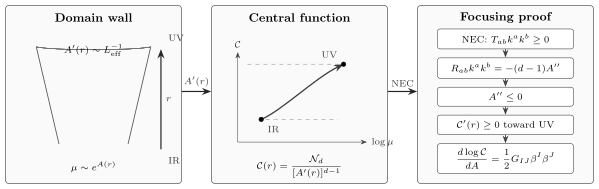
For an Einstein-gravity domain wall, and . The null energy condition implies , so grows toward the UV and decreases along the physical RG flow to the IR.
The proof is short, but the interpretation is subtle. A holographic -theorem is not a magic proof that every coefficient in every QFT decreases. It is a theorem about a specific class of large-, strongly coupled QFTs whose RG flows are described by classical bulk geometries satisfying appropriate energy conditions. Within that class, it is one of the cleanest examples of how field-theory irreversibility becomes a geometric statement.
What should a holographic c-function measure?
Section titled “What should a holographic c-function measure?”At a conformal fixed point, the phrase “number of degrees of freedom” has several precise meanings. In different dimensions one commonly uses:
| Boundary dimension | Common monotonic quantity | Holographic fixed-point scaling |
|---|---|---|
| Virasoro central charge | ||
| sphere free energy | ||
| Euler anomaly coefficient | ||
| general | entropy/anomaly/free-energy coefficient |
In classical Einstein gravity, many of these measures collapse to the same geometric scaling because the bulk theory has very few independent couplings. For example, in a four-dimensional holographic CFT dual to two-derivative Einstein gravity in AdS,
This equality is not true in a general four-dimensional CFT. It is a special large-, strong-coupling feature of a simple Einstein gravity dual. Higher-derivative terms in the bulk can separate from , and then the monotonic quantity is more naturally the A-type anomaly coefficient, not necessarily or the coefficient called in four dimensions.
This is why the word -function is used somewhat generically in holography. The symbol below means “the geometric quantity that becomes the appropriate central measure at conformal endpoints,” not necessarily Zamolodchikov’s two-dimensional in every dimension.
A useful normalization for Einstein gravity is
For this gives
and at an AdS fixed point it becomes
For , this normalization differs by a simple numerical factor from the Brown-Henneaux central charge . The monotonicity proof is insensitive to this convention: multiplying by a positive constant does not change the theorem.
The domain-wall setup
Section titled “The domain-wall setup”Consider a bulk theory governed by Einstein gravity coupled to matter,
For most explicit RG flows, the matter sector contains scalar fields,
A Poincaré-invariant flow takes the form
The UV asymptotic AdS region is
If the IR is also conformal, the geometry approaches another AdS region,
possibly after shifting and rescaling the boundary coordinates. The dual interpretation is an RG flow
If the IR is not AdS, the geometry may cap off smoothly, end at a good singularity, or develop a horizon. Then the flow may describe a mass gap, confinement, finite temperature, or a state rather than a vacuum RG flow. The -function can still be useful, but its endpoint is no longer a central charge of an IR CFT.
Deriving from Einstein’s equations
Section titled “Deriving A′′≤0A''\leq0A′′≤0 from Einstein’s equations”The cleanest proof uses the null energy condition. For the domain-wall metric,
the relevant Ricci components are
and
Choose a radial null vector in the plane,
It is null because
Contracting the Ricci tensor with this null vector gives
Einstein’s equations imply, after contraction with a null vector,
because all terms proportional to vanish when contracted with . The null energy condition is
Therefore
or
For scalar-field matter with a positive target-space metric , the same result follows directly from the reduced Einstein equations:
This last form is especially transparent. The scalar fields roll in the radial direction. Their kinetic energy makes the warp factor concave. Concavity is the bulk image of RG irreversibility.
The c-function and its monotonicity
Section titled “The c-function and its monotonicity”Assume along the flow. This is the usual case for a domain wall whose warp factor increases toward the UV. Define
Then
Using gives
Since the UV lies at larger , increases toward the UV. Equivalently, as the field theory flows to lower energies, decreases. If both endpoints are AdS fixed points, then
so
Thus an Einstein-gravity holographic RG flow between two AdS vacua must flow from the larger-radius AdS region to the smaller-radius AdS region. Because central data scale like , the IR CFT has fewer effective degrees of freedom.
Be careful with the direction of the radial coordinate. The derivative is positive because points toward the UV. The physical RG flow from UV to IR moves toward decreasing , so the same statement is often written as
There is no contradiction: the sign only reflects which direction you call positive.
Relation to holographic beta functions
Section titled “Relation to holographic beta functions”The radial scalar profile defines a geometric beta function. Since , set
For Einstein-scalar flows,
Therefore
Because , this says increases with the energy scale . If we parametrize the RG flow toward the IR by decreasing , then decreases.
This equation is the closest holographic analogue of the positive-definite gradient structure familiar from field-theory -theorems. The metric on scalar field space plays the role of a positive metric on the space of couplings. The right-hand side vanishes exactly at fixed points, where and the geometry is AdS.
One should not overread this formula. A bulk scalar coordinate is not always identical to a canonically normalized field-theory coupling. Operator mixing, multi-trace effects, scheme dependence, and nonlinear source redefinitions can all change the detailed relation. The invariant content is the existence of a monotone geometric quantity whose fixed-point values match central data.
Superpotential flows
Section titled “Superpotential flows”Many supersymmetric and fake-supersymmetric domain walls can be written in first-order form. Suppose the scalar potential can be expressed in terms of a function as
Then a domain-wall solution may satisfy
up to sign conventions for the radial coordinate and the definition of . In such flows, monotonicity follows immediately:
Supersymmetry is not required for the -theorem. It is simply a powerful way to produce controlled examples. The theorem itself only needs the domain-wall assumptions, Einstein equations, and an energy condition.
Fixed points, anomalies, and what is actually monotone
Section titled “Fixed points, anomalies, and what is actually monotone”At a conformal fixed point, holographic data are determined by the AdS radius and bulk couplings. For Einstein gravity,
and the same scaling controls thermal entropy at high temperature,
as well as entanglement entropy coefficients and anomaly coefficients. This degeneracy is why the two-derivative holographic -function can look more universal than the corresponding field-theory statements.
In four-dimensional CFTs, however, there are two independent Weyl anomaly coefficients:
The proven field-theory irreversibility theorem concerns , not :
for nontrivial unitary RG flows between four-dimensional CFTs. In pure Einstein holography, , so this distinction is hidden. In higher-derivative holographic models, and can differ, and the monotone quantity is associated with the A-type anomaly or related universal entanglement coefficient, not generically with every central charge-like parameter.
This is a valuable lesson. The gravitational proof is not merely a trick; it tells us which combination of CFT data is naturally tied to causal focusing, entropy, and RG irreversibility.
Geometric meaning: focusing and loss of area
Section titled “Geometric meaning: focusing and loss of area”The inequality can be read as a focusing statement. Consider radial null congruences in the domain-wall geometry. Their expansion measures how the transverse area changes as the congruence moves through the bulk. The null energy condition forces focusing: null rays cannot defocus in a way that would make transverse area grow too rapidly toward the IR.
Since the area density of a constant- slice is proportional to
the combination controls how quickly this area changes with radial scale. The -function
is therefore a measure of an effective local AdS radius. A larger local radius means more holographic degrees of freedom per scale. A smaller local radius means fewer.
This geometric picture is very useful, but it is not a substitute for the equations. The precise monotonicity is a consequence of Einstein’s equations and an energy condition, not just of an appealing drawing of a narrowing throat.
Example: flow between two AdS critical points
Section titled “Example: flow between two AdS critical points”Suppose the scalar potential has two critical points,
with
The UV and IR CFT central measures scale as
The holographic -theorem requires
In the potential, this means
because a smaller AdS radius corresponds to a more negative cosmological constant. This is why many supergravity RG flows go from a shallower AdS critical point in the UV to a deeper AdS critical point in the IR.
The inequality is not just a property of the potential. A potential may have several critical points, but a regular domain wall connecting them may or may not exist. The -theorem constrains allowed flows; it does not guarantee that every pair of critical points can be connected by a physical solution.
Example: flow to a mass gap
Section titled “Example: flow to a mass gap”Many interesting holographic flows do not end at an IR AdS region. A confining geometry may cap off smoothly, or the solution may end at a good singularity. In such cases there is no IR CFT and no finite to compare with a central charge.
Still, the local -function can be meaningful. If
near the endpoint, then
This is consistent with the idea that a gapped theory has no propagating conformal degrees of freedom at arbitrarily low energies. But this interpretation requires care. A singular endpoint must satisfy an acceptability criterion, and the geometry may be probing physics outside the reliable classical supergravity regime.
A practical rule is:
The -function is a diagnostic, not a full nonperturbative definition of the IR theory.
Quantum and higher-derivative corrections
Section titled “Quantum and higher-derivative corrections”The simple proof above assumes classical two-derivative Einstein gravity. Holographically, this corresponds to large and large gap in the dual CFT. Corrections come in two broad types.
First, higher-derivative terms in the bulk action encode finite-coupling or finite-gap effects. The entropy functional is no longer simply area, and the correct monotone quantity is not always . In carefully chosen higher-curvature theories, one can construct generalized holographic -functions, often tied to the A-type anomaly or universal entanglement entropy.
Second, bulk quantum effects encode corrections. Classical energy conditions may fail pointwise in quantum field theory. Then the appropriate irreversibility statements are expected to involve quantum-corrected entropy conditions or averaged inequalities rather than the naive classical NEC.
This does not invalidate the classical theorem. It tells us what its domain of validity is:
Inside that regime, the proof is robust. Outside it, the statement must be refined.
Common mistakes
Section titled “Common mistakes”Mistake 1: Calling every central charge a c-function. In , the monotone quantity is , not generically . Einstein holography hides this distinction because at leading order.
Mistake 2: Forgetting the orientation of . The derivative means grows toward the UV. Along the physical RG flow to lower energies, it decreases.
Mistake 3: Treating as a coordinate-invariant statement by itself. The simple formula uses domain-wall gauge . The invariant content is the existence of a monotone quantity under the assumptions of Poincaré invariance, radial scale choice, and energy conditions.
Mistake 4: Ignoring the assumption . The expression is meaningful when is a good scale coordinate. If vanishes or changes sign, the RG interpretation needs reanalysis.
Mistake 5: Applying the theorem to arbitrary singular geometries. A monotone does not by itself prove that a singular endpoint is a healthy QFT IR phase.
Mistake 6: Confusing a state with an RG flow. A finite-temperature black brane has a radial profile and a horizon, but it represents a thermal state of a fixed theory, not necessarily a deformation-induced vacuum RG flow. The same geometric tools appear, but the interpretation differs.
The dictionary
Section titled “The dictionary”| Bulk statement | Boundary interpretation |
|---|---|
| AdS critical point of | CFT fixed point |
| Scalar source near UV boundary | Coupling for a relevant operator |
| Domain-wall radial coordinate | Logarithmic RG scale, roughly |
| Warp factor | Local energy scale, |
| from NEC | Irreversibility of RG flow |
| Running count of degrees of freedom | |
| Higher-derivative corrections | Distinguish different central charges |
| Quantum bulk corrections | corrections to classical monotonicity |
Exercises
Section titled “Exercises”Exercise 1: The Ricci contraction
Section titled “Exercise 1: The Ricci contraction”For the metric
use
and the null vector
to show that
Solution
The vector is null because
The contraction is
Since
we obtain
The terms cancel, leaving
Exercise 2: NEC implies concavity
Section titled “Exercise 2: NEC implies concavity”Using Einstein’s equations, show that the null energy condition implies
Solution
Einstein’s equations may include a cosmological constant and matter terms, but after contraction with a null vector all terms proportional to vanish. Thus
The null energy condition says
From Exercise 1,
Therefore
Since , this gives
Exercise 3: Monotonicity of the c-function
Section titled “Exercise 3: Monotonicity of the c-function”Let
and assume . Show that implies .
Solution
Differentiate:
Thus
If , then . Since and , the right-hand side is nonnegative:
This means grows toward the UV if the UV is at larger .
Exercise 4: Fixed-point radii
Section titled “Exercise 4: Fixed-point radii”Assume a regular flow connects two AdS fixed points with
Use to show that
Solution
The coordinate increases toward the UV. Since , the function is nonincreasing as increases. Therefore
Substituting the AdS values gives
For positive AdS radii, this is equivalent to
Since central data scale as , this gives
Exercise 5: Beta functions and positivity
Section titled “Exercise 5: Beta functions and positivity”For an Einstein-scalar domain wall, suppose
and define
Show that
Solution
Start from
Then
Since , we have
Using the Einstein-scalar equation gives
Finally,
so
If is positive definite, the right-hand side is nonnegative.
Exercise 6: Why rather than in four dimensions?
Section titled “Exercise 6: Why aaa rather than ccc in four dimensions?”In a four-dimensional CFT, the trace anomaly contains two independent coefficients and :
Explain why the two-derivative holographic -theorem does not prove that the coefficient decreases in every four-dimensional QFT.
Solution
In two-derivative Einstein gravity duals, the leading large- central charges satisfy
Therefore a monotonic geometric quantity proportional to matches both and at fixed points. This degeneracy is special to the simplest holographic theories.
A general four-dimensional CFT has independent and . The field-theory irreversibility theorem concerns , not . When higher-derivative terms are included in the bulk, and can differ, and the monotone holographic quantity is associated with the A-type anomaly coefficient or related universal entanglement coefficient, not generically with .
Thus the Einstein-gravity proof demonstrates monotonicity for the central measure captured by the simple bulk theory. It does not imply that every central-charge-like coefficient decreases in all QFTs.
Further reading
Section titled “Further reading”- D. Z. Freedman, S. S. Gubser, K. Pilch, and N. P. Warner, Renormalization Group Flows from Holography—Supersymmetry and a c-Theorem.
- J. de Boer, E. Verlinde, and H. Verlinde, On the Holographic Renormalization Group.
- M. Bianchi, D. Z. Freedman, and K. Skenderis, Holographic Renormalization.
- R. C. Myers and A. Sinha, Seeing a c-theorem with holography.
- R. C. Myers and A. Sinha, Holographic c-theorems in arbitrary dimensions.
- H. Casini, M. Huerta, and R. C. Myers, Towards a Derivation of Holographic Entanglement Entropy.
- Z. Komargodski and A. Schwimmer, On Renormalization Group Flows in Four Dimensions.
- D. L. Jafferis, I. R. Klebanov, S. S. Pufu, and B. R. Safdi, Towards the F-Theorem: N=2 Field Theories on the Three-Sphere.