
Quantum Error Correction and Bulk Locality
The main idea
Section titled “The main idea”The previous pages introduced the entanglement wedge as the bulk region naturally associated with a boundary subregion. The next question is sharper:
If a bulk operator lies in the entanglement wedge of a boundary region , how can the same bulk operator also be reconstructible on another boundary region ?
At first sight this sounds impossible. In ordinary quantum field theory, an operator localized in one spatial region is not usually the same operator as something localized in a different region. But holography is not an ordinary local rewriting of bulk fields in boundary variables. The modern answer is that semiclassical bulk physics is encoded in the CFT like a quantum error-correcting code.
The schematic structure is
where is the Hilbert space of a semiclassical bulk effective theory in a chosen background, and is the embedding into the exact boundary Hilbert space. A bulk operator is a logical operator. A boundary operator supported on a region is one possible physical representative if
Equivalently,
There may be another operator supported on a different boundary region such that
Then and need not be equal as operators on the full CFT Hilbert space. They only need to act identically on the code subspace:
This is the basic mechanism behind redundant bulk reconstruction. It is also the cleanest way to understand why bulk locality can emerge from a lower-dimensional, non-gravitational theory without violating boundary causality.
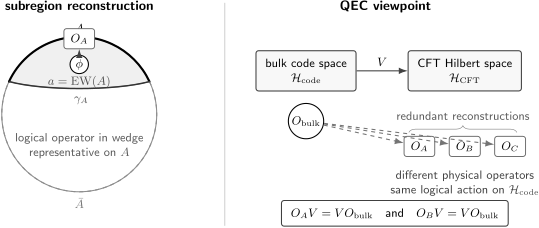
A bulk operator in the entanglement wedge can be represented by an operator supported on . In the code-subspace viewpoint, is a logical operator and are different physical representatives with the same action on .
The slogan is useful but easy to misuse. AdS/CFT is not claiming that the entire CFT Hilbert space is literally a small stabilizer code, and the HaPPY tensor network is not the real CFT. The robust statement is more structural: the map from semiclassical bulk effective theory to exact boundary degrees of freedom has the algebraic properties of quantum error correction.
Why a code subspace is necessary
Section titled “Why a code subspace is necessary”The exact CFT Hilbert space is the nonperturbative quantum-gravity Hilbert space, at least for asymptotically AdS boundary conditions. Semiclassical bulk effective field theory is much smaller. It describes a family of states that look like perturbations of a chosen semiclassical background.
For example, around the CFT vacuum dual to pure AdS, one might consider states created by a finite number of low-dimension single-trace operators:
with dimensions and energies much smaller than the scale at which black-hole formation or stringy physics becomes unavoidable. These states span a code subspace. Around a large AdS black hole, one can similarly define a code subspace of perturbative excitations outside and near the horizon, but the reconstruction map and accessible bulk regions become state-dependent in a controlled sense.
A useful hierarchy is
More precisely, the code subspace must be small enough that a single semiclassical geometry, or a controlled family of nearby geometries, remains meaningful. If the subspace is too large, it contains states with macroscopically different geometries, different RT surfaces, and possibly different entanglement-wedge assignments. Then a single bulk local operator is no longer a state-independent operator with a simple geometric interpretation.
This is not a weakness. It is exactly what one expects in gravity. A local bulk operator must be gravitationally dressed, and the dressing depends on the background and boundary conditions. Bulk locality is therefore not an exact microscopic property of the full Hilbert space. It is an emergent property inside a semiclassical code subspace.
The bulk effective-theory approximation has at least three expansion parameters:
where may denote the mass scale of string modes, Kaluza-Klein modes not included in the effective description, or black-hole/stringy thresholds. The code-subspace language packages these limitations cleanly: it tells us where bulk operators exist, where they can be reconstructed, and what it means for two boundary representatives to be equivalent.
A minimal quantum-error-correction dictionary
Section titled “A minimal quantum-error-correction dictionary”In ordinary quantum error correction, one encodes a logical Hilbert space into a larger physical Hilbert space by an isometry
The image
is the code subspace of the physical Hilbert space.
A logical operator can be represented physically by an operator if
Equivalently, with the code projector
one has
The physical operator is not unique. If annihilates the code subspace,
then is another physical representative of the same logical operator. This non-uniqueness is not a nuisance; it is the point. It is what allows information to be recoverable after erasure of part of the physical system.
Now split the physical system into two parts,
Region can reconstruct a logical operator if there exists an operator acting only on such that
This means that the logical operation can be performed without touching . In error-correction language, erasure of is correctable for this logical algebra.
A useful operational test is this:
If all logical information relevant to an algebra can be recovered from , then no operator acting only on can distinguish or disturb that logical information.
For a full matrix algebra of logical operators, this is closely related to the condition that the reduced density matrix on carries no information about the logical state. For operator-algebra quantum error correction, the statement is refined because only a subalgebra of logical operators may be reconstructible, and the algebra may have a nontrivial center.
The holographic dictionary of error correction
Section titled “The holographic dictionary of error correction”The AdS/CFT version replaces the abstract logical and physical systems by bulk and boundary degrees of freedom:
| Quantum-error-correction language | Holographic language |
|---|---|
| physical Hilbert space | exact CFT Hilbert space |
| logical Hilbert space | semiclassical bulk code subspace |
| encoding map | AdS/CFT map restricted to the code subspace |
| logical operator | bulk effective-field-theory operator |
| physical representative | boundary operator with the same action on the code subspace |
| erasure of | losing access to boundary complement |
| recovery from | reconstructing bulk operators from boundary region |
| correctable region | bulk region protected from boundary erasure |
| logical algebra | bulk operator algebra in an entanglement wedge |
The central holographic statement is:
The bulk operator algebra in the entanglement wedge of is reconstructible on the boundary region .
If denotes the entanglement wedge, then for every sufficiently low-energy bulk operator localized in , there should be a boundary operator such that
inside the appropriate code subspace.
This is called entanglement-wedge reconstruction. It improves on the older causal-wedge expectation. HKLL reconstruction gives an explicit perturbative construction for certain bulk fields in regions causally connected to the boundary domain of dependence. Entanglement-wedge reconstruction says that the recoverable region is generally larger: it extends to the RT/HRT surface, not merely to the causal information surface.
The difference matters. In many geometries,
where is the causal wedge. Operators in
cannot be reconstructed by simple causal propagation from the boundary domain of dependence, but they are nevertheless encoded in the density matrix .
Redundant reconstruction and the no-cloning worry
Section titled “Redundant reconstruction and the no-cloning worry”Suppose a bulk point lies in both and . Then a local bulk operator has representatives and satisfying
This means
It does not mean that the CFT contains two independent copies of the same bulk degree of freedom. It means that the same logical operator has multiple physical representatives.
This resolves the apparent no-cloning problem. In a quantum error-correcting code, information can be recoverable from many overlapping regions without being duplicated as independent degrees of freedom. The different reconstructions agree on the code subspace but may act differently on states outside it.
For a boundary operator algebra, equality on the code subspace is the relevant notion:
The quotient by operators that annihilate the code subspace is what makes the logical algebra well defined.
This is also why the statement “the bulk operator is supported on ” must be interpreted carefully. It means that there exists a representative supported on . It does not mean that every representative is supported on , and it does not mean that the bulk operator is literally a microscopic operator occupying only those boundary lattice sites.
Entanglement-wedge nesting as monotonicity of recovery
Section titled “Entanglement-wedge nesting as monotonicity of recovery”Entanglement-wedge nesting says that if
then
In reconstruction language, this is natural. If a logical operator can be reconstructed on , then it can also be reconstructed on the larger region by using the same representative and acting trivially on :
The geometric nesting theorem is therefore the bulk counterpart of a basic monotonicity property of information access. More boundary degrees of freedom should not reduce the set of logical operators one can reconstruct.
This perspective is especially helpful for understanding radial locality. Operators near the boundary are reconstructible only on relatively specific boundary regions. Operators deeper in the bulk may be reconstructible on many different large boundary regions. The radial direction is therefore tied to the degree of redundancy in the boundary encoding.
Very roughly:
| Bulk location | Boundary reconstruction behavior |
|---|---|
| near boundary | less redundant, tied to smaller/local boundary regions |
| deeper in bulk | more redundant, reconstructible from many large regions |
| near an RT surface | reconstruction changes as the surface crosses the operator |
| behind a horizon | reconstruction depends strongly on state, time, and code subspace |
The word “roughly” is doing real work here. The precise statement is not a pointwise radial formula; it is an entanglement-wedge statement for boundary subregions.
The role of JLMS
Section titled “The role of JLMS”The JLMS relation gives a precise bridge between boundary modular physics and bulk modular physics. In its schematic form,
where and is the area operator associated with the quantum extremal surface.
Taking differences between nearby states gives the quantum-corrected RT/HRT formula. Taking relative entropies gives, schematically,
with the cleanest equality obtained in fixed-area sectors or in formulations where the area contribution is treated as a center of the algebra.
This relation is powerful because quantum error correction can be characterized by equality of relative entropies. Roughly, if the relative entropy between any two code states computed on equals the relative entropy of the corresponding bulk states on , then contains exactly the distinguishability information of the bulk algebra in . That is precisely what is needed for reconstruction.
More concretely, the logic is:
- boundary region has density matrix ;
- the entanglement wedge has bulk density matrix ;
- JLMS identifies the relevant modular and relative-entropy data;
- equality of relative entropies implies the existence of a recovery map;
- the recovery map gives boundary representatives of bulk operators in .
This chain of reasoning is why entanglement-wedge reconstruction is not merely a geometric guess. It is tied to precise quantum-information criteria.
Operator-algebra quantum error correction
Section titled “Operator-algebra quantum error correction”The simplest quantum codes encode a full matrix algebra of logical operators. Holography requires a more refined structure: operator-algebra quantum error correction.
The reason is that gravitational subregions have boundaries. A bulk entanglement wedge has a quantum extremal surface . The area of behaves like a central variable associated with the division of the bulk into subregions. In gauge theories and gravity, subregion algebras often have centers because constraints prevent a naive tensor factorization of the Hilbert space.
A finite-dimensional toy version looks like this. The logical Hilbert space decomposes as
where labels a superselection sector. The algebra reconstructible in acts as
Its center is generated by projectors onto the sectors:
In holography, the label is related to geometric data such as the area of the RT or quantum extremal surface. The entropy formula then has the structure
where
is an area operator in the center. This is the algebraic form of the quantum-corrected RT formula.
This is one of the deepest lessons of the modern story. The area term is not just a mysterious geometric add-on. In the code interpretation, it behaves like part of the entropy of the encoding itself.
Tensor networks as toy models
Section titled “Tensor networks as toy models”Tensor-network models made the QEC structure visually and algebraically explicit. The best-known example is the HaPPY code, built from perfect tensors placed on a hyperbolic tiling.
A perfect tensor has the property that any split of its legs into two sets of size at most half defines an isometry from one side to the other. When perfect tensors are assembled into a hyperbolic network, the network maps bulk legs to boundary legs:
Minimal cuts through the network compute entanglement entropies in a way reminiscent of RT:
Bulk operators can be pushed through perfect tensors to different boundary regions. This gives explicit redundant reconstruction.
Tensor networks are extremely useful for intuition:
- they show how RT-like area terms can arise from entanglement in an encoding map;
- they make entanglement-wedge reconstruction concrete;
- they demonstrate how the same logical operator can have many boundary representatives;
- they model the radial direction as increasing redundancy.
But they are not the full story. Simple HaPPY-like networks do not reproduce all features of a continuum CFT, Lorentzian causality, bulk dynamics, graviton interactions, black-hole interiors, or the full modular structure of AdS/CFT. They are toy models of the encoding, not derivations of string theory.
A good rule is:
Use tensor networks to understand the architecture of holographic encoding. Do not use them as a substitute for the CFT, the gravitational equations, or the string-theory construction.
Bulk locality from a boundary code
Section titled “Bulk locality from a boundary code”Bulk locality means that low-energy bulk operators at spacelike separation approximately commute:
inside a semiclassical code subspace.
This statement is subtle in gravity. A strictly local field is not gauge invariant because diffeomorphisms move the point . To make a gravitationally meaningful operator, one must dress it relationally or attach gravitational dressing to the boundary. Different dressings can give different boundary representations, and commutators can receive corrections.
The QEC viewpoint helps organize these facts:
- Locality is approximate. Bulk commutators vanish at leading order in the semiclassical expansion, but gravitational dressing and interactions produce corrections.
- Locality is code-subspace dependent. The same boundary operator may represent a simple bulk field in one background and not in another.
- Locality is redundant. A bulk local operator can have many boundary representations, depending on the entanglement wedge used for reconstruction.
- Locality is algebraic. What matters is the algebra of operators reconstructible in a wedge, not merely a set of points in a spacetime diagram.
This gives a clean answer to a common puzzle. Boundary operators supported on disjoint boundary regions commute at equal boundary time in an ordinary local CFT. How, then, can they represent bulk operators whose geometric relation is different? The answer is that a bulk operator is represented by equivalence classes of boundary operators on the code subspace. The commutator that matters for bulk effective theory is computed after projecting to the code subspace:
where is the code projector. Boundary locality and bulk locality are compatible because they are locality properties of different algebras, related through a highly nonlocal encoding.
HKLL reconstruction versus entanglement-wedge reconstruction
Section titled “HKLL reconstruction versus entanglement-wedge reconstruction”It is useful to distinguish two ideas that are often blended together.
HKLL reconstruction begins with a bulk free field in a fixed AdS background and expresses it as a smeared boundary operator:
Interactions can be included perturbatively in , and the construction is closely tied to solving bulk equations of motion. HKLL is explicit and calculational, but its simplest form reconstructs operators in causal domains accessible from boundary data.
Entanglement-wedge reconstruction is more general and more algebraic. It says that if a bulk operator lies in , then it has a boundary representative supported on . This statement can hold even when there is no simple causal smearing formula from .
The two viewpoints are complementary:
| Method | Strength | Limitation |
|---|---|---|
| HKLL | explicit perturbative operator formulas | tied to background, gauge choices, and causal reconstruction |
| Entanglement-wedge reconstruction | general subregion criterion | often nonconstructive; existence theorem more than formula |
| Tensor-network reconstruction | visual and exact in toy models | not a full continuum CFT or dynamical gravity |
| Modular reconstruction | deep relation to JLMS/modular flow | technically difficult in interacting CFTs |
For practical calculations, one often uses HKLL-like bulk equations. For conceptual questions about which boundary region contains which bulk information, the entanglement-wedge/QEC criterion is the more powerful organizing principle.
State dependence and its safe meaning
Section titled “State dependence and its safe meaning”The phrase “state dependence” has caused confusion in the black-hole information literature. There is a safe and unavoidable version:
The code subspace and the bulk-to-boundary reconstruction map are chosen around a semiclassical background or family of nearby backgrounds.
This kind of state dependence is ordinary effective-field-theory dependence. The notion of a local bulk point, the choice of gravitational dressing, and the location of an entanglement wedge all depend on the background geometry. A local field in pure AdS and a local field behind a large black-hole horizon are not represented by the same simple boundary construction.
There is also a more controversial use of state-dependent operators for black-hole interiors. That issue is beyond this page. The conservative lesson needed here is that bulk locality is not a globally defined, background-independent operator algebra on the full CFT Hilbert space. It is an emergent algebra in a chosen code subspace.
For many applications, this is enough. Perturbative bulk physics, Witten diagrams, hydrodynamic modes, RT surfaces, and entanglement-wedge reconstruction all operate inside controlled code subspaces.
A precise subregion statement
Section titled “A precise subregion statement”Let be a boundary region and its entanglement wedge in a chosen semiclassical code subspace. Let be the bulk operator algebra in . Entanglement-wedge reconstruction says:
For every , there exists supported in such that
and
for all code states .
The condition involving the adjoint is important. It ensures that correlation functions and algebraic relations are reproduced inside the code subspace, not merely one-sided actions on states.
For complementary reconstruction, if , then operators in should be reconstructible on . The two wedge algebras commute up to the subtleties associated with centers, edge modes, and gravitational constraints.
In a fixed-area sector, the factorization is closest to the ordinary tensor-product intuition:
When area fluctuates, the more accurate structure is the direct sum over sectors described earlier.
What the area term knows about errors
Section titled “What the area term knows about errors”A striking feature of holographic entanglement is that the leading entropy of a region is geometric:
In the QEC interpretation, this area term measures part of the encoding overhead. It is analogous to the entropy associated with the cut through the physical degrees of freedom in a tensor network. More precisely, in an operator-algebra code, the entropy of a boundary region has the structure
where is a central operator. In holography,
Thus the RT area term is not simply the entropy of ordinary bulk matter. It is the entropy cost of how the bulk region is encoded into the boundary degrees of freedom. The bulk matter entropy is the next term, and the two together form the generalized entropy.
This explains why the area term is sensitive to the boundary region even when the same bulk local excitation is present. Changing changes the reconstruction problem and the quantum extremal surface. The logical operator may be the same, but the encoding cut is different.
Common mistakes
Section titled “Common mistakes”Mistake 1: “The bulk Hilbert space equals the boundary Hilbert space region by region”
Section titled “Mistake 1: “The bulk Hilbert space equals the boundary Hilbert space region by region””The exact duality is between the full CFT and the full quantum-gravity theory with given asymptotic boundary conditions. Subregion duality is not a naive equality
Instead, it is an algebraic reconstruction statement inside a code subspace.
Mistake 2: “Two reconstructions mean two copies”
Section titled “Mistake 2: “Two reconstructions mean two copies””If and both represent the same bulk operator, this does not clone information. It means
where projects onto the code subspace. Outside that subspace, and can differ.
Mistake 3: “The HaPPY code is AdS/CFT”
Section titled “Mistake 3: “The HaPPY code is AdS/CFT””HaPPY is a toy model. It captures RT-like entropy and redundant reconstruction beautifully, but it lacks most of the dynamical content of real holography.
Mistake 4: “Entanglement-wedge reconstruction is an explicit smearing formula”
Section titled “Mistake 4: “Entanglement-wedge reconstruction is an explicit smearing formula””Sometimes it can be made explicit, but the general theorem is an existence statement. Finding a simple boundary expression for a given bulk operator may still be hard.
Mistake 5: “The code subspace can be arbitrarily large”
Section titled “Mistake 5: “The code subspace can be arbitrarily large””If the subspace contains too many states with different geometries, a single wedge, area operator, or local bulk algebra may not be well defined.
Mistake 6: “Bulk local operators are exactly local”
Section titled “Mistake 6: “Bulk local operators are exactly local””Gravity has constraints. Gauge-invariant bulk operators require dressing, and commutators receive corrections. Bulk locality is approximate and effective.
Exercises
Section titled “Exercises”Exercise 1: Equality only on the code subspace
Section titled “Exercise 1: Equality only on the code subspace”Let be an isometric encoding map, and suppose and are two physical operators satisfying
Show that and have identical matrix elements between code states, but need not be equal as operators on .
Solution
A code state has the form
For two code states and ,
and similarly
Therefore
Equivalently, their matrix elements agree inside the code subspace.
This does not imply on the full physical Hilbert space. They may act differently on states orthogonal to .
Exercise 2: No cloning from redundant reconstruction
Section titled “Exercise 2: No cloning from redundant reconstruction”Suppose a bulk operator has representatives and on two boundary regions. Explain why this does not mean that the bulk degree of freedom has been cloned.
Solution
Cloning would mean that there are two independent physical systems, one in and one in , each containing an independent copy of the same quantum information.
Redundant reconstruction means something different:
Thus
The two boundary operators are different representatives of the same logical operator. They agree only after projection to the code subspace. They are not independent copies of the logical degree of freedom.
This is exactly how quantum error-correcting codes work: one can recover logical information from different sufficiently large subsets of physical degrees of freedom without duplicating that information into independent copies.
Exercise 3: Reconstruction from a larger region
Section titled “Exercise 3: Reconstruction from a larger region”Assume a logical operator can be reconstructed on , so that there is an operator satisfying
If , show that can also be reconstructed on .
Solution
Since , the Hilbert space of contains the degrees of freedom of together with the extra degrees of freedom .
Define
As an operator on the full boundary Hilbert space, acts the same way as on and trivially on the rest of . Therefore
So any operator reconstructible on is also reconstructible on any larger region .
This is the quantum-information counterpart of entanglement-wedge nesting.
Exercise 4: Code-subspace projection of a commutator
Section titled “Exercise 4: Code-subspace projection of a commutator”Let be the projector onto the code subspace. Suppose and represent logical operators and :
Show that
provided the adjoint reconstruction conditions also hold.
Solution
The adjoint reconstruction condition means that the representatives preserve the logical action not only on ket states but also in matrix elements. Equivalently,
Then
using . Similarly,
Subtracting gives
Thus the logical algebra is reproduced after projection to the code subspace.
Exercise 5: Fixed-area sectors and the area operator
Section titled “Exercise 5: Fixed-area sectors and the area operator”Explain why fixed-area sectors make the entropy formula look closer to an ordinary tensor factorization.
Solution
When the area of the RT or quantum extremal surface fluctuates, the wedge algebra has a center. A schematic decomposition is
where labels area sectors or related geometric data.
In a fixed-area sector, is fixed. The direct sum collapses to a single term:
The area operator is then effectively a constant inside that sector. The entropy formula becomes closer to
with the first term fixed and the state-dependence coming mainly from the bulk density matrix .
Exercise 6: Why gravitational dressing matters
Section titled “Exercise 6: Why gravitational dressing matters”Why is it misleading to say that a bulk field is an exactly local gauge-invariant operator in quantum gravity?
Solution
In a theory with dynamical gravity, diffeomorphisms are gauge redundancies. The coordinate label has no invariant meaning by itself: a diffeomorphism can move the coordinate point while describing the same physical geometry.
To define a gauge-invariant bulk operator, one must specify the point relationally or attach a gravitational dressing to an asymptotic boundary or another reference structure. This dressing is nonlocal. As a result, exact locality is not expected for gravitational observables.
In AdS/CFT, the boundary representation of a bulk operator depends on this dressing and on the code subspace. Bulk locality is therefore an approximate property of low-energy effective theory, valid inside a semiclassical regime and corrected by gravitational interactions.
Further reading
Section titled “Further reading”- A. Almheiri, X. Dong, and D. Harlow, Bulk Locality and Quantum Error Correction in AdS/CFT.
- X. Dong, D. Harlow, and A. C. Wall, Reconstruction of Bulk Operators within the Entanglement Wedge in Gauge-Gravity Duality.
- F. Pastawski, B. Yoshida, D. Harlow, and J. Preskill, Holographic Quantum Error-Correcting Codes: Toy Models for the Bulk/Boundary Correspondence.
- D. L. Jafferis, A. Lewkowycz, J. Maldacena, and S. J. Suh, Relative Entropy Equals Bulk Relative Entropy.
- D. Harlow, The Ryu—Takayanagi Formula from Quantum Error Correction.
- D. Harlow, TASI Lectures on the Emergence of Bulk Physics in AdS/CFT.
- A. Hamilton, D. Kabat, G. Lifschytz, and D. A. Lowe, Local Bulk Operators in AdS/CFT: A Boundary View of Horizons and Locality.
- D. Kabat, G. Lifschytz, and D. A. Lowe, Constructing Local Bulk Observables in Interacting AdS/CFT.