
Exactly Marginal Deformations and Conformal Manifolds
The previous pages introduced global symmetries, superconformal algebras, and BPS shortening. This page explains how a CFT can move continuously while remaining a CFT.
The central object is a conformal manifold: a family of CFTs connected by exactly marginal deformations. For AdS/CFT this is not a decorative topic. It is the boundary description of bulk moduli, massless scalar fields, S-duality identifications, and protected versus unprotected data as functions of coupling.
The practical slogan is:
but the word “exactly” carries all the weight. A scalar operator of dimension is only marginal at first order. It is exactly marginal only if turning on its coupling does not generate a beta function.
Marginal, relevant, irrelevant, exactly marginal
Section titled “Marginal, relevant, irrelevant, exactly marginal”Let be a Euclidean CFT in dimensions. Deform its action by scalar local operators:
Here is a reference RG scale inserted so that is dimensionless. At the undeformed CFT, the operator has scaling dimension . The first-order classification is:
| Type of deformation | Condition at the CFT | First-order RG behavior |
|---|---|---|
| Relevant | grows in the IR | |
| Irrelevant | dies in the IR | |
| Marginal | undecided at first order | |
| Exactly marginal | and along a finite-dimensional locus | stays conformal |
The dangerous case is the marginal one. A marginal operator can be marginally relevant, marginally irrelevant, or exactly marginal. The distinction is invisible from the engineering dimension alone.
Near a fixed point, the beta functions have the schematic form
where
is the area of the unit -sphere, and appears in the OPE
The precise sign and normalization of the quadratic term depend on conventions for the Euclidean action, operator normalization, and coupling normalization. The important invariant statement is that OPE singularities of marginal operators can produce logarithmic divergences in integrated correlation functions, and those logarithms become beta functions.
For marginal operators, . If and have an OPE term proportional to another marginal operator , the integral
is logarithmically divergent. That logarithm is the first obstruction to exact marginality.
Definition of a conformal manifold
Section titled “Definition of a conformal manifold”A conformal manifold is a space whose points are CFTs, modulo equivalences such as field redefinitions and dualities. Locally, one may use coordinates , so that each nearby CFT has correlation functions
The defining condition is
for all couplings tangent to . The tangent space at a point is represented by integrated insertions of exactly marginal scalar primaries:
The phrase “not redundant” is important. Some deformations correspond to changes of variables or to total derivatives. A deformation by a redundant operator can move us through different descriptions of the same CFT rather than to a genuinely new CFT.
The CFT data vary over the conformal manifold:
Protected data may remain constant; unprotected data usually vary. In SYM, for example, dimensions of half-BPS operators are protected, while dimensions of long single-trace operators generally depend on the ‘t Hooft coupling.
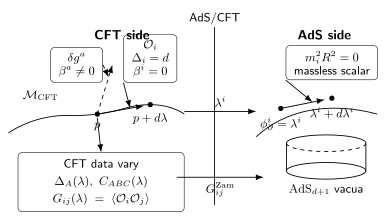
A conformal manifold is a locus of vanishing beta functions. Tangent directions are exactly marginal scalar operators with ; normal directions generally have nonzero beta functions. In AdS/CFT, these tangent directions correspond to massless bulk scalars whose boundary values are CFT couplings.
Conformal perturbation theory
Section titled “Conformal perturbation theory”The most direct way to understand conformal manifolds is to perturb correlation functions. Let
Then, formally,
where is a product of separated local operators. The integral is usually UV divergent near the insertion points of and near coincident insertions in higher derivatives. Renormalization removes these divergences, but the finite answer can depend on contact-term conventions.
At second order,
contains the dangerous region . If the OPE has a marginal term
then the integral contains
The inner integral is logarithmic. Absorbing it into a redefinition of produces a beta function. Thus, a clean first test for exact marginality is:
This condition is not the full story. Higher orders can still obstruct exact marginality. Supersymmetry often makes the higher-order problem tractable.
The Zamolodchikov metric
Section titled “The Zamolodchikov metric”The conformal manifold has a natural metric, defined by two-point functions of exactly marginal operators. For scalar marginal operators in dimensions,
The coefficient is the Zamolodchikov metric. In a unitary Euclidean CFT it is positive definite on non-redundant exactly marginal directions:
for any nonzero tangent vector .
The metric is physical, but its local expression depends on the choice of coordinates . Under a change of exactly marginal coordinates,
it transforms as an ordinary tensor:
There can also be global identifications. A conformal manifold is often not simply a smooth patch of or ; it may be a quotient by a duality group and may have singular loci where extra operators become conserved or extra degrees of freedom become light.
What is held fixed along a conformal manifold?
Section titled “What is held fixed along a conformal manifold?”Moving along preserves conformal symmetry, but it does not preserve every piece of CFT data.
The following structures are typically stable under a smooth exactly marginal deformation:
| Quantity | Behavior along |
|---|---|
| Spacetime dimension | fixed |
| Conformal algebra | fixed |
| Stress tensor multiplet | persists |
| Exactly marginal operators | span tangent directions, may mix |
| Global symmetry | may be preserved, reduced, enhanced, or realized differently at special loci |
| Operator dimensions | generally vary unless protected |
| OPE coefficients | generally vary |
| Central charges/anomaly coefficients | often constrained; in many supersymmetric cases protected |
This is a subtle point for AdS/CFT. Moving along a conformal manifold is not the same as flowing under RG. It is not that the CFT changes scale by scale. Rather, the entire theory is changed while remaining scale invariant at every point.
A useful distinction is:
Examples
Section titled “Examples”The compact boson in two dimensions
Section titled “The compact boson in two dimensions”The simplest exactly marginal family is the compact free boson CFT. Let
Changing the radius changes the spectrum of momentum and winding operators, but the theory remains conformal. The exactly marginal operator is schematically
with conformal weights
Thus is marginal in . In fact it is exactly marginal, and the conformal manifold is the radius line with the T-duality identification
up to conventions for .
This example is pedagogically useful because it shows that moving on a conformal manifold can change the spectrum without breaking conformal invariance.
Four-dimensional SYM
Section titled “Four-dimensional N=4\mathcal N=4N=4 SYM”The canonical AdS/CFT example has an exactly marginal complex coupling
The local conformal manifold is the upper half-plane parameterized by . Globally, one must quotient by S-duality:
In the AdS dual, is identified with the boundary value of the type IIB axio-dilaton. The exactly marginal deformation is in the same supermultiplet as protected operators. The theory remains conformal for all values of , but the anomalous dimensions of unprotected operators vary with .
Four-dimensional SCFTs
Section titled “Four-dimensional N=1\mathcal N=1N=1 SCFTs”In theories, exactly marginal deformations can arise from gauge couplings and superpotential terms. A superpotential deformation
is classically marginal if the chiral operator has R-charge , equivalently dimension in a superconformal theory:
Not every such coupling is exactly marginal. Global symmetries impose moment-map-like constraints, and couplings related by complexified global symmetry transformations can describe equivalent theories. A useful schematic statement is
This quotient structure is one reason conformal manifolds in supersymmetric theories are geometrically rich.
Non-examples
Section titled “Non-examples”A coupling can be classically marginal and still fail to define a conformal manifold. For example, suppose near ,
Then is a fixed point, but runs unless and the higher terms cooperate. The direction is marginally relevant or marginally irrelevant depending on the sign of and on the RG direction.
This is why “dimension ” is a necessary condition for exact marginality, not a sufficient one.
Supersymmetry and protection
Section titled “Supersymmetry and protection”Supersymmetry is the main mechanism that makes conformal manifolds controllable in interacting CFTs. The logic is simple but powerful:
- BPS shortening protects certain operator dimensions.
- Marginal supersymmetric deformations are often descendants of protected primaries.
- Holomorphy and R-symmetry constrain beta functions.
- Multiplet recombination tells us when a candidate marginal operator becomes marginally irrelevant.
For example, in a superconformal theory, an exactly marginal deformation must preserve the superconformal algebra under discussion. This usually means the deformation is not an arbitrary scalar primary of dimension , but a supersymmetric descendant whose integrated insertion is compatible with the preserved supercharges.
A useful diagnostic is recombination. A candidate marginal operator may fail to be exactly marginal because it pairs with a conserved current multiplet when a global symmetry is broken. The corresponding current is no longer conserved, and the would-be marginal deformation becomes part of a long multiplet. In this case the apparent marginal direction is lifted.
This explains why global symmetries are not merely decorative: they can remove naive marginal directions from the true conformal manifold.
Conformal manifold versus moduli space of vacua
Section titled “Conformal manifold versus moduli space of vacua”These two ideas are often confused, especially in supersymmetric theories.
A conformal manifold is a space of theories:
A moduli space of vacua is a space of states within one theory:
for some scalar operator. In a CFT, a nonzero vacuum expectation value of an operator with positive dimension usually introduces a scale and therefore spontaneously breaks conformal invariance.
Thus:
Both can appear in the same supersymmetric model, but they are conceptually different.
AdS/CFT checkpoint
Section titled “AdS/CFT checkpoint”For a scalar operator in a -dimensional CFT, the standard AdS/CFT mass-dimension relation is
If is exactly marginal, then
so
Therefore:
The source for is the boundary value of the bulk scalar:
Moving along the conformal manifold means changing the asymptotic value of a massless scalar while preserving the existence of an AdS vacuum. This is different from exciting a normalizable mode of the scalar, which would correspond to changing the state rather than the theory.
The Zamolodchikov metric is also visible in the bulk. If the low-energy bulk action contains
then the boundary two-point function of the marginal operators determines the metric on the scalar moduli space, up to the usual AdS/CFT normalization factors. Schematically,
This is why conformal manifolds are not just CFT bookkeeping. They are the boundary avatar of bulk moduli spaces of AdS vacua.
Dualities and global structure
Section titled “Dualities and global structure”A conformal manifold is rarely just the naive coupling space. Two values of the apparent coupling may define the same CFT:
Thus the true conformal manifold is often a quotient:
Examples include T-duality for compact bosons and S-duality for SYM. At fixed points of the duality group, the CFT may have enhanced discrete or continuous symmetry. At singular loci, new light degrees of freedom or enhanced conserved currents can appear.
From the CFT side, these phenomena show up as special behavior of CFT data:
From the AdS side, they show up as special loci in the moduli space of AdS vacua.
Common mistakes
Section titled “Common mistakes”The first common mistake is to say “, therefore exactly marginal.” The correct statement is:
Exact marginality requires vanishing beta functions to all orders.
The second common mistake is to identify a coupling with a vev. In AdS/CFT, the distinction is source versus response:
For , the source is the leading mode, up to possible logarithmic subtleties. Changing the source changes the CFT; changing the normalizable mode changes the state.
The third common mistake is to ignore quotienting. The same local Lagrangian parameters can describe physically identical CFTs because of duality or because of global symmetry transformations acting on couplings.
Minimal dictionary
Section titled “Minimal dictionary”| CFT concept | AdS concept |
|---|---|
| Exactly marginal operator with | Massless scalar field |
| Coupling | Boundary value |
| Conformal manifold | Moduli space of AdS vacua |
| Zamolodchikov metric | Bulk scalar kinetic metric |
| Duality quotient | Large gauge/string duality identification |
| Protected operator data | Short multiplet / KK protected data |
| Varying anomalous dimensions | Interaction-dependent bulk masses/energies |
Exercises
Section titled “Exercises”Exercise 1 — Integrated insertions
Section titled “Exercise 1 — Integrated insertions”Let
Show formally that
where is a product of local operators. Explain why the second term usually vanishes in a CFT on flat space when has nonzero dimension and no source.
Solution
Write
Differentiating gives two terms: one from the numerator and one from :
This is the desired formula. In a flat-space CFT without sources, one-point functions of non-identity scalar primaries vanish by translation and scale invariance, so unless is the identity or there are contact/anomaly subtleties.
Exercise 2 — The logarithm behind the beta function
Section titled “Exercise 2 — The logarithm behind the beta function”Suppose and are marginal scalar operators in dimensions and their OPE contains
where is also marginal. Show that the second-order perturbation produces a logarithmic UV divergence proportional to .
Solution
The relevant second-order term is
In the region , use the OPE:
Then the divergent part is
Using spherical coordinates,
The logarithmic dependence on the UV cutoff is the signal of coupling renormalization and hence of a beta function for .
Exercise 3 — Exactly marginal means massless in AdS
Section titled “Exercise 3 — Exactly marginal means massless in AdS”Use
to show that an exactly marginal operator is dual to a massless scalar in . Why do we use rather than ?
Solution
For an exactly marginal operator, . Therefore
The quadratic equation also has the root when . That root corresponds to the identity-like or alternate behavior, not to a nontrivial local marginal scalar operator in the standard quantization. A deformation of the CFT action by a local scalar operator requires an operator of dimension so that
is dimensionless with dimensionless .
Exercise 4 — Compact boson radius deformation
Section titled “Exercise 4 — Compact boson radius deformation”For a free compact boson in two dimensions, take . Show that
has conformal weights . Explain why this is the correct dimension for a marginal deformation in .
Solution
In the free boson CFT, is holomorphic with weights , while is antiholomorphic with weights . Therefore their product has
The scaling dimension is
Since the spacetime dimension of the CFT is , the integrated deformation
has dimensionless coupling. This is the first-order criterion for marginality. In the compact boson, the deformation is exactly marginal and changes the radius .
Takeaway
Section titled “Takeaway”A conformal manifold is the space of continuous CFTs obtained by exactly marginal deformations. Its tangent vectors are scalar primaries of dimension whose integrated insertions do not generate beta functions. Its metric is read from two-point functions of these marginal operators. In holography, the same structure is seen as a moduli space of AdS vacua parameterized by boundary values of massless bulk scalars.