
Gauge Fields, Currents, and the Graviton
The main idea
Section titled “The main idea”The scalar dictionary taught us that a bulk field near the AdS boundary encodes a scalar source and a scalar expectation value. Conserved currents and the stress tensor are more rigid. They are not just generic operators with spin. They are the operators that implement symmetries.
The holographic dictionary is:
Here is a bulk gauge field associated with a CFT global symmetry generator labeled by , and is the bulk metric. The boundary value of is a background gauge field sourcing the CFT current . The boundary value of the bulk metric is the background metric sourcing the CFT stress tensor .
The deep slogan is:
This is not merely an analogy. Bulk gauge constraints become CFT Ward identities. Bulk radial canonical momenta become CFT one-point functions. Bulk diffeomorphism constraints become conservation and trace equations for the boundary stress tensor.
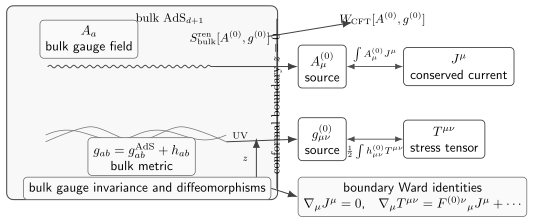
The boundary value of a bulk gauge field sources the conserved current , while the boundary metric sources the stress tensor . Radial electric flux and extrinsic curvature are the bulk canonical momenta that determine the corresponding one-point functions after holographic renormalization.
This page develops the dictionary in a source-first way. The most important lesson is that conserved operators are protected because they are tied to redundancies: a conserved spin-one current has dimension , and the stress tensor has dimension .
Sources for currents and the stress tensor
Section titled “Sources for currents and the stress tensor”Let the CFT live on a background metric and let be a nondynamical background gauge field for a global symmetry group . The connected generating functional is
Our convention for one-point functions is
Thus
Some authors define the stress tensor by varying with respect to rather than . Then a minus sign appears:
This is only a convention. What matters is consistency between the source term, the variation of the renormalized action, and the definition of correlation functions.
For infinitesimal sources around flat space,
one may write schematically
up to Euclidean versus Lorentzian sign conventions. The factor of in the metric coupling is not decorative; it comes from the symmetric variation of the metric.
Why the dimensions are fixed
Section titled “Why the dimensions are fixed”A conserved current obeys
in flat space without sources. In a unitary CFT, a conserved spin-one primary saturates the spin-one unitarity bound, and its scaling dimension is
This also follows from source dimensions. The source deformation is
The background gauge field has engineering dimension one, so must have dimension .
Similarly, the metric source is dimensionless. Since
must be dimensionless and has dimension zero, the stress tensor has
These dimensions are protected. A generic vector operator need not have ; it maps to a massive bulk vector field. A generic symmetric spin-two operator need not have ; it maps to a massive spin-two field. The conserved current and stress tensor are special because they sit in shortened conformal multiplets.
For a massive vector field in AdS, the relation between mass and dimension is
A massless gauge field has , giving the standard current branch together with a second branch associated with boundary gauge-field behavior. In standard AdS/CFT quantization for , the conserved-current interpretation uses .
Bulk gauge fields and boundary currents
Section titled “Bulk gauge fields and boundary currents”Consider, for clarity, a bulk Maxwell field in an asymptotically AdS background:
For a non-Abelian symmetry, one replaces
with the appropriate group indices and trace normalization. The coupling is a bulk gauge coupling. Its value determines the normalization of the current two-point function.
Near the boundary, use Fefferman-Graham/Poincaré coordinates
In radial gauge,
the boundary expansion for takes the schematic form
The leading coefficient is the source. The coefficient is response data. In flat boundary metric and without logarithmic subtleties, the current one-point function is proportional to this response coefficient:
The precise local terms depend on the dimension, the background metric, and the counterterm scheme. The nonlocal part of the response is physical and determines separated-point correlators.
The on-shell variation makes the origin of the formula transparent. Varying the Maxwell action gives a boundary term
where is the induced metric on the cutoff surface and is its outward unit normal. The canonical momentum conjugate to is therefore radial electric flux:
After adding counterterms and taking ,
Depending on whether one writes in Euclidean signature or in Lorentzian signature, the overall sign in this displayed formula may be adjusted. The flux interpretation is invariant.
Current conservation from the radial Maxwell constraint
Section titled “Current conservation from the radial Maxwell constraint”The Maxwell equation is
The component is not an evolution equation for a propagating degree of freedom. It is a constraint:
Near the boundary, this becomes
in flat space with no charged sources. This is the simplest example of a general rule:
The same logic applies in a curved background and for non-Abelian symmetries. Gauge invariance of the generating functional under
gives
After integrating by parts, arbitrary implies
when there are no charged sources and no anomaly.
With charged scalar sources, the Ward identity is modified. Schematically,
where is the symmetry generator acting on the source multiplet and is a possible ‘t Hooft anomaly. Holographically, such anomalies are encoded by bulk Chern-Simons terms. For example, in an AdS bulk, a term of the form
has a boundary gauge variation that reproduces a four-dimensional current anomaly.
This point is subtle but essential. The CFT symmetry may have an ‘t Hooft anomaly. That does not mean the bulk gauge theory is inconsistent. It means that gauge transformations which approach nonzero transformations at the boundary act on the CFT sources with the anomalous variation. Gauge transformations that vanish at the boundary remain true redundancies.
Boundary global symmetry versus bulk gauge redundancy
Section titled “Boundary global symmetry versus bulk gauge redundancy”A boundary global symmetry transformation is a bulk gauge transformation whose parameter approaches a nonzero function at the conformal boundary:
If , the transformation is pure redundancy. If is nonzero, it changes the boundary source by
For constant in flat space with , this is the ordinary global symmetry acting on CFT operators and states. The associated CFT charge is measured in the bulk by electric flux through a surface ending on the boundary.
This is the AdS/CFT version of Gauss’s law. Bulk charged objects cannot be hidden from the boundary: their total charge is visible as boundary flux. This is one reason why exact global symmetries are not expected in quantum gravity. What appears as a global symmetry in the boundary theory is represented in the gravitational bulk by a gauge field.
The metric and the stress tensor
Section titled “The metric and the stress tensor”The stress tensor is sourced by the background metric. On the bulk side, the corresponding field is the full dynamical metric . The gravitational action is
Here is the induced metric on a cutoff surface, is the trace of its extrinsic curvature, and contains local boundary counterterms. The Gibbons-Hawking term is needed for a well-defined Dirichlet variational problem for the metric.
In Fefferman-Graham gauge,
the near-boundary expansion is
The logarithmic term appears in even boundary dimension and is tied to the Weyl anomaly. The leading coefficient is the CFT background metric. Lower coefficients such as are locally determined by and other sources through the bulk equations. The coefficient contains the state-dependent response data.
For flat and no other sources, the stress tensor takes the simple form
On a curved boundary or in the presence of sources, local curvature and source-dependent terms must be added. These are precisely the terms produced by holographic renormalization.
Brown-York stress tensor and counterterms
Section titled “Brown-York stress tensor and counterterms”The gravitational analogue of radial electric flux is the Brown-York stress tensor. At a cutoff surface , define
This expression diverges as because the boundary lies at infinite proper distance and infinite redshift. Holographic renormalization adds local counterterms built from the induced metric and any boundary values of matter fields.
For pure Einstein gravity, the renormalized cutoff stress tensor has the schematic form
where the curvature counterterm is present for and the ellipsis denotes additional terms needed in higher dimensions and matter-coupled systems. The CFT stress tensor is then obtained by the appropriate conformal rescaling and by taking .
Operationally,
Again, depending on Euclidean versus Lorentzian conventions, one may place a minus sign between and . The geometric object being varied is unambiguous: the renormalized on-shell gravitational action as a functional of the boundary metric.
Stress-tensor Ward identities from diffeomorphism invariance
Section titled “Stress-tensor Ward identities from diffeomorphism invariance”Under a boundary diffeomorphism generated by , the sources vary as
and scalar sources vary as
Invariance of gives the diffeomorphism Ward identity. After using the current Ward identity, it can be written schematically as
If all sources vanish except a fixed background metric, this reduces to
The right-hand side in the general identity has a simple physical interpretation. Background gauge fields exert a Lorentz force on charged matter, and spacetime-dependent couplings inject momentum into the system. The stress tensor of the CFT alone is conserved only when the background sources do not exchange momentum with it.
In the bulk, this boundary identity descends from the radial momentum constraint in Einstein’s equations. The radial Hamiltonian constraint gives the trace/Weyl identity.
Trace Ward identity and Weyl anomaly
Section titled “Trace Ward identity and Weyl anomaly”Under a boundary Weyl transformation,
an undeformed CFT in flat space has
With scalar sources, the trace identity contains source terms:
The first term says that a source for a relevant or irrelevant operator explicitly breaks scale invariance. The second term is the Weyl anomaly. It is present in even boundary dimension on curved backgrounds, even for an exact CFT.
Holographically, the Weyl anomaly is not an afterthought. It is the coefficient of the logarithmic divergence in the regulated on-shell action. In Fefferman-Graham language, it is tied to the term in the metric expansion.
For a two-dimensional CFT dual to Einstein gravity in AdS, the anomaly is controlled by the Brown-Henneaux central charge
For a four-dimensional CFT with an Einstein-gravity dual, the two central charges satisfy at leading large , with
in standard AdS normalization. Higher-derivative bulk interactions generally shift these relations and can make .
Central charges and bulk couplings
Section titled “Central charges and bulk couplings”The normalization of a CFT current two-point function is fixed, up to a coefficient , by conformal symmetry:
Holographically,
The stress-tensor two-point function is similarly fixed up to a coefficient :
where is the standard conformal tensor structure. Holographically,
Thus is the invariant measure of the number of degrees of freedom in the classical gravity limit. In matrix large- examples, it scales like . This is the same parameter that suppresses bulk graviton loops.
The proportionality constants depend on conventions for , , group generators, and the gravitational action. The scaling with , , and is the robust part.
Where bulk gauge fields come from
Section titled “Where bulk gauge fields come from”Bulk gauge fields can have several origins.
In the canonical AdS example, the isometry group of is
Kaluza-Klein reduction of the ten-dimensional metric on the sphere gives five-dimensional gauge fields. These are dual to the R-symmetry currents of super Yang-Mills.
Flavor currents often come from gauge fields living on flavor branes. For example, adding probe D7-branes to a D3-brane system introduces fundamental matter, and the worldvolume gauge field on the D7-branes is dual to a flavor current. In the probe limit, , the flavor sector contributes order degrees of freedom and does not strongly backreact on the adjoint plasma.
Other generalized currents are sourced by higher-form gauge fields. A -form global symmetry in the boundary theory is dual to a bulk -form gauge field. The same philosophy applies: boundary global symmetry becomes bulk gauge redundancy, and charged objects are measured by generalized fluxes.
The graviton is universal
Section titled “The graviton is universal”Every local relativistic QFT has a stress tensor if it can be coupled to a background metric. Therefore every ordinary AdS/CFT dual has a bulk graviton. This is not an optional extra field. It is the field sourced by the boundary metric.
However, two qualifications are important.
First, in standard AdS/CFT the boundary metric is a nondynamical source. The CFT is placed on a chosen background geometry; it is not automatically coupled to dynamical -dimensional gravity. Making the boundary metric dynamical requires changing the boundary conditions or adding a boundary gravitational action.
Second, the existence of a stress tensor does not guarantee a weakly curved Einstein-like bulk. Every CFT has , but only very special large- CFTs have a sparse enough single-trace spectrum for the bulk to be well approximated by local Einstein gravity plus a small number of light fields.
So the precise chain is:
A preview: black-brane stress tensor
Section titled “A preview: black-brane stress tensor”The stress-tensor dictionary becomes concrete for the planar AdS black brane,
After converting to Fefferman-Graham form and applying holographic renormalization, the dual CFT stress tensor has the form of a homogeneous thermal plasma:
with
The relation is just tracelessness of the stress tensor in a conformal plasma. The overall coefficient is fixed by the gravitational normalization. Later, in the finite-temperature module, this stress tensor will be matched to the horizon entropy and Hawking temperature.
Standard boundary conditions and alternatives
Section titled “Standard boundary conditions and alternatives”The standard dictionary uses Dirichlet boundary conditions:
This means that the CFT global symmetry is not gauged; is a background source. It also means that the CFT does not include dynamical boundary gravity; is a background metric.
Other boundary conditions are possible in some dimensions. For gauge fields in AdS, changing boundary conditions can correspond to gauging a three-dimensional global symmetry or performing operations related to particle-vortex duality. For gravity, Neumann or mixed metric boundary conditions can couple the boundary theory to dynamical gravity or modify the stress-tensor ensemble. These are important but not the default convention of this course.
Unless explicitly stated otherwise, this course uses standard Dirichlet sources for both and .
Common mistakes
Section titled “Common mistakes”Mistake 1: treating the CFT global symmetry as a bulk global symmetry
Section titled “Mistake 1: treating the CFT global symmetry as a bulk global symmetry”A CFT global symmetry is represented by a bulk gauge field, not by a bulk global symmetry. The bulk has gauge redundancy and Gauss-law constraints. Boundary global charges are measured by bulk flux.
Mistake 2: confusing a boundary source with a dynamical field
Section titled “Mistake 2: confusing a boundary source with a dynamical field”The source is a background gauge field unless one changes the boundary conditions. The source is a background metric unless one couples the boundary theory to gravity. Standard AdS/CFT computes QFT observables as functionals of these nondynamical backgrounds.
Mistake 3: forgetting counterterms
Section titled “Mistake 3: forgetting counterterms”The Brown-York tensor and Maxwell canonical momentum are divergent before renormalization. The physical current and stress tensor are obtained from the renormalized action, not from the raw cutoff variation.
Mistake 4: assuming conservation means zero response
Section titled “Mistake 4: assuming conservation means zero response”Conservation says or under appropriate conditions. It does not say the current or stress tensor vanishes. Thermal states, charged states, rotating states, and states in background fields have nonzero conserved one-point functions.
Mistake 5: ignoring anomalies
Section titled “Mistake 5: ignoring anomalies”Ward identities may contain anomaly terms. In holography, anomalies often arise from logarithmic divergences or Chern-Simons terms. These terms are physical and scheme-independent in their anomaly coefficients.
Exercises
Section titled “Exercises”Exercise 1: Current conservation from source gauge invariance
Section titled “Exercise 1: Current conservation from source gauge invariance”Let
Assume the generating functional is invariant under the Abelian background gauge transformation for arbitrary compactly supported . Show that
Solution
Gauge invariance gives
Integrating by parts and assuming no boundary contribution,
Since is arbitrary,
Exercise 2: Maxwell falloffs in AdS
Section titled “Exercise 2: Maxwell falloffs in AdS”In radial gauge , consider a zero-momentum transverse Maxwell perturbation in Poincaré AdS with . Show that near the boundary the two independent behaviors are
Solution
For a transverse zero-momentum mode, the Maxwell equation reduces near the boundary to
Using
we get
Thus
so
Integrating gives
for . The coefficient is the source , and is proportional to the current response.
Exercise 3: Dimensions of and from sources
Section titled “Exercise 3: Dimensions of JμJ^\muJμ and TμνT^{\mu\nu}Tμν from sources”Use source dimensions to show that a conserved current has dimension and the stress tensor has dimension .
Solution
The current source term is
Since has dimension and a background gauge field has dimension , dimensional neutrality gives
Therefore
For the stress tensor, the source is the dimensionless metric perturbation :
Since ,
so
Exercise 4: The Lorentz-force term in the stress-tensor Ward identity
Section titled “Exercise 4: The Lorentz-force term in the stress-tensor Ward identity”Assume the generating functional depends on a background Abelian gauge field and a metric. Under an infinitesimal diffeomorphism generated by ,
where the second term is a gauge transformation. Using current conservation, show that diffeomorphism invariance implies
Solution
The variation of is
For a diffeomorphism,
The metric term becomes, after integrating by parts,
For the gauge-field term, use
The second term gives zero by current conservation, up to boundary terms. Thus
Diffeomorphism invariance requires this to vanish for arbitrary , so
Exercise 5: Why counterterms are unavoidable
Section titled “Exercise 5: Why counterterms are unavoidable”For pure AdS with cutoff surface , estimate the leading divergence of the induced volume element . Explain why a local counterterm proportional to is needed in the gravitational action.
Solution
In Poincaré AdS,
At , the induced metric is
Therefore
The on-shell gravitational action contains an infinite volume divergence proportional to this factor. A local counterterm of the form
cancels the leading divergence. Additional curvature counterterms cancel subleading divergences when the boundary metric is curved or when is sufficiently large.
Further reading
Section titled “Further reading”- E. Witten, “Anti De Sitter Space and Holography,” for the boundary-source formulation of AdS/CFT and the role of the boundary metric: arXiv:hep-th/9802150.
- D. Z. Freedman, S. D. Mathur, A. Matusis, and L. Rastelli, “Correlation functions in the CFT/AdS correspondence,” for early explicit current and supergravity correlator calculations: arXiv:hep-th/9804058.
- M. Henningson and K. Skenderis, “The Holographic Weyl Anomaly,” for the holographic derivation of Weyl anomalies: arXiv:hep-th/9806087.
- V. Balasubramanian and P. Kraus, “A Stress Tensor for Anti-de Sitter Gravity,” for the counterterm stress tensor: arXiv:hep-th/9902121.
- S. de Haro, K. Skenderis, and S. N. Solodukhin, “Holographic Reconstruction of Spacetime and Renormalization in the AdS/CFT Correspondence,” for the Fefferman-Graham expansion and holographic one-point functions: arXiv:hep-th/0002230.
- K. Skenderis, “Lecture Notes on Holographic Renormalization,” for a systematic account of counterterms, Ward identities, and anomalies: arXiv:hep-th/0209067.