
Holography Before AdS/CFT
The prehistory in one sentence
Section titled “The prehistory in one sentence”Before AdS/CFT, holography was not yet a concrete duality. It was a sharp and disturbing lesson from black holes:
Ordinary local quantum field theory suggests volume counting. Divide a spatial region into cells of size , put finitely many degrees of freedom in each cell, and the number of independent variables grows like
where is the number of spatial dimensions. Gravity says that this reasoning eventually fails. If enough energy is placed inside the region, the region collapses into a black hole, and the entropy of that black hole is not proportional to the volume. It is proportional to the area of the horizon:
In units with , this becomes
That equation is the seed of holography. The microscopic content of a gravitational region appears to be closer to a theory with one fewer spatial dimension than to an ordinary bulk local field theory. AdS/CFT later turned this seed into an exact framework in special asymptotically anti-de Sitter settings.
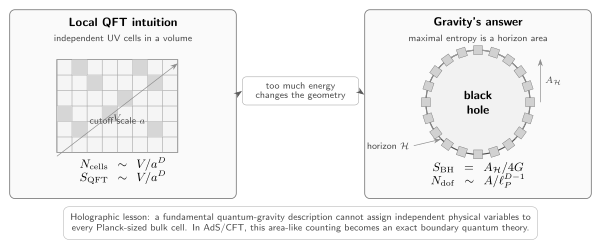
The tension behind holography. A regulated nongravitational QFT naturally counts independent cells in the spatial volume, . In gravity, the highest-entropy object that fits in a region is a black hole, with . The holographic principle says that the fundamental gravitational degrees of freedom are area-like, not volume-like.
The point is not that ordinary QFT is wrong. QFT is extraordinarily successful as an effective theory. The point is that QFT plus dynamical gravity cannot have an arbitrarily large independent Hilbert space attached to every short-distance bulk cell. At sufficiently high energy density, the attempt to excite too many local modes changes the spacetime itself.
Entropy as a counting problem
Section titled “Entropy as a counting problem”Entropy measures the logarithm of the number of accessible states. In statistical mechanics,
where is the number of microstates compatible with the macroscopic data. The formula is schematic unless one specifies an ensemble and a coarse graining, but it captures the essential idea: entropy is a measure of how much independent information a system can store.
For a local quantum field theory with a UV cutoff , a spatial region of volume contains roughly
lattice cells. If each cell has states, the total number of states scales like
and the entropy scales like
This is the natural volume law for a cutoff theory. It is exactly what one expects if every small spatial cell carries its own independent variables.
There is a related statement for thermal radiation in spatial dimensions. For a gas of relativistic degrees of freedom in a box of radius , dimensional analysis gives
Eliminating gives
This grows rapidly with energy. In a nongravitational theory one can keep increasing and produce more entropy. With gravity, that procedure stops being harmless. Once the Schwarzschild radius associated with the energy becomes comparable to the size of the box, the dominant object is no longer a gas in a fixed background. It is a black hole.
Gravity changes the maximum-entropy state
Section titled “Gravity changes the maximum-entropy state”In asymptotically flat spacetime dimensions, the Schwarzschild radius of a neutral black hole of mass scales as
up to dimension-dependent numerical factors. Its horizon area scales as
Therefore the black-hole entropy scales as
Now ask for the largest entropy that can fit in a region of radius . A black hole that fits inside the region has , so
This is area scaling. It is not the entropy of a dilute gas. It is the entropy of the object that gravity itself says should dominate the high-energy density of states.
For comparison, take a radiation gas at the threshold of gravitational collapse. The largest energy that avoids forming a black hole of radius is roughly
Substituting into the gas estimate gives
For a large region in Planck units, this is parametrically smaller than
So black holes are not just another thermodynamic phase. They are the states that reveal the largest possible entropy of a gravitational region.
The Bekenstein-Hawking formula
Section titled “The Bekenstein-Hawking formula”Classical black holes already behave suspiciously like thermodynamic systems. The area theorem says that, under suitable classical assumptions, the event-horizon area does not decrease. The laws of black-hole mechanics identify the surface gravity as the analog of temperature and the horizon area as the analog of entropy.
The analogy became physics when quantum effects were included. A black hole radiates thermally with Hawking temperature
or, in units ,
Combining this temperature with the first law fixes the entropy:
The dots denote work terms such as angular velocity times angular momentum variation and electrostatic potential times charge variation. The crucial point is that is not a tiny correction to ordinary entropy. For a macroscopic black hole it is enormous.
In dimensions, the Planck length satisfies
Thus
A rough information-theoretic translation is
The numerical coefficient is important in precision quantum gravity, but the conceptual shock is already visible from the scaling: the entropy is counted in Planck-area units on the horizon, not Planck-volume units in the interior.
The generalized second law
Section titled “The generalized second law”Bekenstein’s early argument was based on a dangerous-looking process. Drop an object of entropy into a black hole. From the exterior, the object’s entropy disappears behind the horizon. If the ordinary second law were applied only to exterior matter, entropy could decrease.
The proposed cure is the generalized entropy
The generalized second law says
This principle is much more than a mnemonic. It says that black-hole area behaves as real entropy in any process visible to an exterior observer. If matter entropy falls behind the horizon, the horizon area must increase enough to compensate.
The same reasoning leads to a bound on how much entropy can be carried by a weakly gravitating object of energy and size . In units , the Bekenstein bound is often written as
This formula is not the same as the holographic area bound. It applies to weakly gravitating isolated systems under assumptions that matter. But if one combines it with the condition that the system has not already formed a black hole,
then one obtains the area-scaling estimate
This is the bridge from thermodynamic thought experiments to holographic counting.
A useful correction: entropy bounds are subtle
Section titled “A useful correction: entropy bounds are subtle”It is tempting to state the holographic principle as
for every spatial volume . That sentence is too naive.
The problem is that a spatial volume is not an invariantly defined causal object in a dynamical spacetime. Cosmological spacetimes, collapsing geometries, and highly boosted systems can make simple spacelike area bounds fail or become ambiguous. The area of a boundary surface on one time slice is not always the right object to constrain the entropy in the volume enclosed by that slice.
A more covariant idea uses null hypersurfaces. Given a codimension-two surface of area , consider null geodesics shot orthogonally away from . A light-sheet is a null hypersurface generated by those geodesics in a direction for which the expansion is non-positive:
The covariant entropy bound states schematically that the entropy passing through such a light-sheet obeys
This form is much closer to the causal structure of gravity. It also teaches a valuable lesson for AdS/CFT: holography is not merely the phrase “area instead of volume.” The correct formulation must respect gravitational constraints, causal structure, gauge redundancy, and the operational definition of observables.
For this course, the covariant bound will mostly serve as background intuition. AdS/CFT is more concrete: it gives an actual nongravitational quantum theory, not just an inequality.
From entropy bound to holographic principle
Section titled “From entropy bound to holographic principle”The holographic principle, as advocated by ‘t Hooft and Susskind, is the stronger idea that the fundamental description of a gravitational region should involve no more than about one independent degree of freedom per Planck area of an appropriate boundary surface.
In dimensions, the rough counting is
In dimensions, using , it becomes
This does not mean that the world is literally a two-dimensional image painted on a screen. The word “hologram” is an analogy. In an optical hologram, a lower-dimensional plate stores information about a higher-dimensional image. In quantum gravity, the analogy is that a theory with fewer spatial dimensions may encode all physical information about a gravitational spacetime.
But the pre-AdS/CFT holographic principle left several hard questions unanswered:
| Question | Why it matters |
|---|---|
| What are the boundary variables? | Entropy bounds do not tell us the microscopic Hilbert space. |
| What is the Hamiltonian? | A principle of counting is not yet a dynamical theory. |
| How do local bulk fields emerge? | The boundary description must reproduce approximate locality in one higher dimension. |
| Which boundary is meant? | Horizons, asymptotic boundaries, light-sheets, and finite screens are not interchangeable. |
| How are observables defined? | Quantum gravity does not have gauge-invariant local bulk observables in the usual QFT sense. |
AdS/CFT answers these questions in a special but extraordinary class of examples. The boundary variables are those of an ordinary conformal field theory. The Hamiltonian is the CFT Hamiltonian. Bulk locality emerges only in appropriate large-, strong-coupling regimes. The boundary is the conformal boundary of AdS. Observables are defined through CFT quantities: correlation functions, states, partition functions, Wilson loops, entanglement entropies, and other gauge-invariant objects.
Why AdS made holography precise
Section titled “Why AdS made holography precise”The holographic principle was broader than AdS, but AdS was the first setting where it became a precise duality. There are several reasons.
AdS has a timelike conformal boundary
Section titled “AdS has a timelike conformal boundary”In global AdS, the conformal boundary is
A timelike boundary is not merely an edge of a diagram. Boundary conditions at infinity are part of the definition of time evolution in AdS. This makes it natural to define a nongravitational theory on the boundary cylinder and to interpret bulk boundary values as sources.
In contrast, asymptotically flat quantum gravity naturally defines scattering amplitudes at null infinity, while de Sitter space has cosmological horizons and no globally accessible timelike boundary. Holography may exist in those settings, but the dictionary is less direct.
AdS has the right symmetry
Section titled “AdS has the right symmetry”The isometry group of AdS is
which is also the conformal group of a Lorentzian CFT in dimensions, up to global subtleties. This symmetry match is not a derivation, but it is a powerful constraint. It explains why the natural dual of AdS gravity is not just any boundary theory, but a conformal field theory.
AdS is a gravitational box
Section titled “AdS is a gravitational box”In global AdS, light can reach the boundary and return in finite global time once reflecting boundary conditions are imposed. Massive excitations do not simply disperse to infinity as they do in flat space. This makes thermal equilibrium meaningful and allows black holes in AdS to be interpreted as thermal states of the dual CFT.
This fact is crucial for later chapters. The entropy of an AdS black brane becomes the thermal entropy density of a CFT plasma. Quasinormal modes become poles of retarded Green functions. The Hawking-Page transition becomes a confinement/deconfinement transition in suitable boundary theories.
String theory supplied microscopic examples
Section titled “String theory supplied microscopic examples”The entropy argument alone did not identify the microscopic degrees of freedom. D-branes did. In string theory, the same stack of branes can be described at low energy in two complementary ways:
For D3-branes, this logic leads to the canonical duality between super-Yang-Mills theory and type IIB string theory on AdS. The conceptual line is:
The first arrow is a principle. The last arrow is a concrete duality.
The UV cutoff version of the area law
Section titled “The UV cutoff version of the area law”A useful way to connect the area law to the AdS/CFT dictionary is to introduce a radial cutoff in Poincaré AdS:
The cutoff surface has induced spatial volume element proportional to
The number of Planck-area-sized units on this cutoff surface is therefore
In a large- holographic CFT,
where is a measure of the number of boundary degrees of freedom, such as a central charge or its higher-dimensional analogue. For AdS/CFT,
Thus the regulated boundary theory has roughly
degrees of freedom at cutoff scale , matching the scaling of area in bulk Planck units. This is the modern form of the old intuition: the area being counted is not an arbitrary drawing on paper; it is the area of a gravitational cutoff surface measured in units of .
What the pre-AdS/CFT arguments did not prove
Section titled “What the pre-AdS/CFT arguments did not prove”The black-hole entropy argument is powerful, but one should not oversell it. It does not prove the AdS/CFT correspondence. It does not tell us that every gravitational theory has a conventional local boundary CFT. It does not tell us that the boundary theory must live on the geometric boundary one first imagines. It does not even by itself explain how a smooth radial dimension emerges.
What it does prove, or at least strongly indicate, is more basic and more durable:
- Gravity drastically reduces the number of independent short-distance degrees of freedom. A local bulk QFT cutoff at the Planck scale overcounts.
- Black holes are thermodynamic objects with real entropy. The entropy is geometric at leading order.
- The maximum entropy in a region scales like an area. The highest-entropy state is gravitational, not an ordinary gas.
- A microscopic theory of quantum gravity should make area scaling manifest. Holography is not aesthetic; it is forced by entropy.
AdS/CFT is the first framework where these statements become computational. It identifies an exact boundary quantum theory and shows how bulk geometry, fields, black holes, and even spacetime subregions are encoded in boundary data.
Common mistakes
Section titled “Common mistakes”Mistake 1: “Holography means the bulk is fake.”
Section titled “Mistake 1: “Holography means the bulk is fake.””The bulk is not fake in the sense of being useless or unphysical. Bulk effective field theory is an extraordinarily efficient description in the semiclassical regime. The lesson is subtler: bulk locality is emergent and approximate, while the exact quantum description may be organized in lower-dimensional variables.
Mistake 2: “Black-hole area entropy is just ordinary matter entropy on the horizon.”
Section titled “Mistake 2: “Black-hole area entropy is just ordinary matter entropy on the horizon.””The horizon entropy is not simply the entropy of a membrane made of known matter. It counts quantum-gravitational microstates, though the precise microscopic accounting depends on the theory and regime. In AdS/CFT, black-hole microstates are states of the dual CFT.
Mistake 3: “Any area law is holography.”
Section titled “Mistake 3: “Any area law is holography.””Entanglement entropy in ordinary local QFT often has an area-law divergence, but that is not the same statement as the holographic principle. The QFT area law comes from short-distance correlations across an entangling surface. The gravitational area law is a bound on the number of physical states or the entropy of horizons. The two are deeply related in modern holography, but they should not be identified too quickly.
Mistake 4: “The entropy bound is always for any spatial region.”
Section titled “Mistake 4: “The entropy bound is always S≤A/4GS\le A/4GS≤A/4G for any spatial region.””Simple spatial entropy bounds are not generally covariant and can fail in dynamical settings. The covariant light-sheet formulation is closer to the correct general idea. In AdS/CFT, the precise statements are usually made through boundary observables rather than an arbitrary entropy assigned to an arbitrary bulk volume.
Mistake 5: “AdS/CFT is just a consequence of black-hole thermodynamics.”
Section titled “Mistake 5: “AdS/CFT is just a consequence of black-hole thermodynamics.””Black-hole thermodynamics motivated holography. It did not construct the duality. The full correspondence required the additional string-theoretic input of D-branes, open/closed string duality, near-horizon limits, and large- gauge theory.
Exercises
Section titled “Exercises”Exercise 1: Volume counting in a cutoff QFT
Section titled “Exercise 1: Volume counting in a cutoff QFT”Consider a nongravitational quantum field theory in spatial dimensions regulated on a lattice with spacing . A region has volume and each lattice site has possible states. Show that the maximum entropy scales as .
Solution
The number of lattice sites is
If each site has states and the sites are independent, the total number of states is
Therefore
For fixed , the entropy scales with volume. This is the counting that gravity cannot allow to remain fundamental at arbitrarily short distances.
Exercise 2: Radiation entropy at the collapse threshold
Section titled “Exercise 2: Radiation entropy at the collapse threshold”In spatial dimensions, a thermal gas of relativistic particles in a region of radius has
Eliminate to show that . Then impose the gravitational-collapse estimate and compare the gas entropy with the black-hole entropy.
Solution
From
we get
Substituting into the entropy gives
At the threshold of collapse,
so
The black-hole entropy for a black hole of radius is
For large in Planck units, , and therefore
The black hole has parametrically more entropy than the radiation gas that is just about to collapse.
Exercise 3: From the Bekenstein bound to area scaling
Section titled “Exercise 3: From the Bekenstein bound to area scaling”Assume the Bekenstein bound
for a weakly gravitating isolated system of energy and radius . Also assume that avoiding black-hole formation requires
Show that these assumptions imply an area-scaling entropy bound.
Solution
Substitute the gravitational-collapse estimate into the Bekenstein bound:
Since the area of the boundary of a radius- region scales as
we obtain
up to dimension-dependent constants. The important result is the scaling with area rather than volume.
Exercise 4: Boundary cutoff counting in AdS/CFT
Section titled “Exercise 4: Boundary cutoff counting in AdS/CFT”Use the Poincaré AdS metric
and place a cutoff at . Show that the area of a spatial cutoff surface over a boundary spatial region of coordinate volume scales as
Explain why has the same scaling as the number of degrees of freedom of a cutoff large- boundary theory.
Solution
At fixed time and fixed , the induced spatial metric is
The determinant contributes a volume element
Integrating over a boundary coordinate volume gives
Thus
In holographic CFTs, is proportional to the effective number of degrees of freedom. In AdS/CFT, it scales as . A boundary theory regulated at length scale has roughly spatial cells, with degrees of freedom per cell. This matches the bulk area measured in Planck units.
Exercise 5: Why a principle is not yet a duality
Section titled “Exercise 5: Why a principle is not yet a duality”List three pieces of data that an entropy bound does not provide, but a concrete holographic duality such as AdS/CFT does provide.
Solution
Examples include:
- The microscopic Hilbert space. An entropy bound says how many states are allowed, but not what the states are. In AdS/CFT, the states are states of the boundary CFT.
- The Hamiltonian or time evolution. Counting states is not the same as specifying dynamics. In AdS/CFT, the CFT Hamiltonian gives the exact time evolution.
- The observable dictionary. A bound does not tell us how to compute correlation functions, Wilson loops, stress tensors, or entanglement entropies. AdS/CFT gives a dictionary between boundary observables and bulk boundary value problems.
- The regime where local bulk physics emerges. Entropy bounds do not explain why Einstein gravity appears. In AdS/CFT, classical bulk gravity emerges in large-, strong-coupling regimes with a sparse low-dimension spectrum.
The moral is that black-hole thermodynamics motivates holography, but it is not by itself a complete formulation of quantum gravity.
Further reading
Section titled “Further reading”- Jacob D. Bekenstein, “Black Holes and Entropy”, Physical Review D 7, 2333 (1973). The original entropy argument.
- Stephen W. Hawking, “Particle Creation by Black Holes”, Communications in Mathematical Physics 43, 199 (1975). The derivation of black-hole thermal radiation.
- Gerard ‘t Hooft, “Dimensional Reduction in Quantum Gravity”, arXiv:gr-qc/9310026. The classic statement that quantum gravity suggests dimensional reduction of degrees of freedom.
- Leonard Susskind, “The World as a Hologram”, arXiv:hep-th/9409089. The influential string-theoretic development of the holographic principle.
- Raphael Bousso, “The Holographic Principle”, Reviews of Modern Physics 74, 825 (2002). A careful review of entropy bounds, including the covariant light-sheet formulation.