
Liouville and Noncompact CFT
The previous pages emphasized rational and highly algebraic two-dimensional CFTs: minimal models, modular invariant partition functions, affine current algebras, and WZW models with compact symmetry. Those theories often have a discrete set of primary fields, finite fusion rules, and characters that transform among themselves under .
Noncompact CFTs are different. Their fields often take values in a noncompact target space. Their Hilbert spaces often contain continuous spectra. Their OPEs usually involve integrals rather than finite sums. Their two-point functions contain delta functions. Some of their most useful operators are not normalizable states. This sounds less tidy, but it is exactly what one should expect from a CFT describing a radial direction, a scattering problem, a linear dilaton, or the worldsheet of strings moving in a noncompact spacetime.
For AdS/CFT preparation, the main lesson is this:
while
Liouville theory is the paradigmatic example. It is a two-dimensional CFT with a noncompact scalar field , a background charge , an exponential potential , central charge
and a continuous spectrum of normalizable primary states
This page introduces Liouville theory and then places it in the broader class of noncompact CFTs relevant for string theory and AdS/CFT.
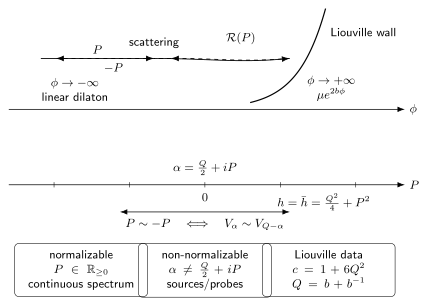
Liouville theory is usefully pictured as scattering in the zero mode . The weak-coupling region is , while the exponential interaction creates a wall toward . Normalizable states are labeled by with . Reflection from the wall identifies the two Liouville momenta and , equivalently up to a reflection amplitude.
1. What changes in a noncompact CFT?
Section titled “1. What changes in a noncompact CFT?”In a compact rational CFT, one often writes the Hilbert space schematically as a discrete sum
where are irreducible representations of the chiral algebra, and the multiplicities are nonnegative integers. The OPE of two primaries is likewise a discrete sum,
In a noncompact CFT, the corresponding formulas are often direct integrals. A typical Hilbert space has the form
where is a continuous label and is a spectral measure. The OPE becomes
The two-point function of normalizable primaries contains delta functions rather than Kronecker deltas:
This is not a pathology. It is the CFT version of plane-wave normalization in ordinary quantum mechanics. Momentum eigenstates in are not square-integrable, but they form a perfectly useful delta-normalized basis. Noncompact CFTs are similar, except that the continuous label may be momentum, spin, Liouville momentum, or a representation-theoretic parameter.
There are three recurring distinctions to keep straight.
First, normalizable states are states in the Hilbert space, usually delta-normalized. They are the analogues of scattering states.
Second, non-normalizable operators are often not states in the Hilbert space but are still excellent local insertions. In a path integral, they may specify boundary conditions or sources. This is conceptually close to the AdS/CFT distinction between normalizable bulk modes and non-normalizable source modes, although the two contexts should not be identified too literally.
Third, analytic continuation is not optional window dressing. Many exact formulas in noncompact CFT are first derived in a convergent domain and then analytically continued to the physical spectrum. The price of exact solvability is that one must be comfortable with distributions and meromorphic functions, not just finite-dimensional matrices.
2. Warm-up: the noncompact free boson
Section titled “2. Warm-up: the noncompact free boson”The simplest noncompact CFT is a free scalar field valued on the real line rather than on a circle:
Its vertex operators are momentum eigenoperators,
The label is continuous. Momentum conservation gives
If instead is compactified on a circle , momenta become quantized and winding appears:
up to convention-dependent factors. This is why compact bosons behave more like rational or nearly rational CFTs at special radii, while noncompact bosons have continuous spectra.
The noncompact free boson already teaches a basic lesson: a CFT can be unitary, local, and perfectly consistent even when its spectrum is continuous and its partition function has volume divergences.
Liouville theory adds a background charge and an exponential wall. Those two ingredients turn the free noncompact boson into a much richer interacting CFT.
3. The linear dilaton and background charge
Section titled “3. The linear dilaton and background charge”Consider a scalar field with a background charge . In standard Liouville conventions, the free linear-dilaton part of the action is
The curvature coupling is a total derivative on a flat worldsheet, but it is not irrelevant. It changes the stress tensor and the central charge. In local complex coordinates, the holomorphic stress tensor is
With these conventions,
The exponential operators are written
Their holomorphic and antiholomorphic dimensions are
This formula is one of the most important formulas on the page. It implies the reflection symmetry
So and label operators with the same conformal dimension. In Liouville theory, this degeneracy is not accidental: the two operators are related by a reflection amplitude.
The continuous normalizable spectrum is obtained by writing
Then
Thus the spectrum begins at and is continuous above it. This lower edge is sometimes called the continuum threshold.
4. Liouville theory
Section titled “4. Liouville theory”Liouville theory adds the exponential interaction
The parameter is the Liouville cosmological constant. The interaction is conformal only if is a operator. Since
marginality requires
This is solved by
With this choice,
For real positive , this gives . This is the usual spacelike Liouville theory, the unitary version most often used in noncritical string theory and in discussions of two-dimensional quantum gravity. There are also timelike continuations, but they are subtler and are not needed for the basic AdS/CFT preparation path.
The Liouville interaction creates an exponential wall. For and , the potential grows rapidly as
while the region
is approximately a linear-dilaton region. A normalizable state is therefore naturally interpreted as a wave coming from the weak-coupling region, reflecting off the Liouville wall, and returning.
This scattering picture explains why the spectrum is continuous and why reflection is fundamental.
5. Reflection: and
Section titled “5. Reflection: VαV_\alphaVα and VQ−αV_{Q-\alpha}VQ−α”Because
Liouville theory identifies the two exponential operators up to a reflection coefficient:
On the physical line
reflection sends
This is why one may restrict the physical momentum to
The two-point function is consequently not just a simple power law with an ordinary constant. Schematically, for states on the physical line one finds a delta-normalized structure of the form
where
The precise normalization depends on conventions and on whether one lets range over all real values or only . The invariant point is the physical one: Liouville primaries are scattering states, and the reflection amplitude is part of the CFT data.
6. Correlation functions and the DOZZ structure constant
Section titled “6. Correlation functions and the DOZZ structure constant”A generic three-point function of scalar primaries is fixed by global conformal invariance up to a structure constant:
Here
In a generic CFT, would be unknown dynamical data. The remarkable fact about Liouville theory is that this structure constant is known exactly. It is called the DOZZ structure constant, after Dorn-Otto and Zamolodchikov-Zamolodchikov.
For this course, the exact special-function expression is less important than its meaning. The DOZZ constant is the continuous-spectrum analogue of the three-point coefficients in a compact CFT. It is one of the fundamental pieces of Liouville CFT data.
The OPE is then an integral over the physical Liouville spectrum:
This formula should be compared with the minimal-model OPE
The conceptual replacement is
The conformal block expansion of a Liouville four-point function is therefore
up to conventional normalizations and position-dependent prefactors. The internal channel is labeled by a continuous momentum .
This is the cleanest two-dimensional example of a conformal bootstrap with a continuous spectrum.
7. Degenerate operators and BPZ equations
Section titled “7. Degenerate operators and BPZ equations”Although the physical Liouville spectrum is continuous, Liouville theory also contains special non-normalizable operators whose Virasoro representations are degenerate. These are labeled by positive integers and have momenta
The corresponding Verma modules contain null states. For example, the degenerate field has a level-two null vector. Correlation functions involving such a field satisfy a second-order BPZ differential equation.
This is one of the most powerful ways to solve Liouville theory. The logic is:
The important point is subtle. Degenerate operators are not generic normalizable states in the Liouville Hilbert space. They are analytic probes. Nevertheless, they constrain the exact CFT data.
This is a recurring theme in noncompact CFT: useful local operators need not be ordinary normalizable states.
8. Liouville theory and noncritical string theory
Section titled “8. Liouville theory and noncritical string theory”Liouville theory appeared historically in the quantization of the string worldsheet metric. In conformal gauge, one writes the worldsheet metric as
The conformal factor does not simply disappear in the quantum theory unless the total Weyl anomaly vanishes. In bosonic string theory, the ghost system contributes
If the matter CFT has central charge , Weyl anomaly cancellation requires
Thus
Using
one obtains
The Liouville field is then the quantum remnant of the worldsheet scale factor. It becomes a dynamical field because the conformal anomaly makes the Weyl mode physical.
This is why Liouville theory is so central to noncritical strings and two-dimensional quantum gravity. It is not just one more CFT; it is the CFT of the fluctuating worldsheet scale.
9. Noncompact WZW models and AdS
Section titled “9. Noncompact WZW models and AdS3_33”Liouville theory is not the only noncompact CFT relevant for strings. Another central family comes from noncompact group manifolds and cosets.
For strings on Euclidean AdS, one encounters the WZW model,
For Lorentzian AdS, the relevant worldsheet theory is closely related to the WZW model. These theories are noncompact, and their spectra involve continuous and discrete representations. In Lorentzian AdS, spectral flow sectors are essential for the string spectrum.
A related and very important coset is the two-dimensional cigar CFT,
Geometrically, it describes the Euclidean two-dimensional black hole. Far from the tip, it looks like an asymptotic cylinder with a linear dilaton. Near the tip, the circle caps off smoothly.
This collection of examples gives a useful hierarchy:
The common theme is that noncompact directions lead to continuous spectra, scattering data, and subtleties in separating states from sources.
10. Toda theory: many Liouville walls
Section titled “10. Toda theory: many Liouville walls”Liouville theory has one scalar field and one exponential wall. Toda theory generalizes this to several scalar fields. For a simple Lie algebra of rank , Toda theory has an -component scalar
and exponential interactions associated with the simple roots :
Here is the Weyl vector. Liouville theory is the case. Toda theories have extended chiral algebras called -algebras. They are important in AGT-type correspondences, higher-spin holography, and the representation theory of noncompact CFTs.
For this course, the takeaway is simple: Liouville is the one-dimensional prototype of a much broader class of noncompact CFTs with exponential walls and continuous momenta.
11. Normalizable versus non-normalizable: the holographic lesson
Section titled “11. Normalizable versus non-normalizable: the holographic lesson”In an ordinary compact unitary CFT, local operators and states are tightly related by the state-operator correspondence. Every local operator inserted at the origin creates a state on the circle:
In noncompact CFTs, the state-operator relation still exists, but the functional-analytic status of states becomes more delicate. Some operators create delta-normalizable states. Others create non-normalizable states or analytic continuations of states.
The distinction is physically valuable:
This is one reason Liouville theory is excellent preparation for AdS/CFT. In AdS/CFT, a bulk field near the boundary behaves schematically as
The coefficient is a source for the boundary operator, while is related to the expectation value or state data. This is not the same mathematical setup as Liouville reflection, but the conceptual habit is similar: one must distinguish source-like data from normalizable state-like data.
Noncompact CFTs train exactly this habit.
12. What survives from rational CFT?
Section titled “12. What survives from rational CFT?”Many rational-CFT tools survive, but in modified form.
The Virasoro algebra still controls descendants and conformal blocks:
is still a Virasoro conformal block.
Crossing symmetry still holds:
But the sum over intermediate primaries becomes an integral.
Modular invariance still exists, but the torus partition function is generally not a finite sesquilinear combination of characters. It contains integrals over continuous labels and often has volume divergences from noncompact zero modes.
Fusion still exists, but fusion coefficients become kernels or measures.
So the rational-CFT dictionary changes as follows:
This is not a loss of structure. It is a different kind of structure.
13. AdS/CFT checkpoint
Section titled “13. AdS/CFT checkpoint”Noncompact CFTs are not optional if one wants to understand holography deeply.
They prepare several AdS/CFT ideas:
-
Radial directions. Liouville theory has a noncompact coordinate with an exponential wall. This is a simple arena for thinking about radial motion, asymptotic regions, and reflection.
-
Normalizable versus non-normalizable data. Liouville separates scattering states from source-like insertions. AdS/CFT separates normalizable bulk modes from boundary sources.
-
Continuous spectra. Bulk physics often has continua: scattering states, black-hole thresholds, long strings, and noncompact momenta. Noncompact CFTs provide exact two-dimensional examples.
-
Worldsheet AdS. String theory on AdS is described by noncompact current algebra, not by a compact rational CFT. Continuous representations, discrete representations, and spectral flow are essential.
-
Exact solvability beyond rationality. Liouville theory is exactly solvable but not rational. It shows that exact CFT does not mean finite CFT.
The most compact slogan is:
That is why it belongs in a modern CFT course aimed at AdS/CFT.
14. Common pitfalls
Section titled “14. Common pitfalls”A few warnings save a lot of confusion.
Pitfall 1: thinking continuous spectrum means nonunitary. A theory can be perfectly unitary and have continuous spectrum. The noncompact free boson is the simplest example. Spacelike Liouville theory with real is also unitary.
Pitfall 2: treating every local insertion as a normalizable state. In noncompact CFT, many useful local insertions are non-normalizable. They are still part of the analytic CFT machinery.
Pitfall 3: expecting rational-CFT modular formulas. Modular invariance still matters, but the partition function generally involves integrals and regularized volumes.
Pitfall 4: confusing Liouville momentum with target-space momentum. The Liouville label is momentum conjugate to the Liouville zero mode. In string applications, it may be related to radial momentum, but the precise interpretation depends on the background.
Pitfall 5: ignoring reflection. The labels and are not independent physical states. Reflection is part of the definition of Liouville CFT data.
15. Minimal formula sheet
Section titled “15. Minimal formula sheet”The formulas most worth remembering are these:
These are enough to recognize Liouville theory whenever it appears in string theory, two-dimensional gravity, or noncompact bootstrap problems.
Exercises
Section titled “Exercises”Exercise 1. Marginality of the Liouville interaction
Section titled “Exercise 1. Marginality of the Liouville interaction”Using
show that the operator is marginal if .
Solution
The interaction is the operator , so its holomorphic dimension is
The full operator is marginal if
Using gives
Therefore is a operator and can be added to the action without breaking conformal invariance.
Exercise 2. The continuum threshold
Section titled “Exercise 2. The continuum threshold”Let
Show that
Explain why and have the same conformal dimension.
Solution
By definition,
For ,
Hence
This depends only on , so and have the same dimension. In Liouville theory this degeneracy is implemented by reflection,
Exercise 3. From sums to integrals in the OPE
Section titled “Exercise 3. From sums to integrals in the OPE”In a rational CFT, a four-point function of scalar primaries has a schematic conformal block decomposition
Write the analogous formula for Liouville theory, where the intermediate primary is labeled by .
Solution
The discrete sum over intermediate primaries becomes an integral over the Liouville momentum:
up to standard position-dependent prefactors and normalization conventions. The qualitative replacement is
Exercise 4. Liouville central charge in noncritical strings
Section titled “Exercise 4. Liouville central charge in noncritical strings”In bosonic noncritical string theory, suppose the matter CFT has central charge . The ghost system has , and the Liouville field has
Use total Weyl anomaly cancellation to find in terms of .
Solution
Weyl anomaly cancellation requires
Since ,
Thus
Using gives
so
Exercise 5. Semiclassical heavy operators
Section titled “Exercise 5. Semiclassical heavy operators”Let with
Consider a Liouville momentum of the form
where is fixed. Show that the dimension scales like and find the leading term.
Solution
We use
For ,
With ,
Therefore
So these are heavy operators in the semiclassical Liouville limit. Since
their dimensions scale like the central charge.
Further reading
Section titled “Further reading”For the exact solution of Liouville theory, the classic references are the DOZZ papers by Dorn-Otto and by the Zamolodchikov brothers, together with Teschner’s work on Liouville conformal blocks and crossing. For a pedagogical review, Nakayama’s review of Liouville field theory is especially useful. For noncompact WZW models and AdS strings, the standard path runs through work on , WZW models, spectral flow, and the cigar CFT.
The next page moves from noncompact 2D CFT to CFT on curved spaces and cylinders, where Weyl maps, finite-size effects, and Casimir energies become the bridge to thermal CFT and black holes.