
String Theory I Introduction
These pages are based on handwritten notes I took during Professor Igor R. Klebanov’s one-semester course, “Introduction to String Theory,” in Spring 2010. The initial drafts were prepared with the assistance of AI and have since been reviewed and edited by me. The site is still under construction; although I have tried to ensure accuracy, some errors may remain. If you notice any significant mistakes, I would greatly appreciate your feedback.
Welcome to String Theory I. The aim of this section is to give a coherent graduate-level path through perturbative string theory: why one-dimensional extended objects are natural, how their worldsheet dynamics is quantized, why two-dimensional conformal field theory becomes the central language, how ghosts and BRST quantization impose gauge invariance, how string amplitudes and spacetime effective actions emerge, and how the NSR superstring leads to Type I/II theories, T-duality, and D-branes. The guiding principle is that every important formula should carry its convention, every conceptual jump should be made explicit, and every calculation should be placed in the larger architecture of the subject.
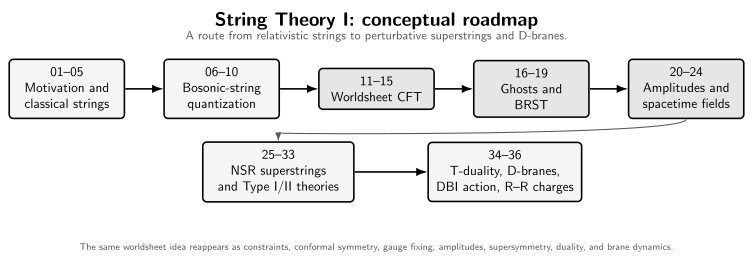
The course has three layers. First come classical and quantum strings. Then worldsheet CFT, ghosts, BRST, amplitudes, and effective actions provide the perturbative framework. Finally the NSR formalism, Type I/II theories, T-duality, and D-branes give the modern superstring picture.
This section stops at D-branes, the DBI action, and R—R charges. AdS/CFT is not included here; it belongs naturally in a later group of notes after D-branes and near-horizon limits have been developed.
The notes keep explicit whenever possible. Some formulas become shorter in special conventions such as , but such choices are not made globally.
Prerequisites
Section titled “Prerequisites”A reader should be comfortable with special relativity, Lagrangian and Hamiltonian mechanics, basic quantum field theory, path integrals, and elementary Lie algebra representation theory. Prior exposure to two-dimensional conformal field theory is helpful but not required; the necessary CFT tools are developed in the middle part of the course.
Global conventions
Section titled “Global conventions”Unless stated otherwise, these notes use units
The spacetime metric is mostly plus:
For a massive particle,
The string tension is
and the string length is
Thus has dimension of length squared, while the characteristic string mass scale is
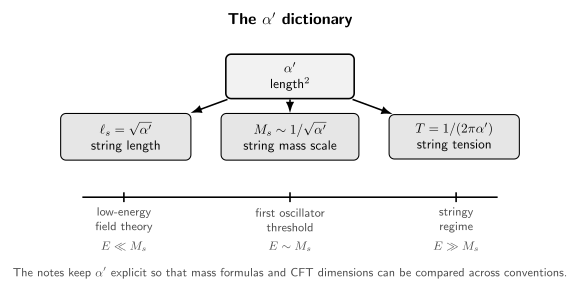
The parameter controls the string length, string tension, and tower of massive oscillator states. Keeping it explicit makes comparison with different textbooks safer.
Worldsheet coordinates are usually
In conformal gauge we often use light-cone coordinates
or Euclidean complex coordinates
For the free bosons in flat target space, the Euclidean worldsheet action is normalized as
The basic OPE is
The holomorphic stress tensor of the free bosons is
and the closed-string bulk exponential operator
has weights
Boundary operators for open strings have a different normalization, derived when needed.
How to read the course
Section titled “How to read the course”There are three natural reading paths.
First, pages 01—10 give the basic bosonic-string construction: actions, symmetries, constraints, spectra, light-cone quantization, Hagedorn growth, and the first worldsheet-CFT ideas.
Second, pages 11—24 develop the worldsheet machinery: OPEs, Virasoro symmetry, radial quantization, null states, ghosts, BRST quantization, tree amplitudes, massless vertices, effective actions, and sigma-model beta functions.
Third, pages 25—36 develop the superstring and D-brane part of the course: NSR worldsheet supersymmetry, GSO projection, Type I/II theories, spin fields, picture changing, T-duality, DBI theory, and R—R charges.
Table of contents
Section titled “Table of contents”| Page | Title | Main topics |
|---|---|---|
| 01 | Why Strings? Regge Behavior and Dual Resonance Models | Motivation, open and closed strings, Regge trajectories, compact dimensions, Veneziano duality. |
| 02 | The Relativistic Point Particle | Reparametrization invariance, einbein action, mass-shell constraint, proper-time propagator. |
| 03 | The Nambu—Goto and Polyakov Actions | Induced metric, string tension, static-gauge expansion, Lüscher term, Polyakov action. |
| 04 | Worldsheet Symmetries, Boundary Conditions, and Conformal Gauge | Diffeomorphisms, Weyl symmetry, conformal gauge, open-string boundary conditions, D-branes. |
| 05 | Classical Rotating Strings and the Regge Slope | Spinning open string, Poincare currents, conserved charges, classical Regge slope. |
| 06 | Mode Expansions and Canonical Quantization | Closed/open string modes, oscillator algebra, Virasoro generators, cylinder-plane map. |
| 07 | Covariant Virasoro Constraints and Bosonic Spectra | Normal ordering, intercepts, open/closed spectra, level matching, negative-norm states. |
| 08 | Light-Cone Quantization and the Critical Dimension | Light-cone gauge, transverse oscillators, Lorentz algebra, . |
| 09 | Hagedorn Growth and String Thermodynamics | Oscillator degeneracies, eta-function asymptotics, Hagedorn temperature. |
| 10 | String Interactions and the Free Boson CFT | Worldsheet interactions, radial ordering, Green functions, first OPEs. |
| 11 | Stress Tensor, Primaries, and Conformal Transformations | Holomorphic stress tensor, primary fields, Ward identities, global conformal maps. |
| 12 | Vertex Operators, OPEs, and the Virasoro Algebra | Exponential vertices, OPEs, central charge, Virasoro modes and algebra. |
| 13 | Radial Quantization and the State—Operator Correspondence | Cylinder-plane map, Schwarzian shift, highest-weight states, oscillator dictionary. |
| 14 | Highest-Weight Modules, Null States, and the Kac Determinant | Verma modules, Gram matrices, null states, Kac determinant. |
| 15 | Minimal Models, Ward Identities, and Correlators | Unitary minimal models, BPZ equations, global constraints, cross-ratios, conformal blocks. |
| 16 | Bosonic Physical States and the No-Ghost Structure | Old covariant physical states, null states, gauge redundancy, no-ghost theorem. |
| 17 | The Ghost System and Ghost Zero Modes | Ghost weights, central charge, ghost number, ghost vacua, sphere zero modes. |
| 18 | The Polyakov Path Integral and Moduli | Gauge fixing, conformal Killing vectors, moduli, Beltrami differentials, -ghost insertions. |
| 19 | Weyl Anomaly, Liouville Theory, and BRST Quantization | Critical dimension, Liouville mode, BRST transformations, BRST cohomology, vertex descent. |
| 20 | Tree-Level String Amplitudes | Sphere amplitudes, vertex insertions, Möbius fixing, Koba—Nielsen factors. |
| 21 | The Virasoro—Shapiro Amplitude and Factorization | Four-tachyon amplitude, gamma functions, pole towers, OPE factorization, Regge behavior. |
| 22 | Massless Closed-String Vertices and Gauge Invariance | Graviton, -field, dilaton, transversality, worldsheet total derivatives. |
| 23 | The Low-Energy Effective Action | String-frame action, dilaton genus weight, Einstein frame, low-energy expansion. |
| 24 | Sigma-Model Beta Functions and the Linear Dilaton | Background fields, RG flow, spacetime equations, linear-dilaton CFT. |
| 25 | Worldsheet Supersymmetry and the NSR Action | Worldsheet fermions, NSR matter action, superconformal gauge, stress tensor, supercurrent. |
| 26 | Superconformal Algebra and NS/R Sectors | Super-Virasoro algebra, spin structures, NS/R modes, normal-ordering constants. |
| 27 | The Open Superstring Spectrum | NS/R Hilbert spaces, physical constraints, NS vector, Ramond ground state. |
| 28 | Ten-Dimensional Spinors and Ramond Ground States | Clifford algebra, spinor Fock construction, Majorana-Weyl spinors, little group. |
| 29 | The GSO Projection and Open-String Supersymmetry | Tachyon removal, Ramond chirality, vector multiplet, Bose/Fermi matching. |
| 30 | Closed Superstring Sectors and Type II Theories | NS-NS, NS-R, R-NS, R-R sectors, Type IIA/IIB spectra, R—R forms. |
| 31 | Bosonization, Spin Fields, and Superghosts | Fermion bosonization, spin fields, branch cuts, superghosts, picture number. |
| 32 | NSR Vertex Operators and Picture Changing | NS/R vertices, picture-changing operator, sphere and disk picture bookkeeping. |
| 33 | Type I Strings, Orientifolds, and Chan—Paton Factors | Type 0, worldsheet parity, Type I projection, Chan—Paton labels, groups. |
| 34 | Closed-String T-Duality and Enhanced Symmetry | Momentum and winding, radius inversion, self-dual radius, enhanced current algebra. |
| 35 | Open-String T-Duality and D-Branes | Neumann/Dirichlet exchange, Wilson lines, brane positions, stretched strings, gauge enhancement. |
| 36 | DBI Action, Tachyon Condensation, and R—R Charges | DBI action, Wess—Zumino couplings, tachyon condensation, Type II brane charges. |
Suggested references
Section titled “Suggested references”The main references for comparison are Green—Schwarz—Witten, Polchinski, Polyakov, Becker—Becker—Schwarz, and Zwiebach. These notes often keep the derivations more explicit than standard textbooks, but the textbooks remain essential for additional examples, exercises, and historical context.