
Geodesics, Redshift, and RG Scale
The main idea
Section titled “The main idea”The radial direction in AdS is not an extra ordinary spatial direction from the CFT point of view. It is the geometric avatar of scale.
In the Poincaré patch,
the boundary is at . Distances and times measured by a local bulk observer are related to boundary distances and times by the warp factor . This produces the central estimate
where is the boundary energy scale associated with a bulk excitation localized around radial position .
This statement is both powerful and dangerous. Powerful, because it explains why near-boundary data encode ultraviolet CFT physics and why deep-bulk dynamics encode infrared CFT physics. Dangerous, because is a coordinate, not an invariant observable. The invariant content is the combination of:
- AdS scale transformations,
- gravitational redshift,
- the width of boundary profiles sourced by bulk objects,
- the behavior of probes such as geodesics, strings, and minimal surfaces.
This page develops the radial/scale dictionary using the simplest probes: particles and geodesics. Later, the same logic will reappear in Wilson loops, black branes, holographic renormalization, entanglement wedges, and real-time correlators.
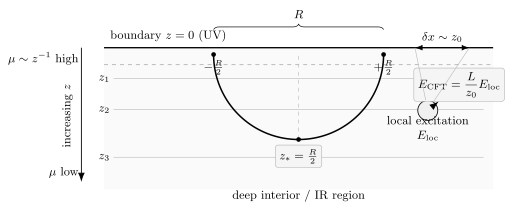
In Poincaré AdS, moving toward the boundary corresponds to higher CFT resolution . A local bulk excitation of proper energy is seen by the boundary Hamiltonian with redshifted energy . A spacelike geodesic connecting boundary points separated by reaches a turning point , so it probes the radial scale associated with that boundary separation.
Scale transformations already know the answer
Section titled “Scale transformations already know the answer”The Poincaré metric is invariant under the simultaneous rescaling
where . Indeed,
so the ratio is unchanged.
On the CFT side, the same transformation is a dilatation. Lengths scale as
while energies and momenta scale as
Therefore transforms like a boundary length scale. A radial cutoff
transforms like a UV length cutoff in the CFT, and the associated energy cutoff scales as
This is the cleanest symmetry argument for the radial/energy-scale relation. It does not say that every radial coordinate in every gauge is literally an energy. It says that in asymptotically AdS geometries, the radial diffeomorphism that approaches
near the boundary acts as a Weyl transformation of the boundary metric. This is the geometric origin of holographic renormalization.
Gravitational redshift
Section titled “Gravitational redshift”The same relation follows from redshift. Consider a static particle at fixed and in the Poincaré patch. The metric component along boundary time is
The proper time of the local observer is
Let be the energy measured in the local orthonormal frame. The energy conjugate to the boundary time is
Thus the same proper bulk excitation looks more energetic to the boundary when it is closer to :
Conversely, for a fixed boundary energy ,
A boundary excitation of finite energy becomes softer in the local frame as it propagates deeper into the Poincaré patch. This is why deep radial regions are naturally associated with long-distance or low-energy boundary physics.
One should be slightly careful about units. The coordinate has units of length, while is the AdS radius. The estimate suppresses order-one constants and the distinction between dimensionless cylinder energy and physical energy. The robust statement is the scaling:
Boundary resolution of a bulk point
Section titled “Boundary resolution of a bulk point”A useful way to phrase the UV/IR relation is:
A bulk excitation localized at depth is represented on the boundary with spatial resolution of order .
This can be seen from the Euclidean bulk-to-boundary kernel for a scalar field of dimension :
For a bulk point at , the denominator changes significantly when
Thus the boundary imprint has characteristic width
This is not a statement that the boundary operator has compact support inside a ball of radius . The kernel has tails. Rather, is the scale at which the boundary representation resolves the bulk point. A point close to the boundary can be represented with fine boundary resolution; a point deep in the bulk is necessarily more spread out.
This intuition will later reappear in more precise language:
| Bulk statement | Boundary statement |
|---|---|
| radial cutoff | UV regulator with |
| local object at | boundary profile of width |
| black-brane horizon at | thermal scale |
| minimal surface turning point | boundary region size |
| near-boundary asymptotic expansion | local UV data, counterterms, sources, one-point functions |
| deep interior geometry | IR state, gap, horizon, confinement scale, or emergent scaling regime |
The last line is deliberately broad. The deep interior can mean many different things depending on the state and theory: a smooth cap, a horizon, an AdS throat, a singularity, a hard wall, or a domain-wall endpoint.
Heavy particles and the geodesic approximation
Section titled “Heavy particles and the geodesic approximation”A massive particle moving in the bulk has worldline action
In Euclidean signature, the semiclassical contribution of a worldline is therefore
where is the proper length of the path. When the dual scalar operator has large dimension,
the bulk scalar is heavy:
The bulk path integral for the two-point function is then dominated by the shortest Euclidean path connecting the two boundary insertion points. Schematically,
This is the geodesic approximation.
It is only an approximation. It becomes accurate when the bulk field is heavy compared with the AdS scale. For light fields, one must solve the wave equation and use the bulk-to-boundary propagator. Nevertheless, the geodesic approximation is conceptually invaluable because it makes the radial/scale relation visible in one line: boundary separation determines how deep the geodesic falls into AdS.
A first computation: the Euclidean two-point function
Section titled “A first computation: the Euclidean two-point function”Work in Euclidean AdS with one boundary separation direction :
Consider two boundary insertions at
By symmetry, the geodesic lies in the plane. In the upper half-plane with metric
the geodesic connecting the two boundary points is a semicircle orthogonal to the boundary:
Its deepest point is
This is the geometric UV/IR relation in its simplest form: a boundary two-point function at separation probes radial depth of order .
To compute the length, set
with
Then
so
The geodesic reaches the boundary, so its length diverges. Regulate it by ending the geodesic at
Near each endpoint,
The regulated length is
Using
we find
The divergent piece is independent of the physical separation except through the standard cutoff normalization of the boundary operator. After subtracting the endpoint divergence, the renormalized length gives
At large dimension, , so
as required by conformal invariance.
This computation is primitive but profound. It shows how the CFT power law emerges from the logarithmic growth of geodesic length near the AdS boundary.
Why the geodesic reaches
Section titled “Why the geodesic reaches z∗∼Rz_*\sim Rz∗∼R”The turning point relation
in pure Euclidean AdS follows exactly from the semicircle. More generally, it expresses a robust physical idea:
A boundary observable of size probes bulk regions whose radial depth is of order .
For a two-point function, the observable size is the separation between insertions. For a Wilson loop, it is the size of the loop. For an entangling region, it is the size of the boundary subregion. In all these examples, the relevant bulk object hangs into the radial direction and reaches a depth controlled by the boundary scale.
This is why the radial coordinate is useful for diagnosing phases.
In a conformal vacuum, no special scale interrupts the geometry, so geodesics and minimal surfaces can probe arbitrarily large as grows.
In a thermal state represented by a planar black brane, the metric has a horizon at
with temperature of order
Large boundary separations are sensitive to the horizon scale. Correlators decay thermally rather than as vacuum power laws.
In a confining geometry, the spacetime may end smoothly or develop an effective IR wall at
corresponding to a mass gap
The geometry has encoded the RG flow.
Global AdS version
Section titled “Global AdS version”The same physics appears in global coordinates. Using a radial coordinate ,
A static local observer at radius measures proper time
Thus
Near the boundary, , this becomes
If we use dimensionless global time , then the dimensionless cylinder energy is
A cutoff at large radius corresponds to a short-distance cutoff on the boundary cylinder. In the compact coordinate ,
so
Therefore the angular resolution on the boundary sphere is roughly
The two common radial conventions are therefore consistent:
| Coordinate system | Boundary at | UV means | IR means |
|---|---|---|---|
| Poincaré | small | large | |
| global | large | smaller or interior endpoint |
This table is a common source of sign errors. In Poincaré coordinates, deeper bulk means larger . In global coordinates, approaching the boundary means larger .
Holographic RG: what is true and what is not
Section titled “Holographic RG: what is true and what is not”The radial/scale relation is often summarized by the slogan:
This slogan is good enough to remember and too crude to use blindly.
The precise near-boundary statement is that changing the cutoff surface
changes the UV regulator of the boundary theory. In the bulk, one evaluates the on-shell action at the cutoff surface,
adds counterterms local on the cutoff surface, and asks how the renormalized functional changes as varies. This is the Hamilton-Jacobi viewpoint on holographic renormalization.
For a scalar field,
Moving the cutoff changes how the same bulk solution is split into source-like data, response-like data, and local counterterms. This is analogous to changing a renormalization scheme in QFT.
However, radial evolution is not identical to Wilsonian RG in an elementary way. There are several reasons.
First, the radial coordinate can be redefined:
This changes the detailed relation between and while preserving the asymptotic scaling.
Second, the bulk equations are second-order in the radial direction. Specifying only sources is not the same as specifying a Wilsonian effective action; one must also encode state or regularity data.
Third, integrating out radial regions can generate multi-trace interactions and scheme-dependent terms. These are physical when interpreted correctly, but they are not captured by the naive phrase “ equals energy.”
Fourth, entanglement and reconstruction complicate locality. A bulk point is not generally represented by one local boundary operator at one scale. It is reconstructed from boundary operator data in a way that depends on the state, code subspace, and chosen boundary region.
A safer dictionary is:
| Safe statement | Unsafe slogan |
|---|---|
| near-boundary cutoff regulates UV divergences | is literally the RG scale |
| transforms like a boundary length under dilatations | radial position is gauge-invariant |
| boundary separation probes depth in pure AdS | every observable of size probes only one radial slice |
| horizons and caps represent important IR scales | all deep-bulk physics is low-energy field theory |
| radial Hamilton-Jacobi equations encode Callan-Symanzik-like identities | holographic RG is identical to textbook Wilsonian RG |
This nuance is not pedantry. It prevents many wrong interpretations of holographic models.
Example: black branes and the thermal scale
Section titled “Example: black branes and the thermal scale”The planar AdS-Schwarzschild black brane can be written as
The horizon is at
The Hawking temperature is
Thus the horizon sits at a radial scale of order the inverse temperature:
This is one of the most useful practical forms of the radial/scale dictionary. Finite temperature cuts off the vacuum geometry in the IR. Boundary probes with size
mostly see the near-boundary vacuum-like region. Probes with
feel the horizon and show thermal behavior.
The same pattern appears in many settings:
| Boundary scale | Bulk feature |
|---|---|
| temperature | horizon scale |
| chemical potential | charged geometry scale |
| confinement scale | cap or wall scale |
| deformation by relevant operator | domain-wall crossover scale |
| entangling-region size | extremal-surface depth in vacuum AdS |
What geodesics do not tell you
Section titled “What geodesics do not tell you”Geodesics are excellent probes, but they are not the whole story.
A geodesic approximation to a two-point function assumes a heavy operator. For an operator of moderate dimension, the full wave equation matters. The correct bulk calculation uses the classical solution with specified boundary behavior and evaluates the renormalized on-shell action.
Spacelike geodesics also do not automatically compute Lorentzian real-time correlators. In Lorentzian signature, one must choose the correct contour, state, and prescription. At finite temperature, retarded correlators are governed by infalling horizon boundary conditions, not by arbitrary geodesic segments.
Finally, geodesics can fail to probe all regions of a geometry. Entanglement surfaces, Wilson-loop worldsheets, causal wedges, quasinormal modes, and wave propagation often reveal different aspects of the bulk. A trustworthy holographic interpretation compares several probes rather than leaning on one picture.
The page in one dictionary
Section titled “The page in one dictionary”| Concept | Formula | Meaning |
|---|---|---|
| Poincaré metric | AdS as a warped space over the boundary | |
| scale isometry | has units of boundary length | |
| redshift | near-boundary excitations are high-energy from the CFT viewpoint | |
| UV cutoff | ||
| boundary profile | a bulk point at is boundary-smeared over scale | |
| heavy operator | large allows a particle/geodesic approximation | |
| geodesic correlator | two-point functions from worldline saddles | |
| pure-AdS turning point | separation probes depth | |
| black-brane horizon | finite temperature introduces an IR radial scale |
Common mistakes
Section titled “Common mistakes”Mistake 1: “The bulk radial coordinate is exactly the RG scale”
Section titled “Mistake 1: “The bulk radial coordinate is exactly the RG scale””Only the asymptotic scaling is invariant. A change of radial coordinate changes the detailed identification. The precise statement is that radial diffeomorphisms acting near the boundary implement Weyl transformations and cutoff changes in the boundary theory.
Mistake 2: “Deep bulk always means low local energy”
Section titled “Mistake 2: “Deep bulk always means low local energy””Deep bulk means low boundary resolution. A local observer deep in the bulk can still see high local energies. The redshift relation is
One must always specify whose energy is being measured.
Mistake 3: “The UV/IR relation has only one direction”
Section titled “Mistake 3: “The UV/IR relation has only one direction””There are two related but distinct statements:
and
The first is a scale-localization statement. The second is a statement about divergences of on-shell actions and entropies.
Mistake 4: “All two-point functions are geodesic lengths”
Section titled “Mistake 4: “All two-point functions are geodesic lengths””Only heavy operators admit the simple geodesic approximation. Generic correlators require solving bulk wave equations and applying the GKP/Witten prescription.
Mistake 5: “The deepest point of a geodesic is an invariant observable”
Section titled “Mistake 5: “The deepest point of a geodesic is an invariant observable””In pure AdS and standard coordinates, is useful and exact. In a general spacetime, the statement “how deep a probe goes” is coordinate-dependent unless phrased in terms of invariant quantities such as proper lengths, extremal surfaces, renormalized actions, or boundary observables.
Exercises
Section titled “Exercises”Exercise 1: Redshift in Poincaré AdS
Section titled “Exercise 1: Redshift in Poincaré AdS”Consider a particle at fixed in the Lorentzian Poincaré metric
Show that the energy conjugate to boundary time is
where is the energy measured by a local static observer.
Solution
For a static observer at fixed ,
The boundary energy is the conserved charge associated with the Killing vector . The local energy is measured with respect to proper time. Frequencies therefore obey
Exercise 2: Scale invariance of the Poincaré metric
Section titled “Exercise 2: Scale invariance of the Poincaré metric”Show that
is an isometry of the Poincaré AdS metric. Explain why this implies .
Solution
Under the transformation,
Therefore
while
The factors of cancel in
Thus scales like a boundary length. Since field-theory energy scales inversely with length,
Exercise 3: Geodesic length and the CFT power law
Section titled “Exercise 3: Geodesic length and the CFT power law”In Euclidean AdS, consider the semicircular geodesic
connecting two boundary points separated by . Regulate the length by cutting off the endpoints at . Show that
Then show that the geodesic approximation gives the expected conformal two-point scaling.
Solution
Parametrize the semicircle by
Then
and hence
The cutoff condition is
so
Thus
The geodesic approximation gives
After absorbing the cutoff-dependent factor into the normalization of , and using for large , one obtains
Exercise 4: Boundary width of a bulk source
Section titled “Exercise 4: Boundary width of a bulk source”For the Euclidean bulk-to-boundary kernel
show that the boundary profile of a bulk point at has characteristic width of order .
Solution
The kernel is largest at . Compare the denominator at separation :
The denominator changes by an order-one factor when
or
Therefore the boundary profile has characteristic width
This is a scaling estimate, not a compact-support statement: the kernel decays with power-law tails.
Exercise 5: Global cutoff and boundary angular resolution
Section titled “Exercise 5: Global cutoff and boundary angular resolution”In global AdS,
Let a radial cutoff be placed at . Show that the corresponding angular distance to the boundary is
Solution
Since
we have
For ,
With ,
Therefore
A larger radial cutoff radius corresponds to finer angular resolution on the boundary cylinder.
Further reading
Section titled “Further reading”- Leonard Susskind and Edward Witten, “The Holographic Bound in Anti-de Sitter Space”. A classic early discussion of the AdS infrared/boundary ultraviolet relation.
- Vijay Balasubramanian, Per Kraus, Albion Lawrence, and Sandip Trivedi, “Holographic Probes of Anti-de Sitter Spacetimes”. A useful early treatment of bulk probes, boundary profiles, and the representation of bulk data in the boundary theory.
- Gary Horowitz and Nissan Itzhaki, “Black Holes, Shock Waves, and Causality in the AdS/CFT Correspondence”. A concrete discussion of UV/IR intuition in dynamical and causal settings.
- Kostas Skenderis, “Lecture Notes on Holographic Renormalization”. The standard entry point for turning the radial cutoff idea into a systematic renormalization procedure.