
Complex Coordinates and Local Conformal Symmetry
The previous modules developed conformal field theory in general spacetime dimension . In , conformal symmetry is powerful but finite-dimensional: the conformal group is generated by translations, rotations, dilatations, and special conformal transformations, and its Lie algebra is in Lorentzian signature or in Euclidean signature.
Two dimensions are different. On a two-dimensional Euclidean surface, every holomorphic coordinate transformation is locally conformal. This promotes the finite-dimensional global conformal algebra into an infinite-dimensional local algebra. The basic two-dimensional slogan is
This single fact is the engine behind Virasoro symmetry, exact minimal models, modular invariance, WZW models, worldsheet string theory, and much of AdS/CFT.
The purpose of this page is to build the complex-coordinate language carefully. The stress tensor, central charge, Virasoro algebra, and radial quantization will come in the next pages.
Complex coordinates on the Euclidean plane
Section titled “Complex coordinates on the Euclidean plane”Let the Euclidean plane have Cartesian coordinates and metric
Define complex coordinates
Equivalently,
The corresponding derivatives are the Wirtinger derivatives
They obey
The metric becomes
If one writes with coordinates , then
and the inverse metric satisfies
The area form is
The flat Laplacian is especially simple:
This factor of is a tiny detail that causes a surprising number of wrong factors in two-dimensional CFT calculations. Keep it close; it will keep you out of several algebraic ditches.
On the real Euclidean plane, is the complex conjugate of . But in many CFT calculations it is useful to complexify and temporarily treat and as independent variables. The physical real surface is recovered by imposing at the end.
Why holomorphic maps are conformal
Section titled “Why holomorphic maps are conformal”A coordinate transformation is conformal if it preserves the metric up to a local Weyl factor:
Consider an orientation-preserving change of coordinates
The transformed line element is
For the transformation to be conformal, must contain only and no or terms. This gives the Cauchy-Riemann condition
Thus the orientation-preserving local conformal maps are
where is holomorphic and is antiholomorphic. On the real surface, is the complex conjugate of .
For such a map,
so
On the real surface this is
The local Weyl factor is therefore
Geometrically, near a point ,
Multiplication by the complex number is a scale times a rotation:
A scale changes lengths but not angles; a rotation also preserves angles. Hence a holomorphic map with is locally conformal at .
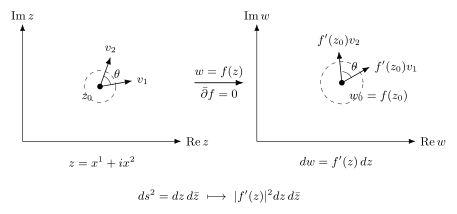
A holomorphic map is locally . Since , it acts on tangent vectors by a scale and a rotation , preserving the angle between them.
This is the two-dimensional miracle. In higher dimensions, the conformal Killing equation is overdetermined and only has finitely many solutions. In two dimensions, the Cauchy-Riemann equation has infinitely many local solutions.
Local versus global conformal transformations
Section titled “Local versus global conformal transformations”Not every holomorphic function is a globally well-defined one-to-one map of the Riemann sphere. This distinction matters.
A local conformal transformation is a holomorphic change of coordinate in a patch:
inside the patch. It may have poles, branch points, or fail to be invertible globally. Local transformations are what give two-dimensional CFT its infinite-dimensional symmetry algebra.
A global conformal transformation of the Riemann sphere is a holomorphic bijection from the sphere to itself. These are exactly the Möbius transformations
Because multiplying by a common nonzero constant gives the same map, the group is projective. It is usually written as
This is the same finite-dimensional global conformal group that one expects from the general -dimensional analysis, since
The infinite-dimensional enhancement is therefore not the group of globally defined conformal maps on the sphere. It is the algebra of locally holomorphic coordinate transformations.
That subtlety is worth saying bluntly:
The power of two-dimensional CFT comes from learning how the local symmetry is represented quantum mechanically. The answer is the Virasoro algebra.
Infinitesimal local conformal transformations
Section titled “Infinitesimal local conformal transformations”An infinitesimal local conformal transformation has the form
where is holomorphic and is antiholomorphic.
Expand the holomorphic vector field in Laurent modes:
It is conventional to introduce the holomorphic vector-field generators
Similarly,
They satisfy
and
This is the classical local conformal algebra, also called the Witt algebra, together with its antiholomorphic copy.
The global holomorphic subalgebra is generated by
These generate, respectively, translations, dilatations/rotations, and special conformal transformations in the coordinate. The barred generators do the same for .
A quick dictionary is
| Generator | Infinitesimal map | Meaning |
|---|---|---|
| translation | ||
| scale/rotation | ||
| special conformal |
The algebra generated by is :
In the quantum theory, these classical vector fields become operator generators and . The commutator acquires a central extension:
That is the Virasoro algebra. We will derive its origin from the stress tensor on the next page. For now, the important point is that vanishes from the global subalgebra because
So global conformal symmetry survives as an honest subalgebra even when the full local algebra has a central charge.
Primary fields and conformal weights
Section titled “Primary fields and conformal weights”In higher dimensions, a primary operator is labeled by its scaling dimension and its spin representation under rotations. In two dimensions, rotations and dilatations combine naturally into holomorphic and antiholomorphic weights.
A local field is called a primary field of weights if under a finite conformal map
it transforms as
The ordinary scaling dimension and spin are
To see this, take a real scale transformation
Then
For a rotation
one obtains
Thus and are more refined labels than and :
Examples:
| Field | Weights | Comment |
|---|---|---|
| scalar primary | spin , dimension | |
| holomorphic current | conserved chiral current | |
| antiholomorphic current | opposite chirality | |
| stress tensor | roughly | not quite primary when |
| stress tensor | roughly | antiholomorphic partner |
The phrase “roughly” for is deliberate. The stress tensor behaves like a field of holomorphic weight under global conformal transformations, but under general local transformations it picks up an anomalous Schwarzian derivative when . That is exactly why the central charge matters.
Infinitesimal transformation of a primary
Section titled “Infinitesimal transformation of a primary”Let
Using the finite transformation law and expanding to first order gives the active variation at the same coordinate point:
This formula is one of the most useful formulas in the subject. It says that a primary is not just dragged along by the vector field. It also carries a local scale weight, encoded by .
In terms of modes, the holomorphic action on a primary is represented by the differential operator
The antiholomorphic counterpart is
These satisfy the same Witt algebra:
This is the differential-operator representation of local conformal transformations on primary fields. In the quantum theory, the abstract generator acts on operator insertions through these differential operators plus possible contributions from descendant structure.
Two- and three-point functions
Section titled “Two- and three-point functions”Let and .
For primary fields, global conformal symmetry fixes the two-point function up to normalization. For diagonal fields with the same weights,
The correlator vanishes unless the two fields have compatible weights. In an orthonormal basis one often writes
The three-point function is also fixed up to one coefficient:
This is the two-dimensional version of the higher-dimensional statement that conformal symmetry fixes scalar two- and three-point functions. The difference is that the dependence factorizes into holomorphic and antiholomorphic powers.
For four points, there is a nontrivial cross-ratio
Global conformal symmetry fixes only the kinematic prefactor. The remaining dynamical information is a function of . Local conformal symmetry then reorganizes this function into Virasoro conformal blocks.
Holomorphic factorization: the first glimpse
Section titled “Holomorphic factorization: the first glimpse”The complex-coordinate split suggests a decomposition into holomorphic and antiholomorphic sectors. In a CFT, the stress tensor will satisfy
up to contact terms and anomalies, while conservation gives
One therefore introduces
with holomorphic and antiholomorphic away from insertions. The precise normalization will be fixed on the next page.
This is where two-dimensional CFT becomes qualitatively different from higher-dimensional CFT. The stress tensor is not merely one conserved operator. It generates infinitely many charges:
These charges are the quantum version of the local vector fields and .
AdS/CFT checkpoint
Section titled “AdS/CFT checkpoint”For AdS/CFT, this page matters in two different ways.
First, in AdS/CFT, the boundary CFT has two-dimensional local conformal symmetry. The resulting Virasoro symmetry is not an optional refinement; it is the organizing principle of the theory. Black-hole entropy, modular invariance, heavy-light correlators, and the Brown-Henneaux central charge all use this language.
Second, in string theory, the worldsheet theory is a two-dimensional CFT. Even when the spacetime holographic CFT lives in or , the string worldsheet is governed by the complex-coordinate machinery developed here. The distinction between holomorphic and antiholomorphic sectors becomes the distinction between left- and right-moving worldsheet modes.
So this module is not a detour from AdS/CFT. It is the exact-solvable 2D technology that repeatedly reappears in holography.
Common pitfalls
Section titled “Common pitfalls”The first pitfall is to identify “holomorphic” with “globally valid.” Holomorphic maps are locally conformal, but only Möbius maps are globally well-defined conformal automorphisms of the Riemann sphere.
The second is to forget the difference between and . On the physical Euclidean plane they are complex conjugates. In complexified CFT manipulations they are often treated as independent variables.
The third is to confuse primary and descendant fields. A primary transforms covariantly under local conformal maps. Derivatives of primaries are usually descendants, not primaries.
The fourth is to assume that is an ordinary primary of weight . It is not, unless . The central charge measures precisely the failure of to transform as a primary under general local conformal maps.
Summary
Section titled “Summary”Two-dimensional conformal symmetry is special because the local conformal transformations are holomorphic maps:
Their infinitesimal generators are
with
Primary fields carry weights :
Their finite transformation law is
This is the input for Virasoro symmetry, the stress-tensor OPE, minimal models, modular invariance, and AdS/CFT.
Exercises
Section titled “Exercises”Exercise 1: Cauchy-Riemann equations from conformality
Section titled “Exercise 1: Cauchy-Riemann equations from conformality”Let
Show that the condition
is equivalent, for an orientation-preserving map, to the Cauchy-Riemann equations
Solution
Write
where and . Then
Conformality requires the cross-term to vanish and the two diagonal coefficients to be equal:
These say that the two column vectors and are orthogonal and have equal length. For an orientation-preserving map, this means the second is obtained by rotating the first by :
Therefore
which are the Cauchy-Riemann equations.
Exercise 2: Local scale factor of a holomorphic map
Section titled “Exercise 2: Local scale factor of a holomorphic map”Let with . Show that
Then compute the Weyl factor for away from .
Solution
Since ,
On the real Euclidean plane, , so
Thus
For ,
so the Weyl factor is
The map is locally conformal wherever . At , the derivative vanishes for , so the map is not locally invertible there.
Exercise 3: The Witt algebra
Section titled “Exercise 3: The Witt algebra”Using
show that
Solution
Act on a test function . First,
Then
Similarly,
Subtracting,
Since
we get
Thus
Exercise 4: Dimension and spin from weights
Section titled “Exercise 4: Dimension and spin from weights”A primary field has weights . Use the finite primary transformation law to show that under a scale transformation it has dimension
and under a rotation it has spin
Solution
For a scale transformation,
Therefore
The primary transformation law gives
So .
For a rotation,
Then
Hence , with the sign convention used in this page.
Exercise 5: Two-point function of primaries
Section titled “Exercise 5: Two-point function of primaries”Assume translation and rotation invariance and let
Use global conformal invariance to show that a nonzero two-point function of primary fields requires compatible weights and has the form
Solution
Translation invariance implies that depends only on
Assume
Under a scale transformation , primary covariance gives
So
Under rotation , covariance gives the spin constraint
Thus
Invariance under the special conformal generator, or equivalently under inversion , further requires
Therefore a nonzero two-point function has
Exercise 6: Why three points can be fixed globally
Section titled “Exercise 6: Why three points can be fixed globally”Show that the Möbius transformation
maps
Why does this explain why there is no conformal cross-ratio made from only three points?
Solution
Evaluate directly:
because the numerator contains .
At ,
At , the denominator vanishes, so
Thus any three distinct points on the Riemann sphere can be mapped to by a global conformal transformation. Since their positions can all be removed by symmetry, no invariant cross-ratio can be built from only three points. Four points are different: after three are fixed, the fourth remains as the cross-ratio.
Further reading
Section titled “Further reading”For the classic treatment of this material, see Di Francesco, Mathieu, and Sénéchal, Chapter 5, especially the sections on conformal mappings, primary fields, correlation functions, and Ward identities. For the modern holographic perspective, keep this page paired with later discussions of AdS/CFT, the Cardy formula, and worldsheet CFT.