
Holographic Anomalies and the Central Charge of $\mathcal N=4$ SYM
In the scalar example, the boundary value of a bulk field acted as a source for a CFT operator. The most important version of the same idea is obtained by making the source the metric. The boundary metric couples to the CFT stress tensor,
Therefore a bulk graviton with boundary value computes stress-tensor correlation functions. In the classical supergravity limit,
where is the asymptotically AdS metric solving the bulk equations with conformal boundary metric . Functional derivatives of give
and higher derivatives give connected correlators of .
This page explains a particularly clean piece of stress-tensor physics: the Weyl anomaly. In four dimensions it is governed by the central charges and . For the canonical duality, the leading large- result is
This equality and its normalization are not just dimensional estimates. They follow from the logarithmic divergence of the on-shell gravitational action and from the reduction of type IIB supergravity on .
Stress tensors from gravitons
Section titled “Stress tensors from gravitons”For a scalar field, the source was a coefficient in the near-boundary expansion of the scalar. For the stress tensor, the source is the boundary value of the metric. In Fefferman—Graham coordinates an asymptotically metric may be written as
with
as . The CFT lives on the conformal class of . More precisely, the radial diffeomorphism
acts near the boundary as a Weyl transformation
This simple observation is the geometric origin of the holographic trace anomaly: a change of scale in the field theory is a change of radial cutoff in the bulk.
The connected two-point function of the stress tensor is fixed by conformal invariance up to one overall number. In four dimensions one common normalization is
where is a known dimensionless tensor determined by symmetry. With the anomaly convention used below,
Thus the coefficient of the graviton kinetic term in is the same information as the four-dimensional central charge . Similarly, the stress-tensor three-point function is computed by the cubic graviton vertex in the Einstein action. In a general four-dimensional CFT, contains more than one independent tensor structure. In a holographic theory governed by pure two-derivative Einstein gravity, the structures occur in the special combination corresponding to
Higher-derivative terms in the bulk action, such as curvature-squared terms, generically shift and differently.
Weyl anomalies in even-dimensional CFTs
Section titled “Weyl anomalies in even-dimensional CFTs”Classically, a CFT on a curved background has a traceless stress tensor,
Quantum mechanically this statement can fail in even spacetime dimension. The failure is local in the background metric and is called the Weyl anomaly or trace anomaly.
In two dimensions the standard normalization is
where is the Virasoro central charge. This is the two-dimensional prototype of a more general phenomenon: the coefficient of the anomaly counts degrees of freedom and is visible in stress-tensor correlators.
In four dimensions the universal part of the anomaly is
Here is the Weyl tensor and
is the Euler density. The coefficient is scheme-dependent: it can be shifted by adding a local counterterm to the generating functional. By contrast, and are universal CFT data.
A useful identity in four dimensions is
Therefore if , the anomaly becomes
This form is exactly what emerges from two-derivative Einstein gravity in .
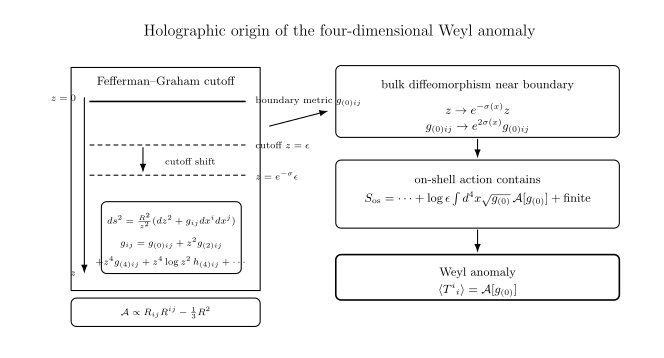
The radial cutoff in AdS is the UV cutoff of the boundary theory. When the cutoff is changed locally, the boundary metric is Weyl-rescaled. Power-law divergences are removable by local counterterms, while the logarithmic divergence produces the Weyl anomaly.
The logarithmic divergence of the AdS action
Section titled “The logarithmic divergence of the AdS action”Take five-dimensional Euclidean Einstein gravity with negative cosmological constant,
The Gibbons—Hawking term makes the variational problem well-defined with Dirichlet boundary conditions for the induced metric . The counterterm action subtracts divergences as the cutoff surface approaches the boundary.
For of radius ,
and the Einstein equation gives
so
The on-shell bulk Lagrangian is therefore constant:
This is why the leading part of the on-shell action is proportional to the regulated hyperbolic volume. In Fefferman—Graham coordinates, after solving the Einstein equations near the boundary and cutting off the spacetime at , the regulated action has the schematic form
The coefficients and are local functionals of the boundary metric and can be removed by local counterterms. The coefficient is also local, but it cannot be removed without introducing a scale. It is the anomaly.
For pure Einstein gravity in , holographic renormalization gives
up to the scheme-dependent term. Equivalently,
Comparing with the four-dimensional anomaly in the special case gives the central result
This equation is the holographic analogue of in . In both cases, the central charge is essentially the AdS radius measured in Planck units.
A quick derivation using an boundary
Section titled “A quick derivation using an S4S^4S4 boundary”The local anomaly formula is powerful, but the normalization of can also be read from a very simple background: Euclidean with an conformal boundary. Write the metric as
At large , the boundary sphere has radius proportional to . Cutting off the space at is therefore equivalent to placing a UV cutoff
The regulated volume contains a term linear in because
After including the standard boundary terms and counterterms, the coefficient of the logarithmic scale dependence is
On the CFT side, is conformally flat, so . The integrated Euler density satisfies
because and . Therefore
with the standard convention
Depending on whether one differentiates with respect to the radius or with respect to the UV cutoff, a minus sign may move between the two sides. The invariant comparison of magnitudes gives
hence again
This spherical calculation is a useful sanity check because it reduces the anomaly matching problem to the coefficient of a single logarithm.
Reducing type IIB supergravity on
Section titled “Reducing type IIB supergravity on S5S^5S5”The result is a five-dimensional statement. To compare with the D3-brane gauge theory, we need express and in string variables.
The ten-dimensional Newton constant is
The compactification space is a round five-sphere of radius , with volume
For the graviton zero mode, dimensional reduction gives
Thus
The D3-brane five-form flux fixes the radius by
Combining these relations,
Substitution into the holographic central charge formula gives
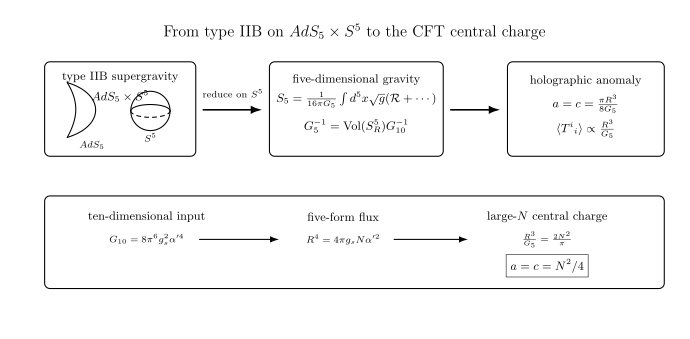
The leading stress-tensor normalization is fixed by the five-dimensional Newton constant. Reducing type IIB supergravity on and using the D3-brane flux relation gives .
The exact central charges of four-dimensional super-Yang—Mills are
The classical supergravity answer sees the leading term. The difference is subleading at large and is associated with quantum effects and the removal of the decoupled overall multiplet. The equality is exact in SYM; it is already visible at leading order because the bulk theory is ordinary Einstein gravity to lowest order.
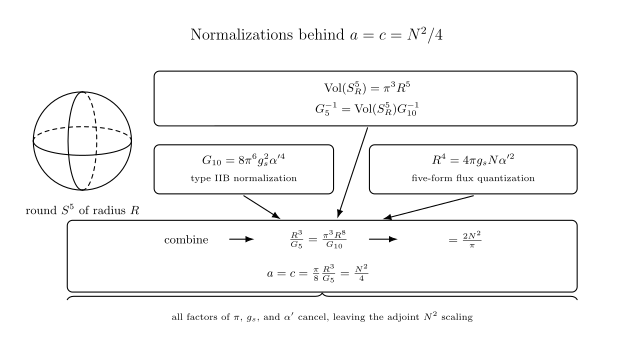
The volume converts into , while five-form flux quantization relates the common radius to the D3-brane number . These two ingredients are the whole normalization behind the central charge.
Why appears
Section titled “Why N2N^2N2 appears”The factor has a simple gauge-theory meaning. The elementary fields of SYM are in the adjoint representation. At large , the number of color degrees of freedom is
The gravity computation translates the same statement into Planck units. The combination controlling classical gravitational correlators in is
Large means , so the five-dimensional gravitational action is large and the saddle-point approximation is reliable. In the string description this is part of the familiar regime
with small enough to suppress string loops. The central charge is therefore a precise measure of the number of degrees of freedom, and the condition is one reason a classical bulk dual can exist.
Why pure Einstein gravity implies
Section titled “Why pure Einstein gravity implies a=ca=ca=c”Four-dimensional CFTs can have . In the bulk, this difference is controlled by higher-derivative gravitational interactions. Schematically,
Curvature-squared terms modify the tensor structures in the stress-tensor three-point function and generally shift and differently. Pure Einstein gravity has only one effective normalization for the graviton interactions, so it cannot generate two independent central charges. That is why the leading holographic prediction for any two-derivative Einstein dual in is
This statement is not an accident of . It is true for a broad class of leading large- holographic CFTs whose bulk dual is dominated by a two-derivative Einstein action. When higher-derivative corrections are important, the ratio becomes a sensitive diagnostic of stringy physics in the bulk.
Central charge, entropy, and the same normalization
Section titled “Central charge, entropy, and the same normalization”The same combination appeared earlier in the entropy density of the near-extremal D3-brane. The black-brane result is
at strong coupling. The central charge result is
Both are consequences of the same fact: classical type IIB supergravity on is normalized by . Thermodynamics, two-point functions, three-point functions, and anomalies all know about the same large number of degrees of freedom.
Exercises
Section titled “Exercises”Exercise 1. The anomaly in Ricci form
Section titled “Exercise 1. The a=ca=ca=c anomaly in Ricci form”Show that in four dimensions
Then derive the anomaly for in the convention
Solution
In four dimensions,
Also,
Subtracting gives
If , then
Exercise 2. Integrated anomaly on
Section titled “Exercise 2. Integrated anomaly on S4S^4S4”For a round four-sphere of radius , verify that
in the standard convention above.
Solution
For a round ,
The Euler density integrates to
because . Hence
Equivalently, using , one finds and . The volume is , so the integral of the Ricci-form anomaly is also .
Exercise 3. On-shell Einstein action in
Section titled “Exercise 3. On-shell Einstein action in AdSDAdS_DAdSD”Let have radius . Show that
and
Solution
The -dimensional Einstein equation with cosmological constant is
For ,
so
Substituting into the Einstein equation gives
hence
Then
Exercise 4. The five-dimensional Newton constant
Section titled “Exercise 4. The five-dimensional Newton constant”Starting from
and
derive
Solution
Dimensional reduction of the Einstein—Hilbert term gives
Therefore
Exercise 5. The central charge of SYM from supergravity
Section titled “Exercise 5. The central charge of N=4\mathcal N=4N=4 SYM from supergravity”Use
and the result of Exercise 4 to show that
Solution
The holographic formula is
Using
we obtain
Now square the radius relation:
Hence
Exercise 6. The stress-tensor two-point coefficient
Section titled “Exercise 6. The stress-tensor two-point coefficient”In the four-dimensional convention
find for strongly coupled SYM at leading large .
Solution
At leading large ,
Therefore
The exact result would replace by .
Exercise 7. Why higher derivatives can make
Section titled “Exercise 7. Why higher derivatives can make a≠ca\ne ca=c”Explain qualitatively why pure Einstein gravity gives , while higher-derivative terms in the bulk can produce .
Solution
Pure Einstein gravity has one overall normalization for the graviton kinetic term and its cubic self-interaction, namely . This fixes the stress-tensor two-point function and the Einstein-gravity stress-tensor three-point structure with a single coefficient. In a four-dimensional CFT language, this corresponds to the special relation .
Higher-derivative terms introduce new independent graviton interactions. For example, curvature-squared terms can change the coefficient of the stress-tensor two-point function and the coefficient of the Euler-anomaly term in different ways. Therefore the two independent CFT anomaly coefficients and no longer have to be equal.