
Nonconformal Branes and Generalized Holography
The main idea
Section titled “The main idea”The D3-brane example is so elegant that it can hide a more general lesson. A stack of D-branes always has two low-energy descriptions:
For , the near-horizon geometry is exactly , the dilaton is constant, and the brane gauge theory is a conformal field theory. This is the canonical AdS/CFT correspondence.
For , the same logic does not give an ordinary CFT. The worldvolume theory is maximally supersymmetric Yang-Mills theory in dimensions, but the Yang-Mills coupling is dimensionful:
There is no scale-invariant fixed point described simply by the Yang-Mills Lagrangian. Correspondingly, the near-horizon D-brane geometry is not AdS in the string frame, and the dilaton runs with the radial coordinate. Nevertheless, there is still a powerful generalized holographic dictionary. The organizing principle is the dimensionless effective coupling
This one formula tells you almost everything qualitative about D-brane holography. At an energy scale , the gauge theory is weakly coupled when . The dual supergravity throat is weakly curved when . But perturbative string theory also requires the local dilaton to be small, which imposes an upper bound on .
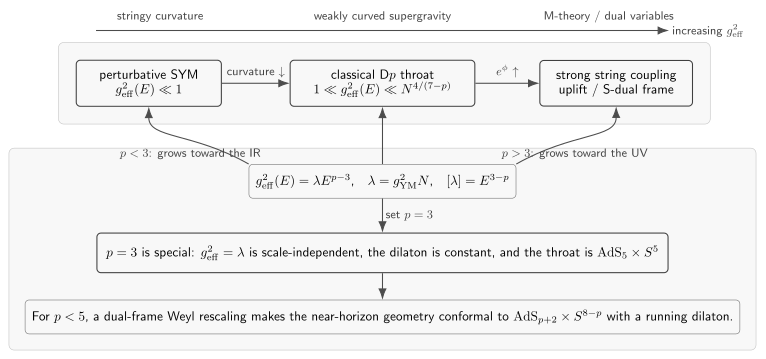
The regime map for D-brane holography. For , the effective coupling runs with the energy scale. The weakly curved classical D-brane throat exists in an intermediate window. The case is special because the effective coupling is scale-independent, the dilaton is constant, and the throat is exactly .
The right way to think about this page is:
It is not a failure of AdS/CFT. It is one of the best laboratories for learning which parts of holography require exact conformal symmetry and which parts only require large , strong coupling, and a controlled gravitational dual.
Why the D3-brane is special
Section titled “Why the D3-brane is special”The worldvolume theory on coincident D-branes contains a gauge field, adjoint scalar fields describing transverse brane fluctuations, and their fermionic superpartners. At low energy it is maximally supersymmetric Yang-Mills theory in dimensions.
The Yang-Mills coupling has dimension
Thus:
| brane | worldvolume dimension | coupling behavior | simple low-energy interpretation |
|---|---|---|---|
| D0 | matrix quantum mechanics | ||
| D1 | superrenormalizable gauge theory | ||
| D2 | flows strongly in the IR | ||
| D3 | conformal SYM | ||
| D4 | nonrenormalizable SYM, M5 completion | ||
| D5 | little-string-theory-like UV behavior |
For , is dimensionless. The near-horizon D3-brane solution has a constant dilaton and an AdS factor. The radial direction may be interpreted as a scale direction in an exactly conformal theory.
For , the coupling itself carries dimension. This does not mean the theory has no useful scaling structure; it means scaling must act on the coupling as well as on spacetime. This is the origin of generalized conformal symmetry.
A useful warning is:
Instead, it is a duality between a large- maximally supersymmetric Yang-Mills theory with a dimensionful coupling and a string/M-theory background whose curvature and dilaton run along the radial direction.
The D-brane decoupling limit
Section titled “The Dppp-brane decoupling limit”The logic mirrors the D3-brane derivation, but the result is less symmetric.
Start with coincident D-branes in type II string theory. The open-string description gives a dimensional gauge theory. The closed-string description gives an extremal black D-brane solution. The decoupling limit keeps the energy of open-string excitations fixed while removing asymptotically flat bulk gravity.
A convenient energy variable is
where is the transverse radial distance from the branes. The near-horizon limit sends
In a common convention,
up to powers of . The precise normalization is not universal across the literature, but the scaling with and is.
The string-frame near-horizon metric has the schematic form
where
and is a numerical constant depending on . The important point is not the constant. The important point is that, unless , the powers of do not combine into an AdS metric with constant sphere size in the string frame.
The dilaton runs as
The string-frame curvature in string units scales as
This immediately gives the two basic conditions for classical type II supergravity:
Equivalently,
This is the central validity window for the classical D-brane throat.
Notice the conceptual difference from the D3-brane case. In AdS/CFT, one can hold fixed and ask whether it is large or small. For , the same theory may be weakly coupled at one energy scale and strongly coupled at another.
The effective coupling as the running scale
Section titled “The effective coupling as the running scale”Because is dimensionful, the natural coupling at energy is
For , the exponent is negative. The effective coupling becomes small in the UV and large in the IR:
For , the direction is reversed:
For , the coupling is independent of scale:
This is why the same D-brane formula contains three qualitatively different behaviors.
The pattern
Section titled “The p<3p<3p<3 pattern”For , the Yang-Mills theory is superrenormalizable. It is weakly coupled in the UV and strongly coupled in the IR. The D-brane supergravity region often describes an intermediate-to-low-energy strong-coupling regime, but at sufficiently strong effective coupling the dilaton may become large and one must change duality frame.
For example, D2-branes at very low energy lift to M-theory and flow to an M2-brane conformal fixed point. This is why the D2 story is a bridge between nonconformal D-brane holography and the AdS/CFT examples discussed earlier in this module.
The pattern
Section titled “The p>3p>3p>3 pattern”For , the Yang-Mills coupling has negative mass dimension, so the Yang-Mills Lagrangian is not a UV-complete local field-theory description by itself. The gauge theory can still be an excellent low-energy effective description of D-brane dynamics, but its UV completion is stringy or M-theoretic.
The D4-brane case is especially important. Five-dimensional maximally supersymmetric Yang-Mills has
At high energy it is completed by the six-dimensional theory compactified on a circle. In the bulk, this is reflected by the lift of the type IIA D4-brane geometry to M-theory.
The and warnings
Section titled “The p=5p=5p=5 and p=6p=6p=6 warnings”For , the usual near-horizon behavior is tied to little string theory and linear-dilaton physics rather than a standard local QFT with an AdS-like boundary. For , the decoupling from bulk gravity and the holographic interpretation are more subtle still. In precision holographic discussions of nonconformal branes, one often focuses on , where the D-brane systems have a particularly clean generalized conformal structure.
This is not pedantry. The phrase “D-brane holography” covers several physically distinct regimes, and the limits do not all behave like AdS/CFT with different numbers of dimensions.
Generalized conformal structure
Section titled “Generalized conformal structure”The Yang-Mills action on D-branes has the schematic form
Under an ordinary scale transformation
the dimensionful coupling must transform as
Equivalently,
The theory is not conformal at fixed , but it is covariant under a combined transformation of coordinates and coupling. This is generalized conformal structure.
A two-point function of an operator of engineering dimension has the generalized scaling form
where
In an ordinary CFT, the function would be a constant up to normalization. In a nonconformal D-brane theory, the function encodes the running effective coupling.
The corresponding Ward identity is not simply . Instead, the trace is related to variation with respect to the coupling. Schematically,
where denotes possible anomaly terms in curved backgrounds or with spacetime-dependent sources. Different sign conventions move factors between the definition of the coupling operator and the trace identity, but the invariant statement is that scale transformations must act on .
On the gravity side, this generalized conformal structure is encoded by the running dilaton. The dilaton source is not an optional decoration; it is the bulk field that remembers the dimensionful Yang-Mills coupling.
Dual frame and generalized AdS behavior
Section titled “Dual frame and generalized AdS behavior”In the string frame, the D-brane near-horizon metric is not AdS for . But for , a Weyl rescaling by a power of the dilaton defines a useful dual frame:
up to normalization conventions for the dilaton. In this frame, the near-horizon geometry is conformal to
with a dilaton that is linear in the logarithm of the AdS radial coordinate.
One way to see the AdS-like structure is to define
Then the -dimensional part of the dual-frame metric has the same radial scaling structure as AdS:
The sphere also has fixed size in the dual frame, while the dilaton continues to run. Thus the geometry is not AdS in the strict Einstein/string-frame sense used in canonical AdS/CFT, but it retains enough AdS-like structure to support a precise holographic dictionary.
This is the geometric meaning of generalized conformal symmetry:
That statement should not be oversold. It does not mean that all CFT techniques apply unchanged. It means that many holographic ideas survive after being reorganized around the dimensionful coupling and the dilaton.
Thermodynamics from generalized scaling
Section titled “Thermodynamics from generalized scaling”The near-extremal D-brane black branes give the finite-temperature thermodynamics of the maximally supersymmetric Yang-Mills theory at strong effective coupling.
Dimensional analysis plus generalized conformal structure strongly constrains the free energy density. Let
be the effective ‘t Hooft coupling at the thermal scale. In the classical supergravity regime, the strong-coupling free energy density scales as
up to a -dependent numerical coefficient.
The entropy density then scales as
For , the exponent vanishes and one recovers the conformal scaling
For , the thermodynamics is not conformal. The trace of the stress tensor is nonzero, and the speed of sound differs from the conformal value. In the classical nonconformal brane plasma one finds a simple equation-of-state relation of the form
again for the standard near-extremal D-brane regime. This reproduces for but gives nonconformal values for other .
This is a good example of how nonconformal brane holography works in practice. The result is not arbitrary model-building. The dependence on , , and is fixed by generalized conformal structure and the gravitational scaling of the D black brane.
What changes compared with AdS/CFT?
Section titled “What changes compared with AdS/CFT?”The computational philosophy remains familiar:
but several technical points change.
The boundary data include the coupling
Section titled “The boundary data include the coupling”In an ordinary AdS/CFT computation, one often fixes the boundary metric and turns on sources for CFT operators. In nonconformal brane holography, the Yang-Mills coupling is a dimensionful source. The dilaton boundary behavior encodes this coupling.
Thus the source sector includes at least
The stress tensor and the coupling operator mix in Ward identities. Ignoring the dilaton generally gives the wrong trace relation.
Holographic renormalization is still possible
Section titled “Holographic renormalization is still possible”Although the spacetime is not asymptotically AdS in the original frame, holographic renormalization can be formulated systematically. The counterterms are organized by generalized conformal covariance and by the radial Hamiltonian structure. The renormalized stress tensor, scalar one-point functions, and Ward identities can be computed in a way that parallels ordinary AdS holographic renormalization.
The slogan is:
What matters is whether there is a controlled asymptotic structure and a well-defined variational problem.
The radial direction is still an energy scale, but not a CFT scale
Section titled “The radial direction is still an energy scale, but not a CFT scale”In AdS/CFT, radial translations correspond to scale transformations of an exact CFT. For D branes, radial evolution changes the effective coupling:
The radial coordinate is still an energy-scale coordinate, but the theory is not invariant under moving along it unless one also transforms .
Validity is local in the radial direction
Section titled “Validity is local in the radial direction”In AdS, if and , the entire throat is weakly curved and weakly coupled in the same parametric sense. For D branes, the curvature and dilaton vary with . A calculation probing different radial depths may move through different validity regimes.
This is especially important for Wilson loops, entanglement surfaces, real-time probes, and finite-temperature horizons. One must ask where the classical solution actually goes in the radial direction and whether that region is inside the supergravity window.
A compact dictionary
Section titled “A compact dictionary”The following table summarizes the basic nonconformal D-brane dictionary.
| Gauge-theory quantity | Bulk quantity | Comment |
|---|---|---|
| RR flux through | controls bulk loop expansion | |
| asymptotic dilaton/source data | dimensionful for | |
| throat scale | dimension | |
| local curvature scale | ||
| local string coupling | ||
| metric response | trace Ward identity includes coupling variation | |
| coupling operator | dilaton response | mixes with trace physics |
| thermal state | near-extremal black D brane | nonconformal equation of state |
The most important row is the effective coupling row. It tells you which language is best at a given scale.
Examples and crossovers
Section titled “Examples and crossovers”D0-branes and matrix quantum mechanics
Section titled “D0-branes and matrix quantum mechanics”D0-branes give maximally supersymmetric matrix quantum mechanics. This system is closely related to the BFSS matrix model and provides a sharp testing ground for gauge/gravity duality because it can be studied numerically on the gauge-theory side. The gravity dual is a black zero-brane geometry in the appropriate thermal state. The effective coupling grows toward low energy.
The theory is not a CFT, but its thermal observables obey characteristic generalized conformal scaling. At strong coupling and large , black zero-brane thermodynamics is described by type IIA supergravity until the dilaton becomes too large and an eleven-dimensional description is needed.
D2-branes and the M2 crossover
Section titled “D2-branes and the M2 crossover”D2-brane Yang-Mills theory has
It is weakly coupled in the UV and strongly coupled in the IR. At very low energy, the type IIA dilaton grows, and the system lifts to M-theory. The IR physics is related to M2-brane conformal physics. Thus D2-brane holography gives an instructive example of a nonconformal flow into a conformal M-theory regime.
D4-branes and the M5 completion
Section titled “D4-branes and the M5 completion”D4-brane Yang-Mills theory is five-dimensional and has
It is not perturbatively UV complete as a standalone Yang-Mills theory. At high energy, the type IIA description lifts to M-theory, and the UV completion is the six-dimensional theory compactified on a circle.
This is the conceptual origin of many holographic QCD-like constructions based on compactified D4-branes. They are not exact duals of four-dimensional QCD, but they give controlled large- geometric models of confinement-like physics in certain limits.
D5-branes, NS5-branes, and little strings
Section titled “D5-branes, NS5-branes, and little strings”D5-branes and their S-dual NS5 descriptions lead toward little string theory rather than ordinary local QFT holography. The near-horizon geometry has linear-dilaton features and a Hagedorn-like density of states. This is a different kind of holography and should not be casually treated as just another AdS/CFT example.
Relation to bottom-up nonconformal models
Section titled “Relation to bottom-up nonconformal models”Earlier in the course, we studied relevant deformations, domain walls, hard-wall and soft-wall models, and holographic QCD-like duals. Nonconformal D-brane holography is related but conceptually distinct.
A relevant deformation of a CFT starts with a UV fixed point and perturbs it by an operator:
A D-brane Yang-Mills theory with is not usually presented as a deformation of a UV CFT by a single operator. The coupling that defines the Lagrangian is dimensionful from the start. The correct scaling structure is generalized conformal rather than ordinary conformal.
Bottom-up models often choose an Einstein-dilaton potential to engineer desired QCD-like behavior. D-brane backgrounds, by contrast, are top-down string/M-theory solutions with fixed potentials, fixed sphere reductions, fixed dilaton couplings, and fixed generalized conformal scaling. They are less flexible but more constrained.
A good rule is:
Common mistakes
Section titled “Common mistakes”Mistake 1: Calling every brane throat “AdS”
Section titled “Mistake 1: Calling every brane throat “AdS””Only special branes have exact AdS near-horizon geometries in the usual frame: D3, M2, M5, and some intersecting or wrapped systems. Generic D branes are not AdS. They may be conformal to AdS in a dual frame, but the running dilaton is essential.
Mistake 2: Treating as dimensionless
Section titled “Mistake 2: Treating λ\lambdaλ as dimensionless”For , has dimension. The meaningful expansion parameter at scale is , not alone.
Mistake 3: Forgetting the dilaton validity condition
Section titled “Mistake 3: Forgetting the dilaton validity condition”Large effective coupling suppresses curvature corrections, but it can also make the dilaton large. Classical type II supergravity needs both small curvature and small string coupling:
The middle window can be large at large , but it is not infinite.
Mistake 4: Applying CFT formulas without modification
Section titled “Mistake 4: Applying CFT formulas without modification”There is no ordinary conformal Ward identity . Entanglement, correlators, thermal observables, and transport coefficients do not have CFT scaling unless or unless the system flows to a separate conformal fixed point.
Mistake 5: Confusing a low-energy Yang-Mills description with a UV completion
Section titled “Mistake 5: Confusing a low-energy Yang-Mills description with a UV completion”For , maximally supersymmetric Yang-Mills is an effective description, not a conventional UV-complete perturbative QFT. The UV completion is string/M-theoretic, as in the D4/M5 relation.
Exercises
Section titled “Exercises”Exercise 1: Dimension of the Yang-Mills coupling
Section titled “Exercise 1: Dimension of the Yang-Mills coupling”In dimensions, the Yang-Mills action contains
Using and , show that
Solution
In dimensions, the gauge field has engineering dimension
in the normalization natural for dimensional reduction from ten dimensions, so
The measure has dimension
Therefore
has dimension
For the action to be dimensionless, must have dimension , so
Equivalently, the ‘t Hooft coupling has the same dimension.
Exercise 2: The effective coupling
Section titled “Exercise 2: The effective coupling”Use dimensional analysis to show that the natural dimensionless ‘t Hooft coupling at energy is
For which values of does the theory become strongly coupled in the IR?
Solution
Since
we need to multiply by to form a dimensionless quantity:
If , then , so
Thus grows in the IR for . If , it grows in the UV. If , it is independent of .
Exercise 3: The supergravity validity window
Section titled “Exercise 3: The supergravity validity window”Assume that in the D-brane throat
Derive the parametric type II supergravity window.
Solution
Small curvature in string units requires
Using
we obtain
Weak local string coupling requires
Using
this gives
Raising both sides to the power gives
Combining the two inequalities,
Exercise 4: Generalized scaling of a two-point function
Section titled “Exercise 4: Generalized scaling of a two-point function”Let have engineering dimension . Show that generalized scale covariance allows the two-point function to take the form
Solution
The two-point function has dimension , so the prefactor gives the correct overall dimension. The remaining dependence must be through dimensionless combinations.
Since
the combination
is dimensionless. It is precisely the effective coupling at the scale :
Therefore the most general generalized-scale-covariant form is
possibly with additional dependence on and other dimensionless parameters.
Exercise 5: Recovering conformal thermodynamics at
Section titled “Exercise 5: Recovering conformal thermodynamics at p=3p=3p=3”The strong-coupling free energy density of near-extremal D branes scales as
Show that for this becomes the usual conformal scaling of four-dimensional SYM.
Solution
Set . Then
Therefore
The free energy density becomes
This is exactly the scaling expected for a four-dimensional conformal plasma. The entropy density scales as
Further reading
Section titled “Further reading”- N. Itzhaki, J. M. Maldacena, J. Sonnenschein, and S. Yankielowicz, “Supergravity and the Large Limit of Theories with Sixteen Supercharges”. The classic source for the D-brane decoupling limits, effective coupling, and supergravity regimes.
- H. J. Boonstra, K. Skenderis, and P. K. Townsend, “The Domain-Wall/QFT Correspondence”. A foundational paper on the domain-wall/generalized-holography viewpoint.
- A. Jevicki and T. Yoneya, “Generalized Conformal Symmetry in D-Brane Matrix Models”. A useful discussion of generalized conformal symmetry from the gauge-theory side.
- I. Kanitscheider, K. Skenderis, and M. Taylor, “Precision Holography for Non-Conformal Branes”. The standard modern reference for holographic renormalization and one-point functions in nonconformal brane backgrounds.
- I. Kanitscheider and K. Skenderis, “Universal Hydrodynamics of Non-Conformal Branes”. A useful bridge between this page and the transport chapters.