
The Four Languages of AdS/CFT
Why one duality needs several languages
Section titled “Why one duality needs several languages”AdS/CFT is one correspondence, but it is rarely understood from only one point of view. The same physical statement can look like a theorem about CFT correlators, a boundary-value problem in curved spacetime, a string-theoretic decoupling limit of branes, or a statement about entanglement and quantum error correction. A mature understanding of holography means being able to translate between these descriptions without confusing their domains of validity.
A useful slogan is:
But in practice we use several approximations to unpack the right-hand side. In the strongest formulation, the boundary CFT is a nonperturbative definition of the bulk quantum gravity theory. In the most calculable regime, the bulk becomes a weakly coupled effective field theory on a classical geometry. Between those two statements lie the parameters, branes, compact spaces, string modes, entanglement wedges, and large- limits that make AdS/CFT a usable tool rather than a slogan.
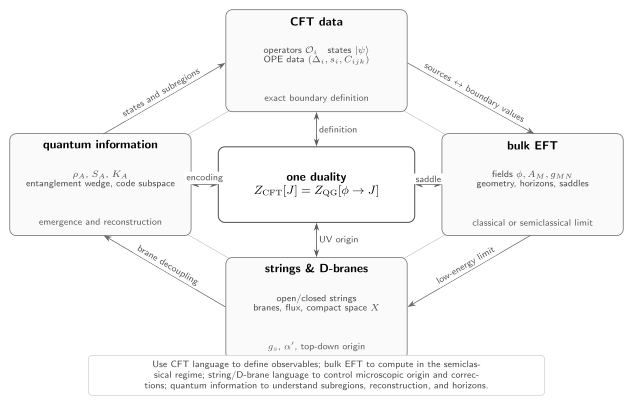
The four languages used throughout this course. The exact statement is the equality of the CFT and bulk quantum-gravity descriptions, schematically . Classical geometry, string/D-brane constructions, and quantum-information structures are different controlled ways of extracting physics from that equality.
Each language has a different natural set of questions.
| Language | Natural objects | Typical question |
|---|---|---|
| CFT | operators, states, OPE data, sources | What are the exact observables of the boundary theory? |
| Bulk EFT | fields, metrics, horizons, boundary conditions | What is the classical or semiclassical gravitational saddle? |
| String/D-brane | open strings, closed strings, branes, flux, compactification | Why does this CFT have a gravitational dual, and what controls corrections? |
| Quantum information | density matrices, entropy, modular flow, code subspaces | How does spacetime emerge from entanglement and redundancy? |
The languages are not competitors. They are coordinate systems on the same conceptual space. One should use the CFT language for exact definitions, the bulk EFT language for practical calculations at strong coupling and large , the string/D-brane language for microscopic origin and correction scales, and the quantum-information language for questions about emergence, subregions, and black-hole information.
Language I: CFT data
Section titled “Language I: CFT data”The cleanest side of the duality is the conformal field theory. A CFT is defined by its Hilbert space, operator algebra, correlation functions, and stress tensor. In a local CFT, one can organize the local operator content into conformal primaries and descendants. The fundamental data include the spectrum of dimensions and spins,
and the OPE coefficients,
with tensor structures suppressed. In many CFTs, this data is the most intrinsic description of the theory. It does not depend on a Lagrangian, a weak-coupling expansion, or a geometric interpretation.
The CFT language asks questions such as:
- What are the single-trace primary operators?
- What are the scaling dimensions and OPE coefficients ?
- What is the stress-tensor two-point coefficient ?
- What is the thermal partition function ?
- What is the entanglement entropy of a spatial region ?
- What is the retarded Green function of a conserved current?
In AdS/CFT, these questions become gravitational questions. A scalar primary operator maps to a bulk field. A conserved current maps to a bulk gauge field. The stress tensor maps to the bulk metric. A thermal state maps to a black hole or another Euclidean saddle. Entanglement entropy maps to a geometric or quantum extremal surface.
The CFT side also provides the most precise formulation of unitarity. If the CFT Hamiltonian is self-adjoint and time evolution is
then the bulk theory is unitary, even when a semiclassical gravitational description seems to hide information behind horizons. This is why AdS/CFT is so powerful in the black-hole information problem: the boundary theory gives a definition that is not formulated in terms of local bulk spacetime variables.
Large as the bridge to particles
Section titled “Large NNN as the bridge to particles”For holographic CFTs with matrix degrees of freedom, the large- expansion organizes correlation functions in a way that resembles a weakly coupled bulk theory. A single-trace operator has schematic form
where the normalization is chosen so that its two-point function is . Then connected correlators often scale as
This is the CFT shadow of bulk perturbation theory. Two-point functions are order one, three-point functions are suppressed by , and connected four-point functions are suppressed by . In the bulk, this is the statement that interactions among canonically normalized single-particle fields are weak when the gravitational coupling is small.
A useful dictionary entry is therefore:
Large alone is not enough to produce Einstein gravity. A vector model can also have a large- expansion, but its bulk dual, when it exists, is usually a higher-spin theory rather than ordinary Einstein gravity. To obtain a local Einstein-like bulk effective field theory, the CFT needs additional structure: a parametrically large gap in the dimensions of higher-spin single-trace operators, sparse low-dimension spectrum, and sufficiently universal stress-tensor dynamics. These conditions will return later when we discuss the canonical example and noncanonical dualities.
Language II: bulk effective field theory
Section titled “Language II: bulk effective field theory”The bulk language is the one most people first associate with AdS/CFT: fields propagating on an asymptotically AdS spacetime. A scalar field in AdS, a Maxwell field , and a metric are not merely decorative bulk variables. They encode CFT operators and sources.
The central semiclassical statement is
in Euclidean signature. Here is a boundary source, solves the bulk equations of motion with prescribed asymptotic behavior, and is the renormalized on-shell action. The word “renormalized” is essential: the infinite volume near the AdS boundary produces divergences, and local boundary counterterms are required before differentiating with respect to sources.
For example, if a scalar operator is sourced by , then
and the bulk problem is to solve for a scalar field whose near-boundary behavior is controlled by . Functional derivatives of the renormalized on-shell action then give CFT correlators.
The bulk EFT language is especially efficient for:
| CFT question | Bulk EFT calculation |
|---|---|
| Two-point function of | Solve a linear wave equation in AdS. |
| Thermal entropy | Compute the area of a black-hole horizon. |
| Transport coefficient | Solve linearized perturbations with infalling horizon boundary conditions. |
| RG flow | Find a domain-wall solution driven by scalar fields. |
| Entanglement entropy at leading large | Extremize an area functional. |
The bulk description also explains why spacetime geometry is dynamical. The CFT stress tensor couples to a background metric , while the dual bulk field is the full metric . The source is the boundary metric, and the response is the expectation value of the stress tensor:
In a semiclassical bulk limit, the expectation value is read from the asymptotic behavior of the metric through holographic renormalization. Thus the gravitational constraints and boundary Ward identities are two versions of the same structure.
What the bulk EFT language hides
Section titled “What the bulk EFT language hides”The bulk EFT language is powerful because it is geometric. It is dangerous for the same reason. Classical geometry is not the fundamental definition of the theory. It is an approximation valid in a regime where several corrections are small.
The usual hierarchy is:
where is the AdS radius, is the bulk Planck length, and is the string length. The first inequality suppresses quantum gravitational loops. The second suppresses higher-derivative stringy corrections. In the canonical AdS/CFT example, these conditions are tied to large and large ‘t Hooft coupling :
Thus the sentence “the dual is classical gravity” should always be expanded into the more precise statement:
That longer sentence is less catchy, but it is much less misleading.
Language III: string theory and D-branes
Section titled “Language III: string theory and D-branes”The string/D-brane language explains why the most famous holographic CFTs exist in the first place. It is the microscopic construction language.
A D-brane has two complementary descriptions. Open strings ending on the brane produce gauge fields and matter degrees of freedom living on the brane worldvolume. The same D-brane also carries energy, tension, and Ramond-Ramond charge, so it sources closed-string fields and curves spacetime. In an appropriate low-energy decoupling limit, these two descriptions isolate two apparently different theories that are then identified.
For coincident D3-branes, the open-string description gives four-dimensional super Yang-Mills theory with gauge group roughly or after removing the decoupled center-of-mass . The closed-string description gives type IIB string theory in the near-horizon geometry
This is why the canonical duality is not an arbitrary guess. It comes from a system with two low-energy descriptions:
The string language naturally contains objects that are invisible or awkward in pure bulk EFT:
- fundamental strings ending on the boundary, dual to Wilson loops;
- D-branes wrapping cycles in the compact space, dual to baryon vertices or defects;
- Kaluza-Klein modes on the internal manifold, dual to towers of CFT operators;
- string oscillator modes, dual to heavy single-trace operators;
- worldsheet genus expansion, dual to the expansion;
- corrections, dual to finite-coupling corrections in the CFT.
The two parameters and are especially important. The string coupling controls the splitting and joining of closed strings, while controls the string length. In the canonical example,
At fixed large , taking makes small and suppresses string loops. Taking makes the string length much smaller than the AdS radius and suppresses stringy higher-derivative corrections. Classical Einstein gravity requires both.
Why string theory is not optional
Section titled “Why string theory is not optional”For many applications, especially bottom-up holography, one begins directly with an effective gravitational action and does not specify a full string compactification. This can be extremely useful. But the string language remains conceptually important for at least three reasons.
First, it explains which quantum gravity theory the bulk EFT is approximating. An Einstein-Maxwell-scalar action in AdS can be a useful model, but by itself it is not automatically a complete ultraviolet-consistent quantum gravity theory.
Second, it controls correction terms. Higher-derivative terms, extra fields, brane sources, and internal dimensions are not arbitrary decorations; in top-down examples they are constrained by string theory.
Third, it distinguishes universal from model-dependent results. Some predictions depend only on two-derivative gravity and horizon regularity. Others depend on the precise compactification, matter content, brane embedding, or string-scale physics.
A good habit is to ask of every bulk model:
The answer determines how much microscopic trust one should place in the calculation.
Language IV: quantum information
Section titled “Language IV: quantum information”The quantum-information language became central because classical geometry alone cannot explain how bulk spacetime is encoded in the boundary theory. A boundary subregion has a reduced density matrix
and an entanglement entropy
In holographic theories, the leading large- entropy of a spatial region is computed by an extremal surface in the bulk:
The dots are not an afterthought. They include bulk entanglement entropy and further quantum corrections. The deeper statement is not simply “entropy equals area.” It is that the pattern of entanglement in the CFT knows about the connectivity, locality, and causal structure of the emergent bulk.
The quantum-information language asks questions such as:
- Which bulk region is encoded in a boundary subregion ?
- Why can the same bulk operator be reconstructed from different boundary regions?
- How does the radial direction emerge from scale and entanglement?
- What is the role of the modular Hamiltonian
- How does a black-hole Page curve arise from a gravitational entropy calculation?
The answer to the first question is the entanglement wedge. Roughly, the boundary region reconstructs the bulk domain bounded by and the appropriate extremal surface . The answer to the second question uses quantum error correction: bulk information is encoded redundantly in the boundary, so a low-energy bulk operator may have multiple boundary reconstructions.
This language is indispensable for modern questions about black holes. The classical bulk description treats the region behind a horizon as a geometric interior. The CFT description treats the same physics as encoded in quantum degrees of freedom with unitary time evolution. The quantum-information language explains how both can be true inside a restricted code subspace, and why semiclassical intuition may fail outside that code subspace.
A translation table
Section titled “A translation table”The following table gives a first map between the four languages. Later chapters turn each row into a calculation.
| Physical idea | CFT language | Bulk EFT language | String/D-brane language | Quantum-information language |
|---|---|---|---|---|
| Local scalar excitation | Primary operator with dimension | Scalar field with | Kaluza-Klein or string mode | Low-energy bulk excitation in a code subspace |
| Global symmetry | Conserved current | Gauge field | Gauge field from compactification or branes | Charged sectors of the Hilbert space |
| Energy and momentum | Stress tensor | Bulk metric | Closed-string graviton | Modular energy and gravitational constraints |
| Source deformation | Add to the action | Boundary condition | Change asymptotic string background | Change the state or Hamiltonian data |
| Thermal state | Euclidean saddle or Lorentzian black hole | Thermal string background | Mixed state or one side of a thermofield double | |
| Wilson loop | Nonlocal operator | Minimal surface ending on | Fundamental string worldsheet | Probe of confinement and screening |
| Entanglement entropy | Area of an extremal surface plus corrections | Geometry from branes and strings | Entanglement wedge and error correction | |
| RG flow | Relevant deformation and running observables | Radial domain-wall geometry | Change of brane configuration or flux background | Coarse graining and scale-dependent encoding |
This table should be used actively. When reading a paper, pause whenever an object appears and ask which row it belongs to. For example, a “charged scalar in RN-AdS” is not just a bulk field in a black-hole metric. It is also a charged CFT operator at finite chemical potential, a sector of a possible string compactification, and a probe of the entanglement structure of a finite-density state.
Example 1: a scalar two-point function
Section titled “Example 1: a scalar two-point function”Consider a scalar primary operator in a -dimensional CFT. In CFT language, conformal invariance fixes its two-point function up to normalization:
In bulk EFT language, this result comes from solving the scalar wave equation in AdS. Near the boundary, the scalar behaves schematically as
The leading coefficient is the source, while the subleading coefficient is related to the expectation value . The mass of the bulk scalar is tied to the dimension of the operator:
In string language, the scalar may be a Kaluza-Klein mode of a ten- or eleven-dimensional field on the compact internal space, or a genuine string excitation. Its mass and interactions are determined by the compactification. In quantum-information language, this scalar describes a low-energy bulk excitation inside a code subspace: a small perturbation around a semiclassical background that can be reconstructed from suitable boundary regions.
All four descriptions are talking about the same object, but they answer different questions. The CFT fixes the allowed conformal form. The bulk EFT computes the normalization and strong-coupling dynamics. The string construction explains where the field came from and what corrections exist. Quantum information tells us how the excitation is encoded in boundary subregions.
Example 2: a thermal state
Section titled “Example 2: a thermal state”Now consider a thermal CFT state at inverse temperature :
In Euclidean CFT language, this is the partition function on a space with a thermal circle of circumference . In Lorentzian language, it defines real-time thermal correlators and hydrodynamic response functions.
In bulk EFT language, a high-temperature deconfined state of a holographic large- CFT is often represented by an AdS black brane or black hole. The temperature is the Hawking temperature, and the entropy is the Bekenstein-Hawking entropy:
In string language, the same background may include a compact thermal circle, possible winding modes, and string-scale corrections. At sufficiently high curvature or near special transitions, the classical black-hole picture may fail and stringy degrees of freedom become important.
In quantum-information language, a thermal density matrix can be purified as a thermofield double state,
which is dual, in the appropriate regime, to an eternal two-sided AdS black hole. The Einstein-Rosen bridge is then not an additional independent system. It is a geometric representation of entanglement between two CFTs in a special entangled state.
Example 3: an RG flow
Section titled “Example 3: an RG flow”A relevant deformation of a CFT has the form
In CFT language, this triggers a renormalization-group flow away from the original fixed point. In bulk EFT language, the source changes the near-boundary behavior of the scalar field dual to , and the geometry may become a domain wall interpolating between two asymptotic regimes. In string language, the flow may correspond to changing brane data, fluxes, compactification moduli, or relevant modes of the worldvolume theory. In quantum-information language, the flow changes the organization of degrees of freedom across length scales and hence the entanglement structure.
The radial coordinate is therefore not merely “the energy scale.” That phrase is often useful, but it is shorthand. The precise statement is that radial evolution in the bulk encodes the way boundary observables change under changes of scale, sources, and cutoff. The map is powerful, but it is not a literal identification of a coordinate with an RG parameter in every gauge and every state.
How to choose the right language
Section titled “How to choose the right language”A common beginner mistake is to choose one language too early and forget the others. A better workflow is:
- Define the observable in CFT language. This prevents confusion about what is actually being computed.
- Translate it into a bulk boundary-value problem. This gives a practical calculation when the semiclassical approximation is valid.
- Ask what controls the approximation. This usually requires large- and string-theory language.
- Ask what is encoded where. This becomes essential for subregions, horizons, and information-theoretic questions.
For example, suppose one wants the conductivity of a finite-density holographic state. The CFT observable is the retarded current-current correlator,
The bulk EFT computation solves a Maxwell perturbation in a charged black-hole background with infalling boundary conditions at the horizon. The string/D-brane language asks whether the Maxwell field is a consistent truncation, whether there are charged branes or extra light modes, and what corrections may affect the result. The quantum-information language asks what the horizon and near-horizon region mean in the boundary theory, especially near extremality.
This habit of translation is what turns holography from a collection of famous formulas into a research method.
Subtleties and common mistakes
Section titled “Subtleties and common mistakes”Mistake 1: treating the bulk picture as always classical
Section titled “Mistake 1: treating the bulk picture as always classical”The exact duality, when it exists, relates the CFT to quantum gravity or string theory, not merely to Einstein’s equations. Classical geometry is a limit. The bulk may contain string-scale curvature, quantum loops, branes, topology change, or no useful geometric description at all.
Mistake 2: treating every large- CFT as Einstein gravity
Section titled “Mistake 2: treating every large-NNN CFT as Einstein gravity”Large gives factorization and a perturbative expansion. It does not automatically give a local Einstein bulk. The low-dimension single-trace spectrum and higher-spin gap matter. This is why matrix large- theories, vector large- theories, and generalized free theories can have very different bulk interpretations.
Mistake 3: forgetting the compact space
Section titled “Mistake 3: forgetting the compact space”Writing “AdS” often hides the internal manifold. In top-down examples, the bulk is usually something like
where is compact. The symmetries, Kaluza-Klein spectrum, flux quantization, and brane objects depend on . Ignoring it is sometimes an excellent low-energy approximation, but it is still an approximation.
Mistake 4: confusing sources and states
Section titled “Mistake 4: confusing sources and states”A source changes the Hamiltonian or action. A state chooses a vector or density matrix in the Hilbert space. In the bulk, these often correspond to different asymptotic and normalizable data. For a scalar field,
where is source-like and is response-like, up to subtleties such as alternate quantization and contact terms.
Mistake 5: reducing quantum information to a metaphor
Section titled “Mistake 5: reducing quantum information to a metaphor”Entanglement wedges and quantum error correction are not just analogies. They give precise constraints on which bulk operators can be reconstructed from which boundary regions. The language is especially important when semiclassical geometry gives ambiguous intuition, as in black-hole interiors and island calculations.
Exercises
Section titled “Exercises”Exercise 1: Translate basic objects
Section titled “Exercise 1: Translate basic objects”Fill in the missing entries in the following dictionary.
| CFT object | Bulk EFT object |
|---|---|
| Scalar primary | ? |
| Conserved current | ? |
| Stress tensor | ? |
| Wilson loop | ? |
| Entanglement entropy | ? |
Solution
The standard leading dictionary is:
| CFT object | Bulk EFT object |
|---|---|
| Scalar primary | Bulk scalar field with |
| Conserved current | Bulk gauge field |
| Stress tensor | Bulk metric , with boundary value |
| Wilson loop | Fundamental string worldsheet ending on at the boundary |
| Entanglement entropy | Extremal surface area, plus quantum corrections |
The entries are leading statements. For example, the Wilson-loop entry is sharpest in string theory, not in pure Einstein gravity. The entanglement entry becomes
once bulk quantum corrections are included.
Exercise 2: Functional derivatives in the semiclassical limit
Section titled “Exercise 2: Functional derivatives in the semiclassical limit”Suppose the Euclidean generating functional is approximated by
and define
Show that, with the convention
one has
Explain why signs may differ in the literature.
Solution
From the saddle-point approximation,
Therefore
Different sign conventions arise because authors may define the Euclidean source term as either
or
They may also work in Lorentzian signature, where the saddle is written as instead of . The invariant lesson is that CFT one-point functions are obtained by differentiating the properly renormalized on-shell action with respect to boundary sources, after fixing a convention.
Exercise 3: Large- factorization and bulk interactions
Section titled “Exercise 3: Large-NNN factorization and bulk interactions”Assume normalized single-trace operators obey
What is the scaling of the connected three-point and four-point functions? Interpret the result in bulk language.
Solution
For ,
For ,
In the bulk, normalized single-trace operators create single-particle states. The suppression of connected higher-point functions means that bulk interactions are weak. A cubic vertex among canonically normalized bulk fields is typically suppressed by , while tree-level exchange or contact contributions to connected four-point functions scale like . This is the CFT manifestation of weakly coupled bulk perturbation theory.
Exercise 4: A thermal state in four languages
Section titled “Exercise 4: A thermal state in four languages”Describe the same thermal state in the four languages of this page.
Solution
In CFT language, a thermal state is described by the density matrix
and the partition function
In bulk EFT language, the dominant high-temperature saddle of a holographic large- theory is often an AdS black hole or black brane. The temperature is the Hawking temperature, and the entropy is computed from the horizon area.
In string/D-brane language, the same state is a thermal state of the underlying string background, with possible winding modes, branes, compact-space effects, and corrections.
In quantum-information language, the thermal density matrix can be purified as a thermofield double state. When the semiclassical regime is valid, the thermofield double is dual to a two-sided eternal AdS black hole.
Exercise 5: Which language controls which approximation?
Section titled “Exercise 5: Which language controls which approximation?”For each statement below, identify the language that most directly diagnoses the issue.
- Whether a CFT has a large higher-spin gap.
- Whether a Wilson loop should be computed by a fundamental string or by a D-brane.
- Whether a black-brane conductivity calculation needs infalling boundary conditions.
- Whether a bulk operator lies in the entanglement wedge of a boundary subregion.
Solution
- The higher-spin gap is diagnosed in CFT language, through the spectrum of single-trace primary operators. It has a bulk interpretation as the separation between light Einstein-sector fields and stringy or higher-spin fields.
- The distinction between fundamental strings and D-branes is most naturally made in string/D-brane language. The answer depends on the representation of the Wilson loop or the type of nonlocal object being inserted.
- Infalling boundary conditions are a feature of the bulk EFT language for Lorentzian retarded correlators in black-hole backgrounds.
- Entanglement wedge membership is part of the quantum-information language, although it is computed geometrically in the bulk when the semiclassical approximation is valid.
The point is not that only one language is relevant. The point is that each issue has one language in which it is most sharply formulated.
Further reading
Section titled “Further reading”- Ofer Aharony, Steven S. Gubser, Juan Maldacena, Hirosi Ooguri, and Yaron Oz, “Large N Field Theories, String Theory and Gravity”, Physics Reports 323, 183 (2000). The classic broad review connecting field theory, strings, gravity, and applications.
- Steven S. Gubser, Igor R. Klebanov, and Alexander M. Polyakov, “Gauge Theory Correlators from Non-Critical String Theory”, Physics Letters B 428, 105 (1998). One of the original generating-functional formulations of the dictionary.
- Edward Witten, “Anti de Sitter Space and Holography”, Advances in Theoretical and Mathematical Physics 2, 253 (1998). The complementary original formulation of the AdS/CFT observable dictionary.
- Joseph Polchinski, “Dirichlet-Branes and Ramond-Ramond Charges”, Physical Review Letters 75, 4724 (1995). The foundational D-brane paper behind the brane construction language.
- Shinsei Ryu and Tadashi Takayanagi, “Holographic Derivation of Entanglement Entropy from AdS/CFT”, Physical Review Letters 96, 181602 (2006). The starting point for the geometric entanglement language.
- Ahmed Almheiri, Xi Dong, and Daniel Harlow, “Bulk Locality and Quantum Error Correction in AdS/CFT”, JHEP 1504, 163 (2015). A central paper explaining the quantum-error-correction perspective on bulk locality.