Scalar correlators are the cleanest place to learn conformal kinematics, but they hide an important part of the story. In any serious CFT, many of the most important operators carry spin:
Jμ,Tμν,Oμ1⋯μℓ,ψα.
For AdS/CFT, spinning operators are unavoidable. A conserved current is dual to a bulk gauge field. The stress tensor is dual to the graviton. A spin-ℓ single-trace primary is dual, when the CFT has a weakly coupled bulk description, to a bulk field of spin ℓ. The spin of the boundary operator is the spin seen by the AdS isometry group.
The central lesson is:
conformal symmetry fixes not only powers of distances, but also tensor structures.
The coefficients multiplying those structures are dynamical CFT data. In holography, they encode bulk kinetic terms and interaction vertices.
The word spin means representation of the rotation group SO(d). In this page we focus on bosonic symmetric traceless tensors, because they are the operators most directly used for currents, stress tensors, higher-spin currents, and many bootstrap applications. Spinors and mixed-symmetry tensors obey the same general logic but require extra representation theory.
A spin-ℓ primary is labeled by
Oμ1⋯μℓ⟺(Δ,ℓ,R),
where Δ is the scaling dimension, ℓ is the spacetime spin, and R is any internal global-symmetry representation.
At the origin, a primary is annihilated by special conformal transformations:
[Kμ,Oμ1⋯μℓ(0)]=0.
Descendants are obtained by acting with translations:
Pν1⋯PνnOμ1⋯μℓ(0)⟺∂ν1⋯∂νnOμ1⋯μℓ(0).
Thus spin is not decoration. It is part of the conformal representation.
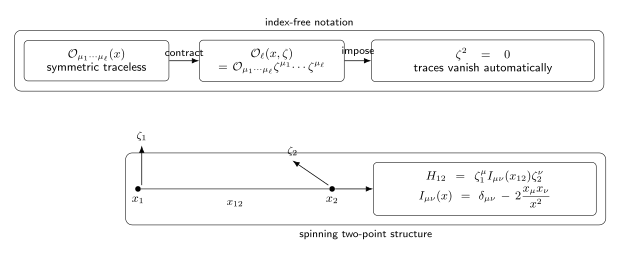
Writing all tensor indices explicitly quickly becomes painful. The standard trick is to contract the operator with an auxiliary polarization vector ζμ:
O(x,ζ)=Oμ1⋯μℓ(x)ζμ1⋯ζμℓ.
The operator is homogeneous of degree ℓ in ζ:
(ζ⋅∂ζ−ℓ)O(x,ζ)=0.
To impose tracelessness efficiently, take the auxiliary vector to be null:
ζ2=0.
Any trace term in the tensor would produce a factor of ζ2, and therefore vanish on the null cone. The null-polarization formalism stores exactly the symmetric traceless part.
For example,
J(x,ζ)=Jμ(x)ζμ,T(x,ζ)=Tμν(x)ζμζν,ζ2=0.
A symmetric traceless tensor can be encoded by the polynomial Oℓ(x,ζ) with ζ2=0. The basic two-point tensor structure is built from the inversion tensor Iμν(x) through H12=ζ1μIμν(x12)ζ2ν.
When needed, explicit components can be recovered by differentiating with respect to ζ and projecting to the symmetric traceless part. In practice, most conformal correlators are clearer in polarization notation.
A two-point function of spinning primaries is fixed by translation, rotation, scale invariance, and inversion. For symmetric traceless spin-ℓ primaries, the answer is simplest in polarization notation:
This is nonzero only when the two operators have the same dimension, the same spin, and conjugate global-symmetry quantum numbers. Otherwise the two-point function vanishes, apart from possible mixing inside degenerate subspaces.
Here
ζ1⋅I(x)⋅ζ2=ζ1⋅ζ2−2x2(ζ1⋅x)(ζ2⋅x).
For ℓ=0, this reduces to the scalar two-point function:
In a unitary CFT, a conserved current is a shortened conformal multiplet. Its scaling dimension is fixed:
ΔJ=d−1.
The two-point function is therefore
⟨Jμa(x)Jνb(0)⟩=(x2)d−1CJδabIμν(x).
The constant CJ is a genuine observable after one fixes the normalization of the symmetry generators. It is often called a flavor central charge. In AdS/CFT, CJ is controlled by the kinetic term of the dual bulk gauge field.
At separated points, current conservation follows directly from the two-point function. With other operators inserted, the full Ward identity contains contact terms:
is the area of the unit sphere Sd−1. The sign convention depends on whether the symmetry generators are taken Hermitian or anti-Hermitian. The invariant content is the flux of Jμa through a small sphere around the operator insertion.
The stress tensor is the conserved current for translations. In a CFT, after possible improvement terms, it is symmetric, conserved, and traceless:
Tμν=Tνμ,∂μTμν=0,Tμμ=0.
As a conformal primary, it has
ΔT=d,ℓT=2.
Its two-point function is fixed to be
⟨Tμν(x)Tρσ(0)⟩=(x2)dCTIμν,ρσ(x).
The coefficient CT is the higher-dimensional analogue of a stress-tensor central charge. In a holographic CFT with an Einstein-gravity dual, it scales schematically as
CT∼GNLd−1,
up to convention-dependent numerical factors. Large CT is the boundary signal of a weakly coupled semiclassical gravitational sector.
For scalar operators, there are no spin terms. For spinning operators, the spin terms implement the local rotation generated by the stress tensor.
The trace Ward identity in flat space is, at separated points,
⟨Tμμ(x)i∏Oi(xi)⟩=0.
At coincident points there are contact terms implementing scale transformations of the inserted operators. On curved backgrounds there may also be Weyl-anomaly terms.
at separated points. When ℓ=0, this reduces to the scalar three-point function from the previous page.
Several useful facts follow immediately. First, there is only one parity-even tensor structure for two scalars and one symmetric traceless spin-ℓ operator. Second, if O1=O2 are identical bosonic scalars, exchanging x1↔x2 sends
Y3μ↦−Y3μ.
The denominator is unchanged. Therefore
λOOXℓ=0for odd ℓ
when O is a real identical scalar and Xℓ is a symmetric traceless operator with no additional antisymmetric internal tensor.
For three spinning symmetric traceless primaries, conformal symmetry allows finitely many tensor structures. Polarization notation makes the classification manageable.
This expression says something important: for spinning operators, a three-point coefficient is usually not a single number. It is a vector of coefficients, one for each independent tensor structure.
In low dimensions, some structures become linearly dependent because of dimension-specific identities. In d=3, parity-odd structures built from ϵμνρ can also appear. Conservation equations further reduce the number of independent coefficients.
Ward identities fix special three-point coefficients
The coefficient in a generic spinning three-point function is dynamical. But when the spinning operator is a conserved current associated with an exact symmetry, the Ward identity can fix some coefficients.
For example, suppose Oi transforms under a global symmetry generated by Ta. The correlator
⟨Jμa(x1)Oi(x2)Oj(x3)⟩
has the conformal form of a vector-scalar-scalar correlator. Its overall coefficient is fixed by the charge of Oi and the normalization of the scalar two-point function. This is the three-point version of the current OPE
Jμa(x)Oi(0)∼Sd−11∣x∣dxμ(Ta)ijOj(0)+⋯.
Similarly, the scalar-scalar-stress-tensor three-point function has one parity-even tensor structure:
The Ward identity fixes λOOT in terms of Δ and the normalization of ⟨OO⟩. A common convention gives
λOOT=−(d−1)Sd−1dΔCO,
where
⟨O(x)O(0)⟩=(x2)ΔCO.
The sign depends on the convention for defining Tμν and the Ward identity, but the proportionality to ΔCO is invariant. In holography, this is the boundary statement that every bulk field couples universally to the graviton.
Spinning operators are constrained by unitarity. For symmetric traceless tensors with ℓ≥1,
Δ≥ℓ+d−2.
When the bound is saturated, the multiplet shortens:
Δ=ℓ+d−2⟹∂μ1Oμ1μ2⋯μℓ=0.
For ℓ=1, this gives a conserved current:
Δ=d−1.
For ℓ=2, it gives the stress tensor:
Δ=d.
For ℓ>2, an exactly conserved higher-spin current is extremely restrictive. In an interacting CFT with a unique stress tensor, the presence of exactly conserved higher-spin currents usually signals a free or higher-spin-symmetric theory. This is why large-N holographic CFTs with local Einstein-like bulk duals do not have light exactly massless higher-spin fields beyond the graviton and gauge fields; their higher-spin single-trace operators acquire anomalous dimensions.
The index A labels independent tensor structures. Crossing symmetry mixes the functions GA(u,v). This is why spinning bootstrap problems are more complicated than scalar bootstrap problems: crossing becomes a matrix equation among tensor structures.
In AdS/CFT, these tensor structures are the boundary shadows of bulk cubic and quartic vertices involving spin. For example, ⟨JJJJ⟩ knows about bulk gauge interactions, while ⟨TTTT⟩ knows about graviton interactions and higher-derivative corrections to the bulk gravitational action.
The most important spinning operators for holography are
Jμa⟷AMa
for global symmetries and bulk gauge fields,
Tμν⟷gMN
for the stress tensor and the bulk metric, and
Oμ1⋯μℓ⟷ΦM1⋯Mℓ
for more general spin-ℓ bulk fields.
The two-point coefficients determine bulk kinetic terms schematically as
CJ∼gd+12Ld−3,CT∼GNLd−1.
Three-point tensor structures determine possible cubic couplings. Conservation of Jμ becomes bulk gauge invariance. Conservation of Tμν becomes bulk diffeomorphism invariance. Violating these conservation laws would mean that the corresponding bulk gauge symmetry is absent or broken.
This is one of the deepest lessons of AdS/CFT:
bulk gauge redundancy is encoded as boundary current conservation.
A spinning correlator is not fixed by dimensional analysis alone. The tensor structures matter as much as the powers of ∣xij∣.
Another common mistake is to treat CJ and CT as completely analogous to scalar two-point normalizations. A scalar operator can be rescaled freely:
O↦λO.
But Jμ and Tμν have canonical normalizations once their Ward identities are fixed. You cannot freely rescale the stress tensor without changing the definition of translations, and you cannot freely rescale a current without changing the normalization of the charge.
A third common mistake is to ignore contact terms. Conservation equations are true at separated points, but Ward identities include delta functions at operator insertions. These contact terms encode charges, dimensions, spin, and translations.
Finally, parity matters. In d=3, parity-odd structures may appear in current and stress-tensor correlators. These structures are especially important in Chern-Simons-matter theories and in holographic models with parity-violating bulk interactions.
CJ↔bulk gauge kinetic term,CT↔bulk Newton constant.
Three-point functions of spinning operators contain finitely many tensor structures, each with its own coefficient. These coefficients are CFT data. In AdS/CFT, they are the boundary encoding of bulk cubic interactions involving gauge fields, gravitons, and higher-spin fields.
For the classic two-dimensional treatment of tensor fields, Ward identities, and the stress tensor, see Di Francesco, Mathieu, and Sénéchal, Chapters 4—6. For modern higher-dimensional spinning correlator technology, see Costa, Penedones, Poland, and Rychkov on spinning conformal correlators, and Simmons-Duffin’s TASI lectures. For holographic applications, compare the current and stress-tensor two-point normalizations with the quadratic action for bulk gauge fields and gravitons.